Question: If you took an electrically charged ball and shook it up - - PDF document

question
SMART_READER_LITE
LIVE PREVIEW

Question: If you took an electrically charged ball and shook it up - - PDF document

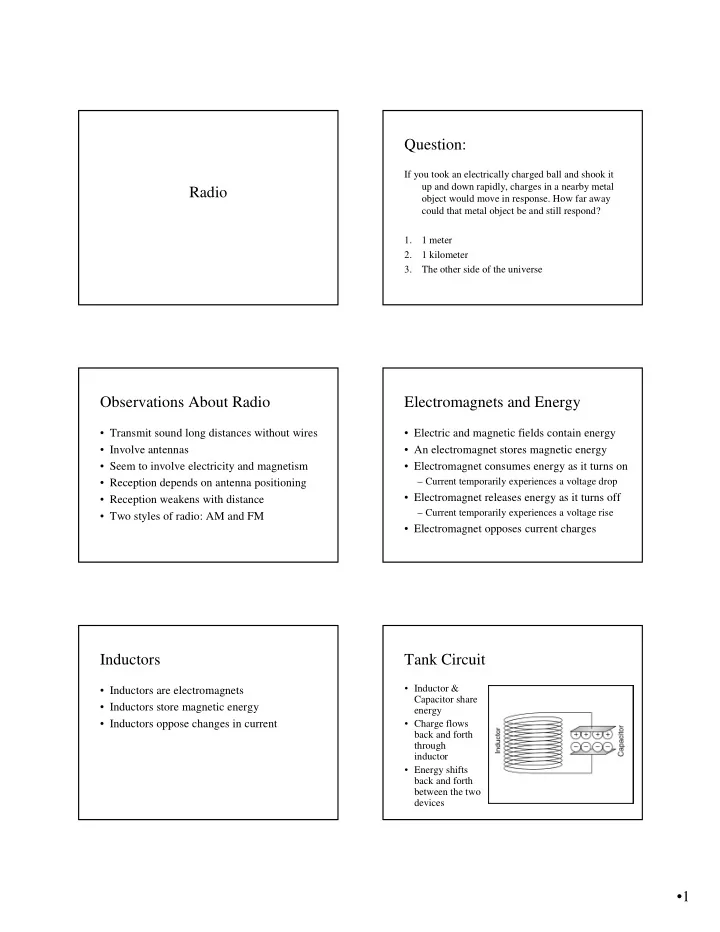
Question: If you took an electrically charged ball and shook it up and down rapidly, charges in a nearby metal Radio object would move in response. How far away could that metal object be and still respond? 1. 1 meter 2. 1 kilometer 3.


slide-1
SLIDE 1
  • 1

Radio Question:

If you took an electrically charged ball and shook it up and down rapidly, charges in a nearby metal

  • bject would move in response. How far away

could that metal object be and still respond? 1. 1 meter 2. 1 kilometer 3. The other side of the universe

Observations About Radio

  • Transmit sound long distances without wires
  • Involve antennas
  • Seem to involve electricity and magnetism
  • Reception depends on antenna positioning
  • Reception weakens with distance
  • Two styles of radio: AM and FM

Electromagnets and Energy

  • Electric and magnetic fields contain energy
  • An electromagnet stores magnetic energy
  • Electromagnet consumes energy as it turns on

– Current temporarily experiences a voltage drop

  • Electromagnet releases energy as it turns off

– Current temporarily experiences a voltage rise

  • Electromagnet opposes current charges

Inductors

  • Inductors are electromagnets
  • Inductors store magnetic energy
  • Inductors oppose changes in current

Tank Circuit

  • Inductor &

Capacitor share energy

  • Charge flows

back and forth through inductor

  • Energy shifts

back and forth between the two devices

slide-2
SLIDE 2
  • 2

Tank Circuit Oscillation Tank Circuits in Radio

  • Tanks are resonant devices
  • Tanks build up energy at a specific frequency
  • Tanks help radios emit radio waves
  • Tanks help radios detect radio waves

Emitting Radio Waves 1

  • A transmitter uses a tank circuit

to “slosh” charge up and down its antenna

  • A receiver uses a tank circuit to

detect charge “sloshing” on its antenna

  • Transmitter antenna charge

affects receiver antenna charge

Emitting Radio Waves 2

  • Accelerating charge emits radio waves

– Charge produces electric field – Current produces magnetic field – Changing current produces changing magnetic field, produces changing electric field, prod…

  • A radio wave consists only of an electric and

magnetic field

  • A radio wave travels through empty space at the

speed of light

Structure of a Radio Wave

  • Electric field is

perpendicular to magnetic field

  • Electric field creates

magnetic field and vice versa

  • Electric field determines

polarization of the wave

AM Modulation

  • Information is encoded

in the fluctuating amplitude of the wave

  • Pressure variations

cause changes in the amount of charge moving on the antenna

slide-3
SLIDE 3
  • 3

FM Modulation

  • Information is encoded

in the exact frequency

  • f the charge motion
  • Pressure variations

cause slight shifts in the frequency of charge motion on the antenna

Question:

If you took an electrically charged ball and shook it up and down rapidly, charges in a nearby metal

  • bject would move in response. How far away

could that metal object be and still respond? 1. 1 meter 2. 1 kilometer 3. The other side of the universe