Question 11 pull Question on Exam 1 a) Give a sensible argument - - PowerPoint PPT Presentation

question 11
SMART_READER_LITE
LIVE PREVIEW

Question 11 pull Question on Exam 1 a) Give a sensible argument - - PowerPoint PPT Presentation

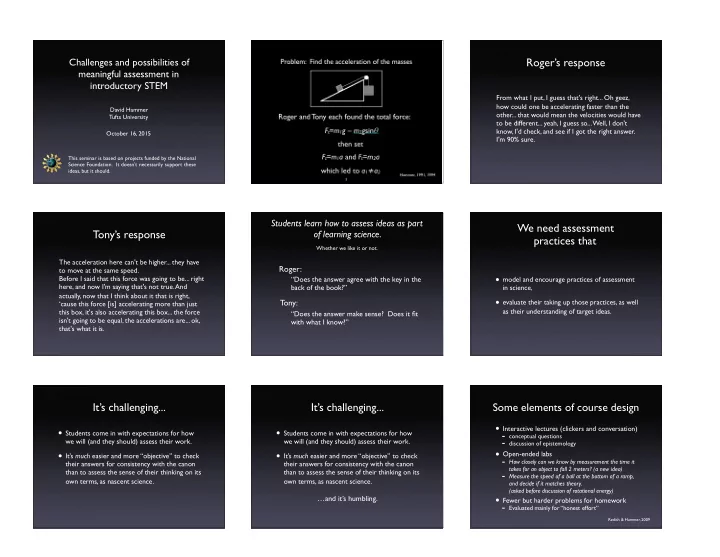
Challenges and possibilities of Rogers response Problem: Find the acceleration of the masses meaningful assessment in introductory STEM From what I put, I guess that's right... Oh geez, how could one be accelerating faster than the David


slide-1
SLIDE 1

Challenges and possibilities of meaningful assessment in introductory STEM

David Hammer Tufts University October 16, 2015

This seminar is based on projects funded by the National Science Foundation. It doesn’t necessarily support these ideas, but it should.

Problem: Find the acceleration of the masses

Roger and Tony each found the total force: Ft=m1g – m2gsinθ then set Ft=m1a and Ft=m2a which led to a1≠a2

Hammer, 1991, 1994

2

Roger’s response

From what I put, I guess that's right... Oh geez, how could one be accelerating faster than the

  • ther... that would mean the velocities would have

to be different... yeah, I guess so... Well, I don't know, I'd check, and see if I got the right answer. I'm 90% sure.

Tony’s response

The acceleration here can't be higher... they have to move at the same speed. Before I said that this force was going to be... right here, and now I'm saying that's not true. And actually, now that I think about it that is right, ‘cause this force [is] accelerating more than just this box, it's also accelerating this box... the force isn't going to be equal, the accelerations are... ok, that's what it is.

Students learn how to assess ideas as part

  • f learning science.

Whether we like it or not.

Roger:

“Does the answer agree with the key in the back of the book?”

Tony:

“Does the answer make sense? Does it fit with what I know?”

We need assessment practices that

  • model and encourage practices of assessment

in science,

  • evaluate their taking up those practices, as well

as their understanding of target ideas.

It’s challenging...

  • Students come in with expectations for how

we will (and they should) assess their work.

  • It’s much easier and more “objective” to check

their answers for consistency with the canon than to assess the sense of their thinking on its

  • wn terms, as nascent science.

It’s challenging...

  • Students come in with expectations for how

we will (and they should) assess their work.

  • It’s much easier and more “objective” to check

their answers for consistency with the canon than to assess the sense of their thinking on its

  • wn terms, as nascent science.

…and it’s humbling.

Some elements of course design

  • Interactive lectures (clickers and conversation)
  • conceptual questions
  • discussion of epistemology
  • Open-ended labs
  • How closely can we know by measurement the time it

takes for an object to fall 2 meters? (a new idea)

  • Measure the speed of a ball at the bottom of a ramp,

and decide if it matches theory. 
 (asked before discussion of rotational energy)

  • Fewer but harder problems for homework
  • Evaluated mainly for “honest effort”

Redish & Hammer, 2009

slide-2
SLIDE 2

Lectures as conversations, to cultivate...

  • Explaining in plain language “for 10 year old”
  • Looking for and trying to address possible

counter-arguments

  • Meaningful questioning (student questions often

become clicker questions)

  • Responsiveness to substance

Swinging a ball in a vertical circle

Most chose B, and we’ve just discussed.

Which$expression$makes$sense$at$the$ boXom$of$the$moFon?$$

  • 1. T$+$mg$=$mv2/r$
  • 2. T$\$mg$=$mv2/r$
  • 3. mg$\$T$=$mv2/r$
  • 4. I’m$not$sure$
  • 5. $%^&!$$We$never$covered$this!$$$

All'of'these'quan77es'are' magnitudes,'so'they’re'all'posi7ve.'''

clip 1 (from lecture 7) clip 1 (from lecture 7)

Assessing their progress

  • Some beginnings
  • A student’s question
  • Attention to coherence
  • Drawing implications from clear ideas
  • Nalani’s, others’ surprise at classmates’ reasoning

Assessing their progress

  • Some beginnings
  • A student’s question
  • Attention to coherence
  • Drawing implications from clear ideas
  • Nalani’s, others’ surprise at classmates’ reasoning
  • Still…
  • Mapping uncritically to remembered cases
  • Inattention to coherence (scientific coherence)
  • Mostly trying to “Get it right”

Assessing their progress

slide-3
SLIDE 3

clip 2, three weeks later

We’ve worked it out that vx = 2 vy

Assessing their progress

  • students’ questions

how would mass make a difference, what if Yara?

Assessing their progress

  • students’ questions

how would mass make a difference, what if Yara?

  • Reasoning across situations

Assessing their progress

  • students’ questions

how would mass make a difference, what if Yara?

  • Reasoning across situations
  • Tangible, sensible reasoning

not as much force gets to Yara

Assessing their progress

  • students’ questions

how would mass make a difference, what if Yara?

  • Reasoning across situations
  • Tangible, sensible reasoning

not as much force gets to Yara

  • Invention

think of half the rope with X and half with Y

Assessing their progress clip 3, near end of course

Close, Gomez & Heron, 2013

Homework assignment they just handed in. Most say the block wins.

slide-4
SLIDE 4
  • Aim of coherence
  • is or isn’t same as ball on ramp
  • argumentation/reconciling inconsistencies
  • Aim of coherence
  • is or isn’t same as ball on ramp
  • argumentation/reconciling inconsistencies
  • Virtue of uncertainty
  • “I’m not happy with it”
  • “What am I trying to say?”
  • Aim of coherence
  • is or isn’t same as ball on ramp
  • argumentation/reconciling inconsistencies
  • Virtue of uncertainty
  • “I’m not happy with it”
  • “What am I trying to say?”
  • Invention
  • F doesn’t act on all the mass
  • think of length of rope
  • Aim of coherence
  • is or isn’t same as ball on ramp
  • argumentation/reconciling inconsistencies
  • Virtue of uncertainty
  • “I’m not happy with it”
  • “What am I trying to say?”
  • Invention
  • F doesn’t act on all the mass
  • think of length of rope

A$2$kg$block$sits$on$on$a$cart$of$mass$8$kg.$$The$cart$is$ acceleraTng$to$the$right$at$2$m/s2,$and$the$block$accelerates$ with$it,$without$slipping.$$The$coefficient$of$staTc$fricTon$ between$the$block$and$cart$is$μS=0.3.$$$ $ What$is$the$size$and$direcTon$of$the$fricTon$force$on$the$ block$by$the$cart?$$$ 1. 6$N$to$the$le`$ 2. 6$N$to$the$right$ 3. 4$N$to$the$le`$$ 4. 4$N$to$the$right$ 5. I$don’t$know.$ A$2$kg$block$sits$on$on$a$cart$of$mass$8$kg.$$The$cart$is$ acceleraTng$to$the$right$at$2$m/s2,$and$the$block$accelerates$ with$it,$without$slipping.$$The$coefficient$of$staTc$fricTon$ between$the$block$and$cart$is$μS=0.3.$$$ $ What$is$the$size$and$direcTon$of$the$fricTon$force$on$the$ block$by$the$cart?$$$ 1. 6$N$to$the$le`$ 2. 6$N$to$the$right$ 3. 4$N$to$the$le`$$ 4. 4$N$to$the$right$ 5. I$don’t$know.$

slide-5
SLIDE 5

Suppose instead of pushing on the 8 kg cart, you push on the 2 kg block. For example, you could pull it with a rope, as I’ve shown. 
 
 What would be the maximum force in that case, that you could exert on the 2 kg block without it slipping? As before, assume there’s no friction between the 8 kg cart and the surface it’s on.

pull

Question on Exam 1

Question 11

a) Give a sensible argument for the answer you believe. b) Give a sensible argument for an answer you think someone else might believe. c) Try to explain the flaw in the reasoning for part b.

Exam 3 Q 11

...The question again is whether the speed of the ball, v, increases, decreases, or stays constant as it spirals inward. (No parts a, b, and c… I can’t be following you around for the rest of your life pestering you to think “what could argue for a different answer, and how do you respond to that reasoning?” But that’s what I hope to see…) 


And not so good... Assessment

slide-6
SLIDE 6

Assessment

Students’, of the quality of ideas

  • Can we explain it in simple terms?
  • Does it make sense?
  • Can we respond to conflicting arguments?

Assessment

Students’, of the quality of ideas

  • Can we explain it in simple terms?
  • Does it make sense?
  • Can we respond to conflicting arguments?

The instructors’ of students’

  • understanding
  • approaches to learning

Assessment

Students’, of the quality of ideas

  • Can we explain it in simple terms?
  • Does it make sense?
  • Can we respond to conflicting arguments?

The instructors’ of students’

  • understanding
  • approaches to learning

Of the class as a whole, as well as

  • f individuals

Assessment

Students’, of the quality of ideas

  • Can we explain it in simple terms?
  • Does it make sense?
  • Can we respond to conflicting arguments?

The instructors’ of students’

  • understanding
  • approaches to learning

As coherent as possible with disciplinary assessment

TA attention and response to student reasoning 
 in written work

Cynthia Hill Tufts University 3rd Annual STEM presentation day

Style & form Ambiguous Style & form Reasoning

Methods: coding written feedback TAs attended mainly to style & form

Markup Style & Form Correctness Reasoning Total Codable 629 421 74% (321) 12% (46) 15% (54)