QUARKS, GLUONS, AND LATTICES Michael Creutz Brookhaven Lab Quarks: - - PowerPoint PPT Presentation

quarks gluons and lattices michael creutz
SMART_READER_LITE
LIVE PREVIEW

QUARKS, GLUONS, AND LATTICES Michael Creutz Brookhaven Lab Quarks: - - PowerPoint PPT Presentation

QUARKS, GLUONS, AND LATTICES Michael Creutz Brookhaven Lab Quarks: fundamental constituents of subnuclear particles Gluons: what holds them together _ Q Q Lattices: a mathematical framework for calculation Michael Creutz BNL 1 Quarks


slide-1
SLIDE 1

QUARKS, GLUONS, AND LATTICES Michael Creutz

Brookhaven Lab

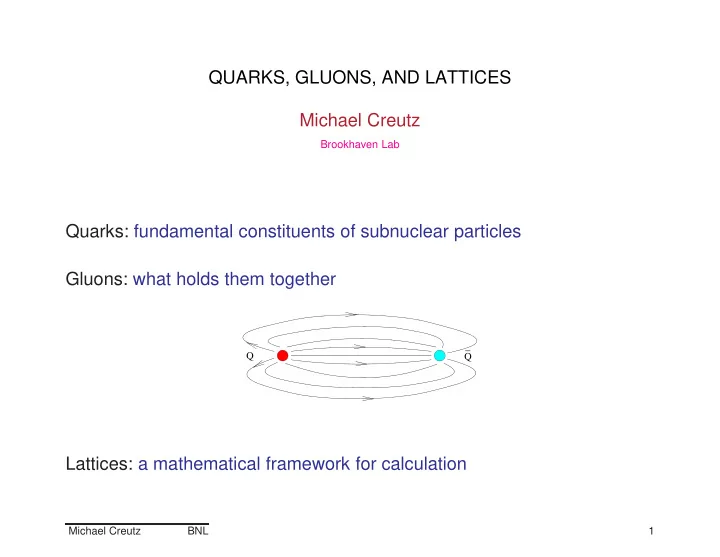
Quarks: fundamental constituents of subnuclear particles Gluons: what holds them together

Q _ Q

Lattices: a mathematical framework for calculation

Michael Creutz BNL 1
slide-2
SLIDE 2

Quarks

Fundamental constituents feeling the nuclear force

  • six known types: u, d, s, c, b, t
  • proton (uud); neutron (udd)

Why do we believe in them?

  • various combinations give families of observed particles
  • high energy scattering suggests pointlike substructure
  • heavy quark bound states, i.e. J = (cc)
  • calculable masses
  • ‘‘hydrogen atoms’’ for quarks

Michael Creutz BNL 2

slide-3
SLIDE 3

Gluons

Fields that hold the quarks together

  • much like electric fields except
  • 8 electric fields, not just one: ‘‘non-Abelian’’ fields
  • charged with respect to each other

Confinement: quarks cannot be isolated

  • self interacting gluon flux lines do not spread out

Q _ Q

  • 1/r2 force replaced by a constant at long distances
  • quarks at ends of ‘‘strings’’

Constant 14 tons of tension pulling the quarks together

Michael Creutz BNL 3

slide-4
SLIDE 4

Lattices

Quark paths or ‘‘world lines’’ − → discrete hops

  • four dimensions of space and time

a

t x

A mathematical trick

  • lattice spacing a → 0 for physics
  • a = minimum length (cutoff) = π/Λ
  • allows computations

Michael Creutz BNL 4

slide-5
SLIDE 5

What led us to the lattice?

Late 1960’s

  • quantum electrodynamics: immensely successful, but ‘‘done’’
  • eightfold way: ‘‘quarks’’ explain particle families
  • electroweak theory emerging
  • electron-proton scattering: ‘‘partons’’

Meson-nucleon theory failing

  • g2

4π ∼ 15

vs.

e2 4π ∼ 1 137

  • no small parameter for expansion

Michael Creutz BNL 5

slide-6
SLIDE 6

Frustration with quantum field theory ‘‘S-matrix theory’’

  • particles are bound states of themselves
  • p + π ↔ ∆
  • ∆ + π ↔ p
  • held together by exchanging themselves
  • roots of duality between particles and forces −

→ string theory What is elementary?

Michael Creutz BNL 6

slide-7
SLIDE 7

Early 1970’s

  • ‘‘partons’’ ←

→ ‘‘quarks’’

  • renormalizability of non-Abelian gauge theories
  • 1999 Nobel Prize, G. ’t Hooft and M. Veltman
  • asymptotic freedom
  • 2004 Nobel prize: D. Gross, D. Politzer, F. Wilczek
  • Quark Confining Dynamics (QCD) evolving

Confinement?

  • interacting hadrons vs. quarks and gluons
  • What is elementary?

Michael Creutz BNL 7

slide-8
SLIDE 8

Mid 1970’s: a particle theory revolution

  • J/ψ discovered, quarks inescapable
  • field theory reborn
  • ‘‘standard model’’ evolves

Extended objects in field theory

  • ‘‘classical lumps’’ a new way to get particles
  • ‘‘bosonization’’

very different formulations can be equivalent

  • growing connections with statistical mechanics
  • What is elementary?

Field Theory >> Feynman Diagrams

Michael Creutz BNL 8

slide-9
SLIDE 9

Field theory has infinities

  • bare charge, mass divergent
  • must ‘‘regulate’’ for calculation
  • Pauli Villars, dimensional regularization: perturbative
  • based on Feynman diagrams
  • an expansion in a small parameter, the electric charge

But the expansion misses important ‘‘non-perturbative’’ effects

  • confinement
  • light pions from chiral symmetry breaking
  • no small parameter to expand in

need a ‘‘non-perturbative’’ regulator

Michael Creutz BNL 9

slide-10
SLIDE 10

Wilson’s strong coupling lattice theory (1973)

Strong coupling limit does confine quarks

  • only quark bound states (hadrons) can move

space-time lattice = non-perturbative cutoff Lattice gauge theory

  • A mathematical trick
  • Minimum wavelength = lattice spacing a
  • Uncertainty principle: a maximum momentum = π/a
  • Allows computations
  • Defines a field theory

Michael Creutz BNL 10

slide-11
SLIDE 11

Wilson’s strong coupling lattice theory (1973)

Strong coupling limit does confine quarks

  • only quark bound states (hadrons) can move

space-time lattice = non-perturbative cutoff Lattice gauge theory

  • A mathematical trick
  • Minimum wavelength = lattice spacing a
  • Uncertainty principle: a maximum momentum = π/a
  • Allows computations
  • Defines a field theory

Be discrete, do it on the lattice

Michael Creutz BNL 10

slide-12
SLIDE 12

Wilson’s strong coupling lattice theory (1973)

Strong coupling limit does confine quarks

  • only quark bound states (hadrons) can move

space-time lattice = non-perturbative cutoff Lattice gauge theory

  • A mathematical trick
  • Minimum wavelength = lattice spacing a
  • Uncertainty principle: a maximum momentum = π/a
  • Allows computations
  • Defines a field theory

Be discrete, do it on the lattice Be indiscreet, do it continuously

Michael Creutz BNL 10

slide-13
SLIDE 13

Wilson’s formulation local symmetry + theory of phases Variables:

  • Gauge fields are generalized ‘‘phases’’ Ui,j ∼ exp(i

xj

xi Aµdxµ)

i j Uij = 3 by 3 unitary (U †U = 1) matrices, i.e. SU(3)

  • On links connecting nearest neighbors
  • 3 quarks in a proton

Michael Creutz BNL 11

slide-14
SLIDE 14

Dynamics:

  • Sum over elementary squares, ‘‘plaquettes’’

2 1 3 4

Up = U1,2U2,3U3,4U4,1

  • like a ‘‘curl’’
  • ∇ ×

A = B

  • flux through corresponding plaquette.

S =

  • d4x (E2 + B2) −

  • p
  • 1 − 1

3ReTrUp

  • Michael Creutz

BNL 12

slide-15
SLIDE 15

Quantum mechanics:

  • via Feynman’s path integrals
  • sum over paths −

→ sum over phases

  • Z =
  • (dU)e−βS
  • invariant group measure

Parameter β related to the ‘‘bare’’ charge

  • β =

6 g2

  • divergences say we must ‘‘renormalize’’ β as a → 0
  • adjust β to hold some physical quantity constant

Michael Creutz BNL 13

slide-16
SLIDE 16

Parameters

Asymptotic freedom

  • 2004 Nobel prize: D. Gross, D. Politzer, F. Wilczek

g2

0 ∼

1 log(1/aΛ) → 0 Λ sets the overall scale via ‘‘dimensional transmutation’’

  • Sidney Coleman and Erick Weinberg
  • Λ depends on units: not a real parameter

Only the quark masses! mq = 0: parameter free theory

  • mπ = 0
  • mρ/mp determined
  • close to reality

Michael Creutz BNL 14

slide-17
SLIDE 17

Example: strong coupling determined

0.1 0.12 0.14

Average Hadronic Jets Polarized DIS Deep Inelastic Scattering (DIS) τ decays Z width Fragmentation Spectroscopy (Lattice) ep event shapes Photo-production Υ decay e+e- rates

αs(MZ) (PDG, 2008) (charmonium spectrum for input, fermion dynamics treated approximately) Michael Creutz BNL 15

slide-18
SLIDE 18

Numerical Simulation Z =

  • dUe−βS

104 lattice ⇒

  • 104 × 4 × 8 = 320, 000 dimensional integral
  • 2 points/dimension ⇒

2320,000 = 3.8 × 1096,329 terms

  • age of universe ∼ 1027 nanoseconds

Use statistical methods

  • Z ←

→ partition function

  • 1

β ←

→ temperature Find ‘‘typical equilibrium’’ configurations C P(C) ∼ e−βS(C) Use a Markov process C → C′ → . . .

Michael Creutz BNL 16

slide-19
SLIDE 19

Z2 example: (L. Jacobs, C. Rebbi, MC) U = ±1 P(1) = e−βS(1) e−βS(1) + e−βS(−1)

P(-1) P(1)

Michael Creutz BNL 17

slide-20
SLIDE 20

Random field changes biased by Boltzmann weight.

  • converge towards ‘‘thermal equilibrium.’’
  • P(C) ∼ e−βS

In principle can measure anything Fluctuations → theorists have error bars! Also have systematic errors

  • finite volume
  • finite lattice spacing
  • quark mass extrapolations

Michael Creutz BNL 18

slide-21
SLIDE 21

Interquark force

  • constant at large distance
  • confinement

UKQCD Collaboration, hep-lat/9411075 Michael Creutz BNL 19

slide-22
SLIDE 22

Extracting particle masses

  • let φ(t) be some operator that can create a particle at time t
  • As t → ∞
  • φ(t)φ(0) −

→ e−mt

  • m = mass of lightest hadron created by φ
  • Bare quark mass is a parameter

Chiral symmetry: m2

π ∼ mq

Adjust mq to get mπ/mρ (ms for the kaon) all other mass ratios determined

Michael Creutz BNL 20

slide-23
SLIDE 23

Budapest-Marseille-Wuppertal collaboration

  • Lattice 2008 conference
  • Science 322:1224-1227,2008
  • improved Wilson fermions

Michael Creutz BNL 21

slide-24
SLIDE 24

Glueballs

  • closed loops of gluon flux
  • no quarks

++ −+ +− −−

PC

2 4 6 8 10 12

r0mG

2

++ ++

3

++ −+

2

−+ *−+

1

+−

3

+−

2

+− +−

1

−−

2

−−

3

−−

2

*−+ *++

1 2 3 4 mG (GeV)

Morningstar and Peardon, Phys. Rev. D 60, 034509 (1999)

  • used an anisotropic lattice, ignored virtual quark-antiquark pairs

Michael Creutz BNL 22

slide-25
SLIDE 25

Quark Gluon Plasma

p p

π π

Finite temporal box of length t

  • Z ∼ Tr e−Ht
  • 1/t ↔ temperature
  • confinement lost at high temperature
  • chiral symmetry restored
  • Tc ∼ 170 − 190 MeV
  • not a true transition, but a rapid ‘‘crossover’’

Michael Creutz BNL 23

slide-26
SLIDE 26

Big jump in entropy versus temperature

5 10 15 20 100 200 300 400 500 600 700 0.4 0.6 0.8 1 1.2 1.4 1.6

T [MeV] s/T3 Tr0

sSB/T3

p4: Nτ=4 6 asqtad: Nτ=6

  • M. Cheng et al., Phys.Rev.D77:014511,2008.
  • uses a non-rigorous approximation to QCD

Michael Creutz BNL 24

slide-27
SLIDE 27

Unsolved Problems

Chiral gauge theories

  • parity conserving theories in good shape
  • chiral theories (neutrinos) remain enigmatic
  • non-perturbative definition of the weak interactions?

Sign problems

  • finite baryon density: nuclear matter
  • color superconductivity at high density
  • θ = 0
  • spontaneous CP violation at θ = π

Fermion algorithms (quarks)

  • remain very awkward
  • why treat fermions and bosons so differently?

Lots of room for new ideas!

Michael Creutz BNL 25