Quantum Quantum Computing Sensing Algorithms Hybrid computing - - PowerPoint PPT Presentation

quantum quantum computing sensing
SMART_READER_LITE
LIVE PREVIEW

Quantum Quantum Computing Sensing Algorithms Hybrid computing - - PowerPoint PPT Presentation

QIS Workshop: Welcome Argonne PSE/CELS QIS Working Group Salman Habib CPS/HEP Divisions September 23, 2019 Quantum Quantum Computing Sensing Algorithms Hybrid computing Compilers Error correction Precision metrology


slide-1
SLIDE 1

QIS Workshop: Welcome

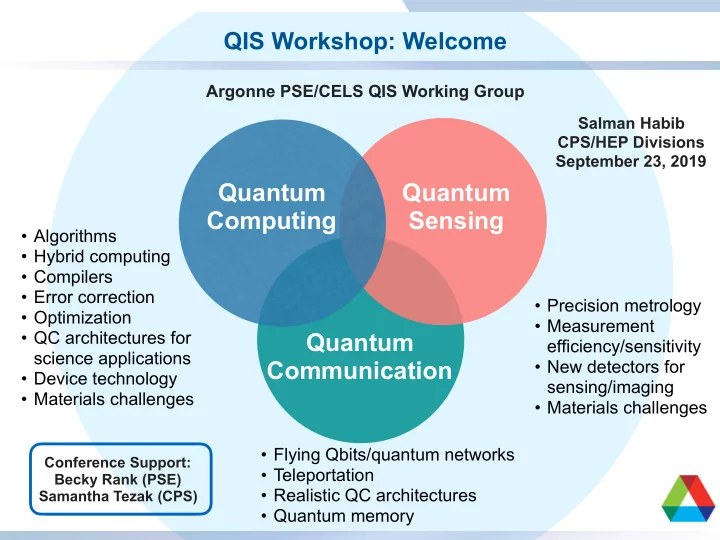
Quantum Computing Quantum Sensing Quantum Communication

  • Algorithms
  • Hybrid computing
  • Compilers
  • Error correction
  • Optimization
  • QC architectures for

science applications

  • Device technology
  • Materials challenges
  • Precision metrology
  • Measurement

efficiency/sensitivity

  • New detectors for

sensing/imaging

  • Materials challenges
  • Flying Qbits/quantum networks
  • Teleportation
  • Realistic QC architectures
  • Quantum memory

Argonne PSE/CELS QIS Working Group

Salman Habib CPS/HEP Divisions September 23, 2019

Conference Support: Becky Rank (PSE) Samantha Tezak (CPS)

slide-2
SLIDE 2

Workshop Goals

  • Snapshot of the state-of-the-art
  • Talks covering the frontier of current

R&D boundaries

  • Forward-looking ideas in both “small”

and “big” science

  • Discussions around new QIS topics

and R&D directions

  • Identification of possible collaborations
  • Talks covering a number of Argonne

QIS activities

  • Enough time in discussion and poster

sessions to explore topics of mutual interest

  • Develop informal and formal

collaborations https://indico.fnal.gov/event/21552/overview

  • Argonne Info
  • First National Lab in the US —

(July 1, 1946), broad science reach, basic to applied

  • Basic science — materials

science, physics, chemistry, biology, high-energy physics, nuclear physics, mathematics and computer science, high- performance computing

  • Applied science and engineering

— energy resources, environmental management, and national security

  • Major facilities — Advanced

Photon Source (APS) , Argonne Leadership Computing Facility (ALCF), Argonne Tandem Linear Accelerator System (ATLAS), Center for Nanoscale Materials (CNM)

slide-3
SLIDE 3

QIS: Engagement Drivers for Argonne

  • Placing QIS in the Argonne Context
  • What can QIS do for Argonne? Key Issues:
  • Argonne mission space axes best aligned to QIS-based technologies
  • QIS projects that strongly impact Argonne’s strategic R&D mission
  • Timescales for development and adoption of QIS-based approaches
  • What can Argonne do for QIS?
  • Argonne R&D capabilities that can nucleate new QIS directions/technologies

and/or accelerate development of known techniques

  • Internal and external collaborations to best achieve connectivity with other

efforts

  • Institutional (PSE/CELS) QIS Working Group
  • Ground-up effort to develop and focus QIS activities
  • coordinate collaborations and responses to proposals
  • organization of seminars/visitors/workshops
  • membership of ~100 Argonne scientists

POCs: Salman Habib (CPS/HEP), habib@anl.gov Stephen Gray (NST), gray@anl.gov

slide-4
SLIDE 4

QIS: Current Argonne Interests

  • Three Overlapping Categories
  • Theory
  • Quantum computing,

simulation, sensing, or other modeling related topics, substantial interest in near- term possibilities/applications

  • Quantum Materials
  • Experimentalists interested in

“quantum materials” and

  • riented more towards fab/

characterization/probes

  • Quantum Devices/Sensors
  • Experimentalists more

interested in technology realizations of quantum devices (includes qubits) and sensors (superconducting technologies)

slide-5
SLIDE 5

QIS at Argonne

  • Argonne Context
  • Leverage traditional strengths in

supercomputing systems and applications

  • HPC quantum simulators (50+ qubits,

Argonne supercomputers, IBM, Atos, —)

  • New NISQ system algorithms,

parameter optimizers for variational algorithms

  • Error models and error correction

tailored to hardware

  • Quantum technology leveraging science

domain interests and materials and fab/ characterization expertise

  • Low-mass dark matter detection (w/

NIST)

  • Single photon sensing (SNSPD)
  • Entangled photon sources
  • New QIS materials
  • Transition-edge sensor development

Matt Otten, Stephen Gray Quantum Computing Workshop

slide-6
SLIDE 6

Quantum Information Science in the Midwest

DOE Laboratories:

Ames Laboratory Argonne National Laboratory Fermi National Accelerator Laboratory

Universities with QIS Programs:

University of Nebraska University of Kansas University of Minnesota University of Iowa Washington University in St. Louis University of Wisconsin University of Illinois University of Chicago Southern Illinois University Northwestern University Purdue University Indiana University University of Michigan Michigan State University Ohio State University —

Industry:

Honeywell Quantum Solutions EeroQ Microsoft Quantum