Quantum Entanglement and Topological Order Ashvin Vishwanath UC - - PowerPoint PPT Presentation

quantum entanglement and topological order
SMART_READER_LITE
LIVE PREVIEW

Quantum Entanglement and Topological Order Ashvin Vishwanath UC - - PowerPoint PPT Presentation

Quantum Entanglement and Topological Order Ashvin Vishwanath UC Berkeley Ari Turner M. Oshikawa Tarun Grover Yi Zhang Berkeley-> Amsterdam ISSP Berkeley->KITP Stanford OUTLINE Part 1: Introduction Topological Phases,


slide-1
SLIDE 1

Quantum Entanglement and Topological Order

Ashvin Vishwanath UC Berkeley

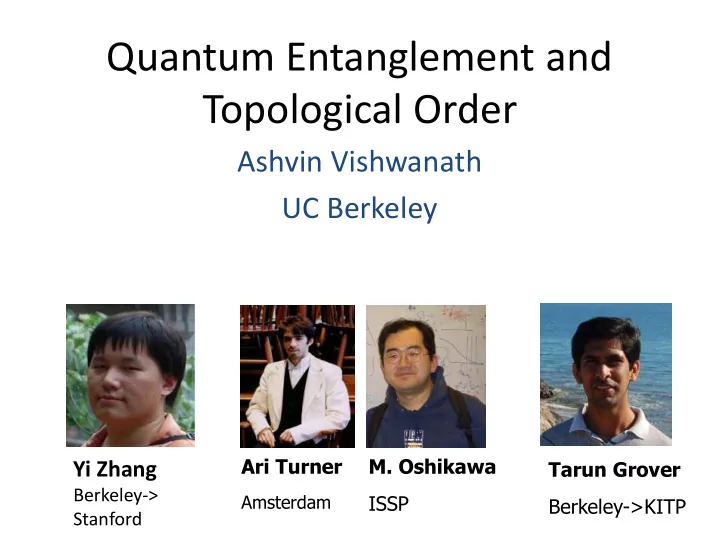
Tarun Grover Berkeley->KITP Ari Turner

Amsterdam

  • M. Oshikawa

ISSP

Yi Zhang

Berkeley-> Stanford
slide-2
SLIDE 2

OUTLINE

  • Part 1: Introduction

– Topological Phases, Topological entanglement entropy. – Model wave-functions.

  • Part 2: Topological Entropy of nontrivial bipartitions.

– Ground state dependence and Minimum Entropy States. – Application: Kagome spin liquid in DMRG.

  • Part 3: Quasi particle statistics (modular S-Matrix)

from Ground State Wave-functions.

Ref: Zhang, Grover, Turner, Oshikawa, AV: arXiv:1111.2342

slide-3
SLIDE 3

Distinguished by spontaneous symmetry breaking. Can be diagnosed in the ground state wave-function by a local

  • rder parameter.
  • Magnets (broken spin

symmetry) M ψ

  • Superfluids

Solid

  • Solid (broken

translation)

In contrast –topological phases…

Conventional (Landau) Phases

slide-4
SLIDE 4

Topological Phases

Integer topological phases

  • Integer Quantum Hall &

Topological insulators

  • Haldane (AKLT) S=1 phase
  • Interacting analogs in

D=2,3 (Kitaev, Chen-Gu-Wen, Lu&AV)

Non-trivial surface states

Fractional topological phases

  • Fractional Quantum Hall
  • Gapped spin liquids

Topological Order:

  • 1. Fractional statistics

excitations (anyons).

  • 2. Topological degeneracy on

closed manifolds.

How to tell – given ground state wave-function(s)? Entanglement as topological `order parameter’.

slide-5
SLIDE 5

Topological Order – Example 1

  • Laughlin state (ν=1/2 bosons) [`Chiral spin Liquid’]

Ψ {𝑨𝑗} = 𝑨𝑗 − 𝑨

𝑘 2𝑓− 𝑨𝑗 2

𝑗

𝑗<𝑘

) , , ( ) , , (

2 1 1 2 1 N C N

r r r r r r  

2 

  

Lattice Version

  • Ground State Degeneracy (N=2g):

N=1 N=2

Quasiparticle Types: {1, s}. # = Torus degeneracy

𝑗 s is a semion

slide-6
SLIDE 6

Topological Order – Example 2 Ising (Z2) Electrodynamics

   E

  • Here E=0,1; B=0,π

(mod 2) (E field loops do not end)

Ψ =

  • Degeneracy on torus=4.
  • Degeneracy on cylinder=2

(no edge states)

slide-7
SLIDE 7

Topological Order – Example 2 Z2 Quantum Spin Liquids

RVB spin liquid: (Anderson ’73). Effective Theory: Z2 Gauge Theory. Recently, a number of candidates in numerics with no conventional order. Definitive test: identify topological order. Kagome (Yan et al) Honeycomb Hubbard (Meng et al) Square J1_J2 (Jiang et al, Wang et al)

Ψ =PG(ΨBCS)

slide-8
SLIDE 8

Entanglement Entropy

  • Schmidt Decomposition:

Ψ = 𝑞𝑗

𝑗

𝐵𝑗 ⊗ 𝐶𝑗 Entanglement Entropy (von-Neumann): 𝑇𝐵 = − 𝑞𝑗log 𝑞𝑗

𝑗

Note: 1) 𝑇𝐵 = 𝑇𝐶 2) Strong sub-additivity (for von-Neumann entropy)

      

ABC AB AC BC C B A

S S S S S S S

slide-9
SLIDE 9

Topological Entanglement Entropy

  • Gapped Phase with topological order.

– Smooth boundary, circumference LA:

B A Topological Entanglement Entropy

(Levin-Wen;Kitaev-Preskill)

ϒ=Log D . (D : total quantum dimension). Abelian phases: 𝐸 = √{𝑈𝑝𝑠𝑣𝑡 𝐸𝑓𝑕𝑓𝑜𝑓𝑠𝑏𝑑𝑧} 

  • aL

S

A A 

Z2 gauge theory: ϒ=Log 2 Constraint on boundary – no gauge charges inside. Lowers Entropy by 1 bit of information.

slide-10
SLIDE 10

Entanglement Entropy of Gapped Phases

  • Trivial Gapped Phase:

– Entanglement entropy: sum of local contributions.

1/κ

A

      

2 2

) (   

l

F

4 2 1

a a a a

Curvature Expansion (smooth boundary):

        

A A

L A L

2 2 2 A

a ] a a [ dl S 

B

Z2 symmetry of Entanglement Entropy: SA= SB AND κ→- κ. So a1=0 No constant in 2D for trivial phase.

X

Grover, Turner, AV: PRB 84, 195120 (2011)

slide-11
SLIDE 11

Extracting Topological Entanglement Entropy

  • Smooth partition

boundary on lattice?

B A OR

  • Problem:

`topological entanglement entropy’ depends on ground state. (Dong et al, Zhang et al)

  • General Partition

B A C

ABC AB AC BC C B A

S S S S S S S

      

(LevinWen;Preskill Kitaev)

Strong subadditivity implies: Identical result with Renyi entropy How does this work with generic states?

 

slide-12
SLIDE 12

Topological Entropy of Lattice Wavefunctions

ϒ – From MonteCarlo Evaluation of Gutzwiller Projected Lattice wave-

  • functions. 𝒇−𝑻𝟑 = 〈𝑻𝑿𝑩𝑸𝑩〉. (Y. Zhang, T. Grover, AV Phys. Rev. B 2011.)

0.42 ± 0.14 Good agreement for chiral spin liquid. Z2 not yet in thermodynamic limit(?)

Alternate approach to diagnosing topological order: Entanglement spectrum (Li and Haldane, Bernevig et al.). Closely related to edge states Does not diagnose Z2 SL Cannot calculate with Monte Carlo.

slide-13
SLIDE 13

Part 2: Ground State Dependence of Topological Entropy

slide-14
SLIDE 14

Topological Entanglement in Nontrivial bipartitions

  • Nontrivial bipartition - entanglement cut is not
  • contractible. Can `sense’ degenerate ground states.
  • Result from Chern-Simons field theory: (Dong

et al.)

  • Abelian topological phase with N ground states on torus.

There is a special basis of ground states for a cut, such that:

  • Ψ =

𝑑𝑜|𝜚𝑜〉

𝑂 𝑜=1

(𝑞𝑜 = 𝑑𝑜 2)

𝛿 = 2𝛿0 − 𝒒𝒐 𝐦𝐩𝐡

𝟐 𝒒𝒐 𝑶 𝒐=𝟐

Topological entropy in general reduced. 0 ≤ 𝛿 ≤ 2𝛿0 For the special states 𝜚𝑜 , equal to usual value (𝛿 = 2𝛿0=2log D). These Minimum Entropy States correspond to quasiparticles in cycle of the torus

slide-15
SLIDE 15
  • Eg. Z2 Spin Liquid on a Cylinder
  • The minimum entropy states (𝛿 = log 2) are `vison’

states – magnetic flux through the cylinder that entanglement surface can measure.

  • State 𝑓 has 𝛿 = 0. Cancellation from:
  • Degenerate sectors: even and odd

E winding around cylinder. Minimum Entropy States:

𝑓 𝑝 0, 𝜌 = ( 𝑓 ± |𝑝〉)/√2

B A

Ψ = 𝐵, 𝑓𝑤𝑓𝑜 𝐶, 𝑓𝑤𝑓𝑜 + 𝐵, 𝑝𝑒𝑒 𝐶, 𝑝𝑒𝑒 √2

0〉, |𝜌

slide-16
SLIDE 16

Application: DMRG on Kagome Antiferromagnet

  • Topological entanglement entropy found by

extrapolation within 1% of log 2.

  • Minimum entropy state is selected by DMRG (low

entaglement).

  • Possible reason why only one ground state seen.

Depenbrock,McCulloch, Schollwoeck (arxiv:1205:4858). Log base 2

Jiang, Wang, Balents: arXiv:1205.4289

B A

slide-17
SLIDE 17

Ground State Dependence of Entanglement Entropy

  • Chiral spin liquid on Torus:

– Degenerate ground states from changing boundary conditions on Slater det. ) , , ( ) , , (

2 1 1 2 1 N C N

r r r r r r  

2 

  

1 

C

Trivial Bipartition: No ground state dependence.

1 2

cos sin       

slide-18
SLIDE 18

Ground State Dependence of Entanglement Entropy

  • Chiral spin liquid on Torus:

– Degenerate ground states from changing boundary conditions on Slater det.

1 

C

Non trivial Bipartition: Ground state dependence!

1 2

cos sin       

slide-19
SLIDE 19

Ground State Dependence of Topological Entropy from Strong Sub-additivity

  • Strong subadditivity: 𝑇𝐵𝐶𝐷 + 𝑇𝐶 − 𝑇𝐵𝐶 − 𝑇𝐶𝐷 ≤ 0

𝜹𝟐 𝜹𝟑 𝜹𝟏

Obtain `uncertainty’ relation:

𝜹𝟐 + 𝜹𝟑 ≤ 𝟑𝜹𝟏

Naïve result, 𝛿1 = 𝛿2 = 2𝛿0 𝑑𝑏𝑜𝑜𝑜𝑝𝑢 hold from general quantum information requirement. True even without topological field theory .

slide-20
SLIDE 20

Part 3: Mutual Statistics from Entanglement

  • Relate minimum entropy states along independent

torus cuts. (modular transformation: S matrix)

𝑁𝐹𝑇: 𝜚1, 𝜚2 𝑁𝐹𝑇: 𝜚′1, 𝜚′2

𝜚′1 𝜚′2 = 𝑻 𝜚1 𝜚2 S encodes quasiparticle braiding statisitics: Chiral Spin Liquid: 𝑇 = 1 √2 1 1 1 −1

e e s s

𝑇ab

𝑏 b

slide-21
SLIDE 21

Zhang, Grover, Turner, Oshikawa, AV (2011).

Semion Statistics!

1.09 0.89 0.89 1.0 2 9 1        

S

Statistics from Entanglement – Chiral Spin Liquid

Wavefunction `knows’ about semion exciations;

slide-22
SLIDE 22

Conclusions

  • Entanglement of non-trivial partitions can be used to

define `quasiparticle’ like states, and extract their statistics.

  • Useful to distinguish two phases with same D. (eg. Z2

and doubled chiral spin liquid, no edge states) Less prone to errors.

  • Can topological entanglement entropy constrain

new types of topological order (eg D=3)?

  • Experimental measurement? Need nonlocal probe.