Reminder: Recursive DFS Algorithm dfs ( G ) 1. Initialise Boolean - - PowerPoint PPT Presentation

reminder recursive dfs
SMART_READER_LITE
LIVE PREVIEW

Reminder: Recursive DFS Algorithm dfs ( G ) 1. Initialise Boolean - - PowerPoint PPT Presentation

Reminder: Recursive DFS Algorithm dfs ( G ) 1. Initialise Boolean array visited by setting all entries to FALSE Inf 2B: Graphs II - Applications of DFS 2. for all v 2 V do 3. if not visited [ v ] then 4. dfsFromVertex ( G , v ) Kyriakos


slide-1
SLIDE 1

Inf 2B: Graphs II - Applications of DFS

Kyriakos Kalorkoti

School of Informatics University of Edinburgh

Reminder: Recursive DFS

Algorithm dfs(G)

  • 1. Initialise Boolean array visited

by setting all entries to FALSE

  • 2. for all v 2 V do

3. if not visited[v] then 4. dfsFromVertex(G, v) Algorithm dfsFromVertex(G, v)

  • 1. visited[v] TRUE
  • 2. for all w adjacent to v do

3. if not visited[w] then 4. dfsFromVertex(G, w) Runtime: T(n, m) = Θ(n + m), using Adjacency List representation.

Trees and Forests

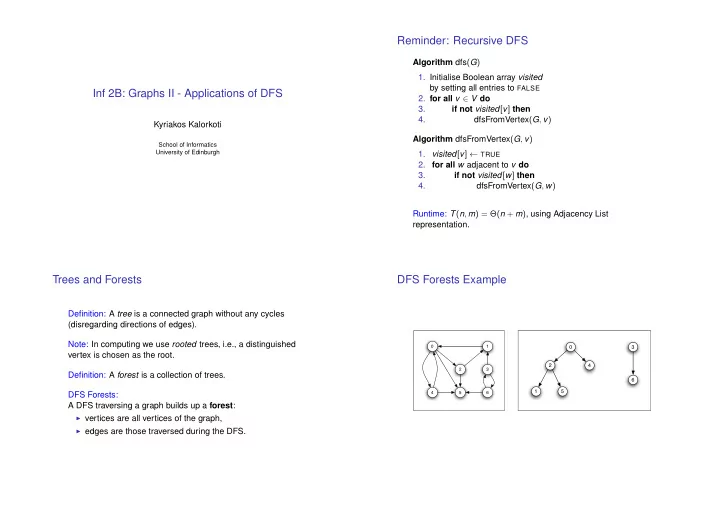
Definition: A tree is a connected graph without any cycles (disregarding directions of edges). Note: In computing we use rooted trees, i.e., a distinguished vertex is chosen as the root. Definition: A forest is a collection of trees. DFS Forests: A DFS traversing a graph builds up a forest:

I vertices are all vertices of the graph, I edges are those traversed during the DFS.

DFS Forests Example

2 3 6 5 4 1

2 4 5 1 6 3

slide-2
SLIDE 2

Connected components of an undirected graph

G = (V, E) undirected graph

Definition

I A subset C of V is connected if for all v, w 2 C there is a

path from v to w (if G is directed, say strongly connected).

I A connected component of G is a maximal connected

subset C of V. Maximal means no connected subset C0 of V strictly contains C.

I G is connected if it only has one connected component,

i.e., if for all vertices v, w there is a path from v to w.

Connected components (continued)

I Each vertex of an undirected graph is contained in exactly

  • ne connected component.

I For each vertex v of an undirected graph, the connected

component that contains v is precisely the set of all vertices that are reachable from v. For an undirected graph G, dfsFromVertex(G, v) visits exactly the vertices in the connected component of v.

Connected components (continued)

Algorithm connComp(G)

  • 1. Initialise Boolean array visited

by setting all entries to FALSE

  • 2. for all v 2 V do

3. if visited[v] = FALSE then 4. print “New Component” 5. ccFromVertex(G, v)

Connected components (continued)

Algorithm ccFromVertex(G, v)

  • 1. visited[v] TRUE
  • 2. print v
  • 3. for all w adjacent to v do

4. if visited[w] = FALSE then 5. ccFromVertex(G, w)

slide-3
SLIDE 3

Topological Sorting

Example: 10 tasks to be carried out. Some of them depend on others.

I Task 0 must be completed before Task 1 can be started. I Task 1 and Task 2 must be done before Task 3 can start. I Task 4 must be done before Task 0 or Task 2 can start. I Task 5 must be done before Task 0 or Task 4 can start. I Task 6 must be done before Task 4, 5 or 7 can start. I Task 7 must be done before Task 0 or Task 9 can start. I Task 8 must be done before Task 7 or Task 9 can start. I Task 9 must be done before Task 2 or Task 3 can start.

Topological order

Definition

Let G = (V, E) be a directed graph. A topological order of G is a total order of the vertex set V such that for all edges (v, w) 2 E we have v w.

Example (continued)

5 3 1 9 4 7 6 8 2

Does this graph have a topological order? Yes, the topological sort is: 8 6 7 9 5 4 2 0 1 3.

Topological order (continued)

A digraph that has a cycle does not have a topological order.

Definition

A DAG (directed acyclic graph) is a digraph without cycles.

Theorem

A digraph has a topological order if and only if it is a DAG.

slide-4
SLIDE 4

Classification of vertices during DFS

G = (V, E) graph, v 2 V. Consider dfs(G).

I v finished if dfsFromVertex(G, v) has been completed.

Vertices can be in the following states:

I not yet visited (call a vertex in this state white), I visited, but not yet finished (grey). I finished (black).

Classification of vertices during DFS (continued)

Lemma

Let G be a graph and v a vertex of G. Consider the moment during the execution of dfs(G) when dfsFromVertex(G, v) is

  • started. Then for all vertices w we have:
  • 1. If w is white and reachable from v, then w will be black

before v.

  • 2. If w is grey, then v is reachable from w.

Topological sorting

G = (V, E) digraph. Define order on V as follows: v w ( ) w becomes black before v.

Theorem

If G is DAG then is a topological order.

Proof.

Suppose (v, w) 2 E. Consider dfsFromVertex(G, v).

I If w is already black, then v w. I If w is white, then by Lemma part 1, w will be black

before v. Thus v w.

I If w is grey, then by Lemma part 2, v is reachable from w.

So there is a path p from w to v. Path p and edge (v, w) together form a cycle. Contradiction! (G is acyclic . . .)

Topological sorting (continued)

Algorithm topSort(G)

  • 1. Initialise array state

by setting all entries to white.

  • 2. Initialise linked list L
  • 3. for all v 2 V do

4. if state[v] = white then 5. sortFromVertex(G, v)

  • 6. print L
slide-5
SLIDE 5

Topological sorting (continued)

Algorithm sortFromVertex(G, v)

  • 1. state[v] grey
  • 2. for all w adjacent to v do

3. if state[w] = white then 4. sortFromVertex(G, w) 5. else if state[w] = grey then 6. print “G has a cycle” 7. halt

  • 8. state[v] black
  • 9. L.insertFirst(v)