Quality of Life after Bone Marrow Transplantation for Severe Sickle - - PowerPoint PPT Presentation

quality of life after
SMART_READER_LITE
LIVE PREVIEW

Quality of Life after Bone Marrow Transplantation for Severe Sickle - - PowerPoint PPT Presentation

Changes in Health-Related Quality of Life after Bone Marrow Transplantation for Severe Sickle Cell Disease Thabat bat Dahdoul, doul, Rebekah h Loving, ing, Marcus Spearma rman Dr. Donna na Neuberg rg and Kristen n Steve venson nson


slide-1
SLIDE 1

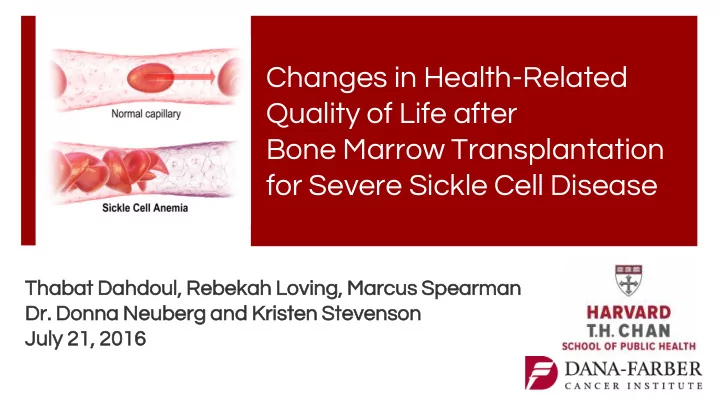
Changes in Health-Related Quality of Life after Bone Marrow Transplantation for Severe Sickle Cell Disease

Thabat bat Dahdoul, doul, Rebekah h Loving, ing, Marcus Spearma rman

  • Dr. Donna

na Neuberg rg and Kristen n Steve venson nson July 21, 2016

slide-2
SLIDE 2

Overview

 What is sickle cell disease (SCD)?  Clinical trial of bone marrow transplantation to cure SCD  Analysis of Health-Related Quality of Life (HRQoL)

  • Methods
  • Results
  • Limitations and implications

2

slide-3
SLIDE 3

What does this disease do?

  • Vaso-occlusive crises
  • Stroke
  • Pulmonary hypertension
  • Acute chest pain

3

slide-4
SLIDE 4

What causes SCD? First a step back...

Everyone has DNA.

  • 23 pairs of chromosomes
  • 24,000 genes
  • 3,200,000,000 nucleotides

4

slide-5
SLIDE 5

Now back to the question… What is SCD caused by?

A Single Nucleotide Polymorphism (SNP) in a specific location.

5

slide-6
SLIDE 6

Inheritance

  • Recessive hereditary disease.
  • 1 in every 13 African-Americans are

carriers of SCD

  • Evolutionary advantage
  • Approximately 100,000 Americans

6

slide-7
SLIDE 7
  • Pilot study of 22 patients with severe SCD
  • Eligibility criteria for severity reviewed prior to enrollment
  • Age: 15-40 years
  • Treatment
  • Chemotherapy
  • Bone marrow transplantation
  • Endpoints:
  • Survival at 1 year without redevelopment of disease
  • Our focus: change in quality of life
  • Assessments
  • HRQoL using PROMIS-57 survey
  • Baseline, 6 months, 1 year

The Study

7

slide-8
SLIDE 8

Eligibility

Criteria

Strokes/Neurological Events (n = 2) Acute Chest Syndrome (ACS) or Pain Crises (n = 18) Red Blood Cell Transfusions (n = 5) Tricuspid Regurgitant Jet Velocity (TRJV) (n = 5)

8

OR OR OR OR

slide-9
SLIDE 9

9 22 years 17 years 36 years 20 years 17 years 28 years 17 years 36 years 24 years

Age

Min Min Min Max Max Max Median Median Median Among Males Among Females

slide-10
SLIDE 10

10

Matched Transplant Donor Relationship Male Related (n = 9) Unrelated(n = 0) Female Related (n = 8) Unrelated(n = 5)

slide-11
SLIDE 11

Measuring HRQoL

  • PROMIS - 57

(Patient Reported Outcomes Measurement Information System)

  • 8 items each scored 1-5
  • Anxiety
  • Depression
  • Fatigue
  • Pain interference
  • Physical function
  • Satisfaction with participation in social roles
  • Sleep disturbance
  • 1 item scored 0-10
  • Pain intensity

11

slide-12
SLIDE 12

12

slide-13
SLIDE 13

Question of Interest

How is quality of life impacted by bone marrow transplantation in patients with severe sickle cell disease?

13

slide-14
SLIDE 14

Methods

 One sample one-sided T-test

  • Ratios comparing 12-month to Baseline
  • Differences of Baseline from 12-month
  • ACS or Pain Crises eligibility

 Two sample Wilcoxon Rank Sum Test with

continuity correction for tied ranks

  • Comparing gender
  • Comparing age categories

14

slide-15
SLIDE 15

15

Table 2. Summary Statistics by Time for PROMIS-57 HRQoL Domains Month All Pts

N=16

6 12 Physical Function Mean (SD) 46.8 (±10.7) 43.7 (±8.3) 46.2 (±11.7) 50.5 (±11.3) Anxiety Mean (SD) 48.3 (±10.3) 50.1 (±10.1) 46.5 (±10.7) 48.1 (±10.5) Depression Mean (SD) 45.9 (±8.9) 44.2 (±6.6) 46.6 (±9.7) 46.9 (±10.3) Fatigue Mean (SD) 47.7 (±12.8) 47.3 (±10.6) 49.9 (±14.9) 46.0 (±13.4) Sleep disturbance Mean (SD) 46.9 (±10.7) 46.2 (±10.8) 47.7 (±12.2) 46.9 (±9.6) Satisfaction with Participation in Social Roles Mean (SD) 50.0 (±12.5) 51.8 (±12.0) 45.7 (±13.0) 52.4 (±12.3) Pain Interference Mean (SD) 52.9 (±11.4) 57.6 (±9.9) 50.8 (±11.8) 50.1 (±11.6) Pain Intensity Mean (SD) 2.5 (±3.0) 2.9 (±3.3) 2.1 (±2.7) 2.4 (±3.0)

slide-16
SLIDE 16

16

* 2 outliers not shown at value of 10 for raw pain intensity

slide-17
SLIDE 17

Table 3. Evaluating the Impact of Bone Marrow Transplantation on Health-Related Quality of Life Using the Ratio of 12-month to Baseline

Mean ( ± SD ) (N = 16) Range Median P-value

T-Score Physical 1.173 (± 0.069) (28.3 - 59.2) 59.2 0.018 T-Score Anxiety 0.977 (± 0.056) (37.1 - 67.7) 46.85 0.676 T-Score Depression 1.057 (± 0.039) (38.2 - 67.7) 41.45 0.139 T-Score Fatigue 0.974 (± 0.042) (33.1 - 77.8) 43.55 0.515 T-Score Social 1.045 (± 0.077) (26.2 - 65.6) 52.05 0.538 T-Score Sleep 1.056 (± 0.076) (30.5 - 74.1) 44.6 0.447 T-Score Pain Interference 0.876 (± 0.041) (40.7 - 77) 45.95 0.005 Raw Pain Intensity 1.765 (± 0.881) (0 - 8) 1 0.369

All p-values computed with one-sided t-test, since, by the distribution of ratios, improvement was the possibly significant outcome.

17

slide-18
SLIDE 18

18 18

* 1 outlier not shown at value of 10 for raw pain intensity

slide-19
SLIDE 19

Table 4. Evaluating the Impact of Bone Marrow Transplantation on Health-Related Quality of Life

Using the Ratio of 12-month to Baseline among Patients Eligible under Acute Chest Syndrome or Pain Crisis

Mean (± SD) (N=11) Range Median P-value

T-Score Physical 1.156 (± 0.082) (28.3 - 59.2) 59.2 0.059 T-Score Anxiety 1.017 (± 0.079) (37.1 - 67.7) 47.8 0.814 T-Score Depression 1.084 (± 0.054) (38.2 - 67.7) 49.4 0.113 T-Score Fatigue 0.971 (± 0.061) (33.1 - 77.8) 42.8 0.609 T-Score Social 1.041 (± 0.11) (26.2 - 65.6) 52.5 0.685 T-Score Sleep 1.12 (± 0.107) (30.5 - 74.1) 43.9 0.239 T-Score Pain Interference 0.875 (± 0.052) (40.7 - 77) 51.2 0.023 Raw Pain Intensity 1.568 (± 2.938) (0 - 8) 2 0.536

All p-values computed with one-sided t-test, since, by the distribution of ratios, improvement was the possibly significant outcome.

19

slide-20
SLIDE 20

20

* 1 outlier in both Male and Female Ratios not shown at value of 10 for raw pain intensity

slide-21
SLIDE 21

Table 5. Evaluating the Impact of Gender on Health-Related Quality of Life Using the Ratio of 12-months to Baseline

Gender: Mean( ± SD) F

n = 8

M

n=8

P-value Female: Range Male: Range

Female: Median Male: Median T-Score Physical 1.163(±0.27) 1.183(±0.26)

0.96

(28.3 - 59.2) (42.4 - 59.2) 43.5 59.2 T-Score Anxiety 0.925(±0.17) 1.030(±0.24)

0.34

(37.1 - 67.7) (37.1 - 58.4) 47.8 41.5 T-Score Depression 1.045(±0.15) 1.069(±0.14)

0.78

(38.2 - 67.7) (38.2 - 54.1) 51.75 38.2 T-Score Fatigue 0.971(±0.17) 0.976(±0.14)

0.79

(41 - 77.8) (33.1 - 46.9) 50.25 33.1 T-Score Social 1.079(±0.37) 1.011(±0.177)

0.79

(26.2 - 65.6) (47.9 - 65.6) 49.35 59.05 T-Score Sleep 1.059(±0.36) 1.053(±0.19)

0.83

(40.4 - 74.1) (30.5 - 52.4) 49.1 42.2 T-Score Pain Interference 0.896(±0.17) 0.856(±0.13)

0.79

(40.7 - 77) (40.7 - 52.3) 55.8 40.7 Raw Pain Intensity 1.999(±3.33) 1.531(±3.49)

0.23

(0 - 8) (0 - 2) 4 All p-values calculated with two sample Wilcoxon rank sum test with continuity correction for tied ranks

21
slide-22
SLIDE 22

* 2 outliers in under 21 not shown at value of 10 for raw pain intensity

22

slide-23
SLIDE 23

Limitations

  • PILOT study with small sample and no controls
  • Only 15 complete all three timepoints
  • Self-selection bias
  • 1 patient's mother filled out surveys
  • 1 patient’s bone marrow graft failed and patient

received re-transplantation

  • 2 patients deceased

23

slide-24
SLIDE 24

Implication of HRQoL Results

 Second clinical trial

  • Approximately 200 individuals
  • Controls

 Promising for those who have no other SCD treatment

  • ptions

 Potential to cure thousands of individuals affected by severe SCD and significantly improve their quality of life

24

slide-25
SLIDE 25

Acknowledgements

  • Dr. Donna Neuberg

Kristen Stevenson

  • Dr. Rebecca Betensky

Heather Mattie Jessica Boyle Department of Biostatistics, HSPH

25

slide-26
SLIDE 26

Questions?

26