Quadratic Equations MPM2D: Principles of Mathematics Recap Solve 2 - - PDF document

quadratic equations
SMART_READER_LITE
LIVE PREVIEW

Quadratic Equations MPM2D: Principles of Mathematics Recap Solve 2 - - PDF document

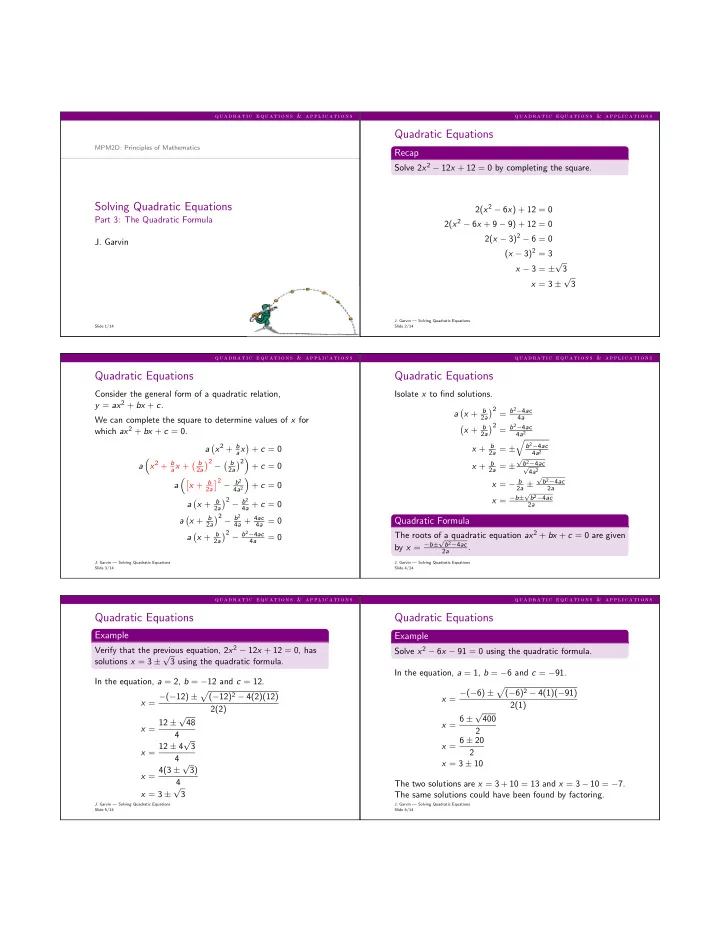
q u a d r a t i c e q u a t i o n s & a p p l i c a t i o n s q u a d r a t i c e q u a t i o n s & a p p l i c a t i o n s Quadratic Equations MPM2D: Principles of Mathematics Recap Solve 2 x 2 12 x + 12 = 0 by completing the


slide-1
SLIDE 1

q u a d r a t i c e q u a t i o n s & a p p l i c a t i o n s

MPM2D: Principles of Mathematics

Solving Quadratic Equations

Part 3: The Quadratic Formula

  • J. Garvin

Slide 1/14

q u a d r a t i c e q u a t i o n s & a p p l i c a t i o n s

Quadratic Equations

Recap

Solve 2x2 − 12x + 12 = 0 by completing the square. 2(x2 − 6x) + 12 = 0 2(x2 − 6x + 9 − 9) + 12 = 0 2(x − 3)2 − 6 = 0 (x − 3)2 = 3 x − 3 = ± √ 3 x = 3 ± √ 3

  • J. Garvin — Solving Quadratic Equations

Slide 2/14

q u a d r a t i c e q u a t i o n s & a p p l i c a t i o n s

Quadratic Equations

Consider the general form of a quadratic relation, y = ax2 + bx + c. We can complete the square to determine values of x for which ax2 + bx + c = 0. a

  • x2 + b

ax

  • + c = 0

a

  • x2 + b

ax +

b

2a

2 − b

2a

2 + c = 0 a

  • x + b

2a

2 − b2

4a2

  • + c = 0

a

  • x + b

2a

2 − b2

4a + c = 0

a

  • x + b

2a

2 − b2

4a + 4ac 4a = 0

a

  • x + b

2a

2 − b2−4ac

4a

= 0

  • J. Garvin — Solving Quadratic Equations

Slide 3/14

q u a d r a t i c e q u a t i o n s & a p p l i c a t i o n s

Quadratic Equations

Isolate x to find solutions. a

  • x + b

2a

2 = b2−4ac

4a

  • x + b

2a

2 = b2−4ac

4a2

x + b

2a = ±

  • b2−4ac

4a2

x + b

2a = ± √ b2−4ac √ 4a2

x = − b

2a ± √ b2−4ac 2a

x = −b±

√ b2−4ac 2a

Quadratic Formula

The roots of a quadratic equation ax2 + bx + c = 0 are given by x = −b±

√ b2−4ac 2a

.

  • J. Garvin — Solving Quadratic Equations

Slide 4/14

q u a d r a t i c e q u a t i o n s & a p p l i c a t i o n s

Quadratic Equations

Example

Verify that the previous equation, 2x2 − 12x + 12 = 0, has solutions x = 3 ± √ 3 using the quadratic formula. In the equation, a = 2, b = −12 and c = 12. x = −(−12) ±

  • (−12)2 − 4(2)(12)

2(2) x = 12 ± √ 48 4 x = 12 ± 4 √ 3 4 x = 4(3 ± √ 3) 4 x = 3 ± √ 3

  • J. Garvin — Solving Quadratic Equations

Slide 5/14

q u a d r a t i c e q u a t i o n s & a p p l i c a t i o n s

Quadratic Equations

Example

Solve x2 − 6x − 91 = 0 using the quadratic formula. In the equation, a = 1, b = −6 and c = −91. x = −(−6) ±

  • (−6)2 − 4(1)(−91)

2(1) x = 6 ± √ 400 2 x = 6 ± 20 2 x = 3 ± 10 The two solutions are x = 3 + 10 = 13 and x = 3 − 10 = −7. The same solutions could have been found by factoring.

  • J. Garvin — Solving Quadratic Equations

Slide 6/14

slide-2
SLIDE 2

q u a d r a t i c e q u a t i o n s & a p p l i c a t i o n s

Quadratic Equations

Example

Determine the x-intercepts of the parabola defined by y = −3x2 − 6x + 15. The x-intercepts correspond to the solutions to the quadratic equation −3x2 − 6x + 15 = 0. Since moving all three terms to the other side of the equation results in the equation 3x2 + 6x − 15 = 0, this equation may also be used. It has the advantage of avoiding a negative denominator.

  • J. Garvin — Solving Quadratic Equations

Slide 7/14

q u a d r a t i c e q u a t i o n s & a p p l i c a t i o n s

Quadratic Equations

x = −6 ±

  • 62 − 4(3)(−15)

2(3) x = −6 ± √ 216 6 x = −6 ± 6 √ 6 6 x = −1 ± √ 6 The x-intercepts are approximately −3.45 and 1.45.

  • J. Garvin — Solving Quadratic Equations

Slide 8/14

q u a d r a t i c e q u a t i o n s & a p p l i c a t i o n s

Quadratic Equations

  • J. Garvin — Solving Quadratic Equations

Slide 9/14

q u a d r a t i c e q u a t i o n s & a p p l i c a t i o n s

Quadratic Equations

Example

Solve 2x2 − x + 5 = 0. In the equation, a = 2, b = −1 and c = 5. x = −(−1) ±

  • (−1)2 − 4(2)(5)

2(2) x = 1 ± √−39 4 At this point there is a problem, since √−39 is not a real number. Therefore, there can be no real solutions to this equation.

  • J. Garvin — Solving Quadratic Equations

Slide 10/14

q u a d r a t i c e q u a t i o n s & a p p l i c a t i o n s

The Discriminant

Let D = b2 − 4ac, the expression inside of the radical sign in the quadratic formula. This expression is known as the discriminant, and it can be used to give us information about both the number of real-valued solutions for a quadratic equation. If D < 0, then √ D will be undefined for any real numbers. If D = 0, then √ D = 0, and the quadratic formula will become x = −b

2a , for which there is one∗ real solution.

If D > 0, then the quadratic formula is x = −b±

√ D 2a

, for which there are two distinct real solutions.

  • J. Garvin — Solving Quadratic Equations

Slide 11/14

q u a d r a t i c e q u a t i o n s & a p p l i c a t i o n s

The Discriminant

To determine the number of real solutions to a quadratic relation, it is only necessary to calculate the value of the discriminant.

Determining the Number of Real Roots

The number of real solutions to a quadratic equation ax2 + bx + c = 0 can be determined using the discriminant, D = b2 − 4ac.

  • If D < 0, there are no real solutions.
  • If D = 0, there is one real solution.
  • If D > 0, there are two distinct real solutions.
  • J. Garvin — Solving Quadratic Equations

Slide 12/14

slide-3
SLIDE 3

q u a d r a t i c e q u a t i o n s & a p p l i c a t i o n s

The Discriminant

Example

Determine the number of real solutions to 4x2 − 20x + 25 = 0. Since D = (−20)2 − 4(4)(25) = 0, there is one real solution.

Example

Determine the number of real solutions to 3x2 + 5x + 4 = 0. Since D = 52 − 4(3)(4) = −23, there are no real solutions.

  • J. Garvin — Solving Quadratic Equations

Slide 13/14

q u a d r a t i c e q u a t i o n s & a p p l i c a t i o n s

Questions?

  • J. Garvin — Solving Quadratic Equations

Slide 14/14