Q&A Please submit all questions concerning webinar content - - PDF document

q a
SMART_READER_LITE
LIVE PREVIEW

Q&A Please submit all questions concerning webinar content - - PDF document

NAACCR 2017-2018 We b ina r Se rie s 11/ 2/ 2017 COLLECTING CANCER DATA: LARYNX 20172018 NAACCR WEBINAR SERIES Q&A Please submit all questions concerning webinar content through the Q&A panel. Reminder: If you have


slide-1
SLIDE 1

NAACCR 2017-2018 We b ina r Se rie s 11/ 2/ 2017 L a rynx 1

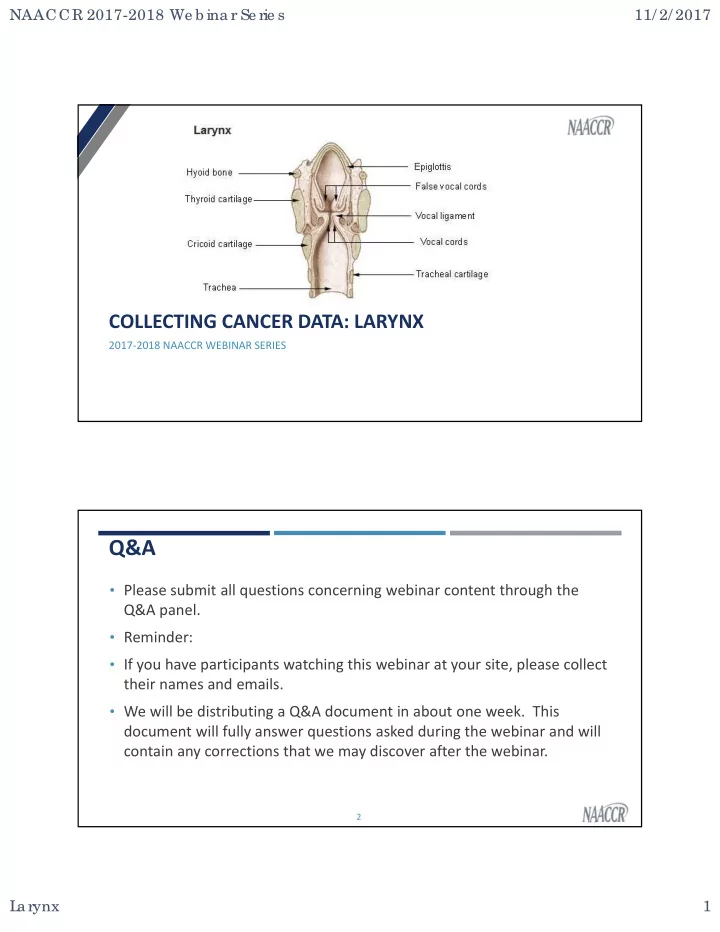
COLLECTING CANCER DATA: LARYNX

2017‐2018 NAACCR WEBINAR SERIES

Q&A

  • Please submit all questions concerning webinar content through the

Q&A panel.

  • Reminder:
  • If you have participants watching this webinar at your site, please collect

their names and emails.

  • We will be distributing a Q&A document in about one week. This

document will fully answer questions asked during the webinar and will contain any corrections that we may discover after the webinar.

2

slide-2
SLIDE 2

NAACCR 2017-2018 We b ina r Se rie s 11/ 2/ 2017 L a rynx 2

3

Fabulous Prizes AGENDA

  • Anatomy
  • Epi Moment
  • Quiz 1
  • Staging
  • Treatment
  • Quiz 2
  • Case Scenarios

4

slide-3
SLIDE 3

NAACCR 2017-2018 We b ina r Se rie s 11/ 2/ 2017 L a rynx 3

ANATOMY

LARYNX

5

LARYNX ANATOMY

6

  • Voice Box
  • Passageway of air
  • Extends from C3 to C6 vertebrae
slide-4
SLIDE 4

NAACCR 2017-2018 We b ina r Se rie s 11/ 2/ 2017 L a rynx 4

LARYNX ANATOMY

7

  • Divided into 3 Sections
  • Supraglottis
  • area above vocal cords, contains epiglottis
  • arytenoids, aryepiglottic folds and false cords
  • Glottis
  • containing true vocal cords, anterior and posterior commissures
  • Subglottis
  • below the vocal cords

LARYNX ANATOMY

  • Epiglottis
  • Anterior and Posterior

Commissure

  • Arytenoids
  • Aryepiglottic Folds
  • False vocal cords
  • True vocal cords

8

slide-5
SLIDE 5

NAACCR 2017-2018 We b ina r Se rie s 11/ 2/ 2017 L a rynx 5

LARYNX ANATOMY

  • Thyroid cartilage
  • Adam’s apple
  • Thyrohyoid membrane
  • Cricoid cartilage
  • Inferior wall of larynx
  • Median cricothyroid ligament
  • Epiglottis
  • Closes off glottis during swallowing
  • Arytenoid cartilage
  • Influence position and tension of the

vocal cords

  • Corniculate cartilage
  • Horn shaped pieces located at the

apex of arytenoid cartilage

  • Cuneiform cartilage
  • Club shaped pieces located anterior to

the corniculate cartilages

9

PRIMARY SITE CODING

  • C32.0
  • True vocal cord
  • C32.1
  • Epiglottis
  • Posterior Surface of epiglottis
  • False vocal cord
  • C32.3
  • Arytenoid cartilage, Cricoid cartilage, cuneiform cartilage, thyroid

cartilage

10

ICDO3 Term C32.0 Glottis C32.1 Supraglottis C32.2 Subglottis C32.3 Laryngeal cartilage C32.8 Overlapping lesion of larynx C32.9 Larynx, NOS

slide-6
SLIDE 6

NAACCR 2017-2018 We b ina r Se rie s 11/ 2/ 2017 L a rynx 6

MULTIPLE PRIMARY AND HISTOLOGY RULES

HEAD AND NECK: CODING PRIMARY SITES

11

CODING PRIMARY SITE : PRIORITY ORDER

  • Tumor Board
  • Staging physician’s site assignment
  • Total resection of primary tumor
  • No resection (biopsy only)
  • Overlapping sites code

12

slide-7
SLIDE 7

NAACCR 2017-2018 We b ina r Se rie s 11/ 2/ 2017 L a rynx 7

ASSIGNING STAGE WHEN PRIMARY SITE IS C32.8 OR C32.9

13

HOW DO WE ASSIGN STAGE WHEN PRIMARY SITE IS C32.8 OR C32.9

  • Can assign a T value based on the location of tumor bulk
  • r epicenter
  • If epicenter can be identified – assign to the subsite

where located

  • If epicenter cannot be identified – use C32.8 or C32.9

code T value to TX, Stage Group should be 99

14

slide-8
SLIDE 8

NAACCR 2017-2018 We b ina r Se rie s 11/ 2/ 2017 L a rynx 8

REGIONAL LYMPH NODES

  • Internal jugular
  • Jugulodigastric (II)
  • Jugulo‐omohyoid (IV)
  • Upper deep cervical II)
  • Lower deep cervical

(IV)

  • Anterior cervical
  • Prelaryngeal (VI)
  • Pretracheal (VI)
  • Paratracheal (VI)
  • Lateral tracheal (VI)
  • Submandibular (IB)
  • Submaxillary
  • Submental (IA)
  • Cervical, NOS

15

DISTANT METASTATIC SITES

  • Bone
  • Lung – most common
  • Liver

16

slide-9
SLIDE 9

NAACCR 2017-2018 We b ina r Se rie s 11/ 2/ 2017 L a rynx 9

LARYNGEAL CANCER HISTOLOGIES

  • Squamous Cell Carcinomas
  • Most common
  • Adenocarcinomas
  • Rare cancers
  • Sarcomas
  • Lymphoma
  • Plasmacytoma

17

QUESTIONS?

18

slide-10
SLIDE 10

NAACCR 2017-2018 We b ina r Se rie s 11/ 2/ 2017 L a rynx 10

EPI MOMENT

19

COLLECTING CANCER DATA: LARYNX

EPI MOMENT: RECINDA SHERMAN NOVEMBER 2, 2017

“official” theme songs…The Voice

slide-11
SLIDE 11

NAACCR 2017-2018 We b ina r Se rie s 11/ 2/ 2017 L a rynx 11

BURDEN OF LARYNX CANCER

21

EPIDEMIOLOGY OF LARYNX CANCER

  • SEER Site Recode: Respiratory Cancers
  • Analyzed in Head & Neck Group (oral + larynx, tobacco‐associated, or alone stand‐alone)
  • Rare, 3.2 per 100,000 (mortality 1 per 100,000)
  • 5‐year survival 61%
  • Incidence 6x higher in men (6.5 per 100,000)
  • Higher in blacks (9.5 per 100,000)
  • Three anatomic subsites (differ in etiology, tx, and survival)
  • Glottic & supraglottic (majority of tumors)
  • Subglottic
  • Predominately squamous
  • Etiology unclear
  • Risk factors—tobacco, alcohol
  • Risk factors—poor nutrition, workplace exposures
  • HPV is rarely a factor

22

slide-12
SLIDE 12

NAACCR 2017-2018 We b ina r Se rie s 11/ 2/ 2017 L a rynx 12

LARYNX CANCER PROGNOSIS

23

10 20 30 40 50 60 70 80 90 100

5‐year RSR

Symptoms: hoarseness/voice changes, dysphonia, dyspnea, and swallowing dysfunction Survivorship concerns: dysphonia can significantly impact quality of life

RECENT TRENDS, 2011‐2015

24

Site Prostate

  • 7.6* (-10.5 - -4.7)

118.2

Lung and bronchus

  • 2.4* (-2.8 - -2.0)

73.2

Colon and rectum

  • 1.9* (-3.2 - -0.6)

46.5

Urinary bladder

  • 0.8* (-1.0 - -0.7)

36.8

Melanoma of the skin +2.3* (2.0 - 2.6)

27.4

Non-Hodgkin lymphoma

  • 0.2 (-0.5 - 0.1)

23.7

Kidney and renal pelvis +1.1* (0.5 - 1.8)

22.3

Leukemia +1.6* (1.1 - 2.1)

19.0

Oral cavity and pharynx +1.3* (1.0 - 1.6)

17.7

Pancreas +1.0* (1.0 - 1.1)

14.5

Liver and intrahepatic bile duct +2.8* (2.0 - 3.6)

12.5

Stomach

  • 0.3 (-0.7 - 0.1)

9.4

Myeloma +2.5* (2.0 - 3.0)

8.7

Esophagus

  • 1.6* (-2.3 - -1.0)

8.1

Brain and other nervous system

  • 0.2* (-0.3 - -0.1)

7.9

Thyroid +2.4* (1.3 - 3.5)

7.3

Larynx

  • 2.3* (-2.4 - -2.1)

6.1

Male Current Trend 5 Year AAPC

Delay‐Adjusted Incidence Rates Cases per 100,000

118.2 73.2 46.5 36.8 27.4 23.7 22.3 19.0 17.7 14.5 12.5 9.4 8.7 8.1 7.9 7.3 6.1

slide-13
SLIDE 13

NAACCR 2017-2018 We b ina r Se rie s 11/ 2/ 2017 L a rynx 13

QUESTIONS?

QUIZ 1

25

SUMMARY STAGE 2000

26

slide-14
SLIDE 14

NAACCR 2017-2018 We b ina r Se rie s 11/ 2/ 2017 L a rynx 14

SUMMARY STAGE

  • Listed with Respiratory tract sites
  • https://seer.cancer.gov/tools/ssm/respir.

pdf

  • Larynx chapters
  • Glottis (C32.0)
  • Intrinsic larynx, laryngeal commissure,

true vocal cord, vocal cord, NOS

  • Supraglottis (C32.1)
  • Extrinsic larynx, laryngeal aspect of

aryepiglotic fold, ventricular band, false vocal cord

  • Subglottis (C32.2)
  • Overlapping lesion or NOS (C32.3,

C32.8, C32.9)

27

SUMMARY STAGE 2018

  • Grouped with head and neck sites (not with respiratory)
  • Regional lymph nodes will match head and neck sites

28

slide-15
SLIDE 15

NAACCR 2017-2018 We b ina r Se rie s 11/ 2/ 2017 L a rynx 15

LOCALIZED/REGIONAL

  • Regional by direct

extension

  • Extension to:
  • Base of tongue
  • Hypopharynx, NOS
  • Postcricoid area
  • Pre‐epiglottic tissues
  • Pyriform sinus (pyriform fossa)
  • Vallecula

29

POP QUIZ 1

  • A patient is found to have a

squamous cell carcinoma

  • riginating in the left true

vocal cord with extension to the right vocal cord, anterior commissure, and supraglottis.

30

Summary Stage 2000 Summary Stage 2018

slide-16
SLIDE 16

NAACCR 2017-2018 We b ina r Se rie s 11/ 2/ 2017 L a rynx 16

AJCC STAGING

7TH EDITION CHAPTER 5 PAGE 57 8TH EDITION CHAPTER 13 PAGE 149

31

AJCC CANCER STAGE: LARYNX

  • ICD‐O‐3 Topography Codes
  • C10.1

Anterior (lingual) surface of epiglottis

  • C32.0

Glottis

  • C32.1

Supraglottis (laryngeal surface)

  • C32.2

Subglottis

  • C32.8

Overlapping lesion of larynx

  • C32.9

Larynx NOS

  • ICD‐O‐3 Histology Code Ranges
  • 8000‐8576, 8940‐8950, 8980‐8981

32

slide-17
SLIDE 17

NAACCR 2017-2018 We b ina r Se rie s 11/ 2/ 2017 L a rynx 17

RULES FOR CLASSIFICATION

  • Clinical staging
  • Evidence prior to treatment
  • Nasolaryngoscopy
  • Laryngeal tumor biopsy
  • Radiologic nodal staging to supplement clinical exam
  • Microlaryngoscopy

33

RULES FOR CLASSIFICATION

  • Pathologic staging
  • Evidence obtained in clinical staging and in histologic study of

surgically resected specimen

  • Lymphadenectomy description describes size, number, and

position of involved nodes and presence or absence of extracapsular spread (ECS)

34

slide-18
SLIDE 18

NAACCR 2017-2018 We b ina r Se rie s 11/ 2/ 2017 L a rynx 18

CLINICALLY OCCULT TUMORS

  • A thorough exam of the larynx has been conducted and

no primary tumor has been identified.

  • Case was diagnosed based on metastasis.
  • Physician has indicated larynx is likely the primary site.
  • T0 removed from larynx chapter in 8th edition (moved to

chapter 6)

Example: Patient is found to have a cervical lymph node positive for

  • metastasis. Physician feels this is most like from a laryngeal primary.

35

T VALUES

  • Supraglottis, glottis,

and subglottis have different T definitions.

  • C32.8 and C32.9

should be assigned TX.

36

slide-19
SLIDE 19

NAACCR 2017-2018 We b ina r Se rie s 11/ 2/ 2017 L a rynx 19

POP QUIZ 2

  • A patient had a core biopsy of a 2cm

movable cervical lymph node that was positive for squamous cell carcinoma.

  • A laryngoscopy showed a tumor

involving the right true vocal cord and right commissure.

  • The physician cannot determine if the

tumor started in the vocal cord or commissure.

  • A staging work‐up did not reveal any

additional metastasis.

37

Data Item 7th ed 8th ed Clinical T Clinical N Clinical M Stage Path T Path N Path M Stage

SUBSITES

38

  • Supraglottis
  • Suprahyoid epiglottis
  • Infrahyoid epiglottis
  • Aryepiglottic folds
  • Ventricular bands
  • Glottis
  • True vocal cords (including

commissures

  • Subglottis
slide-20
SLIDE 20

NAACCR 2017-2018 We b ina r Se rie s 11/ 2/ 2017 L a rynx 20

1‐WHAT IS THE cT VALUE?

  • Tumor arising on the

lingual aspect of the suprahyoid epiglottis and extends along the mucosa to the Infrahyoid

  • epiglottis. No further

extension noted.

39

2‐WHAT IS THE cT VALUE?

  • Tumor arising on left true

vocal and extends to the anterior commissure. The tumor involves the anterior portion of the right true vocal cord. No further extension noted.

40

slide-21
SLIDE 21

NAACCR 2017-2018 We b ina r Se rie s 11/ 2/ 2017 L a rynx 21

3‐WHAT IS THE cT VALUE?

  • Tumor confined to the left

true vocal cord. The tumor is causing partial paralysis of the left cord. No further extension identified.

41

What if the vocal cord had been described as fixed or complete paralysis?

4‐WHAT IS THE cT VALUE?

  • A subglottic tumor

extending to the true vocal cords and into, but not through, the cricoid

  • cartilage. No further

extension identified.

42

slide-22
SLIDE 22

NAACCR 2017-2018 We b ina r Se rie s 11/ 2/ 2017 L a rynx 22

REGIONAL LYMPH NODES

  • Supraglottis
  • Upper and mid jugular
  • Glottic
  • Prelaryngeal
  • Subglottic
  • Prelarnygeal

43

REGIONAL LYMPH NODES

  • 7th & 8th Edition
  • How many lymph node are involved?
  • Ipsilateral vs bilateral?
  • Size of metastatic lymph node?
  • 8th Edition
  • Extranodal extension (ENE)

44

slide-23
SLIDE 23

NAACCR 2017-2018 We b ina r Se rie s 11/ 2/ 2017 L a rynx 23

EXTRANODAL EXTENSION (ENE)

  • Clinical
  • Unquestionable,

unambiguous ENE

  • Pathologic
  • Pathologically

confirmed extension to surrounding tissues or structures

45

POP QUIZ 3 (CLIN)

  • A patient had a core biopsy of a 2cm

movable cervical lymph node that was positive for squamous cell carcinoma.

  • A laryngoscopy showed a tumor

arising in the Infrahyoid epiglottis with extension to the left vocal cord.

  • A staging work‐up did not reveal any

additional metastasis. What is the clinical stage?

46

Data Item 7th ed 8th ed Primary Site Clinical T Clinical N Clinical M Stage Path T Path N Path M Stage

slide-24
SLIDE 24

NAACCR 2017-2018 We b ina r Se rie s 11/ 2/ 2017 L a rynx 24

POP QUIZ 3(PATH)

  • The patient went on to have an

endoscopic resection of the primary tumor and a lymph node dissection.

  • Primary tumor extends arises in

infrahyoid areas and extends into the left vocal cord. The extend into, but not beyond postcricoid area. No additional extension is noted. Margins are negative.

  • 16 lymph nodes marked as level I and

level II cervical lymph nodes were

  • identified. 3 of the lymph nodes were

positive for metastasis. The largest measured 1.5cm. No ENE identified.

47

Data Item 7th ed 8th ed Primary Site Clinical T Clinical N Clinical M Stage Path T Path N Path M Stage

POP QUIZ (4)

  • A patient presents to your facility for

surgery of a primary supraglottic tumor. The ENT has assigned a clinical stage of T3 N1 M0 Stage 3. The T3 is based on imaging showing invasion into the thyroid cartilage.

  • Radical laryngectomy and bilateral neck

dissection: 2 cm poorly differentiated squamous cell carcinoma of epiglottis extends into and through thyroid cartilage with microinvasion of the thyroid; 36 lymph nodes removed; 1 malignant ipsilateral cervical node. No ENE.

48

Data Item 7th ed 8th ed Primary Site Clinical T Clinical N Clinical M Stage Path T Path N Path M Stage

slide-25
SLIDE 25

NAACCR 2017-2018 We b ina r Se rie s 11/ 2/ 2017 L a rynx 25

DISTANT METASTASIS

  • Most common sites of distant mets is lung
  • Other sites include bone and liver
  • Mediastinal nodes (other than level VII)

49

SSF’S

50

slide-26
SLIDE 26

NAACCR 2017-2018 We b ina r Se rie s 11/ 2/ 2017 L a rynx 26

SSF1: SIZE OF LYMPH NODES

  • Code largest diameter of involved regional nodes
  • Clinical assessment
  • Code size as described in clinical or radiographic exam
  • Pathologic assessment
  • Code size as described on pathology report
  • SSDI‐Lymph Nodes Size of Metastasis

51

SSF3 – SSF6: LYMPH NODE LEVELS FOR HEAD AND NECK

  • SSF 3: Levels I‐III
  • Lymph Nodes Head and Neck Levels I‐III
  • SSF 4: Levels IV, V, retropharyngeal nodes
  • Lymph Nodes Head and Neck Levels IV‐V
  • SSF 5: Levels VI, VII, facial nodes
  • Lymph Nodes Head and Neck Levels VI‐VII
  • SSF 6: Parapharyngeal, parotid, and suboccipital/retroauricular nodes
  • Lymph Nodes Head and Neck Other
slide-27
SLIDE 27

NAACCR 2017-2018 We b ina r Se rie s 11/ 2/ 2017 L a rynx 27

SSF3 – SSF6: NODE LEVELS

  • Code presence or absence of node involvement
  • One digit used to represent lymph nodes of a single level
  • If you only have information about one level of lymph nodes,

code all other lymph levels as 0

  • If you know regional lymph nodes are positive but the lymph

node level is unknown, code 000

  • If no lymph nodes are involved clinically or pathologically,

code 000

  • Extracapsular extension
  • Tumor within lymph nodes extends beyond the wall of the node into the

perinodal fat

  • Macroscopic
  • May be described in gross dissection
  • Takes priority over microscopic description
  • Microscopic
  • May not be evident in gross exam
  • Described in microscopic section of path report

SSF9: EXTRACAPSULAR EXTENSION PATHOLOGICALLY, LYMPH NODES

54

slide-28
SLIDE 28

NAACCR 2017-2018 We b ina r Se rie s 11/ 2/ 2017 L a rynx 28

SSDI’S

  • Extranodal Extension Head and Neck Clinical
  • Extranodal Extension Head and Neck Pathological

55

QUESTIONS?

56

slide-29
SLIDE 29

NAACCR 2017-2018 We b ina r Se rie s 11/ 2/ 2017 L a rynx 29

TREATMENT

SURGERY, RADIATION, CHEMOTHERAPY

57

TREATMENT BY CLINICAL STAGE FOR GLOTTIS LARYNX

  • Carcinoma in situ
  • T1‐T2 or Select T3
  • T3 requiring total laryngectomy (N0‐1)
  • T3 requiring total laryngectomy (N2‐3)
  • T4a
  • T4b, any N or unresectable nodal disease or Unfit for surgery
  • Metastatic (M1) disease at presentation

58

slide-30
SLIDE 30

NAACCR 2017-2018 We b ina r Se rie s 11/ 2/ 2017 L a rynx 30

TREATMENT BY CLINICAL STAGE FOR SUPRAGLOTTIC LARYNX

  • T1‐2, N0, Selected T3
  • T3, N0
  • T4a, N0
  • Node‐positive disease
  • T4b, any N or unresectable nodal disease or Unfit for surgery
  • Metastatic (M1) disease at presentation

59

OVERVIEW OF GLOTTIS AND SUPRAGLOTTIC TREATMENT

  • In situ, early stage cancers
  • Surgery or radiation therapy
  • Adjuvant treatment
  • Presence or absence of adverse features
  • Resectable, advance stage cancers
  • If conservation is desired concurrent systemic therapy/RT
  • Total laryngectomy with thyroidectomy and neck dissection followed

by adjuvant treatment

60

slide-31
SLIDE 31

NAACCR 2017-2018 We b ina r Se rie s 11/ 2/ 2017 L a rynx 31

SURGERY

61

  • Vertical Laryngectomy (31)
  • True and ipsilateral false vocal cord, intervening ventricle or ipsilateral

thyroid, may remove arytenoids

  • Anterior Commissure Laryngectomy (32)
  • The anterior commissure is resected with the overlying thyroid

cartilage.

  • Supraglottic Laryngectomy (33)
  • Removal of epiglottis, false vocal cords, aryepiglottic folds, arytenoid

cartilages, ventricle, upper one third of thyroid cartilage and/or thyroid membrane

SURGERY

62

  • Total Laryngectomy ONLY (41)
  • Removal of the entire larynx
  • No longer a connection between the trachea and the mouth

and nose

  • Radical Laryngectomy ONLY (42)
  • Removal of the entire larynx and adjacent sites
slide-32
SLIDE 32

NAACCR 2017-2018 We b ina r Se rie s 11/ 2/ 2017 L a rynx 32

RADIATION

  • IMRT
  • Proton Beam
  • Palliative Radiation

63

SYSTEMIC THERAPY

  • Cisplatin
  • Cetuximab
  • Carboplatin
  • 5‐FU/hydroxyurea
  • Paclitaxel
  • Infusional 5‐FU
  • Docetaxel

64

slide-33
SLIDE 33

NAACCR 2017-2018 We b ina r Se rie s 11/ 2/ 2017 L a rynx 33

QUESTIONS?

65

COMING UP….

  • Collecting Cancer Data: Uterus
  • 12/07/2017
  • Collecting Cancer Data: GIST and Soft Tissue Sarcomas
  • 01/11/2018

66

slide-34
SLIDE 34

NAACCR 2017-2018 We b ina r Se rie s 11/ 2/ 2017 L a rynx 34

67

Fabulous Prizes Winners CE CERTIFICATE QUIZ/SURVEY

  • Phrase
  • Link

http://www.surveygizmo.com/s3/3952987/Larynx‐2017

68

slide-35
SLIDE 35

NAACCR 2017-2018 We b ina r Se rie s 11/ 2/ 2017 L a rynx 35

JIM HOFFERKAMP jhofferkamp@naaccr.org ANGELA MARTIN amartin@naaccr.org

69

RECINDA SHERMAN rsherman@naaccr.org