Case-control studies, regression and survival analysis Tyler Moore - - PDF document

case control studies regression and survival analysis
SMART_READER_LITE
LIVE PREVIEW

Case-control studies, regression and survival analysis Tyler Moore - - PDF document

Notes Case-control studies, regression and survival analysis Tyler Moore CSE 7338 Computer Science & Engineering Department, SMU, Dallas, TX Lectures 67 Notes Outline Case-control studies 1 Regression and survival analysis 2 2 /


slide-1
SLIDE 1

Case-control studies, regression and survival analysis

Tyler Moore

CSE 7338 Computer Science & Engineering Department, SMU, Dallas, TX

Lectures 6–7

Outline

1

Case-control studies

2

Regression and survival analysis

2 / 84 Case-control studies

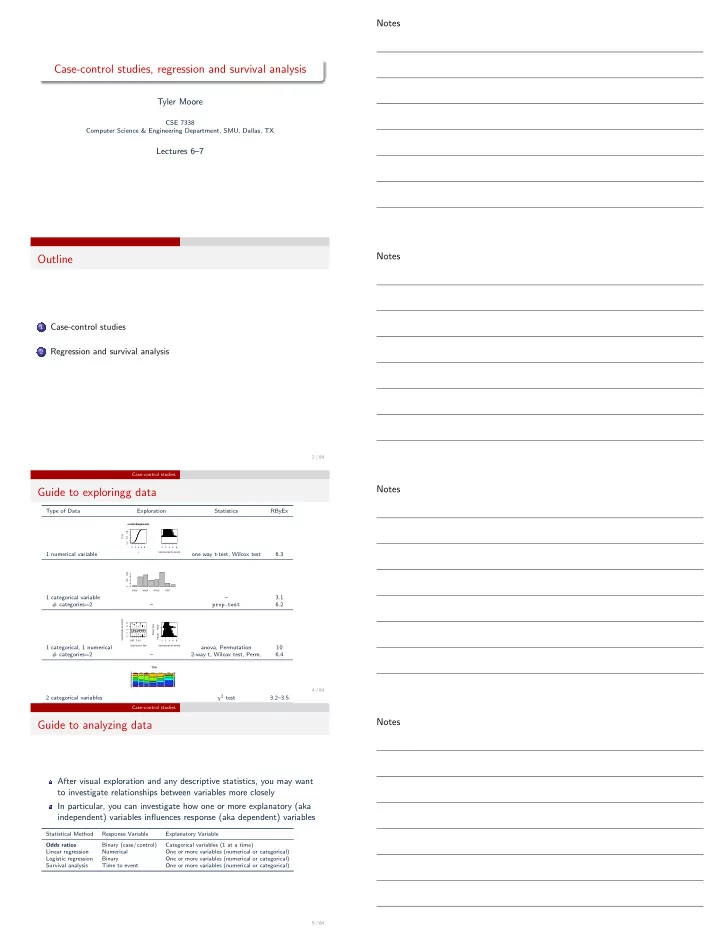
Guide to exploringg data

Type of Data Exploration Statistics RByEx 1 numerical variable

2 4 6 8 0.0 0.4 0.8 ecdf(br$logbreach) x Fn(x) 2 4 6 8 log(#records breached)
  • ne way t-test, Wilcox test

6.3 1 categorical variable

CARD HACK PHYS STAT 400 800

– 3.1 # categories=2 – prop.test 6.2 1 categorical, 1 numerical

  • BSF
EDU 2 4 6 8 Organization Type log(#records breached) 2 4 6 8 FALSE TRUE log(#records breached) Breach type
  • anova, Permutation

10 # categories=2 – 2-way t, Wilcox test, Perm. 6.4 2 categorical variables

TOH BSF BSO BSR EDU GOV MED NGO CARD DISC HACK INSD PHYS PORT STAT UNKN

χ2 test 3.2–3.5

4 / 84 Case-control studies

Guide to analyzing data

After visual exploration and any descriptive statistics, you may want to investigate relationships between variables more closely In particular, you can investigate how one or more explanatory (aka independent) variables influences response (aka dependent) variables

Statistical Method Response Variable Explanatory Variable Odds ratios Binary (case/control) Categorical variables (1 at a time) Linear regression Numerical One or more variables (numerical or categorical) Logistic regression Binary One or more variables (numerical or categorical) Survival analysis Time to event One or more variables (numerical or categorical)

5 / 84

Notes Notes Notes Notes

slide-2
SLIDE 2

Case-control studies

Identifying risk factors in epidemiology

6 / 84 Case-control studies

Case-control studies and cybercrime

In a perfect world, we could measure security using randomized controlled experiments similar to medicine But most security data is observational – we can’t select subjects and apply treatments to a subset Instead, we can observe that some targets are victimized, while other vulnerable targets are not Crucially, this observation happens after the fact (if at all) Case-control study method is ideal for identifying risk factors when all you have is observational data

7 / 84 Case-control studies

Case-control study design

Population Case Control Exposed Not Exposed Exposed Not Exposed Present Past

8 / 84 Case-control studies

Case-control study design: smoking and lung cancer

Population: Doctors Case: Lung Cancer Control: No Lung Cancer Exposed: Smoker Not Exposed: Non-smoker Exposed: Smoker Not Exposed: Non-smoker Present Past

9 / 84

Notes Notes Notes Notes

slide-3
SLIDE 3

Case-control studies

The odds ratio

Case (afflicted) Control (not afflicted) Exposed (has risk factor) p11 p10 Not exposed (no risk factor) p01 p00

  • dd’s ratio = p11 ∗ p00

p10 ∗ p01

10 / 84 Case-control studies

A word on odds ratios

Defining odds

Suppose we have an event with two possible outcomes: success (S)and failure (¯ S) The probability of each occurring happens with ps and p¯

S = 1 − ps.

The odds of the event are given by

ps 1−ps

Defining odds ratios

Suppose now there are two events A and B, both of which can occur (with probabilities pA and pB).

  • dd’s ratio = odds(A)
  • dds(B)

=

pA 1−pA pB 1−pB

= pA × (1 − pB) (1 − pA) × pB

11 / 84 Case-control studies

Odds ratio example

Adapted from http://www.ats.ucla.edu/stat/stata/faq/oratio.htm Suppose that 7 of 10 male applicants to engineering school are admitted, compared to 4 of 10 female applicants

pmale acc. = 0.7, pmale rej. = 1 − 0.7 = 0.3 pfemale acc. = 0.4, pfemale rej. = 1 − 0.4 = 0.6 podds(male acc.) = 0.7

0.3 = 2.33

podds(female acc.) = 0.4

0.6 = 0.667

OR =

2.33 0.667 = 3.5

Hence, we can say that the odds of a male applicant being admitted are 3.5 times stronger than for a female applicant.

12 / 84 Case-control studies

Case-control study: spear phishing and academic specialty

Population: Malware spam recipients Case: Targeted email Control: Un- targeted email Exposed: Aca- demic Subject Not Exposed: Other Subjects Exposed: Aca- demic Subject Not Exposed: Other Subjects Present Past

13 / 84

Notes Notes Notes Notes

slide-4
SLIDE 4

Case-control studies

Odds ratios for academic subjects in spear phishing study

14 / 84 Case-control studies

Illicit online pharmacies

What do illicit online pharmacies have to do with phishing? Both make use of a similar criminal supply chain

1

Traffic: hijack web search results (or send email spam)

2

Host: compromise a high-ranking server to redirect to pharmacy

3

Hook: affiliate programs let criminals set up website front-ends to sell drugs

4

Monetize: sell drugs ordered by consumers

5

Cash out: no need to hire mules, just take credit cards!

For more: http://lyle.smu.edu/~tylerm/usenix11.pdf

15 / 84 Case-control studies

Case-control study: search-redirection attacks

Population: pharma search results Case: Search- redirection at- tack Control: No redirection Exposed: .EDU TLDs Not Exposed: Other TLDs Exposed: .EDU TLDs Not Exposed: Other TLDs Present Past

16 / 84 Case-control studies

Case-control study: search-redirection attacks

R code: http: //lyle.smu.edu/~tylerm/courses/econsec/code/pharmaOdds.R Data format:

Date Search Engine Search Term
  • Pos. URL
Domain Redirects? TLD 2011-11-03 Google 20 mg ambien overdose 1 http://products.sanofi.us/ambien/ambien.pdf sanofi.us False
  • ther
2011-11-03 Google 20 mg ambien overdose 2 http://swift.sonoma.edu/education/newton/newtonsLaws/?20-mg-ambien-overdose sonoma.edu False .EDU 2011-11-03 Google 20 mg ambien overdose 3 http://ambienoverdose.org/about-2/ ambienoverdose.org False .ORG 2011-11-03 Google 20 mg ambien overdose 4 http://answers.yahoo.com/question/index?qid=20090712025803AA10g8Z yahoo.com False .COM 2011-11-03 Google 20 mg ambien overdose 5 http://en.wikipedia.org/wiki/Zolpidem wikipedia.org False .ORG 2011-11-03 Google 20 mg ambien overdose 6 http://blocsonic.com/blog blocsonic.com False .COM 2011-11-03 Google 20 mg ambien overdose 7 http://dinarvets.com/forums/index.php?/user/39154-ambien-side-effects/page dinarvets.com False .COM 2011-11-03 Google 20 mg ambien overdose 8 http://nemo.mwd.hartford.edu/mwd08/images/?20-mg-ambien-overdose hartford.edu True .EDU 2011-11-03 Google 20 mg ambien overdose 9 http://www.formspring.me/AmbienCheapOn formspring.me False
  • ther
2011-11-03 Google 20 mg ambien overdose 11 http://www.drugs.com/pro/zolpidem.html drugs.com False .COM 2011-11-03 Google 20 mg ambien overdose 12 http://www.engineer.tamuk.edu/departments/ieen/images/ambien.html tamuk.edu False .EDU 2011-11-03 Bing 20 mg ambien overdose 1 http://answers.yahoo.com/question/index?qid=20090712025803AA10g8Z yahoo.com False .COM 2011-11-03 Bing 20 mg ambien overdose 2 http://www.healthcentral.com/sleep-disorders/h/20-mg-ambien-overdose.html healthcentral.com False .COM 2011-11-03 Bing 20 mg ambien overdose 3 http://ambien20mg.com/ ambien20mg.com False .COM 2011-11-03 bing 20 mg ambien overdose 4 http://www.chacha.com/question/will-20-mg-of-ambien-cr-get-you-high chacha.com True .COM 2011-11-03 bing 20 mg ambien overdose 5 http://www.rxlist.com/ambien-drug.htm rxlist.com True .COM 2011-11-03 Bing 20 mg ambien overdose 6 http://www.drugs.com/pro/zolpidem.html drugs.com False .COM 2011-11-03 Bing 20 mg ambien overdose 7 http://answers.yahoo.com/question/index?qid=20111024222432AARFvPB yahoo.com False .COM 2011-11-03 Bing 20 mg ambien overdose 8 http://en.wikipedia.org/wiki/Zolpidem wikipedia.org False .ORG 2011-11-03 Bing 20 mg ambien overdose 9 http://www.thefullwiki.org/Sertraline thefullwiki.org False .ORG 2011-11-03 bing 20 mg ambien overdose 10 http://www.rxlist.com/edluar-drug.htm rxlist.com True .COM 2011-11-03 Bing 20 mg ambien overdose 11 http://www.formspring.me/ambienpill formspring.me False
  • ther
2011-11-03 Bing 20 mg ambien overdose 12 http://ambiendosage.net/ ambiendosage.net False .NET

17 / 84

Notes Notes Notes Notes

slide-5
SLIDE 5

Case-control studies

Odds ratios for case-control study

> library(epitools) > pr.tldodds<-oddsratio(pr$tld,pr$redirects,verbose=T) > pr.tldodds$measure

  • dds ratio with 95% C.I.

Predictor estimate lower upper .COM 1.0000000 NA NA .EDU 5.8390966 5.5363269 6.1591917 .GOV 0.4311855 0.3064817 0.5882604 .NET 0.5946029 0.5568593 0.6342355 .ORG 2.8811488 2.7971838 2.9674615

  • ther 1.3437113 1.2809207 1.4090669

18 / 84 Case-control studies

Odds ratios for case-control study

> pr.tldodds$p.value two-sided Predictor midp.exact .COM NA .EDU 0.000000000000000 .GOV 0.000000009212499 .NET 0.000000000000000 .ORG 0.000000000000000

  • ther 0.000000000000000

two-sided Predictor fisher.exact .COM NA .EDU 0.00000000000000000000000000000000000000000000000000000000000000000000 .GOV 0.00000001116730951558381248266507181077233923360836342908442020416260 .NET 0.00000000000000000000000000000000000000000000000000000000000003109266 .ORG 0.00000000000000000000000000000000000000000000000000000000000000000000

  • ther 0.00000000000000000000000000000002254063153941187904769660716762484880

two-sided Predictor chi.square .COM NA .EDU 0.000000000000000000000000000000000000000000000000000000000000 .GOV 0.000000150899123313924415716095442548116967174109959159977734 .NET 0.000000000000000000000000000000000000000000000000000000017562 .ORG 0.000000000000000000000000000000000000000000000000000000000000

  • ther 0.000000000000000000000000000000000390896706121527347442976835

19 / 84 Case-control studies

How to interpret the odds ratios?

> library(epitools) > pr.tldodds<-oddsratio(pr$tld,pr$redirects,verbose=T) > pr.tldodds$measure

  • dds ratio with 95% C.I.

Predictor estimate lower upper .COM 1.0000000 NA NA .EDU 5.8390966 5.5363269 6.1591917 .GOV 0.4311855 0.3064817 0.5882604 .NET 0.5946029 0.5568593 0.6342355 .ORG 2.8811488 2.7971838 2.9674615

  • ther 1.3437113 1.2809207 1.4090669

20 / 84 Regression and survival analysis

Guide to analyzing data

After visual exploration and any descriptive statistics, you may want to investigate relationships between variables more closely In particular, you can investigate how one or more explanatory (aka independent) variables influences response (aka dependent) variables

Statistical Method Response Variable Explanatory Variable Odds ratios Binary (case/control) Categorical variables (1 at a time) Linear regression Numerical One or more variables (numerical or categorical) Logistic regression Binary One or more variables (numerical or categorical) Survival analysis Time to event One or more variables (numerical or categorical)

22 / 84

Notes Notes Notes Notes

slide-6
SLIDE 6

Regression and survival analysis

Linear regression

Suppose the values of a numerical variable Y depend on the values of another variable X. Y = c0 + c1X + ǫ If that dependence is linear then we can use linear regression to estimate the best-fit values of the constants c0 and c1 that minimize the error values for all the values yi ∈ Y . For more info see “R by Example” Ch. 7.1–7.3

23 / 84 Regression and survival analysis

Why?

24 / 84

Notes Notes Notes Notes

slide-7
SLIDE 7

Regression and survival analysis

Dataset for linear regression example

Suppose you hypothesize that the popularity of a CMS platform influences the number of exploits made available We can use linear regression to test for such a relationship generatorType CMSmarketShare numExploits blogger 3.5 10 concrete5 0.1 1 contao 0.2 1 datalife engine 1.5 3 discuz 1.3 8 drupal 7.2 12 Code: http: //lyle.smu.edu/~tylerm/courses/econsec/code/exregress.R Data: http: //lyle.smu.edu/~tylerm/courses/econsec/data/eims.csv

28 / 84 Regression and survival analysis

Scatter plot

  • 10000000
20000000 30000000 40000000 50000000 200 400 600 800 marExp$numServers marExp$numExploits

plot(y=marExp$numExploits,x=marExp$numServers)

29 / 84 Regression and survival analysis

Scatter plot (log-transformed)

  • 100000
500000 2000000 10000000 50000000 1 5 10 50 100 500 1000 marExp$numServers marExp$numExploits

plot(y=marExp$numExploits,x=marExp$numServers,log = ’xy’)

30 / 84

Notes Notes Notes Notes

slide-8
SLIDE 8

Regression and survival analysis

Linear regression

> reg <- lm(lgExploits ~ lgServers, data = marExp2) > summary(reg) Call: lm(formula = lgExploits ~ lgServers, data = marExp2) Residuals: Min 1Q Median 3Q Max

  • 2.9692 -1.0655 -0.6013

0.5555 5.4554 Coefficients: Estimate Std. Error t value Pr(>|t|) (Intercept)

  • 9.4067

3.1924

  • 2.947 0.006280 **

lgServers 0.6304 0.1681 3.750 0.000784 ***

  • Signif. codes:

0 *** 0.001 ** 0.01 * 0.05 . 0.1 1 Residual standard error: 2.091 on 29 degrees of freedom Multiple R-squared: 0.3266, Adjusted R-squared: 0.3034 F-statistic: 14.07 on 1 and 29 DF, p-value: 0.0007842

31 / 84 Regression and survival analysis

Best-fit linear regression

  • 18
20 22 24 2 4 6 8 10 lg(# Servers per CMS) lg(# exploits available per CMS) blogger concrete5 contao datalife engine discuz drupal episerver ez publish joomla mediawiki movable type mybb php link directory phpnuke plone prestashop silverstripe spip typepad typo3 vbulletin vivvo wordpress xoops cms made simple dotnetnuke ip.board sharepoint supesite ucoz umbraco

plot(y = marExp2$lgExploits, x = marExp2$lgServers, xlab = "lg(# Servers per CMS)", ylab = "lg(# exploits available per CMS)", ) text(x = marExp2$lgServers, y = marExp2$lgExploits - 0.3, lab = marExp2$generatorType) abline(reg$coef)

32 / 84 Regression and survival analysis

Guide to analyzing data

After visual exploration and any descriptive statistics, you may want to investigate relationships between variables more closely In particular, you can investigate how one or more explanatory (aka independent) variables influences response (aka dependent) variables

Statistical Method Response Variable Explanatory Variable Odds ratios Binary (case/control) Categorical variables (1 at a time) Linear regression Numerical One or more variables (numerical or categorical) Logistic regression Binary One or more variables (numerical or categorical) Survival analysis Time to event One or more variables (numerical or categorical)

33 / 84 Regression and survival analysis

Logistic regression

Suppose we wanted to examine how a numerical variable (e.g., position in search results) affects a binary response variable (e.g., whether the URL redirects or not) We can’t use the odds ratios from case-control studies because that requires a categorical variable Suppose that we’d also like to examine how both position in search results and TLD affect whether a URL redirects For these cases, we need a logistic regression log p 1 − p = c0 + c1 x1 + c2 x2 + ǫ So for the example above considering position and TLD: log predir 1 − predir = c0 + c1 Position1 + c2 TLD2 + ǫ

34 / 84

Notes Notes Notes Notes

slide-9
SLIDE 9

Regression and survival analysis

Illicit online pharmacies

What do illicit online pharmacies have to do with phishing? Both make use of a similar criminal supply chain

1

Traffic: hijack web search results (or send email spam)

2

Host: compromise a high-ranking server to redirect to pharmacy

3

Hook: affiliate programs let criminals set up website front-ends to sell drugs

4

Monetize: sell drugs ordered by consumers

5

Cash out: no need to hire mules, just take credit cards!

For more: http://lyle.smu.edu/~tylerm/usenix11.pdf

35 / 84 Regression and survival analysis

Logistic regression in action

Code: http://lyle.smu.edu/~tylerm/courses/econsec/code/ pharmaLogit.R

> pr.logit <- glm(redirects ~ tld, data=pr, family=binomial(link = "logit")) > summary(pr.logit) Call: glm(formula = redirects ~ tld, family = binomial(link = "logit"), data = pr) Deviance Residuals: Min 1Q Median 3Q Max

  • 1.1476
  • 0.5442
  • 0.5442
  • 0.5442

2.3438 Coefficients: Estimate Std. Error z value Pr(>|z|) (Intercept) -1.835165 0.008626 -212.75 < 0.0000000000000002 *** tld.EDU 1.764595 0.027159 64.97 < 0.0000000000000002 *** tld.GOV

  • 0.845142

0.165381

  • 5.11

0.000000322 *** tld.NET

  • 0.519996

0.033165

  • 15.68 < 0.0000000000000002 ***

tld.ORG 1.058195 0.015079 70.18 < 0.0000000000000002 *** tldother 0.295390 0.024323 12.14 < 0.0000000000000002 ***

  • Signif. codes:

0 *** 0.001 ** 0.01 * 0.05 . 0.1 1 (Dispersion parameter for binomial family taken to be 1) Null deviance: 165287

  • n 175794

degrees of freedom Residual deviance: 156797

  • n 175789

degrees of freedom AIC: 156809 Number of Fisher Scoring iterations: 4 > NagelkerkeR2(pr.logit) $N [1] 175795 $R2 [1] 0.07736148

36 / 84 Regression and survival analysis

Logistic regression in action (ctd.)

(Dispersion parameter for binomial family taken to be 1) Null deviance: 165287

  • n 175794

degrees of freedom Residual deviance: 156797

  • n 175789

degrees of freedom AIC: 156809 Number of Fisher Scoring iterations: 4 > NagelkerkeR2(pr.logit) $N [1] 175795 $R2 [1] 0.07736148

37 / 84 Regression and survival analysis

Obtaining the odds ratios

Recall the logistic regression equation log p 1 − p = c0 + c1 x1 + c2 x2 + ǫ Exponentiate coefficients to get interpretable odds ratios

> coef(pr.logit) (Intercept) tld.EDU tld.GOV tld.NET tld.ORG tldother

  • 1.8351654

1.7645946

  • 0.8451420
  • 0.5199959

1.0581945 0.2953898 > #get odds ratios for the coefficients plus 95% CI > exp(cbind(OR = coef(pr.logit), confint(pr.logit))) Waiting for profiling to be done... OR 2.5 % 97.5 % (Intercept) 0.1595871 0.1569062 0.1623025 tld.EDU 5.8392049 5.5364431 6.1584001 tld.GOV 0.4294964 0.3053796 0.5858515 tld.NET 0.5945230 0.5568118 0.6341472 tld.ORG 2.8811645 2.7972246 2.9675454 tldother 1.3436501 1.2808599 1.4090019

38 / 84

Notes Notes Notes Notes

slide-10
SLIDE 10

Regression and survival analysis

Logistic regression #2: TLD and search result position

> pr.logit2 <- glm(redirects ~ tld + resultPosition, data=pr, family=binomial(link = "logit")) > summary(pr.logit2) Call: glm(formula = redirects ~ tld + resultPosition, family = binomial(link = "logit"), data = pr) Deviance Residuals: Min 1Q Median 3Q Max

  • 1.2680
  • 0.5968
  • 0.5355
  • 0.4757

2.4268 Coefficients: Estimate Std. Error z value Pr(>|z|) (Intercept)

  • 2.14012

0.01497 -142.920 < 0.0000000000000002 *** tld.EDU 1.77355 0.02726 65.072 < 0.0000000000000002 *** tld.GOV

  • 0.84060

0.16587

  • 5.068

0.000000402 *** tld.NET

  • 0.53121

0.03321

  • 15.993 < 0.0000000000000002 ***

tld.ORG 1.05185 0.01512 69.587 < 0.0000000000000002 *** tldother 0.30033 0.02437 12.322 < 0.0000000000000002 *** resultPosition 0.01803 0.00070 25.762 < 0.0000000000000002 ***

  • Signif. codes:

0 *** 0.001 ** 0.01 * 0.05 . 0.1 1 (Dispersion parameter for binomial family taken to be 1) Null deviance: 165287

  • n 175794

degrees of freedom Residual deviance: 156129

  • n 175788

degrees of freedom AIC: 156143 Number of Fisher Scoring iterations: 5

39 / 84 Regression and survival analysis

Logistic regression #2: TLD and search result position

> exp(cbind(OR = coef(pr.logit2), confint(pr.logit2))) Waiting for profiling to be done... NagelkerkeR2(pr.logit2) #compute pseudo R^2 on logistic regression OR 2.5 % 97.5 % (Intercept) 0.1176407 0.1142316 0.1211375 tld.EDU 5.8917404 5.5852012 6.2149893 tld.GOV 0.4314497 0.3067092 0.5886711 tld.NET 0.5878939 0.5505610 0.6271261 tld.ORG 2.8629455 2.7793345 2.9489947 tldother 1.3503082 1.2870831 1.4161226 resultPosition 1.0181977 1.0168021 1.0195962 > NagelkerkeR2(pr.logit2) #compute pseudo R^2 on logistic regression $N [1] 175795 $R2 [1] 0.08329341

40 / 84 Regression and survival analysis

Logistic regression #3: TLD, position, search engine

> pr.logit3 <- glm(redirects ~ tld + resultPosition + searchEngine, data=pr, family=binomial(link = "logit")) > summary(pr.logit3) Call: glm(formula = redirects ~ tld + resultPosition + searchEngine, family = binomial(link = "logit"), data = pr) Deviance Residuals: Min 1Q Median 3Q Max

  • 1.3270
  • 0.6539
  • 0.4812
  • 0.3956

2.5988 Coefficients: Estimate Std. Error z value Pr(>|z|) (Intercept)

  • 2.5813149

0.0172986 -149.221 < 0.0000000000000002 *** tld.EDU 1.5001887 0.0277776 54.007 < 0.0000000000000002 *** tld.GOV

  • 0.8537354

0.1666852

  • 5.122

0.000000303 *** tld.NET

  • 0.4290936

0.0335099

  • 12.805 < 0.0000000000000002 ***

tld.ORG 0.9098682 0.0154358 58.945 < 0.0000000000000002 *** tldother 0.3191095 0.0246746 12.933 < 0.0000000000000002 *** resultPosition 0.0185985 0.0007081 26.265 < 0.0000000000000002 *** searchEnginegoogle 0.8310798 0.0137375 60.497 < 0.0000000000000002 ***

  • Signif. codes:

0 *** 0.001 ** 0.01 * 0.05 . 0.1 1 (Dispersion parameter for binomial family taken to be 1) Null deviance: 165287

  • n 175794

degrees of freedom Residual deviance: 152322

  • n 175787

degrees of freedom AIC: 152338 Number of Fisher Scoring iterations: 5

41 / 84 Regression and survival analysis

Logistic regression #3: TLD, position, search engine

> exp(cbind(OR = coef(pr.logit3), confint(pr.logit3))) Waiting for profiling to be done... OR 2.5 % 97.5 % (Intercept) 0.07567444 0.0731465 0.07827858 tld.EDU 4.48253465 4.2449618 4.73330372 tld.GOV 0.42582135 0.3022669 0.58201442 tld.NET 0.65109897 0.6094052 0.69495871 tld.ORG 2.48399513 2.4099342 2.56025578 tldother 1.37590197 1.3107099 1.44382462 resultPosition 1.01877252 1.0173601 1.02018796 searchEnginegoogle 2.29579645 2.2348606 2.35850810 > NagelkerkeR2(pr.logit3) #compute pseudo R^2 on logistic regression $N [1] 175795 $R2 [1] 0.1166546

42 / 84

Notes Notes Notes Notes
slide-11
SLIDE 11

Regression and survival analysis

Guide to analyzing data

After visual exploration and any descriptive statistics, you may want to investigate relationships between variables more closely In particular, you can investigate how one or more explanatory (aka independent) variables influences response (aka dependent) variables

Statistical Method Response Variable Explanatory Variable Odds ratios Binary (case/control) Categorical variables (1 at a time) Linear regression Numerical One or more variables (numerical or categorical) Logistic regression Binary One or more variables (numerical or categorical) Survival analysis Time to event One or more variables (numerical or categorical)

43 / 84 Regression and survival analysis

Survival analysis

time

Infection reported Infection removed Infection reported Infection removed Infection reported Infection remains

? Censored

44 / 84 Regression and survival analysis

Censored data happens a lot

Real-world situations

Life-expectancy Criminal recidivism rates

Cybercrime applications

Measuring time to remove X (where X=malware, phishing, scam website, . . . ) Measuring time to compromise Measuring time to re-infection

Best resource I found on survival analysis in R: http://socserv. mcmaster.ca/jfox/Courses/soc761/survival-analysis.pdf

45 / 84 Regression and survival analysis

Survival analysis (package survival in R)

Key challenge: estimating probability of survival when some data points survive at the end of the measurement

Solution: use the Kaplan-Meier estimator to compute probabilities that account for samples still alive (survfit in R)

Common question: Are survival functions split over categorical variables statistically different

Use the log-rank test (survdiff in R) Analagous to χ2 test

Cox-proportional hazard model (coxph in R) is a more sophisticated way to see how multiple variables affect the hazard rate

Hazard function h(t): expected number of failures during the time period t

46 / 84

Notes Notes Notes Notes

slide-12
SLIDE 12

Regression and survival analysis

Pharmacy redirection duration by TLD

50 100 150 200 0.2 0.4 0.6 0.8 1.0

Survival function for search results (TLD) t days source infection remains in search results S(t)

all 95% CI .COM .ORG .EDU .NET

  • ther

47 / 84 Regression and survival analysis

Pharmacy redirection duration by PageRank

50 100 150 200 0.2 0.4 0.6 0.8 1.0

Survival function for search results (PageRank) t days source infection remains in search results S(t)

all 95% CI PR>=7 0<PR<7 PR=0

48 / 84 Regression and survival analysis

Statistics disentangle effect of TLD, PageRank on duration

Cox-proportional hazard model h(t) = exp(α + PageRankx1 + TLDx2) coef. exp(coef.)

  • Std. Err.)

Significance PageRank

  • 0.079

0.92 0.0094 p < 0.001 .edu

  • 0.26

0.77 0.084 p < 0.001 .net 0.10 1.1 0.081 .org 0.055 1.1 0.052

  • ther TLDs

0.34 1.4 0.053 p < 0.001 log-rank test: Q=159.6, p < 0.001

49 / 84 Regression and survival analysis

Phishing website recompromise

Full paper: http://lyle.smu.edu/~tylerm/cs81.pdf What constitutes recompromise?

If one attacker loads two phishing websites on the same server a few hours apart, we classify it as one compromise If the phishing pages are placed into different directories, it is more likely two distinct compromises

For simplicity, we define website recompromise as distinct attacks on the same host occurring ≥ 7 days apart 83% of phishing websites with recompromises ≥ 7 days apart are placed in different directories on the server

50 / 84

Notes Notes Notes Notes

slide-13
SLIDE 13

Regression and survival analysis

The Webalizer

Web page usage statistics are sometimes set up by default in a world-readable state We automatically checked all sites reported to our feeds for the Webalizer package, revealing over 2 486 sites from June 2007–March 2008 1 320 (53%) recorded search terms

  • btained from ‘Referrer’ header in

the HTTP request Using these logs, we can determine whether a host used for phishing had been discovered using targeted search

51 / 84 Regression and survival analysis

Types of evil search

Vulnerability searches: phpizabi v0.848b c1 hfp1 (unrestricted file upload vuln.), inurl: com juser (arbitrary PHP execution vuln.) Compromise searches: allintitle: welcome paypal Shell searches: intitle: ’’index of’’ r57.php, c99shell drwxrwx Search type Websites Phrases Visits Any evil search 204 456 1 207 Vulnerability search 126 206 582 Compromise search 56 99 265 Shell search 47 151 360

52 / 84 Regression and survival analysis

One phishing website compromised using evil search

53 / 84 Regression and survival analysis

One phishing website compromised using evil search

1: 2007-11-30 10:31:33 phishing URL reported: http://chat2me247.com /stat/q-mono/pro/www.lloydstsb.co.uk/lloyds_tsb/logon.ibc.html 2: 2007-11-30 no evil search term 0 hits 3: 2007-12-01 no evil search term 0 hits 4: 2007-12-02 phpizabi v0.415b r3 1 hit 5: 2007-12-03 phpizabi v0.415b r3 1 hit 6: 2007-12-04 21:14:06 phishing URL reported: http://chat2me247.com /seasalter/www.usbank.com/online_banking/index.html 7: 2007-12-04 phpizabi v0.415b r3 1 hit

54 / 84

Notes Notes Notes Notes

slide-14
SLIDE 14

Regression and survival analysis

Let’s work with the data

R code: http: //lyle.smu.edu/~tylerm/courses/econsec/code/surviveEvil2.R Data format:

TLD 1st Compromise 2nd Compromise # days Censored Evil searches? com 2008-01-28 2008-03-31 63 TRUE com 2007-11-23 2008-03-31 129 TRUE IP 2008-01-16 2008-03-31 75 TRUE com 2008-01-16 2008-03-31 75 TRUE com 2007-10-28 2007-11-06 8 1 TRUE com 2008-01-20 2008-03-31 71 TRUE jp 2007-11-12 2008-03-31 140 TRUE nu 2008-01-31 2008-03-31 60 TRUE net 2007-12-27 2008-03-31 95 TRUE com 2008-02-08 2008-03-31 52 TRUE IP 2007-12-07 2008-01-07 31 1 TRUE IP 2008-01-29 2008-03-31 62 TRUE com 2007-10-22 2007-11-14 22 1 TRUE com 2008-01-22 2008-03-31 69 TRUE

55 / 84 Regression and survival analysis

Step 1: Create a survival object

#Remember the definition of censored # 0 = has not been recompromised # 1 = has been recompromised > head(webzlt) dom startdate enddate lt censored hasevil tld 1 com 2008-01-28 2008-03-31 63 TRUE com 2 com 2007-11-23 2008-03-31 129 TRUE com 3 IP 2008-01-16 2008-03-31 75 TRUE IP 4 com 2008-01-16 2008-03-31 75 TRUE com 5 com 2007-10-28 2007-11-06 8 1 TRUE com 6 com 2008-01-20 2008-03-31 71 TRUE com > S.all<-Surv(time=webzlt$lt,event=webzlt$censor,type=’right’)

56 / 84 Regression and survival analysis

Working with survival objects

1 Empirically estimate survival probability overall

Supply survfit with a constant right-hand side formula E.g.: surv.all<-survfit(S.all~1)

2 Empirically estimate survival probability compared to single

categorical variable

Supply survfit with a constant categorical variable in right-hand side

  • f formula

E.g.: survfit(S.all~webzlt$hasevil)

3 Regression with survival probability as response variable

Supply survfit with a constant categorical variable in right-hand side

  • f formula

E.g.: coxph( S.all ~ webzlt$hasevil, method="breslow")

57 / 84 Regression and survival analysis

#1: Empirically estimate survival probability overall

50 100 150 0.4 0.5 0.6 0.7 0.8 0.9 1.0 Survival function for phishing websites t days before recompromise S(t): probability website has not been recompromised within t days

S.all<-Surv(time=webzlt$lt,event=webzlt$censor,type=’right’) surv.all<-survfit(S.all~1) plot(surv.all,xlab=’t days before recompromise’, ylab=’S(t): probability website has not been recompromised within t days’, ylim=c(0.4,1), main=’Survival function for phishing websites’,lwd=1.5)

58 / 84

Notes Notes Notes Notes

slide-15
SLIDE 15

Regression and survival analysis

#2: Emp. estimate survival prob. for 1 cat. var.

50 100 150 0.4 0.5 0.6 0.7 0.8 0.9 1.0 Survival function for phishing websites t days before recompromise S(t) has evil terms no evil terms

S.all<-Surv(time=webzlt$lt,event=webzlt$censor,type=’right’) surv.evil<-survfit(S.all~webzlt$hasevil) plot(surv.evil,xlab=’t days before recompromise’, ylab=’S(t)’,ylim=c(0.4,1), lwd=1.5,col=c(’blue’,’red’), main=’Survival function for phishing websites’) legend("topright",legend=c("has evil terms","no evil terms"), col=c("red","blue"),lty=1)

59 / 84 Regression and survival analysis

#2: Emp. estimate survival prob. for 1 cat. var.

Is the difference between survival probabilities across categories statistically significant?

> survdiff(S.all~webzlt$hasevil) Call: survdiff(formula = S.all ~ webzlt$hasevil) N Observed Expected (O-E)^2/E (O-E)^2/V webzlt$hasevil=FALSE 746 140 156.7 1.79 13.4 webzlt$hasevil=TRUE 121 41 24.3 11.55 13.4 Chisq= 13.4

  • n 1 degrees of freedom, p= 0.000249

60 / 84 Regression and survival analysis

#3: Regression with survival prob. as response variable

S.all<-Surv(time=webzlt$lt,event=webzlt$censor,type=’right’) evil.ph <- coxph( S.all ~ webzlt$hasevil, method="breslow") summary(evil.ph) > summary(evil.ph) Call: coxph(formula = Surv(webzlt$lt, webzlt$censor) ~ webzlt$hasevil, method = "breslow") n= 867, number of events= 181 coef exp(coef) se(coef) z Pr(>|z|) webzlt$hasevilTRUE 0.6393 1.8951 0.1778 3.595 0.000325 ***

  • Signif. codes:

0 *** 0.001 ** 0.01 * 0.05 . 0.1 1 exp(coef) exp(-coef) lower .95 upper .95 webzlt$hasevilTRUE 1.895 0.5277 1.337 2.685 Concordance= 0.539 (se = 0.013 ) Rsquare= 0.013 (max possible= 0.932 ) Likelihood ratio test= 11.43

  • n 1 df,

p=0.0007219 Wald test = 12.92

  • n 1 df,

p=0.0003246 Score (logrank) test = 13.37

  • n 1 df,

p=0.000256

61 / 84 Regression and survival analysis

One more survival example: Bitcoin currency exchanges

Bitcoin is a digital crypto-currency Decentralization is a key feature of Bitcoin’s design Yet an extensive ecosystem of 3rd-party intermediaries now supports Bitcoin transactions: currency exchanges, escrow services,

  • nline wallets, mining pools, investment services, . . .

Most risk Bitcoin holders face stems from interacting with these intermediaries, who act as de facto central authorities We focus on risk posed by failures of currency exchanges R code: http: //lyle.smu.edu/~tylerm/data/bitcoin/bitcoinExScript.R

62 / 84

Notes Notes Notes Notes

slide-16
SLIDE 16

Notes Notes Notes Notes

slide-17
SLIDE 17

Regression and survival analysis

Data collection methodology

Data sources

1

Daily transaction volume data on 40 exchanges converting into 33 currencies from bitcoincharts.com

2

Checked for closure, mention of security breaches and whether investors were repaid on Bitcoin Wiki and forums

3

To assess impact of pressure from financial regulators, we identified each exchange’s country of incorporation and used a World Bank index

  • n compliance with anti-money laundering regulations

Key measure: exchange lifetime

Time difference between first and last observed trade We deem an exchange closed if no transactions are observed at least 2 weeks before data collection finished

69 / 84 Regression and survival analysis

Some initial summary statistics

40 Bitcoin currency exchanges opened since 2010 18 have subsequently closed (45% failure rate)

Median lifetime is 381 days 45% of closed exchanges did not reimburse customers

9 exchanges were breached (5 closed)

70 / 84

Notes Notes Notes Notes

slide-18
SLIDE 18

Regression and survival analysis

18 closed Bitcoin currency exchanges

Exchange Origin Dates Active Daily vol. Closed? Breached? Repaid? AML BitcoinMarket US 4/10 – 6/11 2454 yes yes – 34.3 Bitomat PL 4/11 – 8/11 758 yes yes yes 21.7 FreshBTC PL 8/11 – 9/11 3 yes no – 21.7 Bitcoin7 US/BG 6/11 – 10/11 528 yes yes no 33.3 ExchangeBitCoins.com US 6/11 – 10/11 551 yes no – 34.3 Bitchange.pl PL 8/11 – 10/11 380 yes no – 21.7 Brasil Bitcoin Market BR 9/11 – 11/11 yes no – 24.3 Aqoin ES 9/11 – 11/11 11 yes no – 30.7 Global Bitcoin Exchange ? 9/11 – 1/12 14 yes no – 27.9 Bitcoin2Cash US 4/11 - 1/12 18 yes no – 34.3 TradeHill US 6/11 - 2/12 5082 yes yes yes 34.3 World Bitcoin Exchange AU 8/11 – 2/12 220 yes yes no 25.7 Ruxum US 6/11 – 4/12 37 yes no yes 34.3 btctree US/CN 5/12 – 7/12 75 yes no yes 29.2 btcex.com RU 9/10 – 7/12 528 yes no no 27.7 IMCEX.com SC 7/11 – 10/12 2 yes no – 11.9 Crypto X Change AU 11/11 – 11/12 874 yes no – 25.7 Bitmarket.eu PL 4/11 – 12/12 33 yes no no 21.7

71 / 84 Regression and survival analysis

22 open Bitcoin currency exchanges

Exchange Origin Dates Active Daily vol. Closed? Breached? Repaid? AML bitNZ NZ 9/11 – pres. 27 no no – 21.3 ICBIT Stock Exchange SE 3/12 – pres. 3 no no – 27.0 WeExchange US/AU 10/11 – pres. 2 no no – 30.0 Vircurex US? 12/11 – pres. 6 no yes – 27.9 btc-e.com BG 8/11 – pres. 2604 no yes yes 32.3 Mercado Bitcoin BR 7/11 – pres. 67 no no – 24.3 Canadian Virtual Exchange CA 6/11 – pres. 832 no no – 25.0 btcchina.com CN 6/11 – pres. 473 no no – 24.0 bitcoin-24.com DE 5/12 – pres. 924 no no – 26.0 VirWox DE 4/11 – pres. 1668 no no – 26.0 Bitcoin.de DE 8/11 – pres. 1204 no no – 26.0 Bitcoin Central FR 1/11 – pres. 118 no no – 31.7

  • Mt. Gox

JP 7/10 – pres. 43230 no yes yes 22.7 Bitcurex PL 7/12 – pres. 157 no no – 21.7 Kapiton SE 4/12 – pres. 160 no no – 27.0 bitstamp SL 9/11 – pres. 1274 no no – 35.3 InterSango UK 7/11 – pres. 2741 no no – 35.3 Bitfloor US 5/12 – pres. 816 no yes no 34.3 Camp BX US 7/11 – pres. 622 no no – 34.3 The Rock Trading Company US 6/11 – pres. 52 no no – 34.3 bitme US 7/12 – pres. 77 no no – 34.3 FYB-SG SG 1/13 – pres. 3 no no – 33.7 72 / 84 Regression and survival analysis

What factors affect whether an exchange closes?

We hypothesize three variables affect survival time for a Bitcoin exchange

1

Average daily transaction volume (positive)

2

Experiencing security breach (negative)

3

AML/CFT compliance (negative)

Since lifetimes are censored, we construct a Cox proportional hazards model: hi(t) = h0(t) exp(β1 log(Daily vol.)i + β2Breachedi + β3AMLi).

73 / 84 Regression and survival analysis

R code: Cox proportional hazards model

cox.vh<-coxph(Surv(time=amlsv$lifetime,event=amlsv$censored,type=’right’)~ log2(amlsv$dailyvol)+amlsv$Hacked+amlsv$All, method="breslow") > cox.vh Call: coxph(formula = Surv(time = amlsv$lifetime, event = amlsv$censored, type = "right") ~ log2(amlsv$dailyvol) + amlsv$Hacked + amlsv$All, method = "breslow") coef exp(coef) se(coef) z p log2(amlsv$dailyvol) -0.17396 0.84 0.0719 -2.4185 0.016 amlsv$HackedTRUE 0.85685 2.36 0.5715 1.4992 0.130 amlsv$All 0.00411 1.00 0.0421 0.0978 0.920 Likelihood ratio test=6.28

  • n 3 df, p=0.0988

n= 40, number of events= 18

74 / 84

Notes Notes Notes Notes

slide-19
SLIDE 19

Regression and survival analysis

Cox proportional hazards model: results

coef. exp(coef.)

  • Std. Err.)

Significance log(Daily vol.)i β1

  • 0.173

0.840 0.072 p = 0.0156 Breachedi β2 0.857 2.36 0.572 p = 0.1338 AMLi β3 0.004 1.004 0.042 p = 0.9221 log-rank test: Q=7.01 (p = 0.0715), R2 = 0.145 Higher daily transaction volumes associated with longer survival times (statistically significant) Experiencing a breach associated with shorter survival times (not quite statistically significant)

75 / 84 Regression and survival analysis

Survival probability for Bitcoin exchanges

200 400 600 800 0.0 0.2 0.4 0.6 0.8 1.0 Days Survival probability

Average

76 / 84 Regression and survival analysis

R code: Survival probability for Bitcoin exchanges

par(mar=c(4.1,4.1,0.5,0.5)) plot(survfit(cox.vh),col="black",lty="solid",lwd=2, xlab="Days", ylab="Survival probability", cex.lab=1.3, cex.axis=1.3 ) legend("topright",legend=c("Average"),col=c("black"),lwd=2,lty=c("solid"))

77 / 84 Regression and survival analysis

Reminder: data frame structure

> cox.vh Call: coxph(formula = Surv(time = amlsv$lifetime, event = amlsv$censored, type = "right") ~ log2(amlsv$dailyvol) + amlsv$Hacked + amlsv$All, method = "breslow") coef exp(coef) se(coef) z p log2(amlsv$dailyvol) -0.17396 0.84 0.0719 -2.4185 0.016 amlsv$HackedTRUE 0.85685 2.36 0.5715 1.4992 0.130 amlsv$All 0.00411 1.00 0.0421 0.0978 0.920 Likelihood ratio test=6.28

  • n 3 df, p=0.0988

n= 40, number of events= 18 > head(amlsv[,c(’dailyvol’,’Hacked’,’All’)],10) dailyvol Hacked All Global Bitcoin Exchnage 13.7413402 FALSE 27.866 Vircurex 5.6135567 TRUE 27.866 Crypto X Change 874.2331200 FALSE 25.670 World Bitcoin Exchange 220.0284211 TRUE 25.670 btc-e.com 2603.7702724 TRUE 32.330 Mercado Bitcoin 67.0104275 FALSE 24.330 Brasil Bitcoin Market 0.1896721 FALSE 24.330 Canadian Virtual Exchange 832.3611224 FALSE 25.000

78 / 84

Notes Notes Notes Notes

slide-20
SLIDE 20

Regression and survival analysis

High-volume exchanges have better chance to survive

200 400 600 800 0.0 0.2 0.4 0.6 0.8 1.0 Days Survival probability

  • Mt. Gox

Intersango Average

79 / 84 Regression and survival analysis

R code: High-volume exchanges have better chance to survive

coxplots<-survfit(cox.vh,newdata=amlsv) par(mar=c(4.1,4.1,0.5,0.5)) plot(coxplots[15],col="green",lty="dashed",lwd=2, xlab="Days", ylab="Survival probability", cex.lab=1.3, cex.axis=1.3 ) #Mt Gox lines(coxplots[28],col="blue",lty="dotdash",lwd=2) #Intersango lines(survfit(cox.vh),lwd=2) #Mean legend("topright",legend=c("Mt. Gox","Intersango","Average"), col=c("green","blue","black"),lwd=2, lty=c("dashed","dotdash","solid"))

80 / 84 Regression and survival analysis

Low-volume exchanges have worse chance to survive

200 400 600 800 0.0 0.2 0.4 0.6 0.8 1.0 Days Survival probability

  • Mt. Gox

Intersango Bitcoin2Cash Average

81 / 84 Regression and survival analysis

Yet some lower-risk exchanges collapse, high-risk survive

200 400 600 800 0.0 0.2 0.4 0.6 0.8 1.0 Days Survival probability

  • Mt. Gox

Intersango Bitcoin2Cash Vircurex Exchange BitCoins.com Average 82 / 84

Notes Notes Notes Notes