Disclosure UCSF Current Issues in Pathology 2019 Company - - PDF document

disclosure
SMART_READER_LITE
LIVE PREVIEW

Disclosure UCSF Current Issues in Pathology 2019 Company - - PDF document

5/25/19 Disclosure UCSF Current Issues in Pathology 2019 Company Relationship type Presage Biosciences Consultant Bone Pathology for the Surgical Pathologist Andrew Horvai MD PhD Clinical Professor, Pathology UCSF, San Francisco, CA


slide-1
SLIDE 1

5/25/19 1

Bone Pathology for the Surgical Pathologist

UCSF Current Issues in Pathology 2019

Andrew Horvai MD PhD Clinical Professor, Pathology UCSF, San Francisco, CA

Disclosure

Company Relationship type Presage Biosciences Consultant

Outline

  • Approach to bone pathology
  • Decalcification
  • Osteomyelitis
  • Avascular necrosis
  • Infected arthroplasty

Diseases of bone

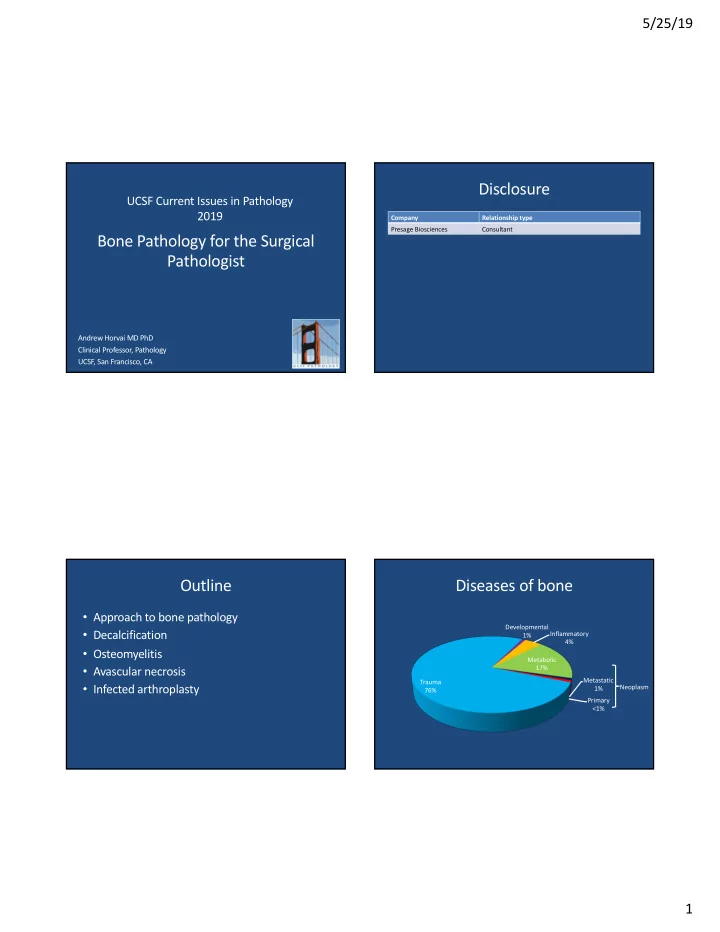
Trauma 76% Developmental 1% Inflammatory 4% Metabolic 17% Metastatic 1% Primary <1% Neoplasm

slide-2
SLIDE 2

5/25/19 2

Clinical Imaging Pathology

Approach to bone diagnosis Approach to bone diagnosis

Clinical Imaging Pathology Clinical Imaging Pathology

Fracture Osteoporosis Metastatic carcinoma Myeloma, lymphoma

Anatomy

epiphysis

metaphysis diaphysis Physis (growth plate) cortex

http://classes.midlandstech.edu

medulla

  • steon

periosteum Haversian canal trabeculae Volkmann canal

Composition

– Osteoid:

  • Collagen (mostly type I)
  • Other proteins

– Mineral

  • Carbonated calcium hydroxylapatite
  • Ca10(PO4)6(OH)2
  • steoid

bone

slide-3
SLIDE 3

5/25/19 3 Decalcification

  • Bone = Protein + Carbonated Calcium hydroxylapatite

[Ca10(PO4)6(OH)2]

  • Calcium crystals in tissue are hard to cut
  • Acid decalcifiers destroy nucleic acids

Product Constituents UCSF use Easy-Cut Formic Acid + HCl Non-neoplastic bone (toes etc.), cortical bone Formical2000 Formic Acid + EDTA Bone biopsy, intramedullary bone tumor Decal-Stat EDTA + HCl Bone marrow IED Formic Acid + HCl + exchange resin Histology Immunocal Formic acid Not used at UCSF EDTA Pure EDTA Not used at UCSF

Sample case

A 16 year old girl with travel to Costa Rica several weeks ago sustained an insect bite on the right leg. This evolved into a presumed septic arthritis which was managed with antibiotics in Costa Rica. She returned to the US with persistent right leg pain and sustained a fracture of the left femur 3 days ago. Imaging revealed a pathologic fracture which was biopsied.

Bone Radiology: Opacity

B

Lytic Sclerotic

slide-4
SLIDE 4

5/25/19 4

Radiology: Border

J J L Circumscribed Marginated Permeative J

Histology: what is “normal”?

lamellar Evenly spaced cement lines Remodeling <20% of surface Marrow: fat and hematopoetic cells only Blue nuclei in lacunae

Always abnormal: woven bone

  • Neoplasms
  • Osteoblastoma
  • Osteosarcoma
  • Inflammatory
  • Osteomyelitis
  • Metabolic/Developmental
  • Osteogenesis Imperfecta
  • Osteopetrosis

Woven Lamellar

Paget disease

Always abnormal: excess cement lines

  • Neoplasms
  • Low-grade osteosarcoma
  • Inflammatory
  • Paget disease
  • Necrosis
slide-5
SLIDE 5

5/25/19 5

Always abnormal: Marrow replaced

Chondrosarcoma

  • Neoplasms
  • Chondrosarcoma
  • Metastasis
  • Hematolymphoid
  • Inflammatory
  • Osteomyelitis
  • Metabolic/Developmental
  • Fibrous dysplasia
  • Xanthomatosis

Hyperparathyroidism

Always abnormal: Excess remodeling

  • Inflammatory
  • Paget disease
  • Chronic osteomyelitis
  • Metabolic/Developmental
  • Hyperparathyroidism
  • Renal osteodystrophy

Empty lacunae

Always* abnormal: Empty lacunae

  • Inflammatory
  • Bone infarct
  • Osteomyelitis
  • Trauma
  • *Normal: interstitial lamellae
  • *Artifact: over-decalcification

Sample case: biopsy

Empty lacunae Marrow replaced

slide-6
SLIDE 6

5/25/19 6

Acute osteomyelitis

  • Clinical: Wide distribution of age and location, often

no pain, or fever; hematogenous or direct.

  • Radiology: Lytic, moth eaten and permeative

– Children: does not cross physis (dual vascular supply) – Infants and adults: can cross physis

  • Histology:

1. Neutrophils 2. dead bone (sequestrum) or unequivocal destruction

  • f bone and/or cartilage (scalloping)

– Optional: New, woven bone (involucrum), bacteria, fungi, chronic inflammation

Sequestrum Involucrum Acute osteomyelitis: sequestrum Acute osteomyelitis Lacunae not empty but destruction of bone and cartilage by neutrophils

slide-7
SLIDE 7

5/25/19 7

Acute osteomyelitis: involucrum

Acute osteomyelitis

  • S. aureus

Polymicrobial Other gram + Other gram - Nonbacterial

Chronic osteomyelitis

  • Clinical: All ages, painless, often no fever

– Progression/reactivation of acute, TB/fungus – Some variants culture negative (CRMO, CNO, SAPHO)

  • Radiology: Lytic -> sclerotic, permeative
  • Histology:

– Very nonspecific, no gold standard – Plasma cells predominate – Sequestrum may persist for months – Involucrum becomes sclerotic (dense, without medullary spaces) – Medullary space may be fibrotic, cellular

  • DDx: Rosai Dorfman (xanthoma + plasma), myeloma,

lymphoma, Langerhans, old bone infarct, nonspecific changes Chronic osteomyelitis

slide-8
SLIDE 8

5/25/19 8

Chronic osteomyelitis Chronic osteomyelitis Chronic osteomyelitis Chronic osteomyelitis

slide-9
SLIDE 9

5/25/19 9

Empty lacunae

  • Osteonecrosis

– Osteomyelitis – Trauma – Avascular necrosis (sterile)

  • Physiologic: interstitial lamellae
  • Artifact: excess decalcification

Avascular necrosis

  • Clinical: Pain with activity then at rest, any age

– Drugs: Glucocorticoids, alcohol, bisphosphonates (?) – Systemic: Hyperbarism, sickle cell, Gaucher – Childhood: Osteochondroses (Legg-Calve-Perthe, Osgood Schlatter, etc.)

  • Radiology:

– Geographic or wedge shaped lucency – Subchondral collapse

  • Histology

– Central: empty lacunae, fat necrosis – Peripheral: Ingrowth of granulation tissue, creeping substitution, calcified rim – Cortex and cartilage usually viable

Bone infarct (avascular necrosis)

Bone infarct

slide-10
SLIDE 10

5/25/19 10

Bone infarct: central Bone infarct Bone infarct: peripheral Bone infarct: creeping substition

slide-11
SLIDE 11

5/25/19 11

Bone infarct: peripheral calcification

Empty lacunae

  • Osteonecrosis

– Acute osteomyelitis – Trauma – Avascular necrosis (sterile)

  • Physiologic: interstitial lamellae
  • Artifact: excess decalcification

Necrosis in interstitial lamellae: not “always” abnormal

Empty lacunae

  • Osteonecrosis

– Acute osteomyelitis – Trauma – Avascular necrosis (sterile)

  • Physiologic: interstitial lamellae
  • Artifact: excess decalcification
slide-12
SLIDE 12

5/25/19 12

Do not overdiagnose over-decalcification as osteonecrosis

Decalcification Osteonecrosis

Do not overdiagnose over-decalcification as osteonecrosis

Decalcification Osteonecrosis

Sample case

  • A 61 year old man with a prior

left hip arthroplasty noted increased pain over 2 months

  • Loosening of the hardware is

noted clinically and radiographically

  • A specimen arrives in the

frozen section lab “rule out infection”

Infected arthroplasty

Early Late

Time <3 months > 24 months Organisms

  • S. Aureus
  • E. Coli

Coag – Staph

  • P. Acnes

Route Direct Hematogenous Clinical Fever ↑ WBC Pain Loosening Instability Pain

  • A “delayed” form (3-24 months) has overlapping

features between Early and Late.

slide-13
SLIDE 13

5/25/19 13

Hardware loosening

  • Aseptic loosening

(85%)

– Wear induced particle debris – Stress shielding (atrophy) – Hardware failure

  • Septic loosening

(15%)

  • Late infection

Immediate replacement Removal Antibiotic cement spacer 6 weeks IV antibiotics

Septic loosening

  • Gold standard: Positive culture from

multiple sites

  • Intraoperative: Neutrophils in capsule,

synovium or granulation tissue

Criterion Sensitivity Specificity Feldman 5 neutrophils/hpf in > 5 hpf* 25% 98% Athanasou 10 neutrophils / 10 hpf 70% 64% *hpf: 400X high power field.

Bori G et al. J Bone Joint Surg 2007 89:1232

PMNs in capsule or granulation tissue :YES

PMNs in fibrin : NO

slide-14
SLIDE 14

5/25/19 14

PMNs in vessels : NO

Common re-do arthroplasty findings

Barium (black flakes) Foam cells

Common re-do arthroplasty findings

Wear debris reaction (polyethylene, Methyl methacrylate, Silastin)

Take home messages

  • Bone lesions require radiographic and clinical

information for accurate diagnosis

  • Woven bone, excess cement lines, marrow

replacement, excess turnover and empty lacunae are (almost) always abnormal

  • Do not mistake over decalcification for
  • steonecrosis
  • Do not count neutrophils in fibrin for septic

loosening