SLIDE 1
2/25/20 1
Class #14: Strings
CS 224 Introduction to Python Spring 2020
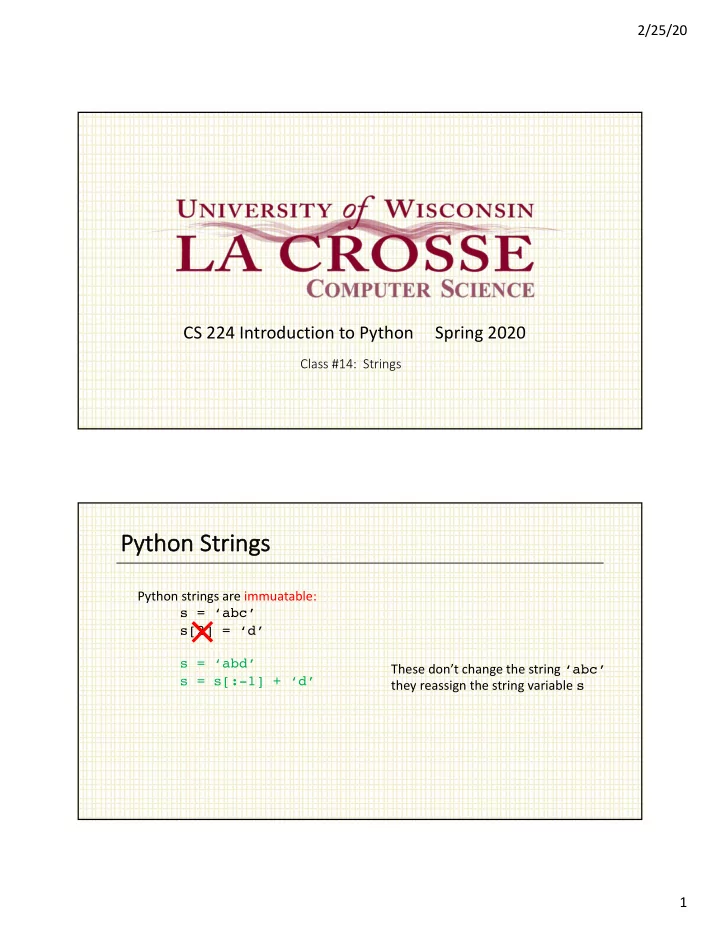
Py Python Strings
Python strings are immuatable: s = ‘abc’ s[2] = ‘d’ s = ‘abd’ s = s[:-1] + ‘d’ These don’t change the string ‘abc’ they reassign the string variable s
SLIDE 2 2/25/20 2
Ac Accessor and Slices
s = ’A diamond necklace played the pawn’ print(s[5]) # prints m print(s[len(s)-1] # prints n print(s[-1]) # prints n print(s[-2]) # prints w print(s[10:18]) # prints necklace t = s[19:] # t is ‘played the pawn’ u = s[:9] # u is ‘A diamond’ print(s[-4:]) # prints pawn v = s[:-16] # v is ‘A diamond necklace’
Me Method
Python provides a broad array of string operations. Because strings are immuatable, the operations do not modify the string. Most methods fall into one of the following categories:
- Return a new string
- Return a Boolean
- Return an int
- Return a tuple or list
SLIDE 3 2/25/20 3
Me Method
that r return rn a a s stri ring
- s.capitalize()
- s.lower()
- s.upper()
- s.join(t)
- s.replace(old, new)
- s.strip()
- s.rstrip()
Up Upper er an and lo lower er cas ase
s.lower() returns an all lower case conversion of s s.upper() returns an all upper case conversion of s s.capitalize() returns s with first character capitalized
SLIDE 4
2/25/20 4
Ex Exampl ples: s: uppe upper and nd lower case se
s = ‘Hand in hand some drummed along’ s.lower() returns ‘hand in hand some drummed along’ s.upper() returns ‘HAND IN HAND SOME DRUMMED ALONG’ s.lower().capitalize() returns ‘Hand in hand some drummed along’ ‘123’.capitalize() returns ‘123’
Jo Join
s.join(t) t is an iterable of strings returns a concatenation of strings in t with string s as a separator
SLIDE 5 2/25/20 5
Ex Exampl ples: s: join
s = ‘ ’ t = [‘this’, ‘is’, ‘a’, ‘test’] s.join(t) # t is an iterable of strings returns ‘this is a test’ ‘,‘.join(t) returns ‘this,is,a,test’ ‘ la ‘.join(t) returns ‘this la is la a la test’
Re Replace
s.replace(old, new)
new is a string returns a string in which occurrences of old have been replaced with new
SLIDE 6
2/25/20 6
Ex Exampl ples: s: repl place
s = ‘this is a test’ s.replace(‘is’, ‘was’) returns ‘thwas was a test’ # unintended consequences s.replace(‘ is’, ‘was’) returns ‘thiswas a test’ # d’oh! s.replace(‘ is’, ‘ was’) returns ‘this was a test’
St Stri rip
s.strip() returns s without leading and trailing whitespace s.rstrip() returns s without trailing whitespace s.strip(t) t is a string returns s without leading and trailing chars in t s.rstrip(t) returns s without trailing chars in t
SLIDE 7
2/25/20 7
Ex Exampl ples: s: strip
s = ‘ Early one mornin the sun was shinin \n’ s.strip() returns ‘Early one mornin the sun was shinin’ s.rstrip() returns ‘ Early one mornin the sun was shinin’
Ex Exampl ples: s: strip
s = ‘de do do do de da da da’ s.strip(‘a’) returns ‘de do do do de da da d’ s.strip(‘ad’) returns ‘e do do do de da da ’ s.rstrip(‘a d’) returns ‘de do do do de’
SLIDE 8 2/25/20 8
Me Method
that r return rn a a Bool Boolean
- s.startswith(prefix)
- s.endswith(suffix)
- s.isalnum()
- s.isalpha()
- s.isdigit()
- s.isupper()
- s.islower()
- s.isspace()
- s.istitle()
Ex Exampl ples: s: st startswith & & ends endswith with
s = ‘She loves you, yeah, yeah, yeah’ s.startswith(‘She lov’) returns True s.startswith(‘she’) returns False s.lower().startswith(‘she’) returns True s.endswith(‘ah, yeah’) returns True
SLIDE 9
2/25/20 9
Ex Exampl ples: s: is isaln alnum, , is isalp alpha, , & is isdig igit it
s = ‘Waiting for the break of day’ t = ’25 or 6 to 4’ u = ‘314159’ s.isalnum() returns True s.isalpha() returns True t.isalnum() returns True
Ex Exampl ples: s: is isaln alnum, , is isalp alpha, , & is isdig igit it
s = ‘Waiting for the break of day’ t = ’25 or 6 to 4’ u = ‘314159’ t.isalpha() returns False t.isdigit() returns False u.isdigit() returns True
SLIDE 10
2/25/20 10
Ex Exampl ples: s: is islo lower er & & is isupper er
s = ‘Waiting for the break of day’ t = ’25 or 6 to 4’ u = ‘314159’ s.islower() returns False t.islower() returns True u.islower() returns False
Ex Exampl ples: s: is islo lower er & & is isupper er
s = ‘Waiting for the break of day’ t = ’25 OR 6 TO 4’ s.isupper() returns False s.upper().isupper() returns True t.isupper() returns True
SLIDE 11 2/25/20 11
Ex Exampl ples: s: is isspac ace & & is istitle title
s = ‘ \t \n’ t = ’Let Him Run Wild’ s.isspace() returns True t.istitle() returns True t.upper().istitle() returns False
Me Method
that r return rn a an in int
- s.count(sub)
- s.find(sub)
- s.rfind(sub)
- s.index(sub)
- s.rindex(sub)
SLIDE 12
2/25/20 12
Cou Count
s.count(sub) sub is a string returns the number of occurrence of sub in s
Ex Exampl ples: s: coun unt
s = ‘de do do do de da da da’ s.count(‘da’) returns 3 s.count(‘da ’) returns 2 s.count(‘do do’) returns 1
SLIDE 13 2/25/20 13
Find Find
s.find(sub) sub is a string returns index of first occurrence of sub in s
s.rfind(sub) sub is a string returns index of last occurrence of sub in s
Ex Exampl ples: s: fi find nd and nd rf rfind
s = ‘De do do do de da da da’ s.find(‘do’) returns 3 s.rfind(‘do’) returns 9 s.find(‘de’) returns 12 s.find(‘Do’) returns -1
SLIDE 14 2/25/20 14
Inde Index
s.index(sub) sub is a string returns index of first occurrence of sub in s
- r gives an error if not found
s.rindex(sub) sub is a string returns index of last occurrence of sub in s
- r gives an error if not found
Ex Exampl ples: s: inde ndex x and nd ri rindex
s = ‘De do do do de da da da’ s.index(‘do’) returns 3 s.rindex(‘do’) returns 9 s.index(‘de’) returns 12 s.index(‘Do’) Crash and burn – should have used find
SLIDE 15 2/25/20 15
Me Method
that r return rn a a t tuple or l
- r list
- s.partition(sep)
- s.rpartition(sep)
- s.split(sep)
- s.rsplit(sep)
- s.splitlines()
Pa Partition
s.partition(sep) first occurrence of sep partitions s returns tuple: (s_up_to_sep, sep, s_after_sep) s.rpartition(sep) last occurrence of sep partitions s returns tuple: (s_up_to_sep, sep, s_after_sep)
SLIDE 16
2/25/20 16
Ex Exampl ples: s: pa partition
s = ‘de do do do de da da da’ s.partition(‘do’) returns (’de ‘, ‘do’, ‘ do do de da da da’) s.rpartition(‘do’) returns (’de do do ‘, ‘do’, ’ de da da da’) s.partition(‘do do do’) returns (‘de ‘, ‘do do do’, ‘ de da da da’) s.rpartition(‘do do do’) returns (‘de ‘, ‘do do do’, ‘ de da da da’)
Ex Exampl ples: s: pa partition
s = ‘Help me Rhonda help help me Rhonda’ s.partition(‘Rhonda’) returns (’Help me ’, ’Rhonda’, ‘ help help me Rhonda’) s.rpartition(‘Rhonda’) returns (’Help me Rhonda help help me ‘, ‘Rhonda’, ‘’)
SLIDE 17
2/25/20 17
Sp Split
s.split(sep [, max]) each occurrence of sep partitions s, up to max times returns list of tokens s.rsplit(sep [, max]) each occurrence of sep partitions s, up to max times returns list of tokens split and rsplit are same unless occurrences > max
Ex Exampl ples: s: spl split
s = ‘de do do do de da da da’ s.split(‘ ’) or s.split() returns [’de‘, ‘do’, ‘do’, ‘do’, ‘de’, ‘da’, ‘da’, ‘da’] s.rsplit(‘ ’) or s.rsplit() returns [’de‘, ‘do’, ‘do’, ‘do’, ‘de’, ‘da’, ‘da’, ‘da’] s.split(‘ ’, 3) returns [‘de‘, ‘do’, ‘do’, ‘do de da da da’) s.rsplit(‘ ‘, 3) returns (‘de do do do de’, ‘da’, ‘da’, ‘da’]
SLIDE 18
2/25/20 18
Ex Exampl ples: s: spl split
s = ’12,657,489,306’ t = ‘de do do do de da da da’ s.split(‘,’) returns [’12’, ‘657’, ‘489’, ‘306’] t.split(‘do’) returns [‘de ‘, ‘ ’, ‘ ’, ‘ de da da da’) s.rsplit(‘do‘, 2) returns (‘de do ‘, ’ ’, ‘ de da da da’]
Sp Splitlines
s.splitlines() splits s at newlines; consumes the newlines returns list of lines
SLIDE 19
2/25/20 19
Ex Exampl ples: s: sp splitlines
s = ‘A diamond necklace played the pawn Hand in hand some drummed along To a handsome man and baton Bygone, bygone’ s.splitlines() returns [‘A diamond necklace played the pawn’, ’Hand in hand some drummed along’, ’To a handsome man and baton’, ‘Bygone, bygone’]