PUTTING IT ALL TOGETHER: CASE STUDIES I have nothing to disclose. - - PowerPoint PPT Presentation

putting it all together case studies
SMART_READER_LITE
LIVE PREVIEW

PUTTING IT ALL TOGETHER: CASE STUDIES I have nothing to disclose. - - PowerPoint PPT Presentation

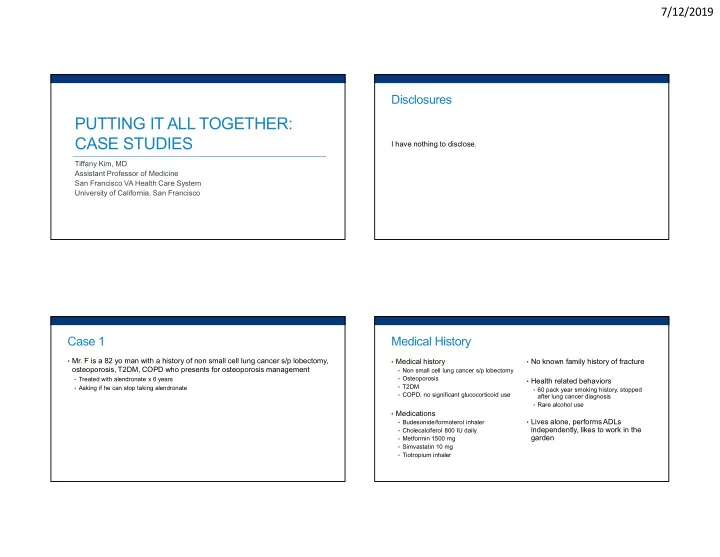
7/12/2019 Disclosures PUTTING IT ALL TOGETHER: CASE STUDIES I have nothing to disclose. Tiffany Kim, MD Assistant Professor of Medicine San Francisco VA Health Care System University of California, San Francisco Case 1 Medical History


slide-1
SLIDE 1

7/12/2019 1

PUTTING IT ALL TOGETHER: CASE STUDIES

Tiffany Kim, MD Assistant Professor of Medicine San Francisco VA Health Care System University of California, San Francisco

Disclosures

I have nothing to disclose.

Case 1

  • Mr. F is a 82 yo man with a history of non small cell lung cancer s/p lobectomy,
  • steoporosis, T2DM, COPD who presents for osteoporosis management
  • Treated with alendronate x 6 years
  • Asking if he can stop taking alendronate

Medical History

  • Medical history
  • Non small cell lung cancer s/p lobectomy
  • Osteoporosis
  • T2DM
  • COPD, no significant glucocorticoid use
  • Medications
  • Budesonide/formoterol inhaler
  • Cholecalciferol 800 IU daily
  • Metformin 1500 mg
  • Simvastatin 10 mg
  • Tiotropium inhaler
  • No known family history of fracture
  • Health related behaviors
  • 60 pack year smoking history, stopped

after lung cancer diagnosis

  • Rare alcohol use
  • Lives alone, performs ADLs

independently, likes to work in the garden

slide-2
SLIDE 2

7/12/2019 2 Baseline Evaluation

  • No prior fractures
  • PE: 5’ 6”, 155 lb, BMI 25, poor dentition
  • Hip x-ray for groin pain in 2010 concern for osteopenic/osteoporotic bones
  • Baseline DXA (2010)
  • L spine
  • 3.2
  • Fem. neck -3.2
  • Total hip
  • 2.8
  • 25(OH) vitamin D: 22 ng/ml  repleted
  • Otherwise unremarkable

Interim Data: Part I

  • Treated with alendronate for 6 years (2010-2016)
  • No interval fractures

2010 2016 L spine

  • 3.2
  • 2.2

Fem neck

  • 3.2
  • 2.9

Total hip

  • 1.8
  • 2.1

+14.9% increase since 2010 No sig. change since 2010

Endocrine E-consult

  • “80 yo man with osteoporosis on alendronate for 6 years, patient wants to

reduce pill burden… would appreciate guidance on recommendations for therapy”

  • Recommendation: Given high risk, consider continuing therapy

Approach to Long Term Bisphosphonate Management

Adler, JBMR 2015 High fracture risk: age >70-75, other strong risks for fracture, or FRAX score above country-specific threshold

slide-3
SLIDE 3

7/12/2019 3 Interim Data: Part II

  • Patient chose to stop alendronate
  • 2017: Worsening back pain, found to have acute L4 compression fracture,

chronic compression fractures of T12 and L3 on MRI

  • Endocrine e-consult recommends IV zoledronic acid or denosumab
  • Patient declines
  • 2019: Right sided chest pain, no trauma, found to have subacute rib fractures
  • 2019: Endocrine clinic consult, recommend dental evaluation and then IV

zoledronic acid (patient declined teriparatide)

Unfortunately, patient sustained a left intertrochanteric hip fracture

Conclusion: patient is scheduled for follow up, willing to re-initiate therapy

Case 1 Summary

  • Certain patients may need >5 years of alendronate
  • High risk
  • Hip BMD T-score ≤ -2.5
  • End the drug holiday and re-initiate therapy if the patient develops fractures

Case 2

  • Mr. C is a 61 yo man with a history of HIV, osteoporosis, hypogonadism,

GERD

  • Has been on alendronate from 2006 to 2018 (12 years)
  • 2 recent metatarsal fractures in his right foot
slide-4
SLIDE 4

7/12/2019 4 Medical History

  • Medical history
  • HIV: diagnosed 1989, h/o tenofovir use
  • Osteoporosis
  • Hypogonadism
  • GERD
  • Cervical spinal stenosis
  • Medications
  • Lamivudine, ritonavir, darunavir,

dolutegravir

  • Testosterone 1.62% gel, 1 pump/day
  • Omeprazole 20 mg
  • Ca carbonate 500mg/Vit D 200 IU BID
  • Ibuprofen prn
  • No known family history of fracture
  • Health related behaviors:
  • Remote smoker for 5 years, occasional

glass of wine

  • Walks 4x/week, no strenuous exercise

Baseline Evaluation

  • Fractures: broke a finger in his 20’s when playing baseball
  • PE: 5”10”, 160 lb, BMI 23
  • Baseline DXA (screening in 2006)
  • L spine
  • 2.5
  • Fem. neck -2.4
  • Total hip
  • 2.4
  • 25(OH) vitamin D: 22 ng/ml  repleted
  • Otherwise unremarkable

Interim Data

  • Interval fractures
  • 2011: left humerus s/p fall
  • 2016: right wrist s/p fall
  • 2018: 2 right stress foot fractures (3rd and 5th metatarsals), minimal trauma
  • 25(OH) vitamin D: 44 ng/ml
  • Otherwise unremarkable

Why is he fracturing?

  • Poor adherence?
  • Treatment failure?
  • High risk patient?

How would you approach this? What would be your next steps?

slide-5
SLIDE 5

7/12/2019 5

Treatment Failure – International Osteoporosis Foundation (IOF)

  • Review adherence
  • Search for occult secondary causes of osteoporosis
  • Consider treatment change if:
  • Two or more incident fragility fractures
  • One incident fracture AND significant BMD decline OR no bone turnover marker response
  • Significant BMD decline + no bone turnover markers response

Diez-Perez, Osteoporos Int 2012

Treatment Failure Considerations (IOF)

  • Fractures of the hand, skull, digits, feet and ankle: not fragility fractures
  • Significant BMD decline:
  • >5% at the lumbar spine
  • >4% at the proximal femur
  • Significant bone turnover response:
  • >25% decline for anti-resorptive treatments
  • If baseline levels unknown: level below the average value of young healthy adults
  • Falls are an important driver of fracture

Diez-Perez, Osteoporos Int 2012

Case 2

  • Review adherence  intermittently took ALN from 2006-2011
  • Search for occult secondary causes of osteoporosis  none identified
  • Consider treatment change if:
  • Two or more incident fragility fractures
  • One incident fracture AND significant BMD decline OR no bone turnover marker response
  • Significant BMD decline + no bone turnover markers response

A closer look at the fractures

  • Interval fractures
  • 2011: left humerus s/p fall
  • Patient not adherent during this time?
  • 2016: right wrist s/p fall
  • Fragility fracture
  • 2018: 2 right stress foot fractures (3rd metatarsal, 5th metatarsal), minimal trauma
  • Foot fractures may not be fragility fractures
slide-6
SLIDE 6

7/12/2019 6

No decline in BMD, bone turnover markers suppressed

2006 2010 2012 2014 2016 2018 L spine

  • 2.5
  • 2.0
  • 1.5
  • 0.9
  • 0.9
  • 1.1

Fem neck

  • 2.4
  • 2.4
  • 2.2
  • 2.1
  • 2.0
  • 2.0

Total hip

  • 2.4
  • 2.3
  • 2.2
  • 1.9
  • 2.0
  • 1.9
  • CT BMD Lumbar Spine: 104.1 mg/cc  osteopenia
  • CTX (bone resorption marker): 73 L (87 – 345 mcg/l)
  • PINP (bone formation marker): 10 L (30 – 110 pg/ml)

Spontaneous fracture and suppression of bone turnover related to long term alendronate use?

Odvina, JCEM 2005

Case 2

  • Review adherence  Intermittently took ALN from 2006-2011
  • Search for occult secondary causes of osteoporosis  None identified
  • Consider treatment change if:
  • Two or more incident fragility fractures  Maybe not
  • One incident fracture AND significant BMD decline OR no bone turnover marker response No
  • Significant BMD decline + no bone turnover markers response  No

Should this patient go on a drug holiday?

?

Conclusion: Decided to start drug holiday

slide-7
SLIDE 7

7/12/2019 7 Case 2: Summary

  • Considerations for treatment failure:
  • Assess adherence
  • Assess occult secondary causes of osteoporosis
  • Consider fractures, BMD response or bone turnover markers
  • Fractures on therapy may be due to poor adherence or over-suppression of

bone turnover (uncommon)

Case 3

  • Ms. P is a 62 yo woman with h/o acute myeloid leukemia s/p chemotherapy,

radiation and bone marrow transplant, abdominal desmoid tumor complicated by small bowel obstruction, osteoporosis, osteoarthritis

  • Medical history
  • Remote acute myeloid leukemia s/p chemotherapy, radiation, and bone marrow transplant
  • Menopause at age 47 due to chemotherapy
  • Abdominal desmoid tumor complicated by small bowel obstruction and ileal resection
  • Osteoporosis
  • Osteoarthritis, h/o steroid injections into hands/shoulders for 3-4 years

Medical History

  • Medications
  • Calcium 500mg/Vitamin D 200 IU

BID

  • Lidocaine patch
  • Meloxicam prn
  • Family history: Mother had a

hip fracture at age 60

  • Health related behaviors:
  • Never smoker, 2 drinks/month
  • Some gardening and lifting

Initial Evaluation

  • Fracture history: Fractured ulna after falling from bike at age 28
  • PE: 5’5”, 145 lb, BMI 24
  • Baseline DXA (2009, age 53) given chemical menopause and +family history
  • L spine:
  • 1.8
  • Fem neck: -2.7
  • Total hip:
  • 2.1
  • 25(OH) vitamin D: 28 ng/ml
slide-8
SLIDE 8

7/12/2019 8 Interim Data: Part I

  • Treated with alendronate for 5 years (2009-2014)
  • 2014: Stubbed toe against furniture  3rd proximal phalangeal fracture

2009 2014 L spine

  • 1.8
  • 2.2

Fem neck

  • 2.7
  • 3.0

Total hip

  • 2.1
  • 2.3
  • 4.9% decrease since 2009
  • 3.9% decrease since 2009

Case 3

  • Review adherence  Only picked up 6 prescriptions in 5 years
  • Search for occult secondary causes of osteoporosis
  • Consider treatment change if:
  • Two or more incident fragility fractures
  • One incident fracture AND significant BMD decline OR no bone turnover marker response
  • Significant BMD decline + no bone turnover markers response
  • Switched to IV zoledronic acid for improved compliance

Interim Data: Part II

  • Treated with IV zoledronic acid for 3 years (2015, 2016, 2017)
  • No interval fractures
  • CTX: 136 (40 – 465 pg/ml)
  • 25(OH) vitamin D: 28 ng/ml
  • 24 hour urine calcium: 174 mg/dl

2009 2014 2018 L spine

  • 1.8
  • 2.2
  • 1.7

Fem neck

  • 2.7
  • 3.0
  • 3.1

Total hip

  • 2.1
  • 2.3
  • 2.4

+6% increase since 2014 No sig. change since 2014

Case 3

  • Review adherence  Received yearly infusions
  • Search for occult secondary causes of osteoporosis  None identified
  • Consider treatment change if:
  • Two or more incident fragility fractures  No
  • One incident fracture AND significant BMD decline OR no bone turnover marker response No
  • Significant BMD decline + no bone turnover markers response  No

Patient did not fail but did not get a good response, what would you do?

slide-9
SLIDE 9

7/12/2019 9 Interim Data: Part III

  • Will likely require many years of antiresorptive therapy, anabolic therapy

contraindicated given h/o skeletal radiation, she is in early 60’s

  • Plan 1 year drug holiday and then start denosumab
  • No interval fractures
  • Start denosumab in March 2019

2009 2014 2018 2019 L spine

  • 1.8
  • 2.2
  • 1.7
  • 2.0

Fem neck

  • 2.7
  • 3.0
  • 3.1
  • 3.1

Total hip

  • 2.1
  • 2.3
  • 2.4
  • 2.6
  • 3.9% decrease since 2018

No sig. change since 2018

Interim Data: Part IV

  • S/p denosumab x 1
  • Interval fractures within 2-3 months
  • Tripped and fell on right shoulder: Nondisplaced fracture of the distal clavicle
  • Traveling, felt ankle give way, fell: Tri-malleolar ankle fracture
  • Considerations:
  • Ankle fracture may not be a fragility fracture
  • Too soon to determine if failed denosumab (<6 months)
  • Treatments reduce fracture risk: not eliminated
  • Conclusion: scheduled for f/u, likely continue DMAB, optimize lifestyle factors

Case 3 Summary

  • Assess compliance, consider IV therapy
  • Difficult to infer fractures within 6 months are due to treatment failure
  • Therapy reduces but does not eliminate the risk of fracture

Summary

  • Limited data on long-term management, mostly expert opinion
  • Drug holidays:
  • Consider fractures, risk factors, hip BMD T-score
  • Drug holidays are not permanent, reassess need for re-treatment
  • Treatment failure considerations:
  • Assess adherence
  • Assess occult secondary causes of osteoporosis
  • Consider fractures, BMD response or bone turnover markers