Public Key Infrastructure e-government, e-commerce, e-mail, etc.) - - PowerPoint PPT Presentation

public key infrastructure
SMART_READER_LITE
LIVE PREVIEW

Public Key Infrastructure e-government, e-commerce, e-mail, etc.) - - PowerPoint PPT Presentation

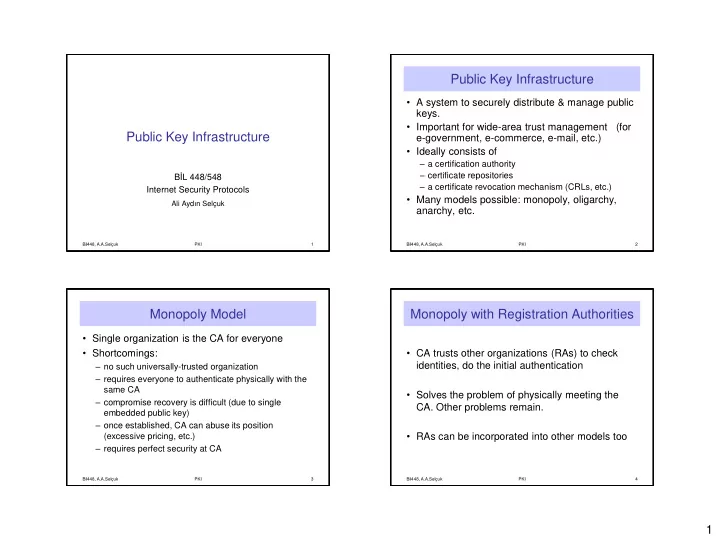
Public Key Infrastructure A system to securely distribute & manage public keys. Important for wide-area trust management (for Public Key Infrastructure e-government, e-commerce, e-mail, etc.) Ideally consists of a


slide-1
SLIDE 1

1

Bil448, A.A.Selçuk PKI 1

Public Key Infrastructure

BİL 448/548 Internet Security Protocols

Ali Aydın Selçuk

Public Key Infrastructure

  • A system to securely distribute & manage public

keys.

  • Important for wide-area trust management (for

e-government, e-commerce, e-mail, etc.)

  • Ideally consists of

– a certification authority – certificate repositories – a certificate revocation mechanism (CRLs, etc.)

  • Many models possible: monopoly, oligarchy,

anarchy, etc.

Bil448, A.A.Selçuk PKI 2

Monopoly Model

  • Single organization is the CA for everyone
  • Shortcomings:

– no such universally-trusted organization – requires everyone to authenticate physically with the same CA – compromise recovery is difficult (due to single embedded public key) – once established, CA can abuse its position (excessive pricing, etc.) – requires perfect security at CA

Bil448, A.A.Selçuk PKI 3

Monopoly with Registration Authorities

  • CA trusts other organizations (RAs) to check

identities, do the initial authentication

  • Solves the problem of physically meeting the
  • CA. Other problems remain.
  • RAs can be incorporated into other models too

Bil448, A.A.Selçuk PKI 4

slide-2
SLIDE 2

2

Delegated CAs

  • Root CA certifies lower-level CAs to certify
  • thers
  • All verifiers trust the root CA & verify certificate

chains beginning at the root (i.e., the root CA is the trust anchor of all verifiers)

  • E.g., a national PKI, where a root CA certifies

institutions, ISPs, universities who in turn certify their members

  • Limitations are similar to monopoly with RAs

Bil448, A.A.Selçuk PKI 5

Oligarchy

  • Many root CAs exists trusted by verifiers
  • The model of web security
  • Solves the problems of single authority (e.g.,

excessive pricing)

  • Disadvantages:

– n security-sensitive sites instead of one. Compromise

  • f any one compromises the whole system

– users can easily be tricked into trusting fake CAs. (depending on implementation)

Bil448, A.A.Selçuk PKI 6

Anarchy

  • Each user decides whom to trust & how to

authenticate their public keys

  • Certificates issued by arbitrary parties can be

stored in public databases, which can be searched to find a path of trust to a desired party

  • Works well for informal, not-so-sensitive

applications (e.g., PGP)

Bil448, A.A.Selçuk PKI 7

Revocation

  • Mechanisms to cancel certificates compromised

before expiration

  • Certificate Revocation List (CRL): list of revoked

certificates, published periodically by the CA

  • Delta CRLs: Only the changes since the last

issue are published

  • Online Revocation Servers: No CRL is
  • published. Verifier queries a central server to

check if a certificate has been revoked.

Bil448, A.A.Selçuk PKI 8

slide-3
SLIDE 3

3

Finding Certificate Chains

  • Can be sent by the subject sending its public

key to the verifier (e.g., SSL)

  • A directory naming structure can be followed

(e.g., LDAP, DNSsec)

Bil448, A.A.Selçuk PKI 9

X.509 Certificates

  • Common standard for certificate format
  • PKIX: Internet standard for X.509-based PKI
  • Fields (X.509 v3):

– version – serial number – signature algorithm identifier – issuer – validity period – subject – subject public key information – signature – standard extensions (key usage limitation, etc.) – other extensions (application & CA specific)

Bil448, A.A.Selçuk PKI 10