The public key setting Bobs secret key is sk [ B ] and its associated - - PowerPoint PPT Presentation

the public key setting
SMART_READER_LITE
LIVE PREVIEW

The public key setting Bobs secret key is sk [ B ] and its associated - - PowerPoint PPT Presentation

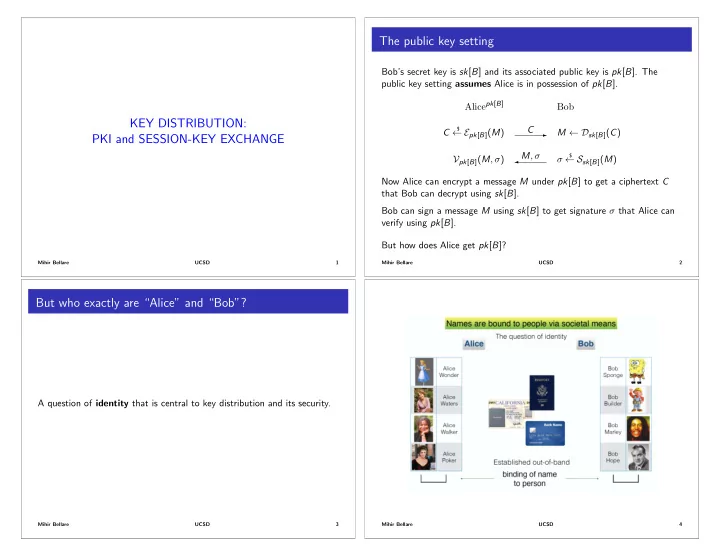
The public key setting Bobs secret key is sk [ B ] and its associated public key is pk [ B ]. The public key setting assumes Alice is in possession of pk [ B ]. Alice pk [ B ] Bob KEY DISTRIBUTION: C - $ E pk [ B ] ( M ) M D sk [ B ] ( C ) C


slide-1
SLIDE 1

KEY DISTRIBUTION: PKI and SESSION-KEY EXCHANGE

Mihir Bellare UCSD 1

The public key setting

Bob’s secret key is sk[B] and its associated public key is pk[B]. The public key setting assumes Alice is in possession of pk[B]. Alicepk[B] Bob C

$

Epk[B](M) C - M Dsk[B](C) Vpk[B](M, σ) M, σ

  • σ

$

Ssk[B](M) Now Alice can encrypt a message M under pk[B] to get a ciphertext C that Bob can decrypt using sk[B]. Bob can sign a message M using sk[B] to get signature σ that Alice can verify using pk[B]. But how does Alice get pk[B]?

Mihir Bellare UCSD 2

But who exactly are “Alice” and “Bob”?

A question of identity that is central to key distribution and its security.

Mihir Bellare UCSD 3 Mihir Bellare UCSD 4

slide-2
SLIDE 2

In TLS, Bob is a server

Mihir Bellare UCSD 5

In TLS, Alice is a client

Alice’s identity could be her ip address or domain name. Alice need not be an individual; she could be a corporation, a server herself, ...

Mihir Bellare UCSD 6

How can Alice get Bob’s public key?

A simple idea: Bob generates his keys, and just sends pk[B] to Alice with his identity “Bob” attached. Alice Bob Bob, pk[B]

  • (pk[B], sk[B])

$

K This enables: C

$

Epk[B](M) C - M Dsk[B](C) Vpk[B](M, σ) M, σ

  • σ

$

Ssk[B](M)

Mihir Bellare UCSD 7

Entity-in-the-middle attack

Alice Adversary A Bob, pk[A]

  • (pk[A], sk[A])

$

K So: C

$

Epk[A](M) C - M Dsk[A](C) Vpk[A](M, σ) M, σ

  • σ

$

Ssk[A](M) Adversary can decrypt ciphertexts intended for Bob. Adversary can forge Bob’s signatures.

Mihir Bellare UCSD 8

slide-3
SLIDE 3

PKI, CAs and certificates

Goal: Alice gets an authentic copy of Bob’s public key, meaning if pk claims to come from Bob, she has proof to that effect. Popular Solution: The PKI (Public Key Infrastructure). Certificate authority: Trusted entity that provides the above proof. Certificate: The proof Note: There are other ways to reach the goal: Bob could post his public key on his Facebook; post it on his personal or corporate webpage; include it as an attachment in his emails; put it on a keyserver like openpgp SGS; hand it to Alice in person; ...

Mihir Bellare UCSD 9

Let’s Encrypt

Mihir Bellare UCSD 10

Let’s Encrypt

Mihir Bellare UCSD 11

Some certificate authorities

Mihir Bellare UCSD 12

slide-4
SLIDE 4

Certificate process

  • Bob generates sk and pk by locally running key-generation
  • Bob sends his identity and pk to CA
  • CA does identity check to ensure pk is Bob’s
  • Bob proves knowledge of sk to CA
  • CA issues certificate to Bob
  • Bob sends certificate to Alice
  • Alice verifies certificate and extracts Bob’s public key pk

Mihir Bellare UCSD 13

Key generation

Bob locally runs a prescribed key-generation algorithm to generate his keys: (pk, sk)

$

K

Mihir Bellare UCSD 14

Key generation example: RSA Key generation with

  • penssl

Mihir Bellare UCSD 15

Key generation Example: EC Key generation with openssl

Mihir Bellare UCSD 16

slide-5
SLIDE 5

Key generation Example: On-line key generation tools

Mihir Bellare UCSD 17

Checks

Bob sends his identity Bob (domain name, ip address, email address, ...) and his public key pk to the certificate authority (CA). Upon receiving (Bob, pk) the CA performs some checks to ensure pk is really Bob’s key. Example: If Bob is a domain name, then the CA sends Bob a challenge and checks that he can put it on the webpage of the domain name. Example: If Bob is an email address, then the CA sends an email to that address with a link for Bob to click to verify that he owns the address. Example: If Bob is a passport or driver’s license, the CA may be able to verify it physically, out of band. Proof of knowledge of secret key: The CA might have Bob sign or decrypt something under pk to ensure that Bob knows the corresponding secret key sk. This ensures Bob has not copied someone else’s key.

Mihir Bellare UCSD 18

Certificate Issuance

Once CA is convinced that pk belongs to Bob, it forms a certificate CERTBob = (CERTDATA, σ), where σ is the CA’s signature on CERTDATA, computed under the CA’s secret key sk[CA], and CERTDATA contains:

  • Bob’s public key pk, and its type (RSA, EC, ...)
  • Identity Bob of Bob
  • Name of CA
  • Expiry date of certificate
  • ...

The certificate CERTBob is returned to Bob.

Mihir Bellare UCSD 19

Certificate usage

Bob can send CERTBob to Alice who is assumed to have the CA’s public key pk[CA] and now will:

  • Parse it as (CERTDATA, σ) CERTBob
  • Check that Vpk[CA](CERTDATA, σ) = 1
  • Extract (pk, Bob, expiry, . . .) CERTDATA
  • Check certificate has not expired
  • . . .

If all is well, Alice accepts the certificate and is ready to use the public key pk therein. How does Bob get pk[CA]? CA public keys are embedded in software such as your browser.

Mihir Bellare UCSD 20

slide-6
SLIDE 6

Certificate hierarchies

Mihir . . . . . . . . . . . . . . . . . . . . . . . . . . . . . . . . . . . . . . . . . . . . . . . . . . . . . . . . . . . . . . . . . . . . . . . . . . . . . . . . . . . . . . . . . . . . . . . . . . . .

ZZ

CA(Calif) CA(SD) CA(Mass) CA(USA) CA(UCSD)

⇢ ⇢

CERTMihir CERT[CA(USA) : CA(Calif )] CERT[CA(Calif ) : CA(SD)] CERT[CA(SD) : CA(UCSD)] CERT[CA(UCSD) : Mihir] CERT[X : Y ] = (pk[Y ], Y , . . . , Ssk[X](pk[Y ], Y , . . .)) To verify CERTMihir you need only pkCA[USA].

Mihir Bellare UCSD 21

Why certificate hierarchies?

  • It is easier for CA(UCSD) to check Mihir’s identity (and issue a

certificate) than for CA(USA) since Mihir is on UCSD’s payroll and UCSD already has a lot of information about him.

  • Spreads the identity-check and certification job to reduce work for

individual CAs

  • Browsers need to have fewer embedded public keys. (Only root CA

public keys needed.)

Mihir Bellare UCSD 22

Certificates on Mac: keychain

Mihir Bellare UCSD 23

A particular certificate

Mihir Bellare UCSD 24

slide-7
SLIDE 7

Revocation

Suppose Bob wishes to revoke his certificate CERTBob, perhaps because his secret key was compromised.

  • Bob sends CERTBob and revocation request to CA
  • CA checks that request comes from Bob
  • CA puts (CERTBob, Revocation date) on its Certificate Revocation

List (CRL)

  • This list is disseminated.

Before Alice accepts Bob’s certificate she should check that it is not on the CRL. The OCSP (Online Certificate Status Protocol) is one-way to do this.

Mihir Bellare UCSD 25

Revocation Issues

  • November 22: Bob’s secret key compromised
  • November 24: Bob’s CERTBob revoked
  • November 25: Alice sees CRL

In the period Nov. 22-25, CERTBob might be used and Alice might be accepting as authentic signatures that are really the adversary’s. Also Alice might be encrypting data for Bob which the adversary can decrypt. In practice, CRLs are large and revocation is a problem.

Mihir Bellare UCSD 26

Certificate transparency

Mihir Bellare UCSD 27

Dissemination of public key via server

Mihir Bellare UCSD 28

slide-8
SLIDE 8

Search on SGS key-server

Mihir Bellare UCSD 29

Shared key setting

AliceK BobK M DK(C) C

  • C

$

EK(M) σ

$

TK(M) M, σ

  • VK(M, σ)

Alice and Bob can

  • send each other encrypted data
  • verify each other’s MACs

Can be preferable to public key setting because computation costs are lower. But how do Alice and Bob get a shared key?

Mihir Bellare UCSD 30

Diffie-Hellman Key Exchange

Let G = hgi be a cyclic group of order m and assume G, g, m are public quantities. Alice Bob x

$

Zm; X gx Alice, X

  • K Y x

Bob, Y

  • y

$

Zm; Y gy K X y Y x = (gy)x = gxy |{z}

K

= (gx)y = X y This enables Alice and Bob to agree on a common key K which can subsequently be used, say to encrypt: Alice Bob M DK(C) C

  • C

$

EK(M)

Mihir Bellare UCSD 31

Security of DH Key Exchange under Passive Attack

Alice Bob x

$

Zm; X gx Alice, X

  • K Y x

Bob, Y

  • y

$

Zm; Y gy K X y Eavesdropping adversary gets X = gx and Y = gy and wants to compute

  • gxy. But this is the (presumed hard) CDH problem.

Conclusion: DH key exchange is secure against passive (eavesdropping) attack.

Mihir Bellare UCSD 32

slide-9
SLIDE 9

Security of DH Key Exchange under Active Attack

Entity-in-the-middle attack: E Bob x

$

Zm; X gx Alice, X

  • K Y x

Bob, Y

  • y

$

Zm; Y gy K X y M DK(C) C

  • C

$

EK(M) Adversary E impersonates Alice so that:

  • Bob thinks he shares K with Alice but E has K
  • E can now decrypt ciphertexts Bob intends for Alice

Conclusion: DH key exchange is insecure against active attack

Mihir Bellare UCSD 33

When is key agreement possible?

In the presence of an active adversary, it is impossible for Alice and Bob to

  • start from scratch, and
  • exchange messages to get a common key unknown to the adversary

Why? Because there is no way for Bob to distinguish Alice from the adversary. Alice and Bob need some a priori “information advantage” over the

  • adversary. This typically takes the form of long-lived keys.

Mihir Bellare UCSD 34

Settings and long-lived keys

  • Public key setting: A has pkB and B has pkA
  • Symmetric setting: A, B share a key K
  • Three party setting: A, B each share a key with a trusted server S.

These keys constitute the long-lived information.

Mihir Bellare UCSD 35

Session keys: The “real” key distribution problem

In practice, Alice and Bob will engage in multiple communication “sessions.” For each, they

  • First use a session-key distribution protocol, based on their long-lived

keys, to get a fresh, authentic session key;

  • Then encrypt or authenticate data under this session key for the

duration of the session Why session keys?

  • In public-key setting, efficient cryptography compared to direct use of

long-lived keys

  • Security attributes, in particular enabling different applications to use

keys in different ways and not compromise security of other applications

Mihir Bellare UCSD 36

slide-10
SLIDE 10

Session key distribution

  • Hundreds of protocols
  • Dozens of security requirements
  • Lots of broken protocols
  • Protocols easy to specify and hard to get right
  • Used ubiquitously: SSL, TLS, SSH, ...

Mihir Bellare UCSD 37

Session key exchange in public key setting

Apk[B] Bpk[A]

  • K

@ @ R

K Most important type of session key exchange in practice, used in all communication security protocols: SSL, SSH, TLS, IPSEC, 802.11, ...

Mihir Bellare UCSD 38

Protocol KE1: Basic Exchange

Apk[B] Bpk[A] A, RA

  • RB, C, B, SignB(A, B, RA, RB, C)
  • C

$

EA(K) A, SignA(A, B, RA, RB)

  • Session key K is chosen by B.

RA, RB are random nonces. SignP(M) is P’s signature of M under sk[P]. It is verifiable given pk[P]. EA(·) is encryption under A’s public key pk[A], decryptable using sk[A].

Mihir Bellare UCSD 39

Beyond KE2

Modern session key exchange protocols enhance KE2 to incorporate many

  • ther security features including
  • Forward security: Exposure of long-lived secret keys should not

compromise PRIOR session keys

  • Anonymity: Eavesdropper cannot figure out identity (public key) of

client authenticating to some server.

Mihir Bellare UCSD 40

slide-11
SLIDE 11

Passwords

A password is a human-memorizable key. Attackers are capable of forming a set D of possible passwords called a dictionary such that

  • If the target password pw is in D and
  • The attacker knows pw = f (pw), the image of pw under some public

function f §. then the target password can be found via for all pw0 2 D do if f (pw0) = pw then return pw0 This is called a dictionary attack.

Mihir Bellare UCSD 41

Password usage

Fact is that in spite of all the great crypto around, a significant fraction of

  • ur security today resides in passwords: bank ATM passwords; login

passwords; passwords for different websites; ... Few of us today have cryptographic keys; but we all have more passwords than we can remember! Passwords are convenient and entrenched. Preventing dictionary attacks is an important concern.

Mihir Bellare UCSD 42

Preventing dictionary attacks: Password selection

Systems try to force users to select “good” passwords, meaning ones not in the dictionary. But studies show that a significant fraction of user passwords end up being in the dictionary anyway. Attackers get better and better at building dictionaries. Good password selection helps, but it is unrealistic to think that even the bulk of passwords are well selected, meaning not in the dictionary.

Mihir Bellare UCSD 43

Popular passwords

In 2016, the 25 most common passwords made up more than 10% of surveyed passwords, with the most common making up 4%.

Mihir Bellare UCSD 44

slide-12
SLIDE 12

Preventing dictionary attacks: avoiding image revelation

An alternative approach is to ensure that usage of a password pw never reveals an image pw = f (pw) of pw under a public function f . Then, even if the password is in the dictionary, the dictionary attack cannot be mounted. Password-based session-key exchange:

  • A, B share a password pw.
  • They want to interact to get a common session key.
  • The protocol should resist dictionary attack: adversary should be

unable to obtain an image of pw under a public function.

Mihir Bellare UCSD 45