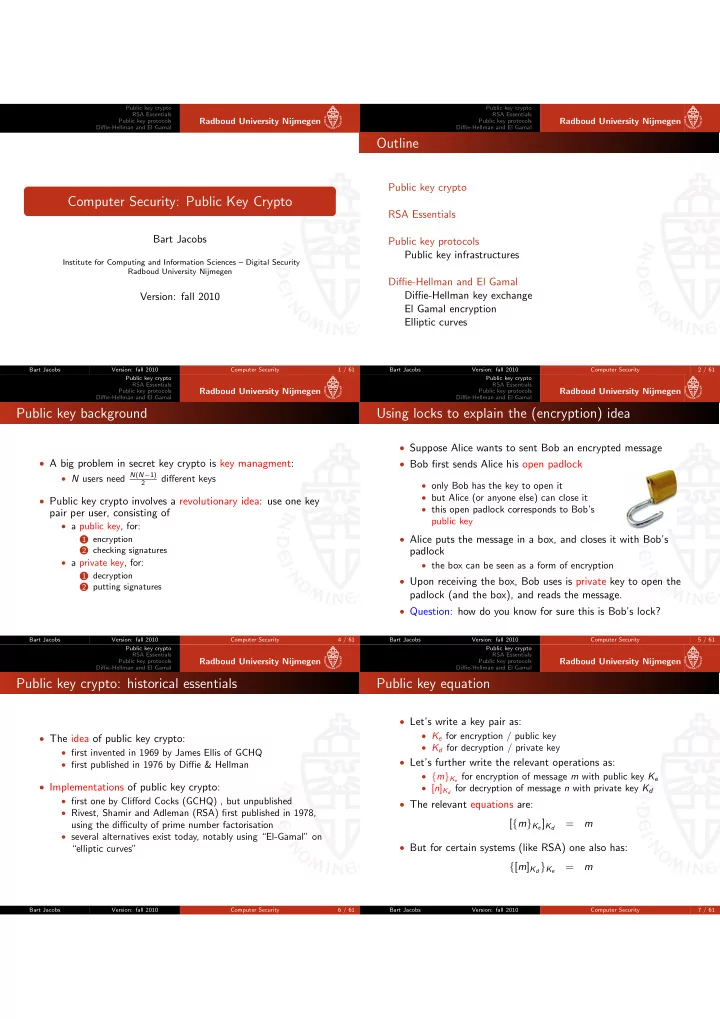
Outline Public key crypto Computer Security: Public Key Crypto RSA - - PDF document

outline
SMART_READER_LITE
LIVE PREVIEW

Outline Public key crypto Computer Security: Public Key Crypto RSA - - PDF document

Public key crypto Public key crypto RSA Essentials RSA Essentials Public key protocols Radboud University Nijmegen Public key protocols Radboud University Nijmegen Diffie-Hellman and El Gamal Diffie-Hellman and El Gamal Outline Public key


slide-1
SLIDE 1

Public key crypto RSA Essentials Public key protocols Diffie-Hellman and El Gamal

Radboud University Nijmegen

Computer Security: Public Key Crypto

Bart Jacobs

Institute for Computing and Information Sciences – Digital Security Radboud University Nijmegen

Version: fall 2010

Bart Jacobs Version: fall 2010 Computer Security 1 / 61 Public key crypto RSA Essentials Public key protocols Diffie-Hellman and El Gamal

Radboud University Nijmegen

Outline

Public key crypto RSA Essentials Public key protocols Public key infrastructures Diffie-Hellman and El Gamal Diffie-Hellman key exchange El Gamal encryption Elliptic curves

Bart Jacobs Version: fall 2010 Computer Security 2 / 61 Public key crypto RSA Essentials Public key protocols Diffie-Hellman and El Gamal

Radboud University Nijmegen

Public key background

  • A big problem in secret key crypto is key managment:
  • N users need N(N−1)

2

different keys

  • Public key crypto involves a revolutionary idea: use one key

pair per user, consisting of

  • a public key, for:

1 encryption 2 checking signatures

  • a private key, for:

1 decryption 2 putting signatures

Bart Jacobs Version: fall 2010 Computer Security 4 / 61 Public key crypto RSA Essentials Public key protocols Diffie-Hellman and El Gamal

Radboud University Nijmegen

Using locks to explain the (encryption) idea

  • Suppose Alice wants to sent Bob an encrypted message
  • Bob first sends Alice his open padlock
  • only Bob has the key to open it
  • but Alice (or anyone else) can close it
  • this open padlock corresponds to Bob’s

public key

  • Alice puts the message in a box, and closes it with Bob’s

padlock

  • the box can be seen as a form of encryption
  • Upon receiving the box, Bob uses is private key to open the

padlock (and the box), and reads the message.

  • Question: how do you know for sure this is Bob’s lock?

Bart Jacobs Version: fall 2010 Computer Security 5 / 61 Public key crypto RSA Essentials Public key protocols Diffie-Hellman and El Gamal

Radboud University Nijmegen

Public key crypto: historical essentials

  • The idea of public key crypto:
  • first invented in 1969 by James Ellis of GCHQ
  • first published in 1976 by Diffie & Hellman
  • Implementations of public key crypto:
  • first one by Clifford Cocks (GCHQ) , but unpublished
  • Rivest, Shamir and Adleman (RSA) first published in 1978,

using the difficulty of prime number factorisation

  • several alternatives exist today, notably using “El-Gamal” on

“elliptic curves”

Bart Jacobs Version: fall 2010 Computer Security 6 / 61 Public key crypto RSA Essentials Public key protocols Diffie-Hellman and El Gamal

Radboud University Nijmegen

Public key equation

  • Let’s write a key pair as:
  • Ke for encryption / public key
  • Kd for decryption / private key
  • Let’s further write the relevant operations as:
  • {m}Ke for encryption of message m with public key Ke
  • [n]Kd for decryption of message n with private key Kd
  • The relevant equations are:

[{m}Ke]Kd = m

  • But for certain systems (like RSA) one also has:

{[m]Kd}Ke = m

Bart Jacobs Version: fall 2010 Computer Security 7 / 61

slide-2
SLIDE 2

Public key crypto RSA Essentials Public key protocols Diffie-Hellman and El Gamal

Radboud University Nijmegen

Number theoretic ingredients I

  • Recall that that a number is prime if it is divisible only by 1

and by itself. Prime numbers are: 2, 3, 5, 7, 11, 13, . . . . . . (infinitely many)

  • Each number can be written in a unique way as product of

primes (possibly multiple times), as in: 30 = 2 · 3 · 5 100 = 22 · 52 12345 = 3 · 5 · 823

  • Finding such a prime number factorisation is a

computationally hard problem

  • In particular, given two very large primes p, q, you can publish

n = p · q and no-one will (easily) find out what p, q are.

  • In 2009 factoring a 232-digit (768 bit) number n = p · q with

hundreds of machines took about 2 years

Bart Jacobs Version: fall 2010 Computer Security 9 / 61 Public key crypto RSA Essentials Public key protocols Diffie-Hellman and El Gamal

Radboud University Nijmegen

Modular arithmetic

  • On a 12-hour clock, the time ‘1 o’clock’ is the same as the

time ‘13 o’clock’; one writes 1 ≡ 13 (mod 12) ie “1 and 13 are the same modulo 12”

  • Similarly for 24-hour clocks:

5 ≡ 29 (mod 24) since 5 + 24 = 29 5 ≡ 53 (mod 24) since 5 + (2 · 24) = 53 19 ≡ −5 (mod 24) since 19 + (−1 · 24) = −5

  • In general, for N > 0 and n, m ∈ Z,

n ≡ m (mod N) ⇐ ⇒ there is a k ∈ Z with n = m + k · N In words, the difference of n, m is a multiple of N.

Bart Jacobs Version: fall 2010 Computer Security 10 / 61 Public key crypto RSA Essentials Public key protocols Diffie-Hellman and El Gamal

Radboud University Nijmegen

Numbers modulo N

How many numbers are there modulo N? One writes ZN for the set of numbers modulo N. Thus: ZN =

  • 0, 1, 2, · · · N − 1
  • Some Remarks
  • Sometimes Z/NZ is written for ZN
  • Formally, the elements m of ZN are equivalence classes

{k | k ≡ m (mod N)} of numbers modulo N

  • These classes are also called residue classeses or just residues
  • In practice we treat them simply as numbers.

Bart Jacobs Version: fall 2010 Computer Security 11 / 61 Public key crypto RSA Essentials Public key protocols Diffie-Hellman and El Gamal

Radboud University Nijmegen

Residues form a ring

  • Numbers modulo N can be added, subtracted and multiplied:

they form a “ring”

  • For instance, modulo N = 15

10 + 6 ≡ 1 6 − 10 ≡ 11 3 + 2 ≡ 5 0 − 14 ≡ 1 4 · 5 ≡ 5 10 · 10 ≡ 10

  • Sometimes it happens that a product is 1

For instance (still modulo 15): 4 · 4 ≡ 1 and 7 · 13 ≡ 1

  • In that case one can say:

1 4 = 4 and 1 7 = 13

Bart Jacobs Version: fall 2010 Computer Security 12 / 61 Public key crypto RSA Essentials Public key protocols Diffie-Hellman and El Gamal

Radboud University Nijmegen

Multiplication tables

For small N it is easy to make multiplication tables for ZN. For instance, for N = 5, Z5 1 2 3 4 1 1 2 3 4 2 2 4 1 3 3 3 1 4 2 4 4 3 2 1

  • Note: every number in Z5 has

an inverse

  • This holds for every Zp with p

a prime number

(more below)

Bart Jacobs Version: fall 2010 Computer Security 13 / 61 Public key crypto RSA Essentials Public key protocols Diffie-Hellman and El Gamal

Radboud University Nijmegen

Greatest common divisors

  • Recall:

gcd(n, m) = “greatest common divisor of n and m” = greatest k with k divides both n, m = greatest k with n = k · n′ and m = k · m′, for some n′, m′

  • Examples:

gcd(20, 15) = 5 gcd(78, 12) = 6 gcd(15, 8) = 1

  • If gcd(n, m) = 1 one calls n, m relative prime

Bart Jacobs Version: fall 2010 Computer Security 14 / 61

slide-3
SLIDE 3

Public key crypto RSA Essentials Public key protocols Diffie-Hellman and El Gamal

Radboud University Nijmegen

GCD computation

Euclid’s algorithm: gcd(n, m) = if m = 0 then n else gcd(m, n mod m) Example: gcd(78, 12) = gcd(12, 78 mod 12) = gcd(12, 6) = gcd(6, 12 mod 6) = gcd(6, 0) = 6.

Bart Jacobs Version: fall 2010 Computer Security 15 / 61 Public key crypto RSA Essentials Public key protocols Diffie-Hellman and El Gamal

Radboud University Nijmegen

Extended GCD computation

The extended GCD algorithm egcd(n, m) returns a pair x, y ∈ Z with n · x + m · y = gcd(n, m). egcd(n, m) = if n mod m = 0 then 0, 1 % in this case m divides n, so gcd(n, m) = m else let x, y = egcd(m, n mod m) % may assume mx + (n mod m)y = gcd(n, n mod m) in y, x − (y · (n div m)) % use n = m · (n div m) + (n mod m)

  • Correctness proof for the induction step:

n · y + m · (x − (y · (n div m))) =

  • m · (n div m) + (n mod m)
  • · y + m · x − m · y · (n div m)

= m · y · (n div m) + (n mod m) · y + m · x − m · y · (n div m) = m · x + (n mod m) · y = gcd(m, n mod m) = gcd(n, m) see the induction step of gcd

  • Bart Jacobs

Version: fall 2010 Computer Security 16 / 61 Public key crypto RSA Essentials Public key protocols Diffie-Hellman and El Gamal

Radboud University Nijmegen

Extended GCD example

egcd(78, 12) = y, x − (y · (78 div 12)) where x, y = egcd(12, 78 mod 12) = egcd(12, 6) = y, x − (y · 6) where x, y = 0, 1, since 12 mod 6 = 0 = 1, 0 − 1 · 6 = 1, −6 Indeed: 1 · 78 − 6 · 12 = 78 − 72 = 6 = gcd(78, 12)

Bart Jacobs Version: fall 2010 Computer Security 17 / 61 Public key crypto RSA Essentials Public key protocols Diffie-Hellman and El Gamal

Radboud University Nijmegen

Relative primes lemma

Lemma

gcd(m, N) = 1 iff m has an inverse modulo N (ie. in ZN) Proof (⇒) Suppose gcd(m, N) = 1. Extended gcd yields x, y with m · x + N · y = 1. This means m · x ≡ 1 mod N. Hence 1

x = m.

Note: thus, egcd is useful for computing modular inverses! (⇐) Suppose m · x ≡ 1 mod N, say m · x = 1 + N · y. Then m · x − N · y = 1. But gcd(m, N) divides both m and N, so it divides m · x − N · y = 1. But if gcd(m, N) divides 1, it must be 1 itself.

  • Corollary

For p a prime, every non-zero n ∈ Zp has an inverse (Zp is a field)

Bart Jacobs Version: fall 2010 Computer Security 18 / 61 Public key crypto RSA Essentials Public key protocols Diffie-Hellman and El Gamal

Radboud University Nijmegen

More on relative primes

One writes: Z∗

N

= {m ∈ ZN | m has an inverse} = {m ∈ ZN | m, N are relative prime} = {m ∈ ZN | gcd(m, N) = 1} φ(N) = the number of elements in Z∗

N

= Euler’s totient function (for N)

Facts

1 Z∗ N is closed under multiplication (the “multiplicative” group) 2 φ(p) = p − 1, for p a prime, since Z∗ p = {1, 2, . . . , p − 1} 3 φ(p · q) = (p − 1) · (q − 1), for p, q prime

(proof e.g. via Chinese Remainder Theorem: Zp·q ∼ = Zp × Zq)

Bart Jacobs Version: fall 2010 Computer Security 19 / 61 Public key crypto RSA Essentials Public key protocols Diffie-Hellman and El Gamal

Radboud University Nijmegen

Multiplicative group example

Take N = 10 = 2 · 5, so that φ(N) = (2 − 1) · (5 − 1) = 4. Thus Z∗

10 has 4 elements m with gcd(m, 10) = 1, namely: 1, 3, 7, 9

They form a multiplication table: Z∗

10

1 3 7 9 1 1 3 7 9 3 3 9 1 7 7 7 1 9 3 9 9 7 3 1

Bart Jacobs Version: fall 2010 Computer Security 20 / 61

slide-4
SLIDE 4

Public key crypto RSA Essentials Public key protocols Diffie-Hellman and El Gamal

Radboud University Nijmegen

RSA, set-up

1 A user chooses:

  • two large primes p, q (each at least 512 bits)
  • a number e ∈ Z∗

φ where φ = φ(p · q) = (p − 1) · (q − 1)

2 The public key is now (n, e), where n = p · q 3 The private key is (n, d), where d = 1 e ∈ Z∗ φ, computed via

egcd, so that e · d ≡ 1 mod φ Note:

  • if the factorisation n = p · q is found by an attacker, the

private exponent d dan be computed from the public exponent e.

  • hence the security of RSA depends on the difficulty of

factoring

Bart Jacobs Version: fall 2010 Computer Security 21 / 61 Public key crypto RSA Essentials Public key protocols Diffie-Hellman and El Gamal

Radboud University Nijmegen

RSA in action

  • Encrypt

{m}(n,e) = me mod n where the plaintext m is a number m ∈ Zn

  • Decrypt

[k](n,d) = kd mod n

  • Correctness is left to mathematicians

Bart Jacobs Version: fall 2010 Computer Security 22 / 61 Public key crypto RSA Essentials Public key protocols Diffie-Hellman and El Gamal

Radboud University Nijmegen

Computing exponents via “repeated squaring”

Via the binary expansion of an exponent, modular exponentation can be done without big numbers. Example: 87 mod 15 ≡ 8 · 86 ≡ 8 · (82)3 ≡ 8 · 643 ≡ 8 · 43 since 64 ≡ 4 mod 15 ≡ 8 · 4 · 42 ≡ 32 · 16 ≡ 2 · 1 since 32 ≡ 2 mod 15 and 16 ≡ 1 mod 15 ≡ 2. If you use linux, the shell program bc is very handy. Typing in bc: 8^7%15 gives 2.

Bart Jacobs Version: fall 2010 Computer Security 23 / 61 Public key crypto RSA Essentials Public key protocols Diffie-Hellman and El Gamal

Radboud University Nijmegen

Simple RSA calculation (required skill)

  • Take p = 5, q = 11, so that n = p · q = 55 and

φ = (5 − 1) · (11 − 1) = 4 · 10 = 40.

  • Choose e = 3 ∈ Z∗

40, indeed with gcd(40, 3) = 1

  • Compute d = 1

e ∈ Z∗ 40 via egcd: it yields x, y ∈ Z with

3x + 40y = 1, so that d = x.

  • By hand: x = 27, y = −2, since

3 · 27 + 40 · −2 = 81 + −80 = 1. Hence d = 1

3 = 27 ∈ Z∗

  • 40. Indeed, 3 · 27 = 81 ≡ 1 mod 40.
  • Let message m = 19 ∈ Zn and encode

{m}(n,e) = {19}(55,3) = 193 mod 55 = 39.

  • Decode [39](n,d) = [39](55,27) = 3927 mod 55 ≡ 19!

Taking a small exponent e makes encryption fast; this is often done, with typical values: e = 3, 5, 17, 65537

Bart Jacobs Version: fall 2010 Computer Security 24 / 61 Public key crypto RSA Essentials Public key protocols Diffie-Hellman and El Gamal

Radboud University Nijmegen

What is new with public key crypto

  • Key management: every user only needs one key pair
  • but how do I get your public key (securely!)
  • where do I keep my private key
  • what if my private key is lost or stolen?
  • Digital signatures with public key crypto
  • What is such a signature?
  • In general asymmetric (public key) crypto operations are more

complicated and slower than in symmetric (secret key)

  • In encryption public key crypto is typically used to encrypt a

session key for symmetric encipherment of the cleartext

Bart Jacobs Version: fall 2010 Computer Security 26 / 61 Public key crypto RSA Essentials Public key protocols Diffie-Hellman and El Gamal

Radboud University Nijmegen

Confidentiality

Assume

  • each user X has keypair (eX, dX)
  • each user X somehow knows the public key eY of each other

user Y (more about this later) Confidential exchange of a message m proceeds via: A − → B : {m}eB

Note

  • After encryption, A cannot read the ciphertext
  • If A is sloppy with her private key dA, this need not affect B
  • Integrity is not guaranteed (like in the symmetric case)

Bart Jacobs Version: fall 2010 Computer Security 27 / 61

slide-5
SLIDE 5

Public key crypto RSA Essentials Public key protocols Diffie-Hellman and El Gamal

Radboud University Nijmegen

Integrity

The symmetric approach does not work in the asymmetric case: A − → B : m, {h(m)}eB

  • What is the problem?
  • Integrity is combined with non-repudiation via a digital

signature

Bart Jacobs Version: fall 2010 Computer Security 28 / 61 Public key crypto RSA Essentials Public key protocols Diffie-Hellman and El Gamal

Radboud University Nijmegen

Authentication

The challenge-response approach works also in the asymmetric case: A − → B : {N}eB B − → A: N

  • r

A − → B : {N}eB B − → A: {N}eA Like for integrity, authentication is often combined with non-repudiation, in a signature (see later)

Bart Jacobs Version: fall 2010 Computer Security 29 / 61 Public key crypto RSA Essentials Public key protocols Diffie-Hellman and El Gamal

Radboud University Nijmegen

Needham-Schroeder two-way authentication

  • Originally proposed in 1978; flaw discovered only in 1996 by

Gavin Lowe (via formal methods, namely model checking)

  • Simple fix exists

Bart Jacobs Version: fall 2010 Computer Security 30 / 61 Public key crypto RSA Essentials Public key protocols Diffie-Hellman and El Gamal

Radboud University Nijmegen

Needham-Schroeder: original version + attack

Protocol Attack A − → B : {A, NA}eB B − → A: {NA, NB}eA A − → B : {NB}eB A − → T : {A, NA}eT T − → B : {A, NA}eB B − → T : {NA, NB}eA T − → A: {NA, NB}eA A − → T : {NB}eT T − → B : {NB}eB

Subtle interpretation of the attack

If A is so silly to start an authentication with an untrusted T (who can intercept), this T can make someone else, namely B, think he is talking to A while he is talking to T.

Bart Jacobs Version: fall 2010 Computer Security 31 / 61 Public key crypto RSA Essentials Public key protocols Diffie-Hellman and El Gamal

Radboud University Nijmegen

Needham-Schroeder: fix

A − → B : {A, NA}eB B − → A: {NA, B, NB}eA A − → B : {NB}eB

Bart Jacobs Version: fall 2010 Computer Security 32 / 61 Public key crypto RSA Essentials Public key protocols Diffie-Hellman and El Gamal

Radboud University Nijmegen

Non-repudiation

  • Recall that RSA not only satisfies [{m}e]d = m, but also

{[m]d}e = m.

  • This can be used for a digital signature
  • Basic form:

A − → B : m, [h(m)]dA

  • What does B need to check?
  • What does he know?
  • Not only integrity, but also authenticity and non-repudiation

(A cannot later deny having sent this message)

  • Implicitly: the message m contains a timestamp, just like with
  • rdinary signatures
  • Why does this not work in the symmetric case (with a shared

key)?

Bart Jacobs Version: fall 2010 Computer Security 33 / 61

slide-6
SLIDE 6

Public key crypto RSA Essentials Public key protocols Diffie-Hellman and El Gamal

Radboud University Nijmegen

Signature variations

  • Both sign and encrypt:

A − → B : {m, [h(m)]dA}eB

  • Use fresh session key K for efficiency:

A − → B : {K}eB, K{m, [h(m)]dA} This is basically what PGP (= Pretty Good Privacy) does, eg. for securing email.

Bart Jacobs Version: fall 2010 Computer Security 34 / 61 Public key crypto RSA Essentials Public key protocols Diffie-Hellman and El Gamal

Radboud University Nijmegen

Signature for authentication

One can also do a challenge-response with a signature: A − → B : N B − → A: [N]dB

Notes

  • This requires a separate authentication keypair
  • you don’t want to use your signing keypair for this, because

the protocol asks you to sign any nonce N

  • this N could be the hash of “A gets everyhing B owns”
  • electronic identity cards (like eNIK in NL) thus have 2

keypairs, for signing and authentication

  • This challenge-response is used in the e-passport:
  • it’s called active authentication
  • aim: authenticity of the document, since the private key is

hardware protected and cannot leave the chipcard

Bart Jacobs Version: fall 2010 Computer Security 35 / 61 Public key crypto RSA Essentials Public key protocols Diffie-Hellman and El Gamal

Radboud University Nijmegen

Digital signatures, in practice

  • The private key is stored on a personal chipcard
  • the chip provides protected memory
  • access is personalised via a PIN
  • the key pair should be generated on-card
  • A card reader is connected to a PC, with appropriate signing

software, eg. as plugin for a mail client

  • When the user agrees to sign a message:
  • the PIN has to be entered via the keyboard
  • the hash of the message is sent to the card, for on-card signing
  • Lots of attack possibilities, esp. when the PC is corrupted
  • catch the PIN, for signing without the card owner
  • show a different message on the screen
  • Possible solution: dedicated, tamper resistant, non-updateble

signature devices (a bit like e-book readers, with only a screen, card reader and a keypad)

Bart Jacobs Version: fall 2010 Computer Security 36 / 61 Public key crypto RSA Essentials Public key protocols Diffie-Hellman and El Gamal

Radboud University Nijmegen

Digital and ordinary signatures

  • Ordinary signature
  • produced by human, expressing clear intent
  • the same on all documents
  • one person typically has one signature
  • technically not very secure, but embedded in established usage

context

  • Digital signature
  • produced by (smart card) device
  • different for each signed document
  • one person may have different signatures (key pairs), for

different roles (eg. business, private)

  • technically secure, but broad experience still missing
  • Legal status when produced under appropriate conditions

(see eg. pkioverheid.nl or diginotar.nl for details)

Bart Jacobs Version: fall 2010 Computer Security 37 / 61 Public key crypto RSA Essentials Public key protocols Diffie-Hellman and El Gamal

Radboud University Nijmegen

Public key problem

  • A fundamental problem in public key crypto (that we

side-stepped so far) is:

  • How do we know for sure what someone’s public key is?
  • Trudy can try to make Alice use eTrudy instead of eBob
  • A Public Key Infrastructure (PKI) is used to provide certainty

about public keys.

  • Basic notion: Certificate, ie. signed statement:
  • “A declares that the public of B is eB;

this statement dates from (start date) and is valid until (end date)”

  • dA
  • There are standardised formats for certificates, like X509

Bart Jacobs Version: fall 2010 Computer Security 38 / 61 Public key crypto RSA Essentials Public key protocols Diffie-Hellman and El Gamal

Radboud University Nijmegen

Two possible PKI solutions

1 phone-book style (“trust what an authority says”, top-down)

  • use a trusted list of pairs name, pubkey
  • but who can be trusted to compile and maintain such a list?
  • this is done by a Certificate Authority (CA)

2 crowd style (“trust what your friends say”, bottom-up)

  • pairs name, pubkey can be signed by multiple parties
  • trust such a pair if sufficiently many friends have signed it
  • this creates a web of trust

Bart Jacobs Version: fall 2010 Computer Security 39 / 61

slide-7
SLIDE 7

Public key crypto RSA Essentials Public key protocols Diffie-Hellman and El Gamal

Radboud University Nijmegen

Certificate Authorities

  • Main tasks of a CA:
  • registration of new certificates
  • publication of (valid) certificates
  • publication of revoked certificates, in a revocation list
  • Most CAs are commercial companies, like VeriSign, Thawte or

Comodo

  • They offer different levels of certificates, depending on the

thoroughness of identity verification in registration

Bart Jacobs Version: fall 2010 Computer Security 40 / 61 Public key crypto RSA Essentials Public key protocols Diffie-Hellman and El Gamal

Radboud University Nijmegen

Example verification, by VeriSign

VeriSign offers three assurance levels for certificates, see verisign.com/repository/rpa.html

1 Class 1 certificate: only email verification for individuals:

“authentication procedures are based on assurances that the Subscriber’s distinguished name is unique within the domain of a particular CA and that a certain e-mail address is associated with a public key”

2 Class 2 certificate: “verification of information submitted by the

Certificate Applicant against identity proofing sources”

3 Class 3 certificate: “assurances of the identity of the Subscriber

based on the personal (physical) presence of the Subscriber to confirm his or her identity using, at a minimum, a well-recognized form of government-issued identification and one other identification credential.”

Bart Jacobs Version: fall 2010 Computer Security 41 / 61 Public key crypto RSA Essentials Public key protocols Diffie-Hellman and El Gamal

Radboud University Nijmegen

Obtaining certificates

  • The most obvious way to obtain a certificate is: directly from

the owner

  • From a certificate directory or key server, such as:
  • pgp.mit.edu

(you can look up BJ’s key there, and see who signed it)

  • subkeys.pgp.net etc.
  • Often “root certificates” are pre-configured, typically in

browsers.

  • Eg. in firefox look under Preferences - Advanced - View

Certificates

  • On the web:

www.mozilla.org/projects/security/certs/included

Bart Jacobs Version: fall 2010 Computer Security 42 / 61 Public key crypto RSA Essentials Public key protocols Diffie-Hellman and El Gamal

Radboud University Nijmegen

Certificate usage examples

  • Secure webaccess via server-side certificates (one way

authentication only), recongnisable via:

  • Code signing, for integrity and authenticity of downloaded

code

  • Client-side certificates for secure remote logic (eg. in VPN =

Virtual Private Network)

  • Sensor-certificates in a sensor network, against spoofing

sensors and/or sensor data

Bart Jacobs Version: fall 2010 Computer Security 43 / 61 Public key crypto RSA Essentials Public key protocols Diffie-Hellman and El Gamal

Radboud University Nijmegen

Revocation, via CRLs

Possible reasons for revocation

  • certificate owner lost control over the private key
  • crypto has become weak (think of MD5 or SHA-1 hash)
  • CA turns out to unreliable

Certificate Revocation Lists (CRLs)

  • maintained by CAs, and updated regularly (eg. 24 hours)
  • must be consulted, in principle, before every use of a

certificate; sometimes unpractical

  • you can subscribe to revocation lists so that they are loaded

automatically into your browser

Bart Jacobs Version: fall 2010 Computer Security 44 / 61 Public key crypto RSA Essentials Public key protocols Diffie-Hellman and El Gamal

Radboud University Nijmegen

Certificate chains

Imagine you have certificates:

1 [“A’s public key is eA . . . ”]dB 2 [“B’s public key is eB . . . ”]dc

Suppose you have these 2 certificates, and C’s public key

  • What can you deduce?
  • Who do you (have to) trust?
  • To do what?

Example: active authentication in e-passport

  • private key securely embedded in passport chip
  • public key signed by producer (Morpho in NL)
  • Morpho’s public key signed by Dutch state

Bart Jacobs Version: fall 2010 Computer Security 45 / 61

slide-8
SLIDE 8

Public key crypto RSA Essentials Public key protocols Diffie-Hellman and El Gamal

Radboud University Nijmegen

Web of trust: decentralised trust model I

Anarchistic form: key signing parties

  • People meet to check each other’s identity
  • and exchange public key fingerprints: (truncated) hashes of

public keys (BJ’s is 0x576B9C3F)

  • later on, they look up the key corresponding to the fingerprint

and sign it

(source: http://xkcd.com/364/)

Bart Jacobs Version: fall 2010 Computer Security 46 / 61 Public key crypto RSA Essentials Public key protocols Diffie-Hellman and El Gamal

Radboud University Nijmegen

Web of trust: decentralised trust model II

CAcert.org style: using assurers

  • cacert.org provides free certificates, via a web-of-trust
  • certificates owners can accumulate points by being signed by

assurers

  • if you have ≥ 100 points, you can become assurerer yourself

CAcert is poorly run and never managed to set up an audit in

  • rder to get its root key into mozilla (or other major browsers)

Bart Jacobs Version: fall 2010 Computer Security 47 / 61 Public key crypto RSA Essentials Public key protocols Diffie-Hellman and El Gamal

Radboud University Nijmegen

Discrete log problem

  • The security of RSA depends on the difficulty of prime

factorisation

  • this creates a “one-way function with a trapdoor”
  • Another mathematical difficulty that is useful in cryptography

is the discrete log problem

  • this applies to (multiplicative) groups like Z∗

N

  • but also to (additive) groups of points on an elliptic curve.
  • This elliptic curve crypto (ECC) is slowly replacing RSA, esp.

because it involves shorter keys and is (thus) more efficient

  • roughly, 168 bit ECC keys correspond to 1024 bit in RSA

Bart Jacobs Version: fall 2010 Computer Security 49 / 61 Public key crypto RSA Essentials Public key protocols Diffie-Hellman and El Gamal

Radboud University Nijmegen

Logarithms

Recall: logarithm is the inverse of exponentiation

gx = y ⇐ ⇒ x = logg(y). The base g is often omitted when it is clear from the context Now assume we have a finite cyclic group G = {g0 = 1, g1 = g, g2, g3, . . . , gN−1}. Discrete log problem: given h ∈ G, find n < N with h = gn That is: n = log(h), wrt. base g ∈ G. In general, this discrete log problem is computationally hard. Intuitively, there is no better way than trying out all gn.

Bart Jacobs Version: fall 2010 Computer Security 50 / 61 Public key crypto RSA Essentials Public key protocols Diffie-Hellman and El Gamal

Radboud University Nijmegen

Log example

Recall the multiplication table: Z∗

10

1 3 7 9 1 1 3 7 9 3 3 9 1 7 7 7 1 9 3 9 9 7 3 1

  • 3 is generator: 30 = 1, 31 =

3, 32 = 9, 33 = 3 · 9 ≡ 7.

  • Thus eg. log3(7) = 3.

Bart Jacobs Version: fall 2010 Computer Security 51 / 61 Public key crypto RSA Essentials Public key protocols Diffie-Hellman and El Gamal

Radboud University Nijmegen

DH key exchange context

In a 1976 paper Whit Diffie and Martin Hell- man published a crazy idea: how two people can agree on a secret key over an insecure line, without authentication Parties A and B already share a publicly known group generator g.

(Alternatively, this info may be sent in the first message)

A and B exchange secrets sA, sB ∈ N in exponents: A − → B : A, gsA B − → A: B, gsB Now they use as common key: KAB = gsAsB =

  • gsAsB =
  • gsBsA,

Both A and B can both compute this KAB, but an eavesdropper in the middle does not have enough information to do so.

Bart Jacobs Version: fall 2010 Computer Security 52 / 61

slide-9
SLIDE 9

Public key crypto RSA Essentials Public key protocols Diffie-Hellman and El Gamal

Radboud University Nijmegen

No free lunch: DH man-in-the-middle

DH does not involve authentication: it gives A and B a shared secret key, but they don’t know who they share it with! The main weakness of DH is a possible man-in-the-middle attack A − → T : A, gsA T − → B : A, gsT B − → T : B, gsB T − → A: B, gsT Trudy then has a shared key KAT = gsAsT for communication with A and KBT = gsBsT for communication with B. She sits quietly in the middle and translates back-and-forth.

Bart Jacobs Version: fall 2010 Computer Security 53 / 61 Public key crypto RSA Essentials Public key protocols Diffie-Hellman and El Gamal

Radboud University Nijmegen

Against man-in-the-middle for DH

Rivest and Shamir have a trick against such man-in-the-middle attacks: after key establishment A and B split the ciphertexts in halve, and send these halves interleaved. Let the A’s ciphertext cA = c1

A c2 A, and similarly for B.

Thus: A − → B : c1

A

B − → A: c1

B

A − → B : c2

A

B − → A: c2

B

Since the attacker in the middle does not have enough information to translate the messages back-and-forth, the attack is quickly

  • detected. Hence it can also be used at the beginning of a session

to detect such a possible attacker.

Bart Jacobs Version: fall 2010 Computer Security 54 / 61 Public key crypto RSA Essentials Public key protocols Diffie-Hellman and El Gamal

Radboud University Nijmegen

DH in action I: cryptophones

  • Diffie-Hellman key exchange is used within the “cryptophone”

(cryptophone.de) for a fresh session key for each call

  • Against man-in-the-middle attacks, a small part of the session

key is shown on the phone’s display, and can (or: should) be communicated by voice at the beginning of a call

  • This requires discipline of the users (tricky): the two parties

can make sure that they have the same key, implicitly using that they (often) know each other’s voices.

A low-level countermeasure that police and intelligence forces can use is jamming: disrupt the conversation as soon as the crypto is used. This forces the parties to communicate in insecure mode. A similar thing is used for GSM: some countries (like Israel) force foreign phones into unencrypted A5/0 mode.

Bart Jacobs Version: fall 2010 Computer Security 55 / 61 Public key crypto RSA Essentials Public key protocols Diffie-Hellman and El Gamal

Radboud University Nijmegen

More about the cryptophone

  • The source code of the cryptophone is available for

inspection, to make sure that there are no:

  • design/programming errors
  • backdoors

One of the people involved is Rop Gongrijp

  • The cryptophone is not only used by criminals, but also by

businessman (some overlap), NGOs, government agencies, etc.

  • They don’t trust the level of protection, here or abroad

(GSM encryption itself is weak)

  • Usage is limited because both caller and callee must have

such a cryptophone

  • Despite questions in parliament, it is not forbidden (in NL)

Bart Jacobs Version: fall 2010 Computer Security 56 / 61 Public key crypto RSA Essentials Public key protocols Diffie-Hellman and El Gamal

Radboud University Nijmegen

Public and private keys

Fix a generator g ∈ G in a finite group, say of size (order) N.

Simple key pair set-up

  • Private key: n ∈ N with n < N
  • Public key: h = gn ∈ G
  • The Discrete Log Problem (DLP) guarantees that the private

key n cannot be computed from the public key h = gn.

  • Next step: how to en/de-crypt and sign with such a key pair

(gn, n)

Bart Jacobs Version: fall 2010 Computer Security 57 / 61 Public key crypto RSA Essentials Public key protocols Diffie-Hellman and El Gamal

Radboud University Nijmegen

El Gamal: randomised en/de-cryption

Encryption

  • assume cleartext is represented as m ∈ G
  • choose random number r < N
  • define, for public key h ∈ G,

{m}h =

  • gr, m · hr

Decryption

  • Assume ciphertext c = (c1, c2), with ci ∈ G
  • define, for private key n < N,

[(c1, c2)]n = c2 (c1)n Correctness

  • For h = gn we get:

[{m}h]n = [gr, m · (gn)r]n = m · gn·r (gr)n = m · gn·r gn·r = m.

Bart Jacobs Version: fall 2010 Computer Security 58 / 61

slide-10
SLIDE 10

Public key crypto RSA Essentials Public key protocols Diffie-Hellman and El Gamal

Radboud University Nijmegen

Background on curves

  • Koblitz and Miller proposed the use of elliptic curves for

cryptography in the mid 1980’s

  • group operation is given by addition of points on a curve
  • nowadays this technology is widely accepted
  • Provides the functionality of RSA and more
  • smaller keys
  • pairings (advanced, cool topic)
  • Standard public key cryptography for embedded platforms

(smart cards, eg. e-passport, sensors, etc.)

  • Different key lengths (in bits) for comparable strength:

RSA ECC 1024 160 2048 282 4096 409

Bart Jacobs Version: fall 2010 Computer Security 59 / 61 Public key crypto RSA Essentials Public key protocols Diffie-Hellman and El Gamal

Radboud University Nijmegen

Elliptic curve addition picture

Elliptic curves are given by equations: y2 = x3 + ax + b, say over Zp Addition P + Q = R and P′ + P′ = 2 · P′ = R′ is given by: There are also explicit formulas for such additions.

Bart Jacobs Version: fall 2010 Computer Security 60 / 61 Public key crypto RSA Essentials Public key protocols Diffie-Hellman and El Gamal

Radboud University Nijmegen

Discrete Log and public keys for ECC

Since additive notation is use for curves the Discrete Log problem looks a bit funny: Given n · P = P + · · · + P, it is hard to find the number n. A keypair on a curve is thus a pair (n · P, n), for a point P and number n.

Bart Jacobs Version: fall 2010 Computer Security 61 / 61