Recap: Part 6 Public key cryptosystem: a pair of keys Public-key: - - PowerPoint PPT Presentation
recap part 6
SMART_READER_LITE
LIVE PREVIEW

Recap: Part 6 Public key cryptosystem: a pair of keys Public-key: - - PowerPoint PPT Presentation

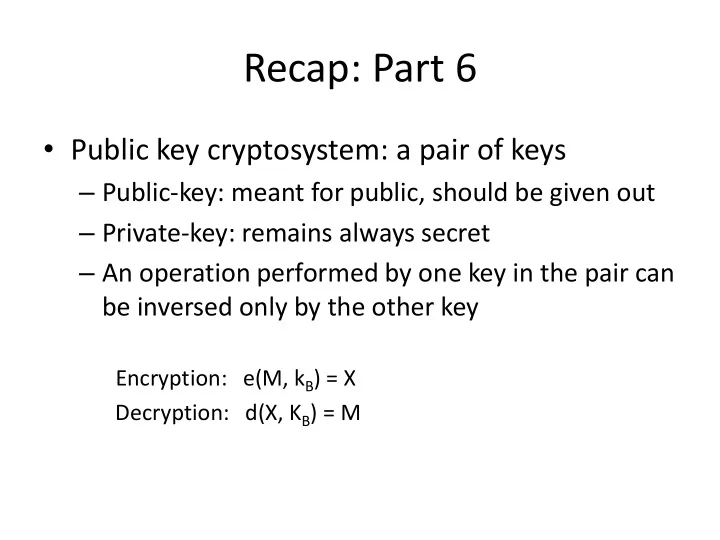
Recap: Part 6 Public key cryptosystem: a pair of keys Public-key: meant for public, should be given out Private-key: remains always secret An operation performed by one key in the pair can be inversed only by the other key


slide-1
SLIDE 1

Recap: Part 6

  • Public key cryptosystem: a pair of keys

– Public-key: meant for public, should be given out – Private-key: remains always secret – An operation performed by one key in the pair can be inversed only by the other key

Encryption: e(M, kB) = X Decryption: d(X, KB) = M

slide-2
SLIDE 2

Recap: Part 6

  • One-way function: usage in achieving integrity

H(M, k) = x and H(M, k) ≠ y Given x, k; it is impossible to find M

slide-3
SLIDE 3

Recap: Part 6

  • Digital Signature: A sequence of operations

performed by a sender, such that the receiver

  • f the message can be ensured with the

following 3 security properties:

– Message authentication – Message integrity – Message non-repudiation

slide-4
SLIDE 4

Recap: Part 6

  • Digital Signature:

H(M) = x E(x, KA) = MA Alice sends M and MA to Bob over insecure network Bob performs the following (Bob knows kA): H(M) = x D(MA, kA) = x

slide-5
SLIDE 5

Exercise

  • We just saw composition of a digital signature

that Alice performed on message M. The composition provided authentication, integrity, non-repudiation

  • What needs to be done in order to provide

confidentiality to message M?

  • http://crypto.stackexchange.com/questions/5782

/why-is-asymmetric-cryptography-bad-for-huge- data

slide-6
SLIDE 6

Sam acting as Trusted Third Party (TTP)

Sam Alice Bob

KPS KSS KPA KSA KPB KSB (KPA KPB … )

slide-7
SLIDE 7

Certification Authority

Sam Alice Bob

KPS KSS KPA KSA KPB KSB (KPA KPB … )

slide-8
SLIDE 8

Digital Certificate from a CA

slide-9
SLIDE 9

Sam acting as TTP in NSSK Protocol

Sam Alice Bob

KAS KBS (KAS KBS … )

{NA}KAB {NA - 1}KAB

slide-10
SLIDE 10

Diffie Hellman Key Exchange

Alice Bob

KAS KBS

{NA}KAB {NA - 1}KAB

slide-11
SLIDE 11

DHKE Protocol

  • 1. Bob: comes up with 2 prime numbers g, p
  • 2. Alice: pick a secret number a and compute

ga mod p = A

  • 3. Bob: pic a secret number b and compute

gb mod p = B

  • 4. Alice: Ba mod p = (gb mod p)a mod p

gba mod p = KAB

  • 5. Bob: Ab mod p = (ga mod p)b mod p

gab mod p = KAB

slide-12
SLIDE 12

Diffie Hellman Key Exchange

Alice Bob

g, p, b

{NA}KAB {NA - 1}KAB

g, p, a

slide-13
SLIDE 13

Exercise

Sam Alice Bob

KPS KSS KPA, KSA, KPS, g, p, a KPB, KSB, KPS, g, p, b (KPA KPB … )

Alice wants to send a huge message M to Bob with the following properties: Authentication, integrity, non-repudiation, confidentiality Alice and Bob trust TTP Sam Symmetric key encryption is multiple orders cheaper than asymmetric key encryption List out the steps involved in transferring M from Alice to Bob