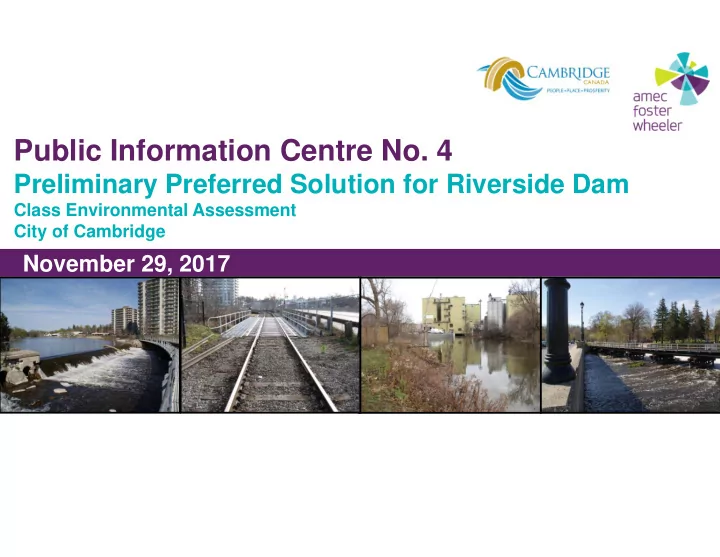
Public Information Centre No. 4 Preliminary Preferred Solution for - - PowerPoint PPT Presentation
Public Information Centre No. 4 Preliminary Preferred Solution for Riverside Dam Class Environmental Assessment City of Cambridge November 29, 2017 Welcome Meeting Agenda Background / Process 1. Project Recap Problem Statement
Riverside Dam Class Environmental Assessment
Welcome
Meeting Agenda
1.
Project Recap
► Background / Process ► Problem Statement ► Consultation ► Ownership
2. Review of Recent Activity
► Hybrid Alternative Development ► Stakeholder Workshops (2) ► Indigenous Communities Consultation ► Structural Inspections
3. Alternative Assessment and Comparison of Rebuild Dam vs. Naturalize River
► Natural / Physical Environment ► Flooding, Stream Stability, Fisheries /Species At Risk, Water
Quality / Temperature
► Social Environment ► Cultural Heritage, Boating, Fishing, Park Vistas, Public Safety ► Economic Environment ► Life Cycle, Liability
4. Summary of Stakeholder Perspectives 5. Preliminary Preferred Solution 6. Next Steps & Schedule 7. Frequently Asked Questions
- 1. Project Recap
Riverside Dam Class Environmental Assessment
1. Project Recap – Study Area Context to Grand River
Riverside Dam and Headpond Grand River
Riverside Dam Class Environmental Assessment
1. Project Recap - Study Area
Riverside Dam
Riverside Dam Class Environmental Assessment
1. Project Recap - Background General
►Riverside Dam was constructed between
1860 and 1880 to support Erb Mill
►Maintenance of the structure likely ended
- nce the dam and associated mill race were
no longer required to power the mill
►Dam has deteriorated to current state ►2008/2009 structural investigation (Sanchez)
determined dam to have elements in poor structural condition
►Emergency repair of south control structure
completed in December 2008
Riverside Dam Class Environmental Assessment
Study Need
► Riverside Dam is structurally in poor condition and in need of management
Study Purpose
► Understand the constraints and opportunities associated with the future of the
Riverside Dam and the immediate Study Area
► Determine the preferred future management alternative for the dam through
technical study and consultation with stakeholders and regulators
Approach
► Study being completed under the Municipal Class Environmental Assessment
process
► The complexity of the potential solutions dictate the associated ‘Schedule’ or the
work and Riverside Dam is being planned as a Schedule ‘B’ undertaking
1. Project Recap - Background
Riverside Dam Class Environmental Assessment Schedule “B” Class Environmental Assessments are to complete Phase 1, 2 and 5.
Phase 1 Identify and Describe the Problem(s) Phase 2 Alternative Planning Solutions Phase 3 Alternative Design Concepts For the Preferred Solution Phase 4 Environmental Study Report Phase 5 Implementation
- Compile an Environmental
Study Report (ESR).
- Place ESR on public
record for review for 30 days.
- Notify the public and
government agencies of completion of the ESR and of the Part II Order provision in the EA Act.
- Proceed to construction of
the project.
- Monitor environmental
provisions and commitments. Problem Statement Preferred Solution ESR Public Consultation
- Identify reasonable
alternative planning solutions.
- Evaluate the alternative
solutions, taking into consideration environmental and technical factors.
- Identify a preferred
solution to the problem(s).
- Identify alternative designs
to implement the preferred solution.
- Inventory natural,
social/cultural and economic environments.
- Identify the impact of the
alternative designs after mitigation.
- Evaluate alternative
designs.
- Identify a preferred
design. Preferred Design
We are here
Agency and Stakeholder Consultation
1. Project Recap - Background
Riverside Dam Class Environmental Assessment
1. Project Recap - Summary of Consultation
► Notice of Project Commencement ► Stakeholder Advisory Committee Meetings (4) ► Technical Advisory Committee Meetings (4) ► Public Information Centres (3 to-date excluding this evening) ► Stakeholder Workshops (2) ► Indigenous Communities (Notices and Face to Face Meetings)
Riverside Dam Class Environmental Assessment
1. Project Recap - Ownership
► Dam originally built to provide power for Erb Mill operation ► Current Mill owner, P&H Milling no longer uses the dam ► The Province controls the bed and banks of the river ► The City, in 2009, constructed interim works to ensure the safety of the dam in the
short term
► While clear ownership remains uncertain, the City has acted as a responsible party,
ensuring the safety of the Public, hence has taken on the ownership of the project
- 2. Review of Recent Activities
Riverside Dam Class Environmental Assessment
2. Review of Recent Activities
Initially screened (2013 / 2014), Amec Foster Wheeler developed additional technical detail on the Offline Dam Alternative, including:
► Geometry ► Configuration ► Pre-design details
i. Hybrid Alternative Development: Off-Line Dam
Riverside Dam Class Environmental Assessment
2. Review of Recent Activities i. Hybrid Alternative Development: Off-Line Dam
Riverside Dam Class Environmental Assessment
2. Review of Recent Activities
► Held May 24 and June 29, 2017 ► Invited Stakeholders included:
► Ancient Mariners Canoe Club ► Grand River Conservation Authority ► P&H Milling ► Ministry of Natural Resources and Forestry ► Save the Dam ► Region of Waterloo ► Preston Towne Centre Business Improvement Area (BIA) ► City Department Staff ► City Councillors ► Municipal Heritage Advisory Committee (MHAC) ► Cambridge Environmental Advisory Committee (CEAC)
- ii. Stakeholder Workshops
Riverside Dam Class Environmental Assessment
2. Review of Recent Activities
► Purpose
► Engage in Class EA Process ► Provide clarity around selection of Alternatives and Evaluation process ► Opportunity to provide input to Alternatives, Criteria, Weighting, and Ranking
► High-Level Outcomes
► Good consensus for most criteria ► Some mixed opinions on Boating, Fishing, Liability and Tourism ► Overall Ranking (Stakeholder Majority) – Naturalize ► Overall Rating (using Stakeholder Majority weighting with Tourism) – Rebuild ► Overall Rating (using Stakeholder Majority weighting without Tourism) – Naturalize Note: GRCA, Region and MNRF did not participate in ranking / rating exercise
- ii. Stakeholder Workshops
Riverside Dam Class Environmental Assessment
2. Review of Recent Activities
► Notified at Project Start-Up ► Notified of Public Information Centres (PICs) ► Recent Face-to-Face Meetings
► Six Nations of the Grand River (SNGR) September 18, 2017 ► Mississaugas of the New Credit First Nation (MNCFN) September 28, 2017 ► Haudenosaunee Development Institute (HDI) Pending
Outcomes:
Verbal support provided for “Naturalize“ alternative from SNGR and MNCFN.
- iii. Indigenous Community Consultation
Riverside Dam Class Environmental Assessment
2. Review of Recent Activities
► Concern raised in 2014 Structural Inspection that dam is continuing to deteriorate ► Municipality proactively conducting annual inspections to determine structural
condition and potential need for short-term repairs
► Dam inspected August 24 and 25, 2017 ► Findings
► Poor condition particularly control structures ► Further deterioration since 2014 ► Debris build up to be addressed ► Failure remains imminent (2 to 10 years) ► Increase inspection frequency to every six (6) months
- iv. Structural Inspection
- 3. Alternative Assessment and Comparison of
“Rebuild Dam” versus “Naturalize River”
Riverside Dam Class Environmental Assessment
3. Alternative Assessment and Comparison of “Rebuild Dam” versus “Naturalize River”
► Eight (8) alternatives considered:
- A. Do Nothing
- B. Repair Riverside Dam
- C. Rebuild Riverside Dam
- D. Lower Dam Crest
- E. Naturalize Speed River (Remove Dam)
- F. Construct In-Steam Rock Structures (Remove Dam)
- G. Build ‘New’ Offline Dam and Naturalize Speed River (Partial Dam Removal)
- H. Incremental Decommissioning of Dam
Long-List of Alternatives
Riverside Dam Class Environmental Assessment
3. Alternative Assessment and Comparison of “Rebuild Dam” versus “Naturalize River” Where alternative deemed to have significant or unjustifiable negative effects, or lacks significant positive effects relative to other alternatives, it was screened out:
- A. Do Nothing
► Does not address deteriorating dam
- B. Repair Riverside Dam
► Does not offer any measurable benefit over Alternative C: Rebuild Riverside Dam and has
a lower life expectancy and more construction uncertainty
- D. Lower Dam Crest
► Minor adjustments to the dam crest can be considered as an option under Alternative C:
Rebuild Dam; reduces headpond size and depth and impacts cultural heritage
- H. Incremental Decommissioning of Dam
► Ultimately mimics “Naturalize” alternative, however with more risk of adverse impacts
Screening of Long-list of Alternatives to Short-list of Alternatives
Riverside Dam Class Environmental Assessment
3. Alternative Assessment and Comparison of “Rebuild Dam” versus “Naturalize River” Offer a greater number of positive effects overall, or address certain key positive effects, along with acceptable or manageable negative effects:
- C. Rebuild Riverside Dam
- E. Naturalize Speed River (Remove Dam)
- F. Construct In-stream Rock Structures (Remove Dam)
- G. Off-line Dam and Naturalize Speed River (Partial Dam Removal)
Initial Short-list of Alternatives
Riverside Dam Class Environmental Assessment
3. Alternative Assessment and Comparison of “Rebuild Dam” versus “Naturalize River” Following consultation with Public and Stakeholders, the following alternatives were further screened: Alternative F: Construct In-Stream Rock Structures
► Limited support-concerns over long-term stability and need for additional operations and
maintenance activities
► Possible negative impacts to boating
Alternative G: Off-line Dam and Naturalize Speed River (Partial Dam Removal)
► Concerns with respect to real benefits and extent of works ► Potential for impounded water to become stagnant
Further Screening
Riverside Dam Class Environmental Assessment
3. Alternative Assessment and Comparison of “Rebuild Dam” versus “Naturalize River”
Evaluation Criteria
Criteria Weighting Category
Cultural Heritage Very High Social Park Vistas Very High Social Public Safety High Social Fish Passage High Natural Aquatic Habitat / Health High Natural Water Quality / Temperature Medium Natural Stream Stability / Sediment Transport Medium Functional / Physical Boating Medium Social Fishing Medium Social Life Cycle Costs (Capital / Operations & Maintenance) Medium Economic Liability Medium Economic Flooding Low Functional / Physical Natural Heritage Low Natural
Weighting Legend: Very High High Medium Low
Riverside Dam Class Environmental Assessment
3. Alternative Assessment and Comparison of “Rebuild Dam” versus “Naturalize River”
Natural / Physical Environment
Flooding Rebuild Dam Naturalize River
►Riverside Park remains at risk (spring) ►Reduced flood risk and frequency ►Higher flood levels
Preferred
Riverside Dam Class Environmental Assessment
Natural / Physical Environment
Stream Stability / Sediment Transport Rebuild Dam Naturalize River
►Dam blocks natural sediment movement flow ►Natural process reinstated ►Requires periodic intervention to clean out collected sediment 3. Alternative Assessment and Comparison of “Rebuild Dam” versus “Naturalize River”
Preferred
Riverside Dam Class Environmental Assessment
Natural / Physical Environment
Fisheries / Aquatic Habitat / Health Rebuild Dam Naturalize River
►Fish passage impaired (ladder may help) ►Aligns with objectives of GRCA Fisheries Management Plan and Provincial Endangered Species Act ►Wavy Ray Lamp Mussel (SAR) negatively affected 3. Alternative Assessment and Comparison of “Rebuild Dam” versus “Naturalize River”
Preferred
Riverside Dam Class Environmental Assessment
Natural / Physical Environment
Water Quality / Temperature Rebuild Dam Naturalize River
►Lower water quality in headpond ►Improved water quality ►Higher temperature ►Lower downstream temperatures ►Natural aeration 3. Alternative Assessment and Comparison of “Rebuild Dam” versus “Naturalize River”
Preferred
Riverside Dam Class Environmental Assessment
Natural / Physical Environment
Natural Heritage Rebuild Dam Naturalize River
►Some opportunity for riparian zone rehabilitation ►Significant opportunity for riparian zone rehabilitation 3. Alternative Assessment and Comparison of “Rebuild Dam” versus “Naturalize River”
Preferred
Riverside Dam Class Environmental Assessment
Social Environment
Cultural Heritage
Rebuild Dam Naturalize River
► New dam can replicate current appearance ► Removal would require consultation with the Municipal Heritage Advisory Committee per Ontario Heritage Act ► Dam is listed on Municipal Heritage Properties Register ► Original Dam cannot be practically retained or restored ► Potential need for an interpretive plaque and / or salvage feature
Visualization: Existing condition:
3. Alternative Assessment and Comparison of “Rebuild Dam” versus “Naturalize River” Preferred
Riverside Dam Class Environmental Assessment
Social Environment
Boating Rebuild Dam Naturalize River
►Creates a barrier to movement ►Removes barrier to movement ►Provides an area for flatwater boating ►Preferred by white water enthusiasts 3. Alternative Assessment and Comparison of “Rebuild Dam” versus “Naturalize River”
No Preference
Riverside Dam Class Environmental Assessment
Social Environment
Fishing Rebuild Dam Naturalize River
►Reduces diversity and numbers and prevents seasonal migration ►Restores fishing to a more diverse and natural population 3. Alternative Assessment and Comparison of “Rebuild Dam” versus “Naturalize River”
Preferred
Riverside Dam Class Environmental Assessment
Social Environment
Park Vistas Rebuild Dam Naturalize River
►View of headpond maintained ►View of nearshore wetlands introduced ►Dam Weir not visible from park,
- nly control structures
3. Alternative Assessment and Comparison of “Rebuild Dam” versus “Naturalize River” Preferred
Riverside Dam Class Environmental Assessment
Social Environment
Public Safety Rebuild Dam Naturalize River
►Risk to public associated with potential failure and need for
- n-going operations and
maintenance ►Reduced risks and no significant maintenance 3. Alternative Assessment and Comparison of “Rebuild Dam” versus “Naturalize River”
Photos Courtesy of: Public Safety Measure Plan for Bala Falls Dam; Prepared by WESA and OEL-HydroSys Inc.
Preferred
Riverside Dam Class Environmental Assessment
Economic Environment
Life Cycle Cost (100 years)
(Capital and Operating Costs)
Liability Rebuild Dam Naturalize River
►$8.5 Million ►$ 5.1 Million
Rebuild Dam Naturalize River
►Public Infrastructure which needs to be maintained in perpetuity by City ►Natural Infrastructure liability minimized 3. Alternative Assessment and Comparison of “Rebuild Dam” versus “Naturalize River”
Preferred Preferred
- 4. Summary of Stakeholder Perspectives
Riverside Dam Class Environmental Assessment
- 4. Summary of Stakeholder Perspectives
► Ministry of Natural Resources and Forestry (MNRF)
► Supports decommissioning of dam from a natural environment and public safety perspective ► Removal contributes to recovery of Provincial Species At Risk ► Eliminates potential hazard associated with dam infrastructure
► Grand River Conservation Authority (GRCA)
► Authority is supportive of alternative to naturalize the Speed River as the preferred alternative to address Class Environmental Assessment Problem Statement ► Aligns with objectives of GRCA Fisheries Management
► Region of Waterloo
► No fundamental disagreement with naturalizing the Speed River; removal of the dam would provide natural aeration of the water
► Municipal Heritage Advisory Committee (MHAC)
► Noted that ALL options require removal of existing structure ► Furthermore, Grand River and its Tributaries are part of the Canadian Heritage River System
► Cambridge Environmental Advisory Committee (CEAC)
► Strongly supports naturalization of Speed River ► Suggests “naturalized river is a great beauty all on its own”
Regulatory / Advisory
Riverside Dam Class Environmental Assessment
- 4. Summary of Stakeholder Perspectives
► Save the Dam
► Continues to believe that the Riverside Park Dam and Mill Pond are a municipal heritage asset with economic, social and recreational benefit to the entire community and are worthy of restoration and development for future generations
► Ancient Mariners Canoe Club
► The Ancient Mariners Canoe Club supports relocating the Riverside Dam 200 metres or so upstream which partially satisfies a lot of the Stakeholders desired criteria, but as users of the river, Naturalization is a perfectly acceptable choice as well
► Preston Towne Centre Business Improvement Area (BIA)
► Preston Towne Centre is very passionate about their stand on the body of water being retained. The EA report indicated the Dam can’t be repaired…therefore Preston Towne Centre wants the Dam to be replaced. This Dam has been the entrance to our community and business area for over 150 years
Others:
► P&H Milling ► K-W Cambridge Bassmasters ► Preston Heights Community Group ► Waterloo Wellington Canoe Club
Public Stakeholders
- 5. Preliminary Preferred Solution
Riverside Dam Class Environmental Assessment
- 5. Preliminary Preferred Solution
- i. Preliminary Preferred Solution
- ii. Cultural Heritage
- iii. Public Amenities
iv.Implementation Outcomes
- v. Strategic Plan
Riverside Dam Class Environmental Assessment
- 5. Preliminary Preferred Solution
► Remove Dam (reclaim some original materials) ► Remove Sediment / Cap Sediment ► Construct new ‘natural’ alignment and geomorphology of Speed River
- i. Naturalize Speed River
Riverside Dam Class Environmental Assessment
- 5. Preliminary Preferred Solution
► Conduct supplemental consultation to develop preferred plan (MHAC) ► Salvage Control Structure material ► Potential to rebuild Control Structure in park with interpretive signage and plaques ► Explore other options to recognize and honour the impact the dam had on the Preston
Community
- ii. Cultural Heritage
Riverside Dam Class Environmental Assessment
- 5. Preliminary Preferred Solution
► Construct near shore wetlands ► Provide safe Public access to River ► Build boardwalks and public viewing platforms ► Engage Public in dialogue on other potential Park enhancements
- iii. Public Amenities
Riverside Dam Class Environmental Assessment
- 5. Preliminary Preferred Solution
Implementation of Preliminary Preferred Solution would result in:
► Reduced flooding of park, particularly in spring ► Improved stream stability, no need to manually manipulate sediment build-up ► Continuous fish passage and improved aquatic health and fisheries diversity ► Reduced water temperature and better water quality ► Recognition of former mill and dam potentially through rebuild of iconic control
structure and signage
► Eliminated need for short portage by boaters ► Improved public safety and reduced municipal liability ► Lower Capital and Operations and Maintenance costs
- iv. Implementation Outcomes
Riverside Dam Class Environmental Assessment
► The City of Cambridge’s 2016 Corporate Strategic Plan provides a framework,
setting the stage for decision-making, priority-setting, and on-going performance management in the Community
► Goals and Objectives organized under three (3) themes:
► People ► Place ► Prosperity
► The Project Team has reviewed the Strategic Plan for guidance in decision-making
- n Riverside Dam and find the preliminary preferred solution aligns closely with
many of the plan’s goals and objectives as they apply to environment, rivers and infrastructure
- v. Strategic Plan
- 5. Preliminary Preferred Solution
- 6. Next Steps and Schedule
Riverside Dam Class Environmental Assessment
- 6. Next Steps & Schedule
Class Environmental Assessment Process
Public Information Centre
November 29, 2017
Public Review Period
December 11, 2017
Completion of Project File
January / February, 2018
Review by City and Agencies
February, 2018
Request to Council to File
February, 2018
Finalize Project File and Post for Public Review
March, 2018
Formal Public Review Period
Thirty (30) days
Riverside Dam Class Environmental Assessment
Under the Environmental Assessment Act, the Municipal Class Environmental Assessment process includes a provision whereby: Any member of the public who has unresolved concerns with a proposed project can request that the Minister require the proponent (of the project) to prepare an Individual Environmental Assessment – Part II Order (Bump-up) In the event of a Part II Order(s), Ministry staff review issues and concerns. Minister may also enlist input from other ministries and technical agencies. Pending input and review, Minister will make a final decision whether or not to require that an individual Environmental Assessment be prepared by the City.
- 6. Next Steps & Schedule
Part II Orders
Riverside Dam Class Environmental Assessment
- 6. Next Steps & Schedule
In the absence of any Part II Orders (2018 to 2020)
Project Planning Initial Detailed Design
Consultation with Agencies and other Public Stakeholders
Finalize Detail Design
Permitting and Approvals Tendering Construction
Riverside Dam Class Environmental Assessment
- 6. Next Steps & Schedule
Permitting Requirements
Act Agency
Lakes and Rivers Improvement Act Ministry of Natural Resources and Forestry Public Lands Act Ministry of Natural Resources and Forestry Ontario Water Resources Act Ministry of the Environment and Climate Change Navigation Protection Act Transport Canada Fisheries Act Department of Fisheries and Oceans Conservation Authorities Act Grand River Conservation Authority Cultural Heritage Act Ministry of Tourism, Culture and Sport Species at Risk Federal Endangered Species Act Ministry of Natural Resources and Forestry
Riverside Dam Class Environmental Assessment
Q1. How long before the dam fails? A1. Predicting when a structure, that is over 100 years old, will fail is very difficult and depends on several variables. Instead we rely on indicators like the structural condition
- f the dam to indicate the potential for failure. Recent investigations (2017) have
determined that portions of the dam are in very poor condition and that the risk of failure is consequently ‘high’. As such, the City of Cambridge is continuing to conduct regular inspections of the structure (recommended at 6 month intervals) until the Preferred Alternative is implemented. Q2. Who owns the dam? A2. It is known that the City of Cambridge does not own the dam. However the City can, and has, worked as the proponent for this project. As part of the detailed design the City will complete an R-Plan and a full title search before any work is completed.
- 7. Frequently Asked Questions
Riverside Dam Class Environmental Assessment
Q3. Why was the ‘Repair the Dam’ alternative screened out? A3. The repair the dam alternative did not have any advantages over the rebuild alternative and a repaired dam would not retain the historical configuration. Furthermore it would not have as long a service life due to system uncertainties. Q4. What will be the impact to Sulphur Creek if the dam is removed? Will water in the creek and pond be maintained? A4. The flow into Sulphur Creek would be maintained through the design of the river cross- section and profile. The inlet to Sulphur Creek would be altered to improve the ability to control inflow into Sulphur Creek and the online pond. Q5. Will removing the dam stop the flooding in the park (i.e. the ball diamonds)? A5. Removing the dam will lower flood elevations and reduce the frequency and extent of flooding in the park, however flooding will not be eliminated.
- 7. Frequently Asked Questions
Riverside Dam Class Environmental Assessment
Q6. Will the removal of the dam affect the flooding of properties downstream of the current dam location? A6. Removing the dam would in fact reduce the risk of flooding associated with a dam
- failure. Removing the dam would not change flooding downstream nor the extent of the
existing downstream floodplain. Q7. What will the sediment management plan entail? A7. Details of the sediment management plan will be determined during detailed design. It will be dependent on the preferred alternative and the volume and quality of the sediment to be managed. Development of the sediment management plan will involve consultation with the regulatory agencies, particularly the MOECC. Q8. Who will be covering the cost of the proposed work? A8. The City of Cambridge will be responsible for the cost of designing and constructing the preferred alternative. The design costs are in the current City budget. The construction costs will be debt financed. The City will also investigate other funding opportunities that may be available.
- 7. Frequently Asked Questions
Riverside Dam Class Environmental Assessment
Q9. When will construction start? A9. After the Class EA is filed, and if there are no Part II Order Requests, the City would first need to complete the detailed design, consult with the Public and stakeholders and then acquire all necessary approvals, before construction can begin. It is anticipated that detailed design and acquiring all approvals would take up to 2 years, so at the earliest construction could start is 2020. Q10. If the dam is removed and the river is naturalized will the CP railway trestle bridge be affected? A10. The trestle bridge is located just beyond where the river flow is affected by the dam. Furthermore the preliminary design of the naturalized river would maintain water levels and velocities at the bridge, hence there would be no impact to the bridge. CP has indicated it is waiting for the outcome of this study to decide on the preferred approach to replace the existing trestle bridge.
- 7. Frequently Asked Questions
Riverside Dam Class Environmental Assessment
Q11. When there are dams upstream and downstream of Riverside Dam, will removing Riverside Dam really have any net benefit to the natural river system? A11. Each individual reach of a river is unique and needs to be looked at as part of the overall river system. The larger scale object relates to system enhancement of form and function. Q12. How wide would the naturalized river section be? What is the widest section of the existing head pond? A12. The new river section would mirror the upstream and downstream reaches at approximately 30 m +/-. The existing head pond is approximately 90 to 100 m at its maximum. Q13. Who would own any shoreline that would be reclaimed if the dam is removed and the remaining sediment is used to reshape the river valley? A13. The adjacent land owner is anticipated to become the owner of the reclaimed land; in the case of Riverside Park this would be the City of Cambridge.
- 7. Frequently Asked Questions
Riverside Dam Class Environmental Assessment
Q14. How would the reclaimed river valley be revegetated and maintained? A14. The final approach to treatment of the reclaimed lands will be based on design, consultation and the approvals and review process with the regulators. Maintenance of this area would be by the future owner (i.e. City of Cambridge). Q15. What can be done to control the geese population in Riverside Park if the Speed River is naturalized? A15. Notably if the river is naturalized it will become a flowing system rather than a backwater ponded area which inherently detracts geese from using the area. Other geese management techniques will be reviewed as part of final design including planting at the water’s edge. Q16. What will happen to the original materials used to build the dam when it is removed? A16. Some may be repurposed in a heritage display, or reused on site, in the case of the core rubble rock, while others may be offered to the public or disposed of.
- 7. Frequently Asked Questions
Riverside Dam Class Environmental Assessment
Please Complete a Comment Sheet:
How to Provide Comments
Please Complete a comment sheet and return it:
- In the box provided
- By Mail
- By Fax
- By e-mail to MacDonaldScott@cambridge.ca or