Public Health Response to Algal Blooms In Florida Andrew Reich, - - PowerPoint PPT Presentation

public health response to algal blooms
SMART_READER_LITE
LIVE PREVIEW

Public Health Response to Algal Blooms In Florida Andrew Reich, - - PowerPoint PPT Presentation

1 Public Health Response to Algal Blooms In Florida Andrew Reich, Bureau of Environmental Health Lake O, Sentinel 3 Image: NOAA 7/10/18 Gulf of Mexico HAB Bulletin: NOAA 8/13/18 Karenia brevis Red Tide Cyanobacteria Bloom 2 Press Reports


slide-1
SLIDE 1

1

Public Health Response to Algal Blooms

Andrew Reich, Bureau of Environmental Health

In Florida

Gulf of Mexico HAB Bulletin: NOAA 8/13/18 Lake O’, Sentinel 3 Image: NOAA 7/10/18
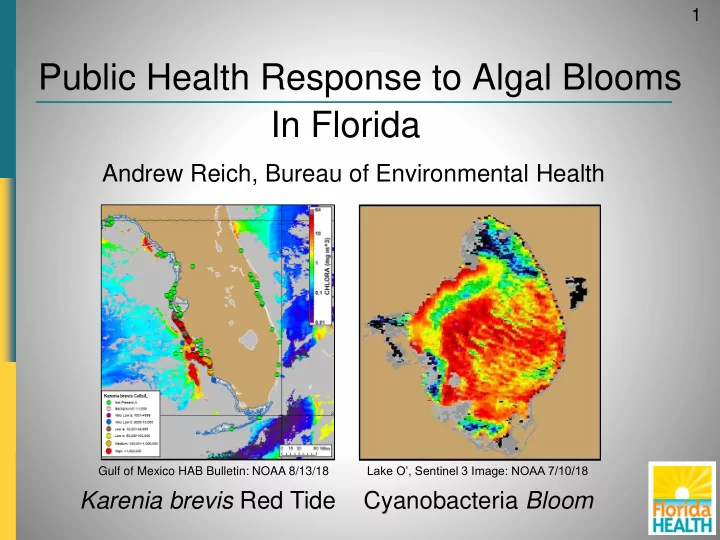
Karenia brevis Red Tide Cyanobacteria Bloom

slide-2
SLIDE 2

2

Press Reports

TC Palm (USA Today) 8/9/18

slide-3
SLIDE 3

Karenia brevis Red Tide

3

Ben Depp, National Geographic 8/8/18

slide-4
SLIDE 4

Red Tide in Florida?

4 floridapolitics.com WIKIMEDIA COMMONS

slide-5
SLIDE 5

Red Tide in Florida?

5

slide-6
SLIDE 6

“Other” Red Tides

6

California. Italian Alps Hong Kong Mexico China

Woods Hole Oceanographic Institution

slide-7
SLIDE 7

Distribution of HABs in the US

Source: U.S. National Office for Marine Biotoxins and Harmful Algal Blooms

7

slide-8
SLIDE 8

Freshwater: Cyanobacteria

  • Microcystis, Anabaena, Cylindrospermopsis

Oscillatoria, Aphanizomenon

8 News-Press (USA Today) 7/14/18 Cape Coral, Florida

slide-9
SLIDE 9

Red Tide vs. BG algae

Compare

  • Single Cells
  • Aquatic Organisms
  • Photosynthetic
  • Produce Toxins
  • Naturally Occurring
  • Do not accumulate in

fish fillets

Contrast

  • Marine vs. Freshwater
  • One vs. Many Species
  • One vs. Many Toxins
  • Aerosols vs Not Airborne
  • Unknown why bloom vs.

known association with nutrients

9

slide-10
SLIDE 10

Florida Red Tide

Positive Samples, 1954 to Present

10

slide-11
SLIDE 11

Approved Shellfish Harvesting Areas

11

slide-12
SLIDE 12

Red Tide Events

12

slide-13
SLIDE 13

Red Tide Events

13

slide-14
SLIDE 14

Red Tide Events

14

slide-15
SLIDE 15

Red Tide Events

15

slide-16
SLIDE 16

Red Tide Sampling 1954 - 2013

16

slide-17
SLIDE 17

NOAA Gulf of Mexico

  • Harmful Algal Bloom Bulletin

17

slide-18
SLIDE 18

HAB Bulletin

  • Potential for Respiratory Irritation

18

slide-19
SLIDE 19

PbTx

Bubble-mediated Transport

19

slide-20
SLIDE 20

Mote Marine Laboratory and Aquarium

20

slide-21
SLIDE 21

Mote Marine Laboratory and Aquarium

Sarasota County: Inland Transect Sampling Locations 21

slide-22
SLIDE 22

Cyanobacteria/Blue-Green Algae

22

Chad Gillis, Fort Myers News-Press

  • Sept. 14, 2018

Shepard Park on the St. Lucie River near downtown Stuart June 12, 2018. (Allen Eyestone / The Palm Beach Post

slide-23
SLIDE 23
  • Cyanotoxins: microcystins, anatoxins,

cylindrospermosins, etc.

23

  • No taste or smell
  • Heat, acid stable
  • Toxic

Rosen et al, 2017

Cyanobacteria/Blue-Green Algae

slide-24
SLIDE 24

Cyanobacteria Satellite Imagery

24 National Aeronautics and Atmospheric Administration, 8/10/18

slide-25
SLIDE 25

Lake Okeechobee Waterway

25

slide-26
SLIDE 26

Signage

26

slide-27
SLIDE 27

Direct Skin Contact

Potential Exposure Pathways

Incidental Ingestion Drinking Water Inhalation of Aerosols Ingestion of Food

27

slide-28
SLIDE 28

Hydrogen Sulfide Testing

28

slide-29
SLIDE 29

www.floridahealth.gov/algaeblooms

29

slide-30
SLIDE 30

Health reports

Emergency Department Visits 30

slide-31
SLIDE 31

Health reports

Florida Poison Control Exposure Calls 31

slide-32
SLIDE 32

Health reports

Florida Poison Control Exposure Calls 32

slide-33
SLIDE 33

Department’s Web Site

33

  • Some blue-green algae produce chemicals called cyanotoxins.
  • At high concentrations, cyanotoxins can affect the liver, nervous

system and skin.

  • Most problems occur when substantial amounts of water containing

high toxin amounts is swallowed such as when people drink untreated surface water.

  • Besides drinking the affected surface water, it is difficult to get

cyanotoxins into the body as they do not become easily airborne and do not pass through the skin readily.

  • Most people avoid a blue-green algae bloom because they tend to

be icky-looking and smelly.

Cyanobacteria/Blue-Green Algae Blooms and Public Health

slide-34
SLIDE 34

Guidance

What are some tips for avoiding cyanobacteria/blue- green algae?

Avoid swimming in or drinking water containing blue-green algae. It is best not to come in to contact with water in areas where you see foam, scum, or mats of algae on the water.

What should I do if I come in contact with cyanobacteria/blue-green algae?

If you come into contact with an algae bloom, wash with soap and

  • water. If you experience an illness, please contact your healthcare

provider.

34

slide-35
SLIDE 35

Department’s Web Site

35

  • People in coastal areas can experience varying degrees of eye,

nose and throat irritation.

  • When a person leaves an area with a red tide, symptoms usually go

away.

  • People with severe or chronic respiratory conditions such as asthma
  • r chronic lung disease are cautioned to avoid areas with active red

tides.

  • If you experience irritation, get out and thoroughly wash off with

fresh water. Swimming near dead fish is not recommended.

  • Wearing a particle filter mask may lessen the effects, and using
  • ver-the counter antihistamines may decrease symptoms.
  • Red Tide Blooms
slide-36
SLIDE 36

Outreach/Education

36

slide-37
SLIDE 37

Dodge it

37

slide-38
SLIDE 38

Outreach Cards

38

slide-39
SLIDE 39

FWC Web Site

39

http://myfwc.com/research/redtide/

slide-40
SLIDE 40

FWC Web Site

40

http://myfwc.com/REDTIDESTATUS

slide-41
SLIDE 41

FDEP Web Site

https://floridadep.gov/AlgalBloom

41

slide-42
SLIDE 42

FDEP Web Site

https://floridadep.gov/AlgalBloom

42

slide-43
SLIDE 43

Contact Information

andy.reich@flhealth.gov (813) 307-8015 x 5961

43