SLIDE 1
1
Feasibility study to identify and treat post-partum depression: Understanding clinical presentation, use of Patient Health Questionnaire 9 (PHQ-9) and suitability of thinking healthy intervention
Project implemented from 18th March to 30th July 2019
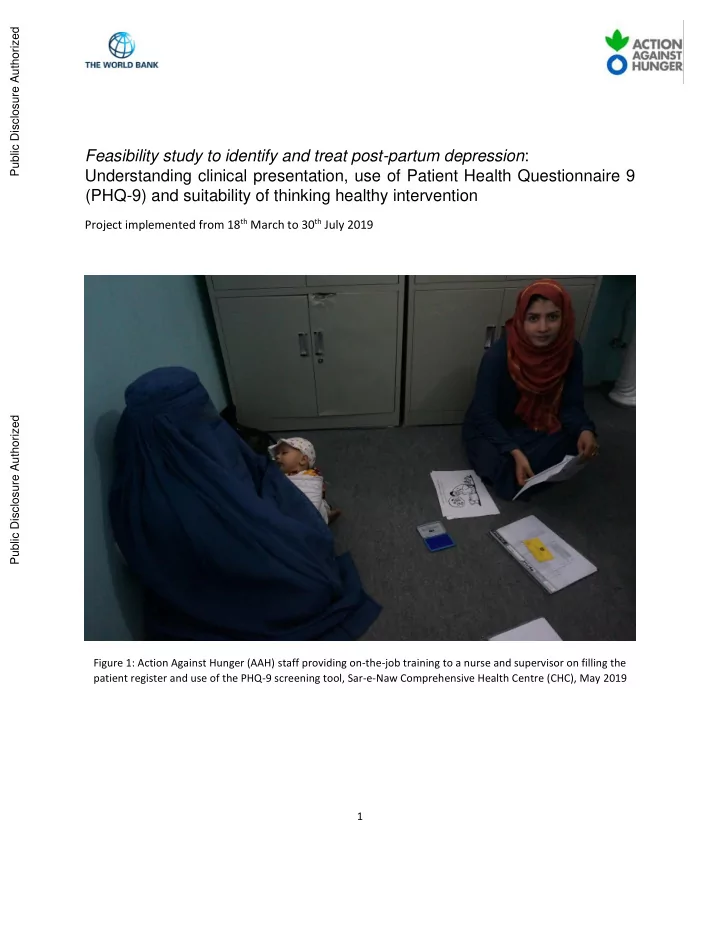
Figure 1: Action Against Hunger (AAH) staff providing on-the-job training to a nurse and supervisor on filling the patient register and use of the PHQ-9 screening tool, Sar-e-Naw Comprehensive Health Centre (CHC), May 2019 Public Disclosure Authorized Public Disclosure Authorized Public Disclosure Authorized Public Disclosure Authorized
SLIDE 2 2 This material has been funded thanks to the contributions of (1) UK Aid from the UK government, and (2) the European Commission (EC) through the South Asia Food and Nutrition Security Initiative (SAFANSI), which is administered by the World Bank. The views expressed do not necessarily reflect the EC or UK government’s
- fficial policies or the policies of the World Bank and its Board of Executive Directors.
SLIDE 3
3
Final Report
Period covered by the report: From the 18th of March to the 31st of July 2019
SLIDE 4
4
Acronyms
AAH: Action Against Hunger BHC: Basic Health Center CHC: Comprehensive Health Center EPDS: Edinburgh Postnatal Depression Scale HF: Health Facility IMAM: Integrated Management of Acute Malnutrition IYCF: Infant and Young Child Feeding MCHP GP: Mental Health and Care Practices, Gender and Protection MEAL: Monitoring, Evaluation, Accountability and Learning OHPM: Organization for Health Promotion and Management PHQ-9: Patient Health Questionnaire-9 PMHO: Provincial Mental Health Officer PNO: Provincial Nutrition Officer PPHD: Provincial Public Health Directorate PPD: Post-Partum Depression WB: World Bank WHO: Work Health Organization
SLIDE 5 5
Between the 18th of March and the 31st of July 2019, Action Against Hunger (AAH) implemented a feasibility study to determine if health facilities in Afghanistan would be able to diagnose and treat Post- Partum Depression (PPD) using the Patient Health Questionnaire 9 (PHQ-9) as a screener to diagnose and the World Health Organization (WHO) Thinking Healthy Intervention protocol to treat PPD. The study was implemented in two health facilities in Parwan Province, one being a Basic Health Center (BHC) and one being a Comprehensive Health Centre (CHC). In order to determine the feasibility of the implementation
- f PPD related diagnosis and treatment, the study measured the following five specific objectives:
- 1. To train nurses in two primary health care districts in Afghanistan to screen women attending
perinatal health services for depression;
- 2. Assess the extent to which nurses understand and are able to effectively implement the
screening tool;
- 3. Based on the numbers of women screening positive, to calibrate the cut off scores to
determine who received treatment;
- 4. To assess whether trained nurses can provide safe and appropriate treatment;
- 5. To assess the acceptability of the intervention to women receiving the intervention and to
assess the extent to which targeted women take up the intervention and return for sessions.
- 2. Results of Feasibility Study
In order to monitor and evaluate the objectives of this feasibility study, AAH created several tool, the results of which are compiled in this section. These tools are: Activity Progress Reports, patient register and patient file, PPD protocol, database, individual interviews with health facility staff and with a representative sample of the beneficiaries. Annexes can be found at the end of this report and attached. Objective 1: To train nurses in two primary health care districts in Afghanistan to screen women attending perinatal health services for depression 1.1. Results Two trainings took place in two primary health care centers in Parwan province, one in Gul-Bahar BHC and one in Sar-e-House CHC. AAH’s master trainers trained HFs staff and Provincial Public Health Directorate (PPHD) staff on both Integrated Management of Acute Malnutrition (IMAM) and Infant and Young Child Feeding (IYCF), and on PPD protocol:
- A six-day training on IMAM and IYCF was conducted on the 28th of March and between the 30th of
March and the 4nd of April 2019;
- A four-day training on the Thinking Healthy protocol was conducted between the 6th and the 10th of
April 2019 Both trainings took place in the training hall of the Organization for Health Promotion and Management (OHPM)’s. The training was provided to ten participants, composed of:
SLIDE 6 6
- Six HF staff including: two doctors, two midwives, one nurse and one psychosocial counsellor;
- Two AAH staff in charge of supervising the study implementation; and
- Two members of the PPHD: one Provincial Nutrition Officer (PNO) and one Provincial Mental Health
Officer (PMHO). Among the ten attendees, six were women and four were men. The training results are below and the reports can be also found in the annexes 1 and 2. The pre- and post-tests conducted during the IMAM/IYCF trainings show an improvement of all the attendees’ scores. The average score of the pre-test for the IMAM and IYCF training was 48.9%. Following the training sessions, the average score of participants was 88.7%. At the end of the IMAM/IYCF trainings, nine of the ten participants scored 85% or above, showing that participants had a very good comprehension of the topics presented during the project.
Figure 1: Pre and Post-test scores of the Nutrition Training
The pre- and post-tests conducted during the PPD training show an improvement of all the attendees’
- scores. The average score of the pre-test was 37.9%. Following the training sessions, the average score of
participants was 88.1%. At the end of the PPD training, six of the eight participants scored 100%, showing that participants had a very good comprehension of the intervention protocol. All the HF staff responsible for directly implementing the project (counselors and midwives) scored 100%.
44 55 15 15 15 30 50 55 100 100 55 100 50 100 100 100 50 100 150 Doctor CHC Midwife CHC Nurse CHC PSS Counselor CHC Doctor BHC Midwife BHC AAH Supervisor AAH Supervisor
Pre and Post-Test Evaluation Scores
Pre-Test Post-Test 65 69 34 33 48 51 42 76 38 33 93 93 74 88 86 93 92 98 85 85 50 100 150 Doctor CHC Midwife CHC Nurse CHC PSS Counselor CHC Doctor BHC Midwife BHC DoPH Doctor DoPH Doctor AAH Supervisor AAH Supervisor
Pre and Post-Test Scores of IMAM Trainees
Pre-Test Post-test
SLIDE 7 7
Figure 2: Pre and Post-test scores of the PPD Training
During the interviews to the HF staff at the end of the project, all staff mentioned they were satisfied with trainings received at the start of the project on Nutrition screening and treatment, PPD and the Thinking Healthy Intervention Protocol. However, staff suggested that future trainings last longer. When asked if they would have benefited from refresher trainings, all HF staff said that it would be beneficial for them to receive additional trainings. They clarified that they would have liked to receive additional trainings on PPD, as the subject material was quite new for them. In addition, AAH supervisors provided near daily support to HF staff with on the job trainings and support throughout the duration of the project. Supervisors were present throughout the working day and monitored the implementation of activities by HF staff, providing support when needed. When asked to the HF staff during the interviews if they had received weekly on the job training from AAH, all staff confirmed that they had received additional support and information throughout the duration of the
- project. They also mentioned that the coordination between AAH and HF staff was good and that AAH did
not interfere in the health facilities other activities.
Thinking Healthy Certification, Parwan Province, 9th of April 2019
1.2. General Recommendations for Future Implementation In order to ensure that HF staff are well trained in future implementations of the project, AAH proposes the following recommendations:
SLIDE 8 8
- All medical staff in the HF should be trained in the PPD Protocol. This will reinforce the acceptance
- f the protocol in the HF, as all staff members will be aware of its purpose and importance in
supporting women who are suffering from PPD. Furthermore, by training all medical staff on this protocol, the responsibility for the implementation of the screening and treatment sessions can be split between HF staff, depending on the number of staff available in the targeted HF.
- AAH recommends that partners in charge of observing and supporting medical staff with the
implementation of the PPD Protocol be trained immediately in the protocol and the tools that are to be used in the project. This will ensure the quality of the activities.
- For future trainings at the beginning of the project, the duration of the trainings should be longer,
especially for the PPD training as it is a new topic for the HF staff. AAH recommends to extend the training to six days training instead of 4 days training.
- AAH recommends implementing partners to provide individual and tailored on the job and
refresher trainings to medical staff to ensure they understand the PPD Protocol, as well as associated procedures and good practices (screening using the PHQ-9, follow up sessions with patients, complete and organized patient files). Objective 2: Assess the extent to which nurses understand and are able to effectively implement the screening tool 2.1 Results Since the start of the project 215 women have been screened with the PHQ-9 screening tool in both HFs, 98 in the Gul-Bahar BHC and 117 in the Sar-e-House CHC. All women screened were over the age of 18, as per standards put in place by AAH at the beginning of the project. Beneficiary screenings were
- rganized by the HF nurse, counselor or mid-wife and were carried out in rooms offering privacy to the
- patient. AAH supervisors were present during the majority of PHQ-9 screenings to offer support to HF
staff and to observe how the forms were filled out. Towards the end of the project, AAH supervisors were
- nly observers to evaluate the capacity of the staff to effectively implement the screening tool without
AAH support. Of the 215 participants screened, 131 women received a score of 12 or above on the PHQ-9 representing 61% of the women presenting PPD symptoms. AAH supervisors and the project manager conducted spot checks on PHQ-9 forms and consent forms throughout the duration of the project to verify that they were filled accurately. In instances where mistakes were identified, these were shared with HF staff. Overall, the majority of PHQ-9 forms were filled out in accordance with established criteria. Overall, results show that nurses have a good understanding of the use of the screening tool. During the interviews, HF staff claimed that they were comfortable with the use of the PHQ-9 screening tool. Information regarding the use and completion of the document was clearly explained to them. Half of respondents said that they completely understood how to use the tool and half claimed they felt they understood the tool well. This information has been confirmed through spot checks which AAH conducted
SLIDE 9 9
again at the end of the project on filled PHQ-9s. From a sample of 43 PHQ-9s, all, except for two, were correctly filled out and cross-referenced with the patient register. It is important to mention that 29% of the women screened presented suicidal thoughts identified in question 9 of the PHQ-9: Thoughts that you would be better off dead, or of hurting yourself. As per the PPD protocol, when a patient scores positive (1, 2 or 3) she must be referred to a doctor as question 9 detects intention of suicide, indicating the need for immediate attention as well as follow up. From the 62 women who scored positive in question 9 (out of 215 patients screened), even though all patients were referred to doctor at the HF, only 3 were referred to the provincial hospital. The main reasons why the
- ther women were not referred to a specialized services were because the patient did not come back to
the health facility and because the women refused to go to another health facility.
Figure 3: PHQ-9 question 9 results
As per PPD Protocol, all women scoring positive in PHQ-9 were offered the possibility to participate in Thinking Healthy intervention sessions, after agreeing to sign the consent form. All women signed the consent form. Despite the high rate of consent from women participants, it is important to note that the drop-out rate of patients from the first Thinking Healthy session (screening session) to the second session is high, with 55% of consenters not returning to the HF. This may be linked to the fact that women did not fully understand the need to return to the HF for further sessions or that women tend to accept and believe that they will be able to return to further session even if it is not the case later on. 2.2 General Recommendations for Future Implementation When asked what recommendations they had to improve the implementation of the screening tool, the following suggestions were provided by HF staff:
71% 17% 6% 6% 0% 10% 20% 30% 40% 50% 60% 70% 80% 90% 100% (+1) (+2) (+3) Not at all (0) Several days More than half the days Nearly every day
PHQ-9 Question 9: Thoughts that you would be better off dead, or
SLIDE 10 10
- All HF staff claimed that they felt confident using screening tool. However, they clarified that they
would like to receive additional refresher courses on diagnosis as the subject material is quite
- new. They also encouraged that all HF staff receive some form of training on diagnosing PPD.
- HF staff’s follow-up of referral cases, particularly those pertaining to patients that at are at risk of
suicide, should be strengthened to ensure that patients are actually being provided with adequate
- services. Patients scoring positive in question 9 should be followed up on an individual basis to
ensure they are accessing services.
- AAH also recommends to strengthen the referral pathway by identifying specialized services for
PPD and to include costs of transportation as the services that can ensure an adequate treatment are in Kabul province. Objective 3: Based on the numbers of women screening positive, to calibrate the cut off scores to determine who receive treatment 1.1. Results At the beginning of the project, it was agreed that under this study the cut-off score applied for the PHQ- 9 screening tool would be lowered to 12 (instead of 15) as it is a research study. The cut-off needed to be adapted taking into consideration the cultural aspects and context of Afghanistan, therefore it was decided to include the highest range of the women scoring moderate depression (from 10 to 14). The PHQ-9 standardized severity grid was used as reference. PHQ-9 Severity Grid Score Depression severity Evaluation 0-4 Minimal or none Do not require treatment 5-9 Mild Use clinical judgment (symptom duration, functional impairment) to determine necessity of treatment 10-14 Moderate 15-19 Moderately severe Warrants active treatment with psychotherapy, medications, or combination 20-27 Severe Although initial discussion between AAH and the World Bank (WB) recommended that the cut-off score would be recalibrated following an initial analysis of the data, AAH proposed later on to WB to continue screenings with the same cut-off score until the end of the project. This would ensure that data collected throughout the study is consistent to be able to analyze the information and recommend a cut-off score based on the evaluation done. HFs’ staff screened a total of 215 lactating women. Of the 215 women, 131,
- r 61%, scored 12 or above and 84, or 39%, scored below 12. When calculating the percentage of women
positive in PHQ-9 with score 15 as the cut-off, less than half (46%) of the total of women screened scored positive.
SLIDE 11 11
Figure 4: PHQ-9 results with cut-off score applied for this project Figure 5: PHQ-9 results with cut-off score of 15
When analyzing the score of all women, it is observed that the highest scores are 6 (mild depression), 13 and 14 (moderate depression) and 15 being the highest score (moderately severe). On average the PHQ- 9 score of screened women was 12.9. From the total number of women screened, is it important to understand that 27% are moderately severe depressed representing the highest number followed by mild depression (21%), moderate (20%) and severe depression (19%). 13% presented minimal or no symptoms
- f depression. The tables below highlight the PHQ-9 scores of women participants according to their
scores and severity.
Figure 6: PHQ-9 scores before intervention 39% 61%
PHQ-9 Screening results (cut-off score of 12)
Negative Positive 54% 46%
PHQ-9 Screening results (cut-off score of 15)
Negative Positive 3 4 5 5 11 8 14 6 11 7 7 3 4 14 14 20 8 10 8 12 12 10 7 7 3 1 1 5 10 15 20 25 1 2 3 4 5 6 7 8 9 10 11 12 13 14 15 16 17 18 19 20 21 22 23 24 25 26 27
PHQ-9 Scores
SLIDE 12 12
Figure 7: Severity result according to PHQ-9 grid
AAH complemented the assessment with a patient file form (see annex 4) which asked sociodemographic information of the women scoring positive in PHQ-9 and accepting to participate to the Thinking Healthy
- sessions. When asked what were the causes of distress, 20% declared they felt depressed due to the
arrival of the baby and the impact it had. Other main reasons were grief or loss of a family member (12%), emotional distress of the mother (12%) or the child (11%) and anxiety (11%). The main symptoms that women declared they felt were fatigue (17%), variation in appetite habits (16%) and sleeping habits (15%), sadness (14%), anxiety (12%) and irritability (11%).
Figure 8: Causes of distress identified by the women Figure 9: Symptoms of distress identified by the women 13% 21% 20% 27% 19% 0% 10% 20% 30% 40% 50% 60% 70% 80% 90% 100% (0-4) (5-9) (10-14) (15-19) (20-27) Minimal or none Mild Moderate Moderately Severe Severe
PPD Severity according to PHQ-9 Scores
Maritial dispute 6% Emotional distress 12% Perinatal depression 20% Grief and loss 12% Abuse/ Violence 5% Emotional distress of child 11% Psychoso matic disorder 9% Anxiety 11% Isolation 10% Trauma or acute stress 4% Other 0%
Causes of distress
Sleeping disorder 15% Anxiety 12% Fatigue 17% Appetite disorder 16% Irritablity 11% Psychosomatiques complaint (headache, stomach, etc..) 10% Sadness 14% Traumatism 5% Other 0%
Symptoms of distress
SLIDE 13 13
1.2. General Recommendations for Future Implementation In order to reinforce the future implementation of the project, AAH proposes the following recommendations on the cut-off rate:
- In future projects, AAH recommends to use 13 as a cut-off score (green line in figure 6). This cut-
- ff is based on the representing sample that has been evaluated in this project taking into
consideration: the cultural aspect and context of the country and the standardized cut-off (score 15, red line in figure 6). AAH decided to use 12 for the study (blue line), Figure 6 shows that 4 women out of 215 scored 12. However, 28 women scored 13 or 14. Not including them in the intervention would exclude 13% of the total number of women presenting moderate depression.
- AHH would also recommend to use Edinburgh Postnatal Depression Scale (EPDS) as a screening
tool instead of PHQ-9. While this last one measure depression in general, the EPDS is a tool that includes 10 question which enables identifying patients at risk for perinatal depression. The EPDS is easy to administer and has proven to be an effective screening tool. The EPDS tool is in annexes. Objective 4: To assess whether trained nurses can provide safe and appropriate treatment 4.1. Results Although results indicate that HF staff understand the Thinking Health Protocol and how to use relevant documents to measure patients PHQ-9 score, the physical environment of the HFs and the small number
- f medical staff, hinder the ability of HFs to provide safe and appropriate treatment to women
participating in the protocol. This is particularly the case for the Gul-Bahar BHC which is currently run by
- nly one doctor and one midwife. BHCs are one of the most primary HFs in the country, offering a small
range of services with restricted means. In the case of the Gul-Bahar BHC, the HF operates out of a small building, making it difficult to find spaces which ensure patient privacy and confidentiality. Initially, screenings and patient sessions were organized in the mid-wife’s office, however, due to a lack of space, meetings with patients started being conducted in the HF’s corridor, compromising patient privacy. In
- rder to ensure patient privacy in the Gul-Bahar BHC, AAH provided a small tent to the HF. This tent freed
up the mid-wives office and provide a separate space for screening and Thinking Healthy sessions. Out of 215 women, 106 women received individual sessions and 25 participated in group sessions. The high number of individual sessions is due to women coming at different hours of the day, but also due to the lack of space to conduct group sessions. Furthermore, the small number of staff available at the BHC has meant that screening of women and the follow up of patients has added additional burdens on the HF staff. These challenges were less apparent in the CHC of Sar-e-House, which has four medical staff (one nurse, one mid-wife, one psychosocial counsellor and one doctor). Furthermore the CHC has the rooms and space necessary to provide women with privacy for the sessions. Through this constant monitoring of HF staff, AAH was able to ensure that data was collected accurately and stored in safe and secure locations. Regarding the perception of the women that participated in the study, during the interviews done to the patients at the end of the project, the Monitoring, Evaluation, Accountability and Learning (MEAL) team asked if sessions were conducted in spaces that ensured patients privacy and intimacy, 30 respondents
SLIDE 14 14
- ut of 33 said yes. Two respondents did not provide feedback as they did not participate in any sessions
and phone connection with 1 of the respondents was interrupted. Regarding the impact of the project on respondent’s mental health and well-being, out of 33 only 1 respondent said they felt the same, 17 said they felt a bit better and 12 said they felt much better. Three respondents did not provide any response. Furthermore, when asked if they felt the sessions were useful for them, 16 women responded that they were a bit useful and 14 said they were very useful. Three respondents did not provide any feedback. Finally, 29 respondents claimed that because of the project they had improved relationships with their children and their family members. Additionally, 5 respondents noted that they had been able to talk about their mental health issues with family members. The 47 women who completed all Thinking Healthy Sessions were re-scored through the PHQ-9 before being discharged. All women’s scores decreased by at least 6 points, with an average decrease of 13 points improving considerably their well-being. All women scored below the cut-off score of 12. The changes in participant’s scores can be found in the table below. Figure 10 in section 4 also shows the perceived state
- f improvement by the participants. When asked what they thought about the overall quality of the
project, 4 respondents answered Neither Good nor Bad, 14 answered Good, and 13 answered Very Good. Two respondents did not provide any feedback as they did not participate in any sessions.
Figure 10: PHQ-9 result before and after the Thinking Healthy intervention
13 19 21 12 13 20 14 13 15 15 13 23 14 21 21 17 16 17 16 13 13 15 19 13 22 22 14 26 27 23 21 20 20 15 20 21 19 18 12 23 16 18 15 17 15 15 15 2 2 9 5 6 3 2 6 3 3 2 4 4 10 8 8 3 8 3 5 2 5 8 6 6 5 3 5 5 7 4 7 4 2 7 6 2 6 6 10 6 6 4 4 3 5 5 10 15 20 25 30 1 2 3 4 5 6 7 8 9 10 11 12 13 14 15 16 17 18 19 20 21 22 23 24 25 26 27 28 29 30 31 32 33 34 35 36 37 38 39 40 41 42 43 44 45 46 47
PHQ-9 Results
before intervention after intervention
SLIDE 15 15
4.2. General Recommendations for Future Implementation In order to reinforce the future implementation of the project, AAH proposes the following recommendations:
- The Thinking Healthy Protocol should only be rolled out in HFs that are able to accommodate the
participants to ensure patient confidentiality and the respect of the Do No Harm principle. This has to take into account staffing capacities as well the physical space available in the HF.
- Although BHCs are offering services to some of the most vulnerable population groups, who
already have restricted access to HFs, the lack of staff available to run the HFs and the lack of space available, hinders the appropriate implementation of the protocol. This lack of capacity translates to patients being provided with services in spaces that do not ensure their privacy. It should be noted that if the Thinking Healthy Protocol is to be rolled out in smaller HFs, these will need to be supported with materials, and, in some instances, additional staff, to ensure adequate implementation of services. Objective 5: To assess the acceptability of the intervention to women receiving the intervention and to assess the extent to which targeted women take up the intervention and return for sessions 5.1. Results Out of the 131 women who scored above the PHQ-9 cut-off and who signed the consent letter to participate in the Thinking Healthy sessions, 72 women, or 55% returned for the first session. The majority returned within one week to the HF to partake in the first Thinking Healthy session in exception of five women who returned within two weeks for the first session, one women returned within two weeks and
- ne women returned within two months. When broken down per HF, the data collected was the
following:
- In Gul-Bahar BHC, of the 60 women who scored above the PHQ-9 cut off and who signed the
consent letter, 39 women, or 65%, returned for the first Thinking Healthy session.
- In Shar-e-house CHC, of the 71 women who scored above the PHQ-9 score cut off and who signed
the consent letter, 33 women, or 46%, returned for the first Thinking Healthy session. It is important to note that women who started participation in the first Thinking Healthy Session, in general returned regularly to take part in following sessions. Of the 72 women who came to the first Thinking Health Session, 41, or 60%, returned regularly for following sessions. In the first week, 131 participants who scored positive signed the consent to participate and were briefed on the program. In the second week 72 women participated and explain to them presentation of thinking healthy and introduction session. In the third week, 59 women participated and explained to them addressing mother’s personal health by identifying negative thoughts, replacing the negative thoughts with constructive ones and practicing constructive thoughts into positive actions. In week four, 54 participated addressing the relationship between the mother and the child, in week five 49 women participated to the session related to the mother and the relationship with others and in week six 47 women participated in the discharge session. This data suggests the adhesion of women to the intervention once they have
SLIDE 16 16
started the Thinking Healthy protocol. A beneficiary’s testimony can be read in Annex 8 and below the participation rate.
Figure 11: Participation rate of women in the Thinking Healthy intervention sessions
In total, 47 women completed the sessions and 84 women did not complete the sessions. Of the returning women, five (16%) missed one session and four (13%) missed two sessions. The reasons behind the low attendance of women to subsequent sessions could be linked to several factors including:
- The study is taking place during the month of Ramadan, which generally sees a reduction in individuals’
activities;
- Women may be signing consent forms to participate in the Thinking Healthy sessions without realizing
- r understanding that they may be expected to return on a weekly regular basis to sessions.
- Women may be unable to attend sessions due to family pressures or distance from the HF.
Between the 14th and 31st of July, AAH’s MEAL department contacted women who had registered to participate in the project. Of the 131 patients who registered to participate in the Thinking Health program, 47 women provided contact details to HF staff. Of the 47 contact numbers available, 33 answered phone calls by AAH’s MEAL department and consented to participate in the remote call monitoring exercise. This represents 25% of all beneficiaries. Of the 31 patients interviewed, 17 were registered in the Gul Bahar BHC and 16 were registered in the Shar-e-House CHC. Patients were asked a series of 29 questions aimed at collecting information on their access and satisfaction with the project. The full questionnaire can be found in annex 7. On average, participants attended 4.5 Thinking Healthy
- sessions. The majority of respondents, 13, attended all 6 sessions, 6 attended 5, 5 attend 4, 3 attended 3,
2 attended 2 and 2 attended 1. In addition, 2 respondents did not participate in any sessions and had only registered for the project. Regarding the regularity of participation in sessions, 20 respondents claimed to have missed at least one session. Of these, 6 had missed one session, 5 two sessions and 9 three or more sessions. All HF staff claimed that the project had been successful implemented and that the project had a positive impact on the women who had registered in the project. However, the project faced some challenges in
100% 55% 41% 37% 34% 31% 0% 20% 40% 60% 80% 100% 120% Women scoring positive and signing consent letter Session 1 Session 2 Session 3 Session 4 Discharge
Participation rate of women in Thinking Healthy Sessions
SLIDE 17 17
terms of community acceptance and patient accessibility to health services. By consequence this affected participant’s ability to return regularly to sessions at the health facilities. According to HF staff the biggest challenges that women faced regarding access to services were:
- Restriction of movements by family members, who were not always understanding or approving
- f the services provided by the health facilities
- The high cost of transportation to and from health facilities
Key reasons they gave for missing sessions were illnesses of children (8 respondents), religious or cultural events (4 respondents), prohibition by family (3 respondents) and other reasons (5 respondents). Of those who responded Other, one was not satisfied by the quality of services, one was referred to another hospital for treatment and one claimed that staff were not present at the HF. The two remaining respondents were unable to attend due to personal issues. Of the 20 respondents who had missed sessions, 17 said that they would return to the HF to continue thinking healthy sessions. Of these, 3 clarified that they would only return if their husband gave them permission to return to the HF and 1 respondent clarified that they would return if transportation costs would be covered. Figure 12: Number of Thinking Heatlhy sessions missed Despite the fact that many participants missed sessions over the course of the project, HF staff clarified that many women returned when they could, sometimes after missing sessions for several weeks. They also noted that women who were participating in the project were encouraging other women in their communities to sign up for the program. Also, as part of the Thinking Healthy protocol tools, women were asked to fill in a mood chart every day during 4 weeks in order to monitor their well-being. The graphs below (figure 13) show the results throughout the 4 weeks of intervention. While negative and neutral feelings (very bad, bad, not good nor not bad) slightly decrease, the positive feeling (good and very good) slightly increase.
5 10 15 1 2 3 or more
Number of Respondents
Number of Sessions Missed
SLIDE 18
18 Figure 12: Thinking Healthy mood chart result
When asked if the project and tools were clearly explained to them, all respondents, but one, said that all aspects were clearly explained. This included how to fill tools (PHQ-9, mood charts, etc.), answering questions about the project, and providing additional charts for patients to fill at home. 26 respondents said they had no issues filling in documents for the Thinking Healthy Sessions. However, when checking the charts not all 26 respondents have properly filled in the charts. Figure 14 shows the percentage of charts properly filled in, the low percentage can be explained mainly due to not completing the intervention or the document rather than not understanding how to use the charts. Thus, Thinking Healthy charts have been modified and culturally adapted (annex 3). The remaining 7 respondents did not provide feedback as 4 had not participated in three or more sessions, 2 had not participated in any sessions, and phone connection with 1 of the respondents was interrupted.
Very good 30% Good 24% NgNb 26% B 10% Very bad 10%
First week
Very good 32% Good 24% NgNb 20% B 17% Very bad 7%
Second Week
Very good 37% Good 21% NgNb 22% B 12% Very bad 8%
Third Week
Very good 45% Good 24% NgNb 15% B 9% Very bad 7%
Fourth Week
SLIDE 19 19 Figure 13: Thinking Healthy charts completed correctly results
When asked if they thought the documents were cultural appropriate, all respondents claimed that there were no issues with the documents. However, one respondent clarified that the images used in the Thinking Healthy Protocol were not always appropriate, as women were not always veiled in the images. This resulted in at least one patient refusing to participate in the program. Images have been modified and adapted culturally and are part of the PPD manual (annex 3). When asked what could be done to improve the quality of the project, HF staff proposed the following recommendations:
- Provide incentives for patients to participate in the project, either as cash for transportation or as
hygiene kits.
- Improve community sensitization on the issue of Post-Partum Depression to encourage family
members to allow women to participate in the program.
- Include patient relatives in the initial session so that family members understand what the
sessions are about and feel comfortable allowing women to return to health facilities.
- Thinking Healthy sessions should be paired with the prescription of medicines as certain patients
also had psychological issues which could not be treated only through the sessions. Furthermore all HF staff thought that the project should continue in their health facilities as it was having a positive impact on the targeted women. HF staff also felt confident enough to train other HF staff on Post-Partum Depression diagnosis and treatment, as they were provided with the necessary training materials. 5.2. General Recommendations for Future Implementation Based on the results presented above, AAH has the following recommendations for future implementation of PPD projects:
- Patient follow-up should be reinforced in order to ensure that patients return to HFs to take part
in sessions and to allow HF staff to be able to understand why patients are unable, or unwilling, to return to future sessions. As a standard practice the phone number of all patients needs to be registered by HF staff and attributed to patient files. In instances where patients do not have mobile phone numbers, a close family member’s number can be used. It is also good practice for HF staff to share their numbers (office numbers) with patients, in order to ensure they do not feel
0% 50% 100% Nutrition Baby Interaction Relaxation Sleeping
Thinking Healthy Charts properly filled in
SLIDE 20 20
that they are receiving “unknown” phone numbers, which reduces the likelihood that the patient will pick up. In order to ensure successful patient follow-up, telephone credit has been provided to HF staff so they can actively call back patients that are defaulting on schedule sessions.
- Women who default on one session, should not be offered two sessions as “catch-up” during their
next visit at the health center. Instead, sessions should continue to progress as planned, with a week delay, ensuring that the patient returns to the HF five times and that all related charts are filled out. Despite prolonging the time spent with the patient, this will ensure that the targeted women receive the quality treatment intended.
- AAH recommends that community and household level engagement be a core component of the
Thinking Healthy Sessions. Interviews with key informants and remote calling assessments have highlighted that women’s movements to HFs are restricted by family members. Community and household level understanding of the needs of women with PPD could remove some of the barriers faced by women when seeking to participate in Thinking Healthy session at HFs. Initial sensitization sessions could be established at the community level through health shuras, and when present, family health action groups. Information provided to these community level structures could then be disseminated throughout community groups.
- During a key informant interview with one of the women who had failed to return to the HF, a
reason for not returning to sessions was the need to care for children at the household. A way of encouraging women’s participation would be to provide child friendly spaces in HFs so that women can bring their children to HFs during sessions. Her full testimony can be read in Annex 9.
- Results show that there are high number of the women suffering from PPD and that there is a
need to address the issue and provide support at HF level. It is also shown that Thinking Healthy protocol is a good intervention tool to provide support to PPD, using the culturally adapted tools (images and charts) will make the intervention more effective.
- The protocol used for this project was adapted for only lactating women facing post-partum
depression, however, in future projects, pregnant women should also be included as targeted beneficiaries facing perinatal depression.
Annex 1: IMAM training report Annex 2: Post-Partum Depression training report Annex 3: Post-Partum Depression Manual (English and Dari versions) Annex 4: Patient File (English and Dari versions) Annex 5: Edinburgh Postnatal Depression Scale Annex 6: Monitoring Checklist Annex 7: Questionnaire Annex 8: Beneficiary’s testimony – patient Annex 9: Beneficiary’s testimony – defaulter Annex 10: IMAM Training Participants manual Annex 11: IYCF Training Participants manual Annex 12: Perceived state of improvement by the participants (figures) Annex 13: Pre-test for Thinking Healthy Training
SLIDE 21
21