Proxy voting is something we all know as the standard in corporate - - PDF document

proxy voting is something we all know as the standard in
SMART_READER_LITE
LIVE PREVIEW

Proxy voting is something we all know as the standard in corporate - - PDF document

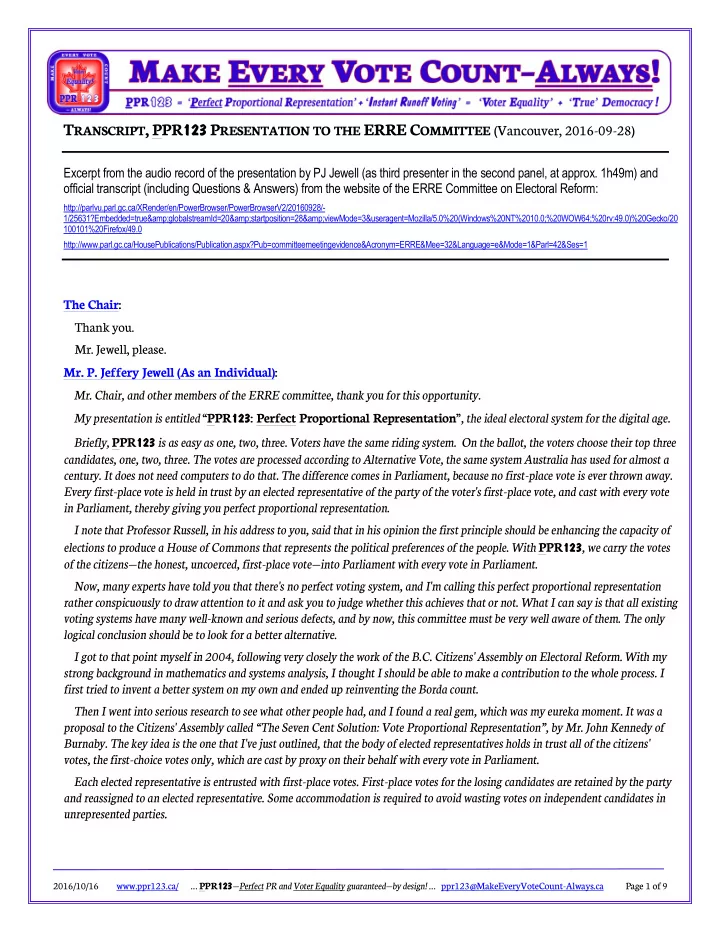
T RANSCRIPT , PPR 123 P RESENTATION TO THE ERRE C OMMITTEE (Vancouver, 2016-09-28) Excerpt from the audio record of the presentation by PJ Jewell (as third presenter in the second panel, at approx. 1h49m) and official transcript (including


slide-1
SLIDE 1

2016/10/16 www.ppr123.ca/ … PPR123—Perfect PR and Voter Equality guaranteed—by design! … ppr123@MakeEveryVoteCount-Always.ca Page 1 of 9

TRANSCRIPT, PPR123 PRESENTATION TO THE ERRE COMMITTEE (Vancouver, 2016-09-28)

Excerpt from the audio record of the presentation by PJ Jewell (as third presenter in the second panel, at approx. 1h49m) and

  • fficial transcript (including Questions & Answers) from the website of the ERRE Committee on Electoral Reform:

http://parlvu.parl.gc.ca/XRender/en/PowerBrowser/PowerBrowserV2/20160928/- 1/25631?Embedded=true&globalstreamId=20&startposition=28&viewMode=3&useragent=Mozilla/5.0%20(Windows%20NT%2010.0;%20WOW64;%20rv:49.0)%20Gecko/20 100101%20Firefox/49.0 http://www.parl.gc.ca/HousePublications/Publication.aspx?Pub=committeemeetingevidence&Acronym=ERRE&Mee=32&Language=e&Mode=1&Parl=42&Ses=1

The Chair: Thank you.

  • Mr. Jewell, please.
  • Mr. P. Jeffery Jewell (As an Individual):
  • Mr. Chair, and other members of the ERRE committee, thank you for this opportunity.

My presentation is entitled “PPR123: Perfect Proportional Representation”, the ideal electoral system for the digital age. Briefly, PPR123 is as easy as one, two, three. Voters have the same riding system. On the ballot, the voters choose their top three candidates, one, two, three. The votes are processed according to Alternative Vote, the same system Australia has used for almost a

  • century. It does not need computers to do that. The difference comes in Parliament, because no first-place vote is ever thrown away.

Every first-place vote is held in trust by an elected representative of the party of the voter's first-place vote, and cast with every vote in Parliament, thereby giving you perfect proportional representation. I note that Professor Russell, in his address to you, said that in his opinion the first principle should be enhancing the capacity of elections to produce a House of Commons that represents the political preferences of the people. With PPR123, we carry the votes

  • f the citizens—the honest, uncoerced, first-place vote—into Parliament with every vote in Parliament.

Now, many experts have told you that there's no perfect voting system, and I'm calling this perfect proportional representation rather conspicuously to draw attention to it and ask you to judge whether this achieves that or not. What I can say is that all existing voting systems have many well-known and serious defects, and by now, this committee must be very well aware of them. The only logical conclusion should be to look for a better alternative. I got to that point myself in 2004, following very closely the work of the B.C. Citizens' Assembly on Electoral Reform. With my strong background in mathematics and systems analysis, I thought I should be able to make a contribution to the whole process. I first tried to invent a better system on my own and ended up reinventing the Borda count. Then I went into serious research to see what other people had, and I found a real gem, which was my eureka moment. It was a proposal to the Citizens' Assembly called “The Seven Cent Solution: Vote Proportional Representation”, by Mr. John Kennedy of

  • Burnaby. The key idea is the one that I've just outlined, that the body of elected representatives holds in trust all of the citizens'

votes, the first-choice votes only, which are cast by proxy on their behalf with every vote in Parliament. Each elected representative is entrusted with first-place votes. First-place votes for the losing candidates are retained by the party and reassigned to an elected representative. Some accommodation is required to avoid wasting votes on independent candidates in unrepresented parties.

slide-2
SLIDE 2

2016/10/16 www.ppr123.ca/ … PPR123—Perfect PR and Voter Equality guaranteed—by design! … ppr123@MakeEveryVoteCount-Always.ca Page 2 of 9

Proxy voting is something we all know as the standard in corporate shareholder democracy, but in a political democracy, the way to think of it is that every adult citizen is an owner entitled to exactly one equal voting share to be entrusted in the representative. What we have now, by contrast, is that we count the votes; the winners are elected, and they go to Parliament. How many votes do they have? They have one: their own. All the citizens' votes are thrown away. The conclusion that I want to make to you is that truly democratic representative government cannot be achieved simply by changing how the citizens vote. Truly democratic representative government can only be achieved by changing both how the citizens vote and how the Parliament votes. PPR123, which eliminates strategic voting and wasted votes, is based on the alternative vote, thereby ensuring that every elected representative has true democratic legitimacy by being the candidate supported by a majority of the electors. Then, in Parliament, we have true democratic legitimacy and absolute equitability through the voting power of each party being exactly equal to and derived from all of the first-place votes of citizens. Using the alternative vote ensures that the first-place vote is uncoerced and therefore an honest vote. So, please, don't do anymore looking backward to previous centuries to look for the best way to do voting in the digital age. Thank you. The Chair: Thank you very much, Mr. Jewell. We'll go to the first questioner, Ms. Sahota, for five minutes.

  • Ms. Ruby Sahota:

Thank you to all our panellists who are here today. I think today has been a great day of panels. We've heard very diverse opinions from person to person, and we enjoy that. I will start with you, Mr. Jewell. First of all, I'd like to thank you and your lovely wife, Diana, for visiting me in Brampton and presenting me with your PPR system, perfect proportional representation, as I think you're calling it. I think we could benefit, though, from further explanation of the system. I think we've heard it also called weighted

  • voting. Is that true? Is that a reference you've heard? Under your system would the weight of each individual MP's vote

change in the House of Commons? Is that a correct representation?

  • Mr. P. Jeffery Jewell:

I wouldn't like to refer to it as a weighted vote, although mathematically you could consider it as such. As I've tried to explain, the rationale for it is that you are not voting your own single vote. You're voting all of the votes that have been entrusted to you, and that is true for all of the members, and everyone's vote is entrusted to somebody. So, yes, you could say that's a weighted vote, and indeed, there's even a stronger reason for thinking that it might be considered in that way, because one of the issues with respect to the matter is that it could be that there are constitutional issues where some provinces may be guaranteed a certain number of seats. My solution to that one is to derive the equivalent seat total that each member would hold in trust by using the total vote and doing a simple calculation, to say so many votes is equal to so many seats. We're talking, of course, about fractional seats. And so, within Parliament itself, you would need computers to keep score of either the citizens' votes or the equivalent seat total votes instead.

  • Ms. Ruby Sahota:

Have you looked at a specific example that you could give us, a simulation maybe from your riding or your region?

  • Mr. P. Jeffery Jewell:
slide-3
SLIDE 3

2016/10/16 www.ppr123.ca/ … PPR123—Perfect PR and Voter Equality guaranteed—by design! … ppr123@MakeEveryVoteCount-Always.ca Page 3 of 9

The first thing to know is that this proposal is strictly neutral and scrupulously fair to all voters, all parties, and all candidates, because it goes right back to the citizens' votes and because it's using only their uncoerced vote, which doesn't exist today. I think the Broadbent report said something like 40% of the votes are strategic votes. Who knows what those people really would have preferred to do? I did do one number, as an example. With the Green Party having only one elected member, it became fairly easy to figure out. According to the last election, the number of votes that the Green Party got would be the equivalent of about 12 seats, so when Ms. May would vote in Parliament, she would have about 12 seats. The people who are never representatives would probably have about three-quarters of a seat. They have less than

  • ne since they would be overrepresented in Parliament because of the distortions of first past the post, which of course

would not exist in the system I'm proposing.

  • Ms. Ruby Sahota:

Thank you, Mr. Jewell. That cleared up some of my questions. I admire your dedication to electoral reform. You and your wife have been watching every single one of our committee meetings. I have to say that's more dedication than we expect from the average person, but you're not an average couple, I guess. So, thank you for that.

  • Mr. Nathan Cullen:
  • Mr. Kam, just looking through your notes, I don't know if you land on a preferred type of voting system, if you go

between the proportional or the current system at all. Do you express a preference?

  • Mr. Christopher Kam:

No.

  • Mr. Nathan Cullen:

You don't have one?

  • Mr. Christopher Kam:

No, I'm choosing among flawed alternatives. I think the trade-offs between them is almost perfect. So what I get from one I lose from another and....

  • Mr. Nathan Cullen:

Okay. So the mandate of this committee is to come up with something among these imperfections. Here's my intuitive challenge. Mr. Jewell, I know you don't want to call it weighted, but it's the only way I can think

  • f it. MPs who are casting their vote in the House based on your system would have a different impact, would have

different significance on the outcome of any vote in Parliament. Is that correct?

  • Mr. Patrick Jewell:

That is correct, but I would like to explain that. The party vote is exactly what it should be.

  • Mr. Nathan Cullen:
  • Right. The final result is that if the Conservatives get 20% of the vote, they contribute to 20% of the vote.
  • Mr. Patrick Jewell:

Let me retranslate my answer to your question. If your party is under-represented, your weighted vote will be greater than one, as it were. If your party is

  • verrepresented, it will be less than one, but it will rectify the distortion.
  • Mr. Nathan Cullen:
slide-4
SLIDE 4

2016/10/16 www.ppr123.ca/ … PPR123—Perfect PR and Voter Equality guaranteed—by design! … ppr123@MakeEveryVoteCount-Always.ca Page 4 of 9

I'll just give you my impressions of that. I imagine that voters represented by people who have a greater weight to their MP's casting ballot will feel empowered, yet voters who have an MP representing them who's at 0.7 of a vote will not feel as great. I know the goal you're aiming at. At an intuitive level, I could imagine people standing in the House of Commons and I could imagine voters saying, “You're my MP. I want you to vote this way.” Elizabeth has 12 votes, I have 0.75 votes, and yet we're still members of Parliament. It feels odd, I guess.

  • Mr. Patrick Jewell:

I'm glad you've challenged this aspect of it, but I'm pleased to respond to it, as well. The first point you made, two minutes ago, was that people living in a riding where the outcome is a known conclusion have no reason to vote. In this system, every vote counts equally, period, all the time. It solves that problem. As to what happens in Parliament, you vote one vote. The computer says that you have 1.5 votes, 0.8 votes, or whatever, but you don't see it. You don't need to think about it. The citizen doesn't need to see it or think about it. All they know is that their wishes, as they expressed them in the election through their honest first-place vote, will be honoured with every vote in Parliament. The Chair: Thank you. Monsieur Ste-Marie. [Translation]

  • Mr. Gabriel Ste-Marie:

Good afternoon, gentlemen. I will take this opportunity to display my knowledge of Spanish too.Encantado, señor

  • Mr. Jewell, one thing I liked in your brief was the possibility of members of Parliament voting remotely. Given that

we are in Vancouver right now, we have missed four votes in the last hour. These are the sacrifices we have to make to meet with you, but the pleasure is greater than the cost, you can rest assured.

  • Mr. Gabriel Ste-Marie:

... I will ask Mr. Jewell a question. In the system you recommend, you keep the same ridings and the person who gets the most votes wins the election. However, you use a preferential system to weight everyone's vote. Is that right?

  • Mr. Jewell, I will have questions for you in a few minutes,

[English]

  • Mr. Patrick Jewell:

No, that's not correct. The alternative vote is such that, as I think you understand the Australian example, all votes are counted, first-place votes. If the leader has 50% plus one, that person is elected. If not, the bottom candidate is eliminated, and those votes for that eliminated candidate revert to their second-place vote. [Translation]

  • Mr. Gabriel Ste-Marie:

All right.

slide-5
SLIDE 5

2016/10/16 www.ppr123.ca/ … PPR123—Perfect PR and Voter Equality guaranteed—by design! … ppr123@MakeEveryVoteCount-Always.ca Page 5 of 9

In other words, to elect someone, we are talking about a preferential system. You know that this system tends to reduce third parties and shift votes toward the more centrist parties. So it would widen the gap between the votes cast for each party and the number of members that represent them. [English]

  • Mr. Patrick Jewell:

That's a possibility, but another possibility is that, because the first-place vote is an honest vote, the third party candidate, as you refer to it, might get many more first-place votes than they do under the existing system. In any case, the first-place vote counts for that party regardless of how many members are elected. [Translation]

  • Mr. Gabriel Ste-Marie:

All right. Thank you. Elizabeth May: I'm going to turn to Mr. Jewell, just because I really do need to understand your system better. It seems to me, it is perfect in proportionality, but there are other values we've been asked to look at, including inclusiveness. I'm picturing myself here in the election. I'd certainly have the voting power to potentially work in a minority government to some greater effect, but I'm still just one person and I think I'm going to die. There are committees. There are amendments. There are debates. Of course, we'd also like to see greater proportionality in the House to be closer to the gender parity in real life in our society. Is there some way that I'm missing in which your system would increase the number of women in Parliament? I think I know the answer. It couldn't increase the number of people who are actually Green Party members working in Parliament, but would it do anything around inclusivity and increasing the proportion of women or other unrepresented groups?

  • Mr. P. Jeffery Jewell:

Thank you, Ms. May. First, I'd say again that the intent of this system is to be scrupulously fair to everyone. When we have a system that is fair, the thing that none of us can foresee is what the difference will be in the voter behaviour if they have a fair

  • system. Therefore, I can't say that you will have more colleagues, but what I can say is that you are supremely

disadvantaged in the existing system, and nobody really knows what the natural level of support for your party would be if there was an honest voting system. That's the first thing. As to the matter of gender parity, I do have ideas on that, which I have elaborated on. I have about 30 documents on the website. Just to make it simple, I believe that the election after 2019 should be one where Elections Canada goes through a serious redistricting. One area to focus on would be to reduce the number of ridings in urban areas, because we will now have a system in which it is geography neutral or population neutral. It doesn't matter how many people are in any riding. Every citizen's vote counts the right amount, wherever they happen to be. In the case of Mr. Cullen, you have a heck of a tough riding to handle. It's tough for you. It's tough for your constituents. I don't think that's a good use of the seats in the legislature. We have so many surplus seats in the urban areas, so I'm saying Elections Canada should be tasked to squeeze out some of those surpluses and reallocate them geographically, where it would provide better service and make your efforts easier. As for females, there is no reason that we couldn't have, within an urban area, a district where there would be six seats, three of which could be reserved for male and three for female. Then you get gender parity by the design of the system and the candidates that the parties propose for it. You can do the same for other diversity goals that you would have. Within the urban areas, there's plenty of potential to do much smarter things with the seats that we've got.

slide-6
SLIDE 6

2016/10/16 www.ppr123.ca/ … PPR123—Perfect PR and Voter Equality guaranteed—by design! … ppr123@MakeEveryVoteCount-Always.ca Page 6 of 9

  • Mr. Gérard Deltell:

Gentlemen, it's a real pleasure for me to meet you. As I said earlier, gentlemen, I welcome that kind of discussion. In our party, we always have the door open. We want a referendum, for sure, but we are open to discussion about the future of the electoral system. This is why, Mr. Jewell, I welcome your proposition, even if I am not quite sure I understand it very well. This is why I raise this question: How do you think we can educate people about so many propositions that we have on the table? How do you think we could achieve that? Because it's not an easy task. We have run on this electoral system for the last century and more. If we want something else, it is quite a challenge. What do you think we should do to educate people before moving on with a new electoral system?

  • Mr. P. Jeffery Jewell:

Is it on the consultation that is the question?

  • Mr. Gérard Deltell:

On the consultation, or how to educate people. It's how you tell the people that this is the new way we want to deal with the electoral system. It's simply to be sure that people understand what the issue is.

  • Mr. P. Jeffery Jewell:

I think it's quite simple to explain the system. It's different, to be sure, but if you explain to people that you vote your first three choices and.... Everyone knows how leaders were elected. That's the process that is used, so that's how your individual member is elected. People will understand that their vote will be taken forward into Parliament and trust in their elected representative, if they voted for the candidate who was elected, or someone else from that party if their candidate was

  • defeated. I think they'll understand that pretty quickly. They'll understand that they're getting better with that system

than they are under this system. Did you ask about the question of validation for a system of this nature?

  • Mr. Gérard Deltell:

Okay, I will express myself in French so the translator will make it easier for you to understand what I tried to ask.

  • Mr. P. Jeffery Jewell:

You mentioned a referendum.

  • Mr. Gérard Deltell:

I invite you to talk on that.

  • Mr. P. Jeffery Jewell:

I have actually recommended a referendum on the PPR side of it. I think the government has all the power to implement the alternative vote. It's an upgrade on the first-past-the-post system. Parliament has the door to that. It's a proven system. It has been used in Australia for a century. It is the mother ship for the PPR side, so I say push forward with alternative vote, put out the PPR side to the public in a referendum, so that they have the understanding of what is being proposed and changed, and let them decide. If they wish to not have PPR, so be it. I think that would be a pretty easy sell, because it's clearly putting more power in the hands of the people and, as was previously said, what the public wants is more power in their hands.

  • Mr. Gérard Deltell:

Is a referendum also a tool or a weapon, to give power to the people in a referendum?

  • Mr. P. Jeffery Jewell:
slide-7
SLIDE 7

2016/10/16 www.ppr123.ca/ … PPR123—Perfect PR and Voter Equality guaranteed—by design! … ppr123@MakeEveryVoteCount-Always.ca Page 7 of 9

It's your call whether you go with a referendum or not, and I'm not a huge advocate of referenda. I've seen how easily they can be perverted by political forces. I also have an enormous respect for the role of representative government. I had a small experience as a municipally elected member. I know how hard elected members work, and it's that research and deliberation that the people really need. If you guys are comfortable, and if you have a consensus that is cross-party, you have all the authority to go forward with this thing. The Chair: Thank you. We'll go to Monsieur Boulerice. [Translation]

  • Mr. Alexandre Boulerice:

Thank you, Mr. Chair. I would like to thank the witnesses for being here with us this afternoon. And thanks to the many people from Vancouver who are in the room for being passionate and interested in a fundamental subject that affects the quality of our democracy. Our committee was given the mandate of studying the various options available to us. In the normal course of things, the 2015 election will be the last one conducted under the present electoral system, the first past the post

  • system. I am using the English term even though I am speaking French, because it is quicker.

I have a question for you, Professor Kam. You say there are always compromises to make, because all electoral systems have advantages and disadvantages. You talked about one compromise in particular relating to

  • accountability. There is also a compromise to be made between the proportionality of a system and the value of local
  • representation. We have heard a lot about that in recent weeks and this summer, when people came to see us. You can

have a system where local representation is very strong, but the distortions are also very strong. The existing system creates distortions that are so large that the will of the people is sometimes overturned. We saw that situation at the federal level in 1979, as well as in British Columbia and three times in Quebec, in 1944, 1966 and

  • 1998. The party that got the most votes lost the election.

Professor Kam, do you think that the fact that this kind of system can overturn the will of the electorate is a fundamental democratic problem? [English]

  • Mr. Christopher Kam:

The question, then, is about when you have a party that wins second place in the popular vote but forms government, that's a problem. Yes, that can be a problem. Ideally, we wouldn't like that. It's rare, but it happens. But I can point to other problems in other systems. When you have a centrist party that gets to make a coalition or be in a minority position regardless of what happens to its vote share, that also would be a problem. That's why I put forward a metric of the responsiveness between shifts in power with respect to shifts in votes. I'm a little uneasy talking about what the voters' will is. Remember that these results of wrong-winner governments come about mostly because of the accumulation of votes, not just within ridings, but mostly the aggregation across ridings, so it could be that one party won very big in some ridings and very small in others. These distortions can happen either at the electoral stage—where that's what happens in the first past the post—or they can happen at the parliamentary stage, when you have a proportional system that generates the need to form coalitions.

slide-8
SLIDE 8

2016/10/16 www.ppr123.ca/ … PPR123—Perfect PR and Voter Equality guaranteed—by design! … ppr123@MakeEveryVoteCount-Always.ca Page 8 of 9

There is a recent paper by G. Bingham Powell, of the University of Rochester, that basically says the propensity for these sorts of—what shall we call them—distortions to emerge is about equal under the two systems, it's just that they

  • ccur in different places in the electoral process. In the proportional system, they're almost always going to have to
  • ccur in the parliamentary formation of coalition governments, where parties could conceivably lose votes, yet

because their ideological location gives them a bargaining advantage, they get into cabinet. Would we call that a distortion? That's why I'm saying I'm a little.... We're making choices in a less-than-perfect world, so there is no first best electoral system. This is akin to buying the used car that you can. No matter which electoral system you get, it's like a used car. It's going to have some dings in it, and you're going to discover some of those problems once you drive it for a little while. [Translation]

  • Mr. Alexandre Boulerice:

Thank you, Professor Kam. I think our committee is going to try to use Mr. Churchill's precept, when he said that democracy was the worst of the existing systems, except all the others. We are going to try to improve the best of the imperfect systems.

  • Mr. Jewell, I would like to ask you a question. I heard the explanation of your system just now. We have not done

this for a long time, but I would like to read you a question from Keith Spoors on Twitter. He asks you what would happen, under your system, if a party did not elect any members, but got 3% or 4% or 5% of the votes. You assign different weight to the votes for each member. There might still be the possibility of a party getting 6% everywhere in the country but not electing any members. In that case, there is no way to assign any weight, or not, to that popular vote. [English]

  • Mr. P. Jeffery Jewell:

Yes, thank you for the question. That's what I was alluding to with the simple statement that some accommodation is necessary to avoid wasting votes for independent candidates or parties that don't elect anyone. The possibilities I see would be to set a threshold, and that's a common thing in proportional systems. Set a threshold of 3%, 4%, or 5%, whatever it is, and if the party reaches that, then they are assured representation extraterritorially from a seat. It could be picked from the strongest defeated candidate or the leader of a small party, whatever. You would have to do that. For the independent candidates, my thought was to have an ombudsperson type of idea where any of the otherwise unrepresented votes or independents would have some representation in a non-partisan form. The Chair: Thank you. We'll go now to Mr. DeCourcey.

  • Mr. Matt DeCourcey:

Thanks very much.

  • Mr. Jewell, in your follow-up testimony to questioning, you believe that we should go ahead and move to an AV

system and run a referendum on the perfect proportional representation. Is that what you concluded?

  • Mr. P. Jeffery Jewell:
slide-9
SLIDE 9

2016/10/16 www.ppr123.ca/ … PPR123—Perfect PR and Voter Equality guaranteed—by design! … ppr123@MakeEveryVoteCount-Always.ca Page 9 of 9

I did feel that a referendum on the PPR side, since it is unprecedented, is something that would need to have public acceptance, and I do believe that's quite achievable because of the merit and the nature of it. I think it's also something that's easy to explain to people, and especially, I think it's easy because it won't have the political opposition of

  • pportunism, which we certainly witnessed here in British Columbia. The political parties had reasons to defeat that
  • recommendation. I don't think they'll have the same motivation to defeat PPR because it is scrupulously fair to

everyone. Since I may not have another chance to talk on this, I'd like to also say that the relationships within the political world should also benefit enormously because, on the alternative vote side, you don't win by undercutting your

  • pponent; you win by getting secondary support. In Parliament, you are not likely going to have a majority, and you

need to work with other people, whether it's a coalition or a minority government, whatever. I think the nature of having a truly honest voting system, where the political parties cannot gain by slagging one another, should help politics in elections. The public's fed up with this kind of nonsense, as you well know, but it wins. Unfortunately, under the system we have, that kind of bad behaviour is rewarded and, under an honest system, it will be punished.