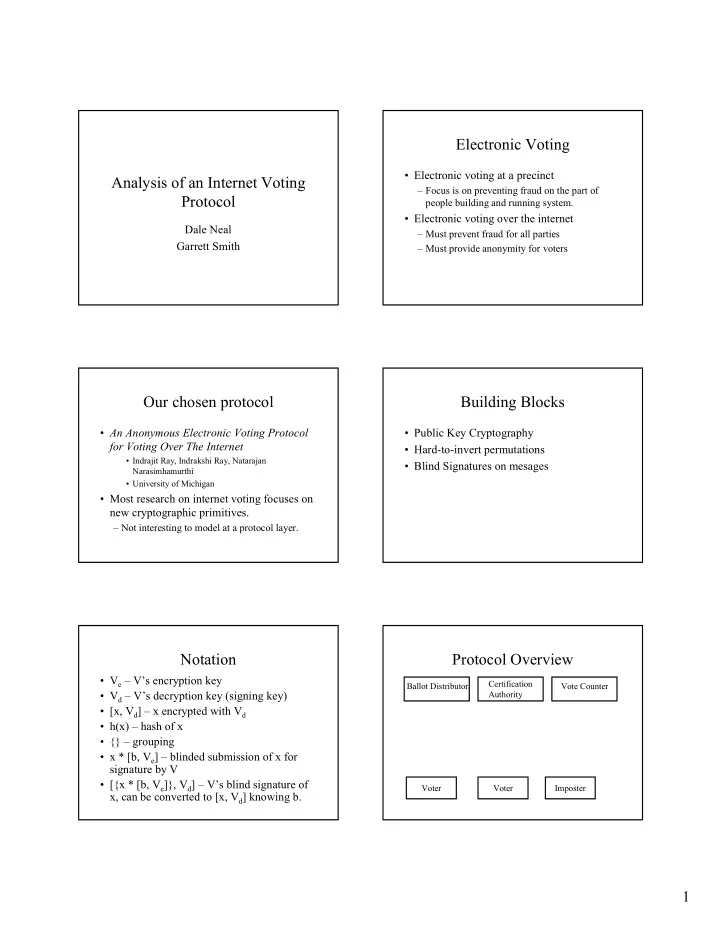
Electronic Voting Electronic voting at a precinct Analysis of an - - PDF document

electronic voting
SMART_READER_LITE
LIVE PREVIEW

Electronic Voting Electronic voting at a precinct Analysis of an - - PDF document

Electronic Voting Electronic voting at a precinct Analysis of an Internet Voting Focus is on preventing fraud on the part of Protocol people building and running system. Electronic voting over the internet Dale Neal Must


slide-1
SLIDE 1

1

Analysis of an Internet Voting Protocol

Dale Neal Garrett Smith

Electronic Voting

  • Electronic voting at a precinct

– Focus is on preventing fraud on the part of people building and running system.

  • Electronic voting over the internet

– Must prevent fraud for all parties – Must provide anonymity for voters

Our chosen protocol

  • An Anonymous Electronic Voting Protocol

for Voting Over The Internet

  • Indrajit Ray, Indrakshi Ray, Natarajan

Narasimhamurthi

  • University of Michigan
  • Most research on internet voting focuses on

new cryptographic primitives.

– Not interesting to model at a protocol layer.

Building Blocks

  • Public Key Cryptography
  • Hard-to-invert permutations
  • Blind Signatures on mesages

Notation

  • Ve – V’s encryption key
  • Vd – V’s decryption key (signing key)
  • [x, Vd] – x encrypted with Vd
  • h(x) – hash of x
  • {} – grouping
  • x * [b, Ve] – blinded submission of x for

signature by V

  • [{x * [b, Ve]}, Vd] – V’s blind signature of

x, can be converted to [x, Vd] knowing b.

Protocol Overview

Ballot Distributor Certification Authority Vote Counter Voter Voter Imposter

slide-2
SLIDE 2

2

Pre-protocol setup

Voter Voter Imposter Registration Authority Voters register and are issued a certificate with public key and identity. Ballot Distributor Certification Authority Vote Counter Voter

Blank Ballot Distribution

[{y, [h(y), BDd]}, Ve] y – ballot serial number

Generate a voter mark

  • Voter mark allows voter to identify their

ballot without letting others identify their ballot.

  • Generated by a one-way permutation of the

serial number.

  • Poorly described in the paper

– We assume they meant a keyed hash.

Voter Certification (part a)

Ballot Distributor Certification Authority Vote Counter Voter y – serial number m – voter mark r – blinding factor [{m * [r,CAe], [h(m*[r,CAe]), Vd], V}, CAe]

Voter Certification (part b)

Ballot Distributor Certification Authority Vote Counter Voter y – serial number m – voter mark r – blinding factor [[{m * [r,CAe]}, CAd], Ve]

Vote Casting

Ballot Distributor Certification Authority Vote Counter Voter [{vote, [m, CAd]}, VCe] m – voter mark Note: Abstracted away public FTP server intermediary

slide-3
SLIDE 3

3

Publishing

Ballot Distributor Certification Authority Vote Counter {vote2, [m2, CAd]} {vote1, [m1, CAd]} {vote3, [m3, CAd]} {m1 * [r,CAe], [h(m1*[r,CAe]), V1d]} {m2 * [r,CAe], [h(m2*[r,CAe]), V2d]} {m3 * [r,CAe], [h(m3*[r,CAe]), V3d]} y1 y2 y3

Attack Model

  • Any of CA, BD, VC could collude among

themselves and with any voters.

– Only colluding voters votes should be affected

  • If fraud occurs, the fraud can be proved

Claimed Properties

  • Only eligible voters are able to cast votes
  • A voter is able to cast only one vote
  • A voter is able to verify that his or her vote is

counted in the final tally

  • Nobody other than the voter can link a cast vote

with a voter

  • If a voter decides not to vote, nobody is able to

cast a fraudulent vote in place of the voter.

Modeling in Murphi

  • Encryption, signatures modeled same as in

Needham-Schroeder with AgentId

  • Serial number, voter mark, blind signatures

modeled in the same way.

  • Registered and unregistered voters
  • BD, CA, VC can all act fraudulently, and

accept invalid data

Invariants

  • Different type of invariant than for

Needham-Schroeder and other authentication protocols.

  • Of the type: if there is fraud, can a party

detect it?

invariant "voter can prove fraud if their vote is uncounted" forall i: GoodVoterId do forall j: VCId do voter[i].state = V_VOTED & multisetcount (l:vc[j].votes, vc[j].votes[l].signedMark = voter[i].signedMark) = 0

  • >

ismember(voter[i].ballotSigner, BDId) & ismember(voter[i].markSigner, CAId) end end;

slide-4
SLIDE 4

4

invariant "voter cannot claim fraud when they don’t vote" forall i: GoodVoterId do forall j: VCId do voter[i].state != V_VOTED & multisetcount(l:vc[j].votes, vc[j].votes[l].signedMark = voter[i].signedMark & vc[j].votes[l].vote = true) = 0

  • >

!(ismember(voter[i].ballotSigner, BDId) & ismember(voter[i].markSigner, CAId)) end end;

Invariant is violated

  • After Voter Certification voter has:

– Serial number signed by BD – Voter mark signed by CA

  • VC cannot demonstrate it never received

vote as opposed to VC discarding the vote.

  • Since any voter can demonstrate fraud even

if none exists, demonstrations of fraud have no meaning.

Detecting know flaws

  • We were able to construct an invariant to

detect a flaw discussed in the paper: If a voter completes Voter Certification, but does not vote the three agents can collude to cast a fraudulent vote in that voters place.

invariant "a fraudulent vote can be detected" forall i: VCId do forall j: CAId do multisetcount(l:vc[i].votes, vc[i].votes[l].vote = false) > 0

  • >

multisetcount(l:vc[i].votes, true) > multisetcount(m:ca[j].certifications, ca[j].certifications[m].response)

  • - if there is a fraudulent vote, there must
  • - be more votes than published certified voters.

end end;

Deficiencies we couldn’t model

  • Ballot distribution seems unnecessary

– Voter chooses nonce – CA keeps track of which voters have submitted nonces for blind signature and only signs one nonce per registered voter

  • Encrypting traffic makes it harder for bystanders

to eavesdrop, but doesn't provide any extra guarantees because even with CA, BD, and VC colluding they can’t determine who cast what vote.

Benefits of modeling

  • Ambiguities in the protocol description

were cleared up by modeling the protocol and figuring out what had to be provided to ensure desired properties

slide-5
SLIDE 5

5

Conclusions

  • Being able to demonstrate fraud when there

is none is a fatal flaw.

  • Murphi is not well suited to modeling this

flavor of protocol.

– All of the flaws we found were discovered while trying to model the protocol – Proof oriented analysis seems to be a better fit

  • Prove for each type of fraud, that if it happens, then

an honest party can prove that it happened