
SLIDE 1
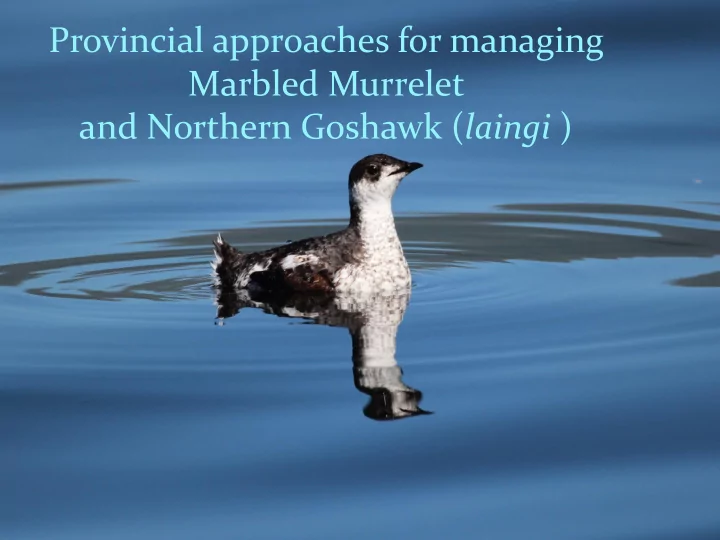
Provincial approaches for managing Marbled Murrelet and Northern - - PowerPoint PPT Presentation
Provincial approaches for managing Marbled Murrelet and Northern Goshawk ( laingi ) Purpose of Presentation Why prepare Implementation Plans? Share information re: proposed provincial management approach for MAMU and NOGO Review next
Why prepare Implementation Plans? Share information re: proposed provincial management
approach for MAMU and NOGO
Review next steps, timelines
Seek to meet commitments in the Accord for the
Guide management actions; Informed by science; Consider socio-economic factors. Represent a formal government commitment
provincial Crown land;
Conservation Regions;
Proposed approach:
Adopt updated Minimum Habitat Thresholds
(MHTs) and Conservation Region (CR) distribution as outlined in the 2014 Federal MAMU Recovery Strategy applied to Crown land only
Northern Mainland Coast (68%) Haida Gwaii (68%) Central Mainland Coast (68%) South Coast (85%) West & North Vancouver Island (68%) Eastern Vancouver Island (90%) Alaska Border (70%) Total Area (70%) All Lands 293,242 150,315 229,577 103,468 179,893 71,700 19,018 1,047,213 Crown Land 265,872 148,529 228,962 97,391 173,467 25,863 19,013 959,096
Spatialize and legalize 80% of the total suitable
habitat in the WNVI and SMC CRs
Explore opportunities to spatialize functional
habitat on EVI with affected parties (e.g. PMFL holders).
Vancouver Island Conservation Region South Coast Conservation Region North Coast Conservation Region Haida Gwaii Conservation Region Total Home Ranges
Original Federal Home Range Targets
184 122 80 58 444
Original Provincial Home Range Targets
184 122 80 25 411
Revised Federal Home Range Targets
145 110 128 58 441
Recommended Revised Provincial Home Range Targets
145 110 128 25 408
Provides more management flexibility
Increases number of BAs that can contribute to
Research plan being developed Pursuing additional analyses/ modelling Actions to be included in I.P.
Except Haida Gwaii, BC adopts federal home range
Does not adopt Critical Habitat on all 108 home ranges
Management by design (vs. by discovery).
Proposes low-risk management approach (200 ha
Small deviation from federal formula
Decision on foraging habitat management deferred
Inventory and Monitoring to support new WHAs UBC/ Genome BC genomic research Shared stewardship discussions on non-Crown land
Implementation Plan
target: ~June 2017 Breeding Area management ‘by design’ Transition Zone
Foraging habitat research plan and analyses by 2020
Legalize draft OGMAs with high suitability MAMU habitat Finalize works in progress (i.e. priority WHAs for both
species) enabled by CFPA MOU
Continued inventory and monitoring Explore shared stewardship on non-Crown land Develop Implementation Plans (target: June 2017) including
continued engagement with CFPA et al.