Protein-Protein Docking Current Methods and New Challenges Hybrid - - PowerPoint PPT Presentation

protein protein docking current methods and new challenges
SMART_READER_LITE
LIVE PREVIEW

Protein-Protein Docking Current Methods and New Challenges Hybrid - - PowerPoint PPT Presentation

Outline Review of Selected CAPRI Targets Some Algorithms Used in CAPRI Assembling Symmetric Multimers Protein-Protein Docking Current Methods and New Challenges Hybrid Approaches Knowledge-Based + MD New Challenges Structural


slide-1
SLIDE 1

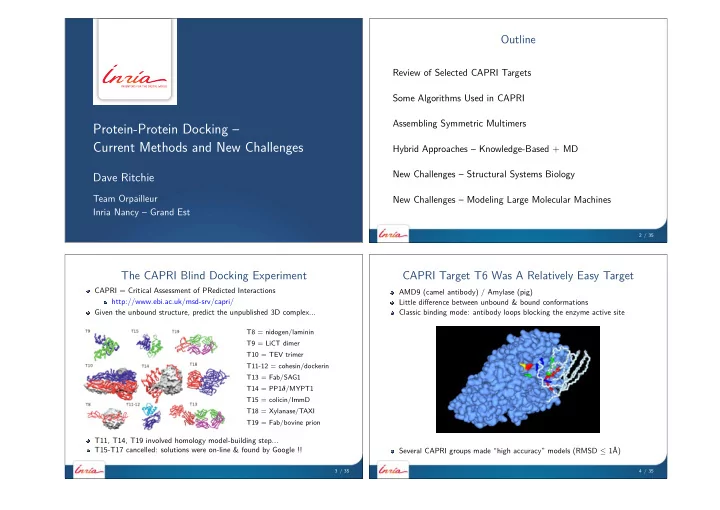
Protein-Protein Docking – Current Methods and New Challenges

Dave Ritchie

Team Orpailleur Inria Nancy – Grand Est

Outline

Review of Selected CAPRI Targets Some Algorithms Used in CAPRI Assembling Symmetric Multimers Hybrid Approaches – Knowledge-Based + MD New Challenges – Structural Systems Biology New Challenges – Modeling Large Molecular Machines

2 / 35

The CAPRI Blind Docking Experiment

CAPRI = Critical Assessment of PRedicted Interactions http://www.ebi.ac.uk/msd-srv/capri/ Given the unbound structure, predict the unpublished 3D complex...

T8 = nidogen/laminin T9 = LiCT dimer T10 = TEV trimer T11-12 = cohesin/dockerin T13 = Fab/SAG1 T14 = PP1δ/MYPT1 T15 = colicin/ImmD T18 = Xylanase/TAXI T19 = Fab/bovine prion

T11, T14, T19 involved homology model-building step... T15-T17 cancelled: solutions were on-line & found by Google !!

3 / 35

CAPRI Target T6 Was A Relatively Easy Target

AMD9 (camel antibody) / Amylase (pig) Little difference between unbound & bound conformations Classic binding mode: antibody loops blocking the enzyme active site Several CAPRI groups made “high accuracy” models (RMSD ≤ 1˚ A)

4 / 35

slide-2
SLIDE 2

CAPRI Target T27 Was A Surprisingly Difficult Target

Arf6 GTPase / LZ2 Leucine zipper was difficult for most predictors http://www.ebi.ac.uk/msd-srv/capri/ Circles show LZ2 centres: blue = high quality green = medium quality cyan = acceptable quality yellow = wrong

Janin (2010) Molecular BioSystems, 6, 2362–2351

5 / 35

Predicting Protein-Protein Binding Sites

Many algorithms/servers exist for predicting protein binding sites

For a review: Fern´ andez-Recio (2011), WIREs Comp Mol Sci 1, 680–698

Many docking algorithms show clusters of orientations – docking “funnels” Lensink & Wodak: docking methods are best predictors of binding sites

Fern´ andez-Recio, Abagyan (2004), J Molecular Biology, 335, 843–865 Lensink, Wodak (2010), Proteins, 78, 3085–3095

6 / 35

CAPRI Results: Targets 8 – 19

Software T8 T9 T10 T11 T12 T13 T14 T18 T19 ICM ** * ** *** * *** ** ** PatchDock ** * * * *

  • **

** * ZDOCK/RDOCK ** * *** *** *** ** ** FTDOCK * * ** * ** ** * RosettaDock

  • **

*** ** *** *** SmoothDock ** *** *** ** ** * RosettaDock ***

  • **

*** ** Haddock

  • **

** *** *** ClusPro ** *** * * 3D-DOCK ** * * ** * MolFit *** * *** ** Hex ** *** * * Zhou

  • ***

** * * DOT *** *** ** ATTRACT **

  • ***

** Valencia * * *

  • GRAMM
  • **

** Umeyama ** * Kaznessis

  • ***

Fano

  • *

Mendez et al. (2005) Proteins Struct. Funct. Bionf. 60, 150-169

7 / 35

ICM Docking – Multi-Start Pseudo-Brownian Search

Start by sticking pins in protein surfaces at 15˚ A intervals For each pair of pins, find minimum energy (6 rotations for each):

E = EHVW + ECVW + 2.16Eel + 2.53Ehb + 4.35Ehp + 0.20Esolv

Often gives good results, but is computationally expensive

Fern´ andez-Recio, Abagyan (2004), J Mol Biol, 335, 843–865

8 / 35

slide-3
SLIDE 3

PatchDock – Docking by Geometric Hashing

Use “MS” program to calculate mesh surfaces for each protein Divide the mesh into convex “caps”, concave “pits”, and flat “belts” For docking, match pairs of concave/convex, and flat/any ... ... then test for steric clashes between rest of surfaces The method is fast (minutes/seconds), and gave good results in CAPRI

Duhovny et al. (2002), LNCS 2452, 185–200 Schneidman-Duhovny et al. (2005), NAR, 33, W363–W367 Connolly (1983), J Appl Cryst, 16, 548–558

9 / 35

Protein Docking Using Fast Fourier Transforms

Conventional approaches digitise proteins into 3D Cartesian grids... ...and use FFTs to calculated TRANSLATIONAL correlations: C[∆x, ∆y, ∆z] =

  • x,y,z

A[x, y, z] × B[x + ∆x, y + ∆y, z + ∆z] BUT for docking, have to repeat for many rotations – expensive! Conventional grid-based FFT docking = SEVERAL CPU-HOURS

Katchalski-Katzir et al. (1992) PNAS, 89 2195–2199

10 / 35

Quick Summary of FFT Docking Methods

3D Cartesian FFT Methods

DOT (shape + electro): http://www.sdsc.edu/CCMS/DOT/ FTDOCK (shape + electro) http://www.sbg.bio.ic.ac.uk/docking/ GRAMM (shape?) http://vakser.bioinformatics.ku.edu/main/resources gramm.php ZDOCK (shape + “ACP”) http://zdock.umassmed.edu/software/ PIPER (shape + “DARS” potential): http://cluspro.bu.edu/ MegaDock (shape only?): http://www.bi.cs.titech.ac.jp/megadock/

Polar Fourier FFT Methods

Hex (shape + electro): http://hex.loria.fr/ Frodock (shape only?): http://chaconlab.org/methods/docking/frodock/

Interactive FFT with 3D Graphics

Hex!

11 / 35

Knowledge-Based Protein Docking Potentials

Several groups have developed “statistical potentials” Example: DARS – “Decoys As Reference State” – http://structure.bu.edu/ Define interaction energy (“inverse Boltzmann”): EIJ = −RT ln(Pnat

IJ /Pref IJ )

Pnat

IJ

= prob. that atoms I and J are in contact in native complex Pref

IJ

= reference state prob., calculated from 20,000 docking decoys This gives a matrix of 18 x 18 atom-type interaction energies Clever trick: diagonalise matrix to get first 4 or 6 leading terms... ... allows PIPER to use 4 or 6 FFTs instead of 18

PIPER + DARS is one of the best approaches in CAPRI...

Kozakov et al. (2006) Proteins, 65, 392–406

12 / 35

slide-4
SLIDE 4

DARS Finds More Hits Than ZDOCK or Shape-Only

These plots compare “hits” versus “rank” DARS potential = red; ZDOCK (ACP) = green; shape-only = blue

Kozakov et al. (2006) Proteins, 65, 392–406

13 / 35

Consider Protein Docking in Polar Coordinates

Rigid docking can be considered as a largely ROTATIONAL problem This means we should use ANGULAR coordinate systems With FIVE rotations, we should get a good speed-up?

14 / 35

Spherical Polar Fourier Representations

Represent protein shape as a 3D shape-density function... τ(r) = N

nlm aτ nlmRnl(r) ylm(θ, φ)

...using spherical harmonic, ylm(θ, φ), and radial, Rnl(r), basis functions

Image Order Coefficients A Gaussians

  • B

N = 16 1,496 C N = 25 5,525 D N = 30 9,455 15 / 35

Protein Docking Using SPF Density Functions

Favourable:

  • (σA(r A)τB(r B) + τA(r A)σB(r B))dV

Unfavourable:

  • τA(r A)τB(r B)dV

Score: SAB =

  • (σAτB + τAσB − QτAτB)dV ,

Penalty Factor: Q = 11 Orthogonality: SAB =

  • nlm

nlmbτ nlm + aτ nlm

nlm − Qbτ nlm

  • Search:

6D space = 1 distance + 5 Euler rotations: (R, βA, γA, αB, βB, γB)

16 / 35

slide-5
SLIDE 5

HexServer – GPU-Accelerated Web Server

Very fast – can cover 6D search space using 1D, 3D, or 5D FFTs... “Easy” to accelerate the 1D FFTs on highly parallel GPUs ... Widely used around the world – 33,000 downloads...

http://www.loria.fr/hex/ and http://www.loria.fr/hexserver/

17 / 35

RosettaDock – Flexible Side Chain Re-Packing

Given a rigid body starting pose, repeat 50 times:

REMOVE and RE-BUILD side chains Minimise as rigid-body with Monte-Carlo accept/reject Successful on several CAPRI targets and 50% of Docking Benchmark v2

18 / 35

Haddock – “Highly Ambiguous Data-Driven Docking”

Flexible refinement using CNS with ambiguous interaction restraints (AIRs) Use of “active” and “passive” residues ensures active residues at interface E.g. residue i of protein A: deff

iAB =

NiA

miA=1

NresB

k=1

NkB

nkB=1

  • 1

d6

miA,nkB

−1/6 Restraints from: SAXS mutagenesis mass spec NMR

van Dijk et al. (2005) FEBS J, 272, 293–312 van Dijk et al. (2005) Proteins, 60, 232–238

19 / 35

Modeling Protein Flexibility Using Elastic Network Models

ENMs assume protein Cα atoms are coupled via a harmonic potential .. V=potential, dij=distance, d0

ij=ref distances, H=Hessian, C=const

E=eigenvector matrix, ei=normal modes, Λii=magnitudes V =

i<j C(dij − d0 ij)2

Hij = (∂/∂xi)(∂/∂xj)V H = E T.Λ.E Then, represent protein as a linear combination of first eigenvectors: PNEW = P0 + 3N

i=6 wiei

On-line examples:

ElN´ emo web-server: http://www.igs.cnrs-mrs.fr/elnemo/ Macromolecular Movements: http://www.molmovdb.org/

Tirion (1996), Physical Review Letters, 77, 1905–1908 (first paper) Andrusier et al. (2008), Proteins, 73, 271–289 (review

20 / 35

slide-6
SLIDE 6

Simulating Flexibility Using “Essential Dynamics”

Generate distance-constrained samples in CONCOORD, then apply PCA

Covariance matrix, C: Cij = < (xi − x i)(xj − x j) > Eigenvectors, E: C = E.Λ.E T Conformations, P: PNEW ≃ P0 + n

k=1 αkek

First eigenvectors encode most of RMSD between bound and unbound See also SwarmDock – http://bmm.cancerresearchuk.org/∼SwarmDock/

Mustard, Ritchie (2005), Proteins 60, 269–274 (first NMA protein docking?) Moal, Bates (2010) Int J Molecular Sciences, 11, 3623–3648 (SwarmDock)

21 / 35

EigenHex – Flexible Docking Using Pose-Dependent ENM

Apply fresh eigenvector analysis to the top 1,000 Hex orientations

Overall approach: Cα elastic network model (ENM) Use up to 20 eivenvectors Search using PSO Score using DARS potential Results: DARS works well but... Still need better scoring function Much effort – small improvement!!

Venkatraman, Ritchie (2012), Proteins, 80, 2262–2274

22 / 35

Docking Symmetric Structures

Several groups have developed symmetry docking algorithms

Molfit (D2): Berchanski et al. (2003), Proteins, 53, 817–829 M-ZDOCK (Cn): Pierce et al. (2005), Bioinformatics, 21, 1472–1478 SymmDock (Cn): Schneidman et al. (2005), Proteins, 60, 224–231 Cluspro (Cn,D2, D3): Comeau et al. (2005), JSB, 150, 233-244

(these algorithms “post-filter” blind docking searches)

Symmetric complexes are remarkably common in the PDB

n 2 3 4 5 6 7 8 Cn 8740 992 223 107 76 29 5 Dn 2111 585 173 46 20 23 6 (data from: http://www.3dcomplex.org)

23 / 35

Coming Soon: “SAM” – Symmetry Assembler

Uses multiple 1D Polar Fourier FFT searches

Implemented for all point group symmetries: Cn, Dn, T, O, I Works well for small protein domains... Need to develop coarse-grained scoring for large proteins Need to extend to symmetric cryo-EM density fitting...

24 / 35

slide-7
SLIDE 7

Systems Biology View of Protein-Protein Interactions

Protein interactions are central to many biological systems Each protein is part of a large network of interactions

To understand how proteins really work, we need to know their three-dimensional structures... But solving structures is difficult! We need to exploit knowledge of known structures and interactions...

25 / 35

Protein-Protein Interaction Challenges

Can we predict all interactions within a proteome – the interactome? For each interaction, can we predict the interface and 3D complex? For each protein can we predict its ligand binding sites?

Wass, David, Sternberg (2011) Current Opinion in Structural Biology, 21, 382–390

26 / 35

Protein-Protein Interaction Resources

STRING – Search Tool for Retrieval of Interacting Genes 12 million known PPIs; 44 million predicted – http://string.embl.de/ 3DID – 160,000 DDIs – http://3did.irbbarcelona.org/ KBDOCK – Knowledge-Based Docking (“Domain Family Binding Sites”) 280,000 DDIs + 4,000 DFBIs – http://kbdock.loria.fr/

Szklarzyk et al. (2011), Nucleic Acids Research, 39, D561–D568 Stein et al. (2010), Nucleic Acids Research, 33, D413–D417 Ghoorah et al. (2014), Nucleic Acids Research, 42, D389–D395

27 / 35

CAPRI Target 40 (2009) – API-A/Trypsin

It was given that there were TWO different binding sites We searched SCOPPI and 3DID for similar 3D interactions This helped to identify two inhibitory loops on API-A Using Hex + MD refinement gave NINE “acceptable” solutions

28 / 35

slide-8
SLIDE 8

The KBDOCK Database and Web Server

Domains are superposed and clustered by PFAM family ∼ 8,000 non-redundant domain family binding sites (DFBSs) ∼ 20,000 domain family interactions (DFIs)

http://kbdock.loria.fr/

Ghoorah et al. (2014) NAR, 42, D389-D395

29 / 35

The Inside of a Cell is Highly Crowded

This image shows a model of the cytoplasm in E. Coli Can we use docking algorithms to predict the protein-protein interactions ?

McGuffee, Elcock (2009), PLoS Comp Biol, 6, e1000694

30 / 35

Large-Scale Cross-Docking Using Hex

Wass et al. cross-docked 56 true pairs with 922 non-redundant “decoys” For each pair, they plotted the profile of the best 20,000 docking scores... (-ve scores are good; red/blue = correct PPI; red/cyan = incorrect interactions) 48/56 true PPIs have significantly higher energies than false pairs Only 8/56 true PPIs have indistinguishable profiles to the non-binders

Wass et al. (2011) Molecular Systems Biology, 7, article 469

31 / 35

IMP – Integrative Modeling Platform

Python system for multi-component modeling – http://salilab.org/imp/ Combines data from: cryoEM (mainly), X-Ray, NMR, SAXS, Modeller, ... ... with with interaction data from BioGRID – http://thebiogrid.org/ Minimise multi-term objective function: F =

i αi + i<j βij

αiare single-body terms (e.g. density fitting score, protrusion penalty) βij are two-body terms (e.g. docking scores) But it is a highly combinatorial search space, with missing/incomplete data...

Russel et al. (2012) PLoS Biology, 10, e1001244 Lasker et al. (2009) J Molecular Biology, 388, 180–194

32 / 35

slide-9
SLIDE 9

Putting The Pieces Together – The Nuclear Pore Complex

The NPC has some 650 components – raw data at http://salilab.org/npc/ It required an immense multi-disciplinary effort to build this model ... See Dreyfuss et al. for an interesting computational validation of the model

Alber et al. Nature (2007) 450, 683–694 and 695–701 Dreyfuss et al. Proteins (2012) 80, 2125–2136

33 / 35

Conclusions

(+) Better potentials are helping to improve pair-wise docking (+) Cross-docking can detect true partners remarkably often (+) General symmetry assembly is “coming soon”... (−) Modeling protein flexibility during docking is still difficult (+) Knowledge-based protein docking is becoming very useful

Most Pfam families have just one binding site – often re-used

(+) Current strategy: “data-driven” or “knowledge-based” docking (?) The next challenge – modeling “the structural interactome”

All-vs-all docking ? Electron-microscopy density fitting ? Assembling multi-component machines ?

34 / 35

Thank You! Acknowledgments

Anisah Ghoorah Matthieu Chavent Diana Mustard Vishwesh Venkatraman Lazaros Mavridis BBSRC, EPSRC, ANR

35 / 35

Hex program and papers:

http://hex.loria.fr/