Pros and cons of propositional logic Propositional logic is - - PowerPoint PPT Presentation

pros and cons of propositional logic
SMART_READER_LITE
LIVE PREVIEW

Pros and cons of propositional logic Propositional logic is - - PowerPoint PPT Presentation

Pros and cons of propositional logic Propositional logic is declarative : pieces of syntax correspond to facts Propositional logic allows partial/disjunctive/negated information (unlike most data structures and databases) First-order logic


slide-1
SLIDE 1

First-order logic

Chapter 8

Chapter 8 1

Outline

♦ Why FOL? ♦ Syntax and semantics of FOL ♦ Fun with sentences ♦ Wumpus world in FOL

Chapter 8 2

Pros and cons of propositional logic

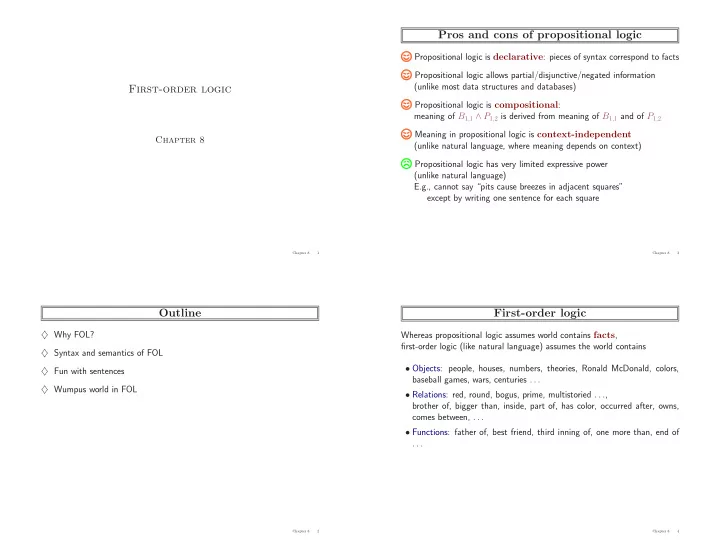
Propositional logic is declarative: pieces of syntax correspond to facts Propositional logic allows partial/disjunctive/negated information (unlike most data structures and databases) Propositional logic is compositional: meaning of B1,1 ∧ P1,2 is derived from meaning of B1,1 and of P1,2 Meaning in propositional logic is context-independent (unlike natural language, where meaning depends on context) Propositional logic has very limited expressive power (unlike natural language) E.g., cannot say “pits cause breezes in adjacent squares” except by writing one sentence for each square

Chapter 8 3

First-order logic

Whereas propositional logic assumes world contains facts, first-order logic (like natural language) assumes the world contains

  • Objects: people, houses, numbers, theories, Ronald McDonald, colors,

baseball games, wars, centuries . . .

  • Relations: red, round, bogus, prime, multistoried . . .,

brother of, bigger than, inside, part of, has color, occurred after, owns, comes between, . . .

  • Functions: father of, best friend, third inning of, one more than, end of

. . .

Chapter 8 4

slide-2
SLIDE 2

Logics in general

Language Ontological Epistemological Commitment Commitment Propositional logic facts true/false/unknown First-order logic facts, objects, relations true/false/unknown Temporal logic facts, objects, relations, times true/false/unknown Probability theory facts degree of belief Fuzzy logic facts + degree of truth known interval value

Chapter 8 5

Syntax of FOL: Basic elements

Constants KingJohn, 2, UCB, . . . Predicates Brother, >, . . . Functions Sqrt, LeftLegOf, . . . Variables x, y, a, b, . . . Connectives ∧ ∨ ¬ ⇒ ⇔ Equality = Quantifiers ∀ ∃

Chapter 8 6

Atomic sentences

Atomic sentence = predicate(term1, . . . , termn)

  • r term1 = term2

Term = function(term1, . . . , termn)

  • r constant or variable

E.g., Brother(KingJohn, RichardTheLionheart) > (Length(LeftLegOf(Richard)), Length(LeftLegOf(KingJohn)))

Chapter 8 7

Complex sentences

Complex sentences are made from atomic sentences using connectives ¬S, S1 ∧ S2, S1 ∨ S2, S1 ⇒ S2, S1 ⇔ S2 E.g. Sibling(KingJohn, Richard) ⇒ Sibling(Richard,KingJohn) >(1, 2) ∨ ≤(1, 2) >(1, 2) ∧ ¬>(1, 2)

Chapter 8 8

slide-3
SLIDE 3

Truth in first-order logic

Sentences are true with respect to a model and an interpretation Model contains ≥ 1 objects (domain elements) and relations among them Interpretation specifies referents for constant symbols → objects predicate symbols → relations function symbols → functional relations An atomic sentence predicate(term1, . . . , termn) is true iff the objects referred to by term1, . . . , termn are in the relation referred to by predicate

Chapter 8 9

Models for FOL: Example

R J

$ left leg left leg

  • n head

brother brother person person king crown

Chapter 8 10

Truth example

Consider the interpretation in which Richard → Richard the Lionheart John → the evil King John Brother → the brotherhood relation Under this interpretation, Brother(Richard, John) is true just in case Richard the Lionheart and the evil King John are in the brotherhood relation in the model

Chapter 8 11

Models for FOL: Lots!

Entailment in propositional logic can be computed by enumerating models We can enumerate the FOL models for a given KB vocabulary: For each number of domain elements n from 1 to ∞ For each k-ary predicate Pk in the vocabulary For each possible k-ary relation on n objects For each constant symbol C in the vocabulary For each choice of referent for C from n objects . . . Computing entailment by enumerating FOL models is not easy!

Chapter 8 12

slide-4
SLIDE 4

Universal quantification

∀ variables sentence Everyone at Berkeley is smart: ∀ x At(x, Berkeley) ⇒ Smart(x) ∀ x P is true in a model m iff P is true with x being each possible object in the model Roughly speaking, equivalent to the conjunction of instantiations of P (At(KingJohn, Berkeley) ⇒ Smart(KingJohn)) ∧ (At(Richard, Berkeley) ⇒ Smart(Richard)) ∧ (At(Berkeley, Berkeley) ⇒ Smart(Berkeley)) ∧ . . .

Chapter 8 13

A common mistake to avoid

Typically, ⇒ is the main connective with ∀ Common mistake: using ∧ as the main connective with ∀: ∀ x At(x, Berkeley) ∧ Smart(x) means “Everyone is at Berkeley and everyone is smart”

Chapter 8 14

Existential quantification

∃ variables sentence Someone at Stanford is smart: ∃ x At(x, Stanford) ∧ Smart(x) ∃ x P is true in a model m iff P is true with x being some possible object in the model Roughly speaking, equivalent to the disjunction of instantiations of P (At(KingJohn, Stanford) ∧ Smart(KingJohn)) ∨ (At(Richard, Stanford) ∧ Smart(Richard)) ∨ (At(Stanford, Stanford) ∧ Smart(Stanford)) ∨ . . .

Chapter 8 15

Another common mistake to avoid

Typically, ∧ is the main connective with ∃ Common mistake: using ⇒ as the main connective with ∃: ∃ x At(x, Stanford) ⇒ Smart(x) is true if there is anyone who is not at Stanford! ∃ x ¬At(x, Stanford) ∨ Smart(x) just needs one person not at Stanford to make the sentence true.

Chapter 8 16

slide-5
SLIDE 5

Properties of quantifiers

∀ x ∀ y is the same as ∀ y ∀ x ∃ x ∃ y is the same as ∃ y ∃ x ∃ x ∀ y is not the same as ∀ y ∃ x ∃ x ∀ y Loves(x, y) “There is a person who loves everyone in the world” ∀ y ∃ x Loves(x, y) “Everyone in the world is loved by at least one person” Quantifier duality: each can be expressed using the other ∀ x Likes(x, IceCream) ¬∃ x ¬Likes(x, IceCream) ∃ x Likes(x, Broccoli) ¬∀ x ¬Likes(x, Broccoli)

Chapter 8 17

Fun with sentences

Brothers are siblings

Chapter 8 18

Fun with sentences

Brothers are siblings ∀ x, y Brother(x, y) ⇒ Sibling(x, y). “Sibling” is symmetric

Chapter 8 19

Fun with sentences

Brothers are siblings ∀ x, y Brother(x, y) ⇒ Sibling(x, y). “Sibling” is symmetric ∀ x, y Sibling(x, y) ⇔ Sibling(y, x). One’s mother is one’s female parent

Chapter 8 20

slide-6
SLIDE 6

Fun with sentences

Brothers are siblings ∀ x, y Brother(x, y) ⇒ Sibling(x, y). “Sibling” is symmetric ∀ x, y Sibling(x, y) ⇔ Sibling(y, x). One’s mother is one’s female parent ∀ x, y Mother(x, y) ⇔ (Female(x) ∧ Parent(x, y)). A first cousin is a child of a parent’s sibling

Chapter 8 21

Fun with sentences

Brothers are siblings ∀ x, y Brother(x, y) ⇒ Sibling(x, y). “Sibling” is symmetric ∀ x, y Sibling(x, y) ⇔ Sibling(y, x). One’s mother is one’s female parent ∀ x, y Mother(x, y) ⇔ (Female(x) ∧ Parent(x, y)). A first cousin is a child of a parent’s sibling ∀ x, y FirstCousin(x, y) ⇔ ∃ p, ps Parent(p, x) ∧ Sibling(ps, p) ∧ Parent(ps, y)

Chapter 8 22

Equality

term1 = term2 is true under a given interpretation if and only if term1 and term2 refer to the same object E.g., ∀ x ×(Sqrt(x), Sqrt(x)) = x are satisfiable 2 = 2 is valid E.g., definition of (full) Sibling in terms of Parent: ∀ x, y Sibling(x, y) ⇔ [¬(x = y) ∧ ∃ m, f ¬(m = f) ∧ Parent(m, x) ∧ Parent(f, x) ∧ Parent(m, y) ∧ Parent(f, y)]

Chapter 8 23

Interacting with FOL KBs

Suppose a wumpus-world agent is using an FOL KB and perceives a smell and a breeze (but no glitter) at t = 5: Tell(KB, Percept([Smell, Breeze, None], 5)) Ask(KB, ∃ a Action(a, 5)) I.e., does KB entail any particular actions at t = 5? Answer: Y es, {a/Shoot} ← substitution (binding list) Given a sentence S and a substitution σ, Sσ denotes the result of plugging σ into S; e.g., S = Smarter(x, y) σ = {x/Hillary, y/Bill} Sσ = Smarter(Hillary, Bill) Ask(KB, S) returns some/all σ such that KB | = Sσ

Chapter 8 24

slide-7
SLIDE 7

Knowledge base for the wumpus world

“Perception” ∀ b, g, t Percept([Smell, b, g], t) ⇒ Smelt(t) ∀ s, b, t Percept([s, b, Glitter], t) ⇒ AtGold(t) Reflex: ∀ t AtGold(t) ⇒ Action(Grab, t) Reflex with internal state: do we have the gold already? ∀ t AtGold(t) ∧ ¬Holding(Gold, t) ⇒ Action(Grab, t) Holding(Gold, t) is not a percept ⇒ keeping track of change is essential

Chapter 8 25

Deducing hidden properties

Properties of locations: ∀ x, t At(Agent, x, t) ∧ Smelt(t) ⇒ Smelly(x) ∀ x, t At(Agent, x, t) ∧ Breeze(t) ⇒ Breezy(x) Squares are breezy near a pit: Diagnostic rule—infer cause from effect ∀ y Breezy(y) ⇒ ∃ x Pit(x) ∧ Adjacent(x, y) Causal rule—infer effect from cause ∀ x, y Pit(x) ∧ Adjacent(x, y) ⇒ Breezy(y) Neither of these is complete—e.g., the causal rule doesn’t say whether squares far away from pits can be breezy Definition for the Breezy predicate: ∀ y Breezy(y) ⇔ [∃ x Pit(x) ∧ Adjacent(x, y)]

Chapter 8 26

Summary

First-order logic: – objects and relations are semantic primitives – syntax: constants, functions, predicates, equality, quantifiers Increased expressive power: sufficient to define wumpus world

Chapter 8 27