First-Order Logic J Propositional logic is compositional: q meaning - - PDF document

first order logic
SMART_READER_LITE
LIVE PREVIEW

First-Order Logic J Propositional logic is compositional: q meaning - - PDF document

Propositional logic J Propositional logic is declarative First-Order Logic J Propositional logic is compositional: q meaning of B 1,1 P 1,2 is derived from meaning of B 1,1 and of P 1,2 J Meaning in propositional logic is


slide-1
SLIDE 1

1

First-Order Logic

Russell and Norvig Chapter 8

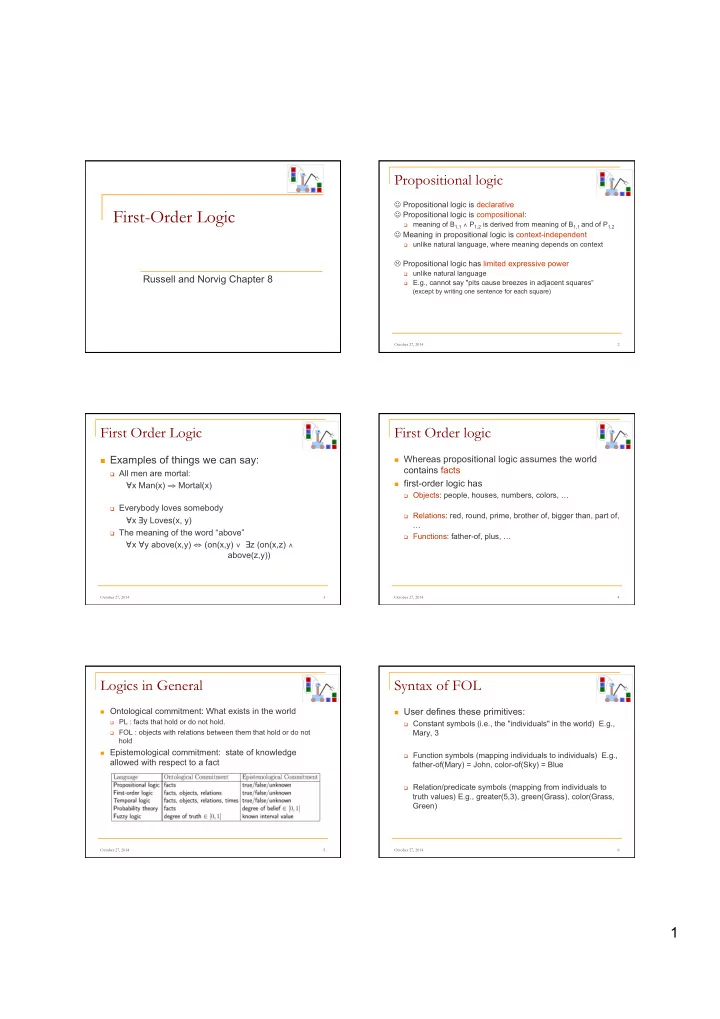
Propositional logic

J Propositional logic is declarative J Propositional logic is compositional:

q meaning of B1,1 ∧ P1,2 is derived from meaning of B1,1 and of P1,2

J Meaning in propositional logic is context-independent

q unlike natural language, where meaning depends on context

L Propositional logic has limited expressive power

q unlike natural language q E.g., cannot say "pits cause breezes in adjacent squares“

(except by writing one sentence for each square)

October 27, 2014 2

First Order Logic

n Examples of things we can say:

q All men are mortal:

∀x Man(x) ⇒ Mortal(x)

q Everybody loves somebody

∀x ∃y Loves(x, y)

q The meaning of the word “above”

∀x ∀y above(x,y) ⇔ (on(x,y) ∨ ∃z (on(x,z) ∧ above(z,y))

October 27, 2014 3

First Order logic

n Whereas propositional logic assumes the world

contains facts

n first-order logic has

q Objects: people, houses, numbers, colors, … q Relations: red, round, prime, brother of, bigger than, part of,

q Functions: father-of, plus, … October 27, 2014 4

Logics in General

n Ontological commitment: What exists in the world

q PL : facts that hold or do not hold. q FOL : objects with relations between them that hold or do not

hold

n Epistemological commitment: state of knowledge

allowed with respect to a fact

October 27, 2014 5

Syntax of FOL

n User defines these primitives:

q Constant symbols (i.e., the "individuals" in the world) E.g.,

Mary, 3

q Function symbols (mapping individuals to individuals) E.g.,

father-of(Mary) = John, color-of(Sky) = Blue

q Relation/predicate symbols (mapping from individuals to

truth values) E.g., greater(5,3), green(Grass), color(Grass, Green)

October 27, 2014 6

slide-2
SLIDE 2

2 Syntax (cont.)

n FOL supplies these primitives:

q Variable symbols. E.g., x,y q Connectives. Same as in PL: ¬, ⇒, ∧, ∨, ⇔ q Equality = q Quantifiers: Universal (∀) and Existential (∃)

October 27, 2014 7

Atomic sentences

Atomic sentence = predicate (term1,...,termn)

  • r term1 = term2

Term = function (term1,...,termn)

  • r constant or variable

Examples: Brother(KingJohn,RichardTheLionheart) Greater(Length(LeftLegOf(Richard)), Length(LeftLegOf(KingJohn)))

October 27, 2014 8

Complex sentences

Complex sentences are made from atomic sentences

using connectives ¬S, S1 ∧ S2, S1 ∨ S2, S1 ⇒ S2, S1 ⇔ S2 and by applying quantifiers.

Examples:

Sibling(KingJohn,Richard) ⇒ Sibling(Richard,KingJohn)

greater(1,2) ∨ less-or-equal(1,2) ∀x,y Sibling(x,y) ⇒ Sibling(y,x)

October 27, 2014 9

Truth in first-order logic

n Need to specify

constant symbols →

  • bjects

predicate symbols → relations function symbols → functional relations

n An atomic sentence predicate(term1,...,termn) is true

iff the objects referred to by term1,...,termn are in the relation referred to by predicate.

October 27, 2014 10

Models for FOL: Example

October 27, 2014 11

Models for FOL

n We can enumerate the models for a given KB

vocabulary:

n Computing entailment by enumerating the

models will not be easy !!

October 27, 2014 12

slide-3
SLIDE 3

3 Quantifiers

n Allow us to express properties of collections of objects

instead of enumerating objects by name

n Universal: “for all” ∀ n Existential: “there exists” ∃

October 27, 2014 13

Universal quantification

∀<variables> <sentence> Everyone at CSU is smart: ∀x At(x, CSU) ⇒ Smart(x)

n ∀x P(x) is true iff P is true for every object x n Roughly speaking, equivalent to the conjunction of

instantiations of P

At(KingJohn,CSU) ⇒ Smart(KingJohn) ∧ At(Richard,CSU) ⇒ Smart(Richard) ∧ At(CSU,CSU) ⇒ Smart(CSU) ∧ ...

October 27, 2014 14

Using universal quantifiers

n Typically ⇒ is the main connective with ∀ n Do not make the following mistake:

∀x At(x, CSU) ∧ Smart(x) means “Everyone is at CSU and everyone is smart”

October 27, 2014 15

Existential quantification

∃<variables> <sentence> Someone at CSU is smart: ∃x At(x, CSU) ∧ Smart(x)

n ∃x P(x) is true iff P is true for some object x n Roughly speaking, equivalent to the disjunction of

instantiations of P

At(KingJohn,CSU) ∧ Smart(KingJohn) ∨ At(Richard, CSU) ∧ Smart(Richard) ∨ At(CSU, CSU) ∧ Smart(CSU) ∨ ...

October 27, 2014 16

Existential quantification (cont.)

n Typically, ∧ is the main connective with ∃ n Common mistake: using ⇒ with ∃:

∃x At(x, CSU) ⇒ Smart(x) When is this true?

October 27, 2014 17

Properties of quantifiers

∀x ∀y is the same as ∀y ∀x ∃x ∃y is the same as ∃y ∃x ∃x ∀y is not the same as ∀y ∃x: ∃x ∀y Loves(x,y)

q “There is a person who loves everyone in the world”

∀y ∃x Loves(x,y)

q “Everyone in the world is loved by at least one person” n Quantifier duality: each can be expressed using the other

∀x Likes(x,IceCream) ¬∃x ¬Likes(x,IceCream) ∃x Likes(x,Broccoli) ¬∀x ¬Likes(x,Broccoli)

October 27, 2014 18

slide-4
SLIDE 4

4 Equality

n term1 = term2 is true if and only if term1 and term2 refer to

the same object

n E.g., definition of Sibling in terms of Parent:

∀x,y Sibling(x,y) ⇔ [¬(x = y) ∧ ∃m,f ¬(m = f) ∧ Parent(m,x) ∧ Parent(f,x) ∧ Parent(m,y) ∧ Parent(f,y)]

October 27, 2014 19

Interacting with FOL KBs

n Suppose a wumpus-world agent is using an FOL KB and perceives

smell and a breeze (but no glitter) at position [i,j]: Tell(KB,Percept([Smell,Breeze,NoGlitter],[i,j])) (= assertion) Ask(KB,∃a BestAction(a,[i,j])) (=query) I.e., does the KB entail some best action?

n Answering yes without the best action is not very helpful so:

Answer: Yes, {a/Shoot} : substitution (binding list)

n Ask(KB, α) returns some/all s such that KB entails SUBST(s, α). n To determine good course of action: Ask(KB, Safe([1,3])) October 27, 2014 20

KB for wumpus world

n Perception

q ∀ t,s,g,m,c Percept([s,Breeze,g,m,c],t) ⇒

Breeze(t)

n Action

q ∀t Glitter(t) ⇒ BestAction(Grab, t)

21

The wumpus world

Squares are breezy near a pit:

n First define the concept of adjacency:

∀x,y,a,b Adjacent([x,y],[a,b]) ⇔ (x = a∧(y=b-1∨y=b+1))∨(y=b∧(x=a-1∨x=a+1))

n Represent time with additional parameter

At(Agent,s,t) means Agent at square s and time t

n Infer properties

∀s,t At(Agent,s,t)∧Breeze(t) ⇒ Breezy(s)

22

The wumpus world

Squares are breezy near a pit: ∀s Breezy(s) ⇔ ∃r Adjacent(s, r) ∧ Pit(r) What is the following saying? ∀x,r,s,t At(x,r,t) ∧ At(x,s,t) ⇒ s = t How would we say that there is a single wumpus?

October 27, 2014 23

Creating a KB using FOL

1.

Identify the task (what will the KB be used for)

2.

Assemble the relevant knowledge Knowledge acquisition.

3.

Decide on a vocabulary of predicates, functions, and constants Translate domain-level knowledge into logic-level names.

4.

Encode general knowledge about the domain

5.

Encode a description of the specific problem instance

6.

Pose queries to the inference procedure and get answers

7.

Debug the knowledge base

October 27, 2014 24

slide-5
SLIDE 5

5 Examples

The kinship domain

n Basic predicates: Female, Parent…

Other predicates in this domain:

n One's mother is one's female parent

∀m,c (Mother(c) = m) ⇔ (Female(m) ∧ Parent(m,c))

n This means?

∀x,y Sibling(x,y) ⇔ [¬(x = y) ∧ ∃p Parent(p,x) ∧ Parent(p,y)]

n These are the axioms of the domain (they are also definitions since

they use biconditionals).

n Some sentences are “theorems” -- they can be derived from the

axioms:

q

“Sibling” is symmetric ∀x,y Sibling(x,y) ⇔ Sibling(y,x)

25

Examples (cont)

The set domain Notation: {x|s} is the set resulting from adding x to the set s.

n ∀s Set(s) ⇔ (s = {} ) ∨ (∃x,s2 Set(s2) ∧ s = {x|s2}) n ¬∃x,s {x|s} = {} n ∀x,s x ∈ s ⇔ [ ∃y,s2 (s = {y|s2} ∧ (x = y ∨ x ∈ s2))] n ∀s1,s2 s1 ⊆ s2 ⇔ (∀x x ∈ s1 ⇒ x ∈ s2) n ∀s1,s2 (s1 = s2) ⇔ (s1 ⊆ s2 ∧ s2 ⊆ s1) n ∀x,s1,s2 x ∈ (s1 ∩ s2) ⇔ (x ∈ s1 ∧ x ∈ s2) n ∀x,s1,s2 x ∈ (s1 ∪ s2) ⇔ (x ∈ s1 ∨ x ∈ s2)

October 27, 2014 26

Examples (cont)

The natural numbers domain

n 0 is a natural number:

NatNum(0)

n The successor of a natural number is a natural number:

∀n NatNum(n) ⇒ NatNum(S(n))

n Constraints on the successor function:

∀n ¬(0 = S(n)) ∀m,n m ¬(m = n) ⇒ ¬(S(m) = S(n))

n Defining addition:

∀n NatNum(n) ⇒ +(0, n) = n ∀m,n NatNum(m) ∧ NatNum(n) ⇒ +(S(m), n) = S(+(m,n))

27