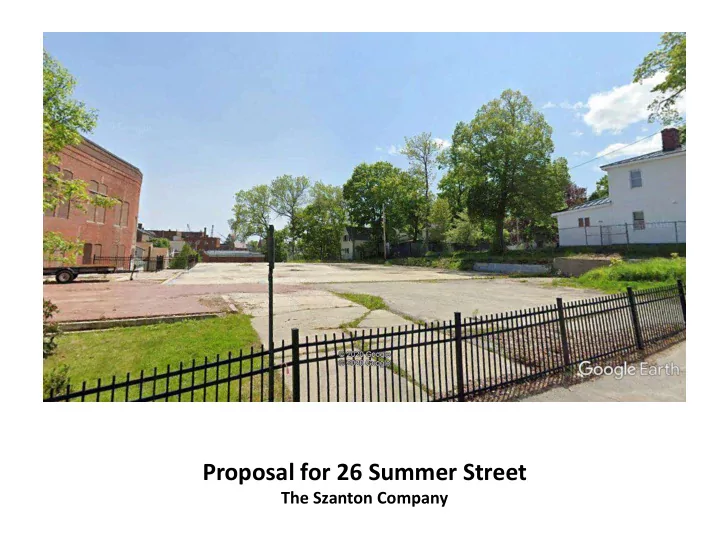
Proposal for 26 Summer Street The Szanton Company Casco Terrace - - PowerPoint PPT Presentation
Proposal for 26 Summer Street The Szanton Company Casco Terrace 2004 27 apartments Walker Terrace 2006 40 apartments New Construction Buildings Portland 53 Danforth 2009 43 apartments The Squamscott Block Exeter, NH 2007 30
Casco Terrace 2004 27 apartments Walker Terrace 2006 40 apartments 53 Danforth 2009 43 apartments
New Construction Buildings – Portland
The Squamscott Block Exeter, NH 2007 30 apartments / 2628 sf retail The Hartley Block , Lewiston 2019 63 apartments / 4000 sf retail
Buildings with ground– level retail
The Mill at Saco Falls 2009 66 apartments The Lofts at Saco Falls 2016 80 apartments The Lofts at Bates Mill 2012 48 apartments
Historic Rehabilitation
Huse School Apartments Bath 2017 59 apartments
The Huse School Apartments
The Uptown
Moses & Columbia Blocks – Historic Rehabilitation
Project overview
- Age 55 or better
- 46 apartments in a new building – 60 total
- Rehabilitation of the Moses & Columbia Blocks:
- Retain existing retail tenants
- Rehab of 10 existing apartments in the Moses Block
- 4 new apartments in the Columbia Block
- Targeting households at a variety of income levels
- Market Rate
- Units at 50-60% of the Area Median Income
- Total parking: 42 spaces
- Handicap parking on-site – 9 spaces
- Lease lot at corner of Front & Summer – 33 spaces
Parking Experience In our projects, 55+ households own fewer cars than younger households. In our downtown locations:
- In Biddeford – 0.7 cars per unit
- In Portland – 0.5 cars per unit
Parking study by Traffic Solutions (William Bray, P.E.)
- done in 2018
- focused on Greater Portland Area
- shows 0.41 spaces per unit is average in senior projects
Factoring out spaces dedicated to retail tenants, we are proposing 0.62 spaces/unit
Bath’s Housing Needs:
1 in 6 Bath households experience what the federal government defines as a “severe” housing problem:
- more than 50% of household income used to pay for housing
- the unit has incomplete kitchen or plumbing facilities
- the household is overcrowded
A mismatch between current housing stock and household size
- The majority of homes in Bath today contain one-and two-person families, but the
majority housing is in two and three-bedroom units or larger
- An increase in senior households, with significant numbers facing:
- a lack of transportation
- inability to afford housing upkeep and heating costs
- social isolation
Accessibility
- More than 1 in 3 Bath seniors live with a sensory, cognitive, or ambulatory disability
- Much of the existing housing stock is inaccessible, or poses injury risk for those with
disabilities
Source: The Bath Area Housing Assessment, conducted by Planning Decisions on behalf of Bath Housing in 2014
Demand for Quality Affordable Rental Housing for Older Adults
- Huse School leasing experience
- Huse School is not age-restricted
- 59% of units are occupied by 55+
- The average age of all units head of household ages is 57
- Of those households occupied by 55+, the average age is 70
Income and Rent Ranges
Type Income Range (household of 2) Number of Apartments Expected One-Bedroom Monthly Rent Expected Two-Bedroom Monthly Rent Market-Rate $38k -100K+ 18 $1,200 $1,350 60% area median income Up to $38k
$18.27 per hour (full time)
25 $840 $1,000 50% area median income Up to $31k
$14.90 per hour (full time)
17 $695 $825
Rent includes heat, hot water, wi-fi, fitness room, community room, resident services coordination, and parking (if available). *Income ranges are approximate & change annually by HUD
Why does this project need a TIF?
- Financial Necessity
– Gives the project the ability to take on additional debt in order to fill a gap of approximately $400K
- Provides crucial 2 points on MaineHousing application—likely making the
difference between success and failure.
MaineHousing Selection Process
– Projects apply for funding annually in September. – Projects are scored on a variety of factors, including location, project details, and participation from
- ther partners such as municipalities or other
government entities. – Last year 14 projects applied for funding.
- 5 projects funded
- 1 of the 5 was a set-aside and not chosen via
highest score (a category we are not eligible for)
- 4 Projects chosen from the general pool
79 74 71 70 69 69 66 63 62 57 57 51 48 26 1 2 3 4 5 6 7 8 9 10 11 12 13 14
Funded Not Funded Scoring 2019 Projects
79 74 71 70 69 69 67 60 62 64 66 68 70 72 74 76 78 80
TIF – 2 Pts CDBG – 2 Pts
71
26 Summer
Proposed 26 Summer/Moses & Columbia Blocks TIF
Current Valuation Current Taxes New Valuation (after construction) New Taxes Incremental Increase in Taxes 50% of Increment $1,334,500 (entire site) $19,908 $4,340,000 (estimated) $4,340,000 x mil rate = $85,922 85,922– 19,908 = 66,014 $33,007 to Project $52,915 to City (33,007+19,908)
Where Does Tax Money Go?
7.18% Loss of State Revenue Sharing
Without a TIF, new taxes from this project would be subject to the “tax shift”
42.83% to City Coffers
42.83% 41.31% 8.68% 7.18%
41.31% Loss of State Aid to Education 8.68% County Taxes
Where Does Tax Money Go? With a TIF, all new taxes from this project would be sheltered from the “tax shift” for the length of the TIF
50% to City Coffers 50% to project
50% 50%
The difference between 42.83% and 50% is approximately $4,700 in 1 year, and $95,000 over 20 years (without accounting for increase in taxes)
What does a TIF for the project accomplish?
- Supports goals of Comprehensive Plan and Bath Area Housing Assessment (high-quality,
energy-efficient, mixed-income rental housing).
- Provides crucial 2 points on MaineHousing application—potentially making difference
between success and failure.
- Puts 26 Summer back on tax rolls, adding $33,000 annually to City coffers for first 20
years, then $66,000 annually (not counting inflation).
- TIF District keeps incremental assessed value from triggering decreases in State aid to
education and revenue-sharing, or increases in County taxes.
- Brings 50 net new households to Bath, each one a “little economic engine.”