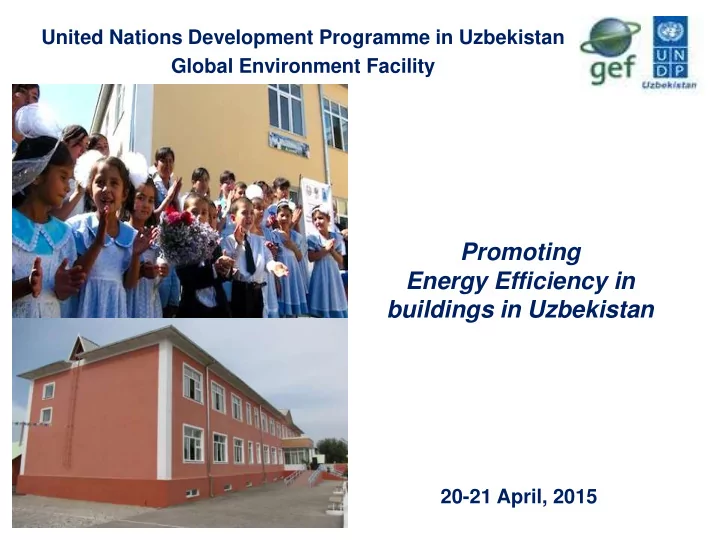
Promoting Energy Efficiency in buildings in Uzbekistan 20-21 - - PowerPoint PPT Presentation
United Nations Development Programme in Uzbekistan Global Environment Facility Promoting Energy Efficiency in buildings in Uzbekistan 20-21 April, 2015 Main prerequisites for promoting EE in buildings 49% of total energy consumption (17
Main prerequisites for promoting EE in buildings
- 49% of total energy consumption (17 mln toe), and
- 39% of total annual CO2 emissions
- Old non-EE buildings consume 423 kwth/м2/yr
- Population growth (more than 30mln.)
- Increasing demand for health and education services/facilities.
- Potential for EE and CO2 emissions reduction – 55-65%
- motivation
- information
- financial resources
- organization/coordination
- technologies
- financial/pricing
- structure and organization of economy
- institutional
- social
- cultural
- behavioral
Lack of Nature of barriers
Barriers to promote EE
Key Facts about the Building Sector in Uzbekistan
Residential buildings: Total area 450 mln.sq.m Individual houses 392 mln.sq.m Social buildings: 110 mln.sq.m New construction (1990-2010): Multi-flat apartments 48,5 mln.sq.m (10%) Rural residential houses 119,2 mln.sq.m (30%) Predictive estimate on residential houses sector: Total area by 2030 764 sq.m Total area by 2050 949-987 sq.m
Buildings energy consumption rate (kwt-h/m2/year)
Energy consumption range: 150 – 690 All buildings 423 Social buildings 333 – 450 New rural residential houses 277 – 315 Energy audit results (2012-2013) 390
Why public buildings?
7
- Substantial state budget investments;
- Rational use / strict control over use of State funds;
- Good centralized planning, staged implementation with
provision of sufficient financial/human resources, technologies, materials;
- State strategy on socio-economic development, incl.
improvement of healthcare and educational facilities;
- Serve as a model for attracting private investment,
international donors.
Policy/ Regulations introduced with an assistance of UNDP in Uzbekistan
- State Standard on Biogas (2013);
- 10 core Building Codes and standards, 3 levels of
thermal protection (2011-2012);
- 5 Reference Manuals to them (2012), mandating at least
40-50% reduction in energy consumption in buildings;
- 3 energy management systems (2013);
- 3 State Educational Standards, 11 educational programs
- n energy management, incl. a new field of study
Energy Management (2011-2012).
Policy/ Regulations introduced with an assistance of UNDP in Uzbekistan (2)
- Concept of Integrated Building Design (2013);
- Rural residential homes (3/4/5 rooms) designs
revised/adopted with EE consideration
- A new pilot EE rural house designed/constructed
- More than 1,000 design/construction experts/students
trained on EE construction and maintenance
- PR/outreach/media activities
11
- 1. SNiP 2.08.02-09 “Public buildings and structures”
- 2. SNiP 2.08.04-04 “Administrative buildings”
- 3. SNiP 2.08.05-97 “Buildings and structures accommodated for
medical treatment facilities”
- 4. SNiP 2.01.04-97 “Building Heat Engineering”
- 5. SNiP 2.04.05-97 “Heating ventilation and air conditioning”
- 6. SNiP 2.01.18-00 “Standards of energy consumption for
heating ventilation and air conditioning of buildings and structures”
- 7. SNiP 2.03.10-95 “Roofs”
- 8. SNiP 1.03.09-97 “Provisions on Chief Engineer (Chief
Architect) of the project”
- 9. SNiP 1.01.04.04-98 “Architectural-construction terminology”
10.SNiP 1.03.01-08 “Composition, procedures of development, agreement and approval of design documentation for capital construction of buildings and facilities”
List of revised EE building codes
Demonstration: Geography of 8 pilot sites across Uzbekistan
2,100 school children, teachers and 19,400 patients benefited from this work
Government and UNDP/GEF shares on re/construction of 8 pilots, (in USD)
9%
91%
Total investment cost,
- incl. EE solutions –
3 664,62 thousand USD
UNDP/GEF share: EE technical solutions applied, thousand USD
Heat insulation of walls 177,2 Heat Insulation of socle/basement 28,06 Heat insulation of roof 105,03 Heat Insulation of fundament 25,05 Total: 335,34
Government share
General construction works
3 329,28 GRAND TOTAL: 3 664,62
3,329.28 335.34
Правительство ПРООН
Demonstration: Energy consumption reduction
Energy consumption in 8 pilots reduced by:
58%-65% (451,1 vs. 156,5) in retrofits. 38%-45% (256 kwt/m2.yr.
- vs. 141)
in new buildings; Gas and coal consumption reduced by 45-60%
190.2 103.4 56.4 85.4 120.4 67.3 23.1 68.4 81.1 37.4 20.5 29.2 42.9 18.9 6 17 109 66 36 56 78 48 17 51
50 100 150 200 250 300 350 400
Школа в Андижане (строит-во) Школа в Навои (строит- во) Школа в Каракалпакии Школа в Кашкадарье Школа в Фергане Школа в Навои СВП в Таш.области СВП в Навои
Годовое снижение После До
Reduction of СО2 emissions for approx. 67%
Reduction of СО2 emissions in 8 pilots
Δ 57% Δ 64% Δ 64% Δ 66% Δ 64% Δ 74% Δ 75% Δ 72%
СО2 emissions (tons/year)
Reduction of СО2 emissions during 20 years (tons/20 years) Total reduction of СО2 emissions on 8 pilots for 20 years – 9,232 tons СО2
Reduction of СО2 emissions in 8 pilots (2)
500 1000 1500 2000 2500
2182 1320 718 1124 1550 968 342 1028
Energy saving in 8 pilots after re/construction
7.5 8.7 6.4 1.6 4.7 7.4 5.3 2.2 3.5
1 2 3 4 5 6 7 8 9 10
Школа в Андижане (строит-во) Школа в Навои (строит- во) Школа в Навои 2 Школа в Навои 3 (строит-во) Школа в Каракалпакии Школа в Карши Школа в Фергане СВП в Таш.области СВП в Навои
Energy savings based on export prices, thousand USD Energy saving 47.3 K $
16.6 6.3 3.5 7.6 7.2 4.8 4 6.9 4.2
2 4 6 8 10 12 14 16 18 Школа в Андижане (строит-во) Школа в Навои (строит-во) Школа в Навои 2 Школа в Навои 3 (строит-во) Школа в Каракалпакии Школа в Карши Школа в Фергане СВП в Таш.области СВП в Навои
Pay-back period based on export tariffs, approx. 5.5 years
Pay-back period of EE solutions in 8 pilots
Economic benefits
- Saved funds in 8 pilots in amount of:
- 47K USD per year
- 940K USD for 20 years
- Increase of buildings lifetime
- Decrease of investments in capital reconstruction
- Development of EE construction materials market etc.
- Comfort facilities for
population
- Reduction of sickness and
increase of attendance rate
- Awareness raising in
energy management issues
- Dissemination of good
practices, improved knowledge among population and construction sector
Social Benefits
- Contribution to implementation of
international ecological conventions
- Reduction of СО2 emissions
Environmental benefits
Cabinet of Minister Decree 01-05/23-3 dd. 27.11.2014 President Resolution #8
- dd. 22.01.2015
Results sustainability
President / Govt. Orders on promoting EE in buildings sector
- Legislative-normative (Codes, Certification system)
- Institutional
- Education, capacity building
- Technological
- Economic
- Social
- Environmental
Knowledge products
- Analytical report “EE in buildings: hidden resource
- f sustainable development in Uzbekistan”
- Roadmap on Biogas development in Uzbekistan
- Roadmap on transition from CDM to NAMA
- Analytical/Strategy papers on promoting EE in buildings
- Guidelines on Integrated Building Design
- Building Codes and Guidance Manuals
- Catalog of EE technical solutions
Thank you!
- Mr. Kakhramon Usmanov