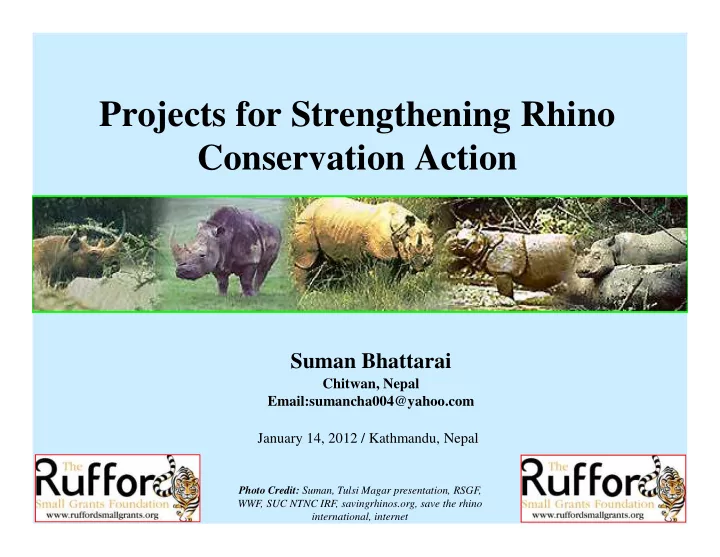
SLIDE 1 Projects for Strengthening Rhino Conservation Action
Suman Bhattarai
Chitwan, Nepal Email:sumancha004@yahoo.com January 14, 2012 / Kathmandu, Nepal
Photo Credit: Suman, Tulsi Magar presentation, RSGF, WWF, SUC NTNC IRF, savingrhinos.org, save the rhino international, internet
SLIDE 2 Background
African Asian
One Horn Greater Asian Rhino
White (Ceratotherium simum) Black ( Diceros bicornis) Sumatran (Dicerorhinus sumatrensis) Javan (Rhinoceros sondaicus) Rhinoceros unicornis
SLIDE 3 Contd..
Background
Extinction Verge of Extinction
20150 4860
- Europe, Asia & North America
- Extinct (10000 yrs before)
- Sumatran (Last family representative)
Wooly (Coelodonta antiquitatis)
- Extinct ( West Black /North White African)
- Javan ( Extinct from Vietnam)
- Greater Asian (Myanmar/Bhutan/Pakistan)
2850 200 <44
Cause!! Extreme Habitat Destruction & Poaching
SLIDE 4 Background
Total: 2,700-2850 (IRF) India: Manas, Dudhwa, Karteniaghat, Orang,
Kagiranga, Laokhowa, Pabitora , Gorumara, Pockets-Assam, Jaldapara (10 Sites)
Nepal: Chitwan, Bardia, Shukla Phanta Pakistan: Lalsorna (Doubt)
Chitwan National Park
- Near about 42 post merged into 7
- Hard to launch conservation programme
from park and other institution side
- Extreme Habitat Destruction & Poaching
- Population decreased 544 to 372
SLIDE 5 Threat
Natural
Flooding/ Desertification Predator
Poverty/Hunger Resource Scarcity/ Improper Resource Mobilization Inadequate Monitoring /Evaluation
Invasion Climate Change
Evolution/Succession
Poverty/Hunger
AWARENESS: Conservationist, Politician, Local People, Attitude (Blaming each other), Benefit Sharing
Improper Resource Mobilization /Evaluation Scientific Analysis & Research Unsatisfactory Compensation/Relief Unemployment
SLIDE 6 Threat
Contd..
Learning Environment Deforestation Pollution Human Wildlife Conflict Lack: Rescue / Caring / Veterinary Center
Policy (Confined on protected Area) Habitat Loss Poaching Population Loss
Center Based on some of these issue, projects were developed
Policy (Confined on protected Area)
SLIDE 7
Objective
Educating local people Making people responsible for conservation action Generating public participation Strengthen rhino conservation programme through Generating public participation Exploring conservation based income generation activity Networking and Alerting stakeholders for conservation action
SLIDE 8 Activity
Campaign/Rally Radio Tour/Class
A w a r e n e s s
Poster Board
s
Wall Painting
SLIDE 9
Activity
SLIDE 10 Activity
Bee keeping
Income generation
Cupboard Library
Piggery Fishery
SLIDE 11 Activity
Networking/ Coordination Teacher’s Forum Local Conservation Stakeholders Outside Schools Magazine Board
Savingrhinos.org, Bushwarriors, Teacher’s forum, Media (local/national/international), Local Clubs/NGO, BZUCs, BZCFs, Park, Grantees (>12), Assistance to form clubs and groups
Nature Club
SLIDE 12 Achievement
Before After Project
- Rhino Population 503 (Count 2011)
- No Rhino Poaching Year (Jan 3, 2011 – Jan 3, 2012)
- Even in Mid Night local people inform about the wildlife attack and other case
Contribution can be taken as a small brick of this achievement / building
SLIDE 13 Continuity
Historic event in Nepal “ 2nd World Rhino Day”
institution in conservation work (Electric fencing / Shiva BZCF)
students “Appreciative Inquiry in Conservation”
- Advocating/lobbing for
- rphanage/wounded wildlife
- Assisting many researchers
and conservationists in their works
Historic event in Nepal “ 2 World Rhino Day”
SLIDE 14 Though there is slow recovery in rhino population but…
- Rescue/caring/treatment of orphanage/wounded wildlife
- Effective monitoring & Validity/reliability in
census/count
- Habitat management (reduction in waterhole and
proliferation of invasive species), Climate Change
Challenge
proliferation of invasive species), Climate Change
- Human Population Growth / Relief Mechanism
- Poaching/Rehabilitation of poachers
- Educating outsiders (Outside of Bufferzone)
- Awareness level on conservationist/local people
- Action/Management plan preparation & resource
arrangement
SLIDE 15
- Habitat (grassland /waterhole) management to reduce threats
- Awareness Programme (Chepang/other outside Bufferzone)
- Action Plan for next period should be made and implemented
properly with enough resources
- Rescue/treatment/Care center
Suggestion
- Rescue/treatment/Care center
- Target Young groups rather than old age
- Valid / reliable data should be captured and conduct regular
effective monitoring i.e. census/count
- Coordination with concerned parties to launch Youth Self
Employment to Bufferzone people
- Law/rule/regulation enforcement through campaign at grass
root level
SLIDE 16
Acknowledgement
RSGF, Prof. C.P. Upadhyaya, N. C. Paudel, B. Regmi, R. R. Devkota, S. Paudel, Dr. S. Rayamijhii, Late K.N. Paudel, Dr. K.D. Awasthi, G. Pant, RSG grantees (P.B. Singh, D.R. Thanet, R. Rajchal, E. Udas, B.H. Wagle, U. Sharma, D. Paudel, B.P. Devkota, G. Sharma, D. Paudel, B.P. Devkota, G. Kafle, P. Jha, D. Acharya), NMB Pradhan, R. Larson, J. Cole, Bufferzone User Committees, Chitwan National Park, Journalists, Medias (Local/National/International: Paper / Digital, Audio / Visual), BICORF, PARC, Saving Rhinos, ARP, Schools, Clubs, BZCF & others
Thank you