Project Background Funding for the project is from a Federal Grant - - PDF document

project background
SMART_READER_LITE
LIVE PREVIEW

Project Background Funding for the project is from a Federal Grant - - PDF document

5/18/2010 Nebraska Youth Suicide Prevention Project Community Grant Technical Assistance Webinar May 18, 2010 y Denise Bulling, University of Nebraska Public Policy Center Project Partner Marilyn Mecham, Interchurch Ministries of Nebraska


slide-1
SLIDE 1

5/18/2010 1

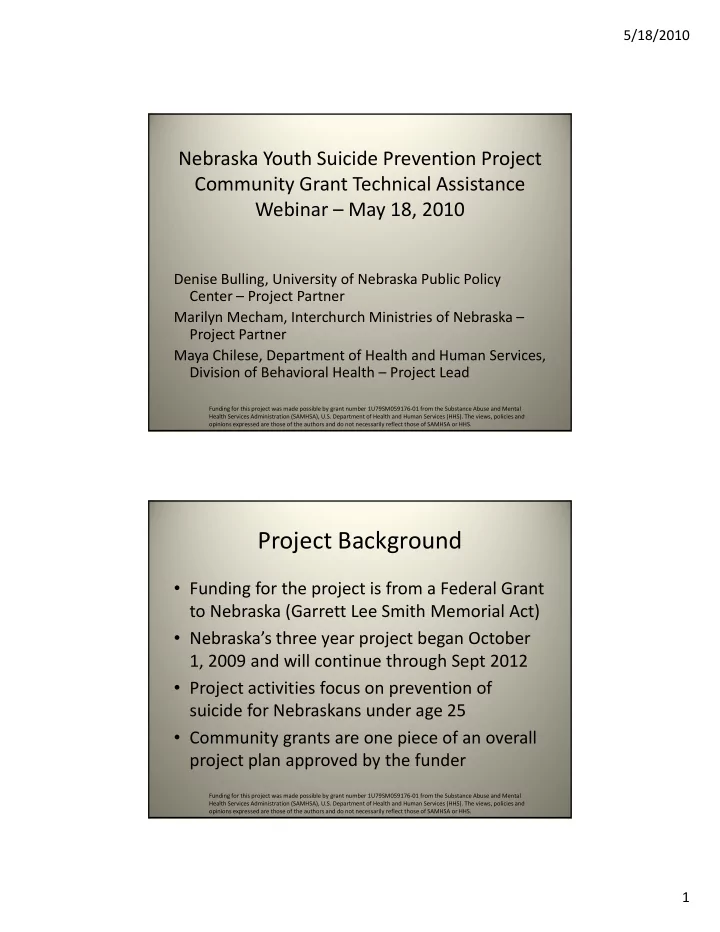
Nebraska Youth Suicide Prevention Project Community Grant Technical Assistance Webinar – May 18, 2010

Denise Bulling, University of Nebraska Public Policy Center – Project Partner Marilyn Mecham, Interchurch Ministries of Nebraska –

y

Project Partner Maya Chilese, Department of Health and Human Services, Division of Behavioral Health – Project Lead

Funding for this project was made possible by grant number 1U79SM059176‐01 from the Substance Abuse and Mental Health Services Administration (SAMHSA), U.S. Department of Health and Human Services (HHS). The views, policies and

  • pinions expressed are those of the authors and do not necessarily reflect those of SAMHSA or HHS.

Project Background

  • Funding for the project is from a Federal Grant

t N b k (G tt L S ith M i l A t) to Nebraska (Garrett Lee Smith Memorial Act)

  • Nebraska’s three year project began October

1, 2009 and will continue through Sept 2012

  • Project activities focus on prevention of

suicide for Nebraskans under age 25 suicide for Nebraskans under age 25

  • Community grants are one piece of an overall

project plan approved by the funder

Funding for this project was made possible by grant number 1U79SM059176‐01 from the Substance Abuse and Mental Health Services Administration (SAMHSA), U.S. Department of Health and Human Services (HHS). The views, policies and

  • pinions expressed are those of the authors and do not necessarily reflect those of SAMHSA or HHS.
slide-2
SLIDE 2

5/18/2010 2

  • Funding for each proposal is limited to $5,000

Community Grants

  • Coalitions must identify a single fiscal agent

who takes responsibility for reporting and managing the funds

  • Application forms are available on‐line at

http://www youthsuicideprevention nebraska http://www.youthsuicideprevention.nebraska. edu

Funding for this project was made possible by grant number 1U79SM059176‐01 from the Substance Abuse and Mental Health Services Administration (SAMHSA), U.S. Department of Health and Human Services (HHS). The views, policies and

  • pinions expressed are those of the authors and do not necessarily reflect those of SAMHSA or HHS.
  • Community coalition activities directly related

t l i f th i id ti

What is funded

to planning for youth suicide prevention

  • Support for gatekeeper training using the QPR

model (Trainers are available in Nebraska)

  • Support for community awareness activities
  • Support for implementation of evidence
  • Support for implementation of evidence

based intervention in schools, primary care, youth facilities/groups, communities

Funding for this project was made possible by grant number 1U79SM059176‐01 from the Substance Abuse and Mental Health Services Administration (SAMHSA), U.S. Department of Health and Human Services (HHS). The views, policies and

  • pinions expressed are those of the authors and do not necessarily reflect those of SAMHSA or HHS.
slide-3
SLIDE 3

5/18/2010 3

  • Intervention programs that are not listed on one of

three websites:

What is not funded

– http://www.sprc.org/featured_resources/bpr/nrepp_bpr.a sp#programs – http://www.sprc.org/featured_resources/bpr/ebpp.asp#lis t – http://www.sprc.org/featured_resources/bpr/standards.as p#programs – Intervention programs can be adapted from the original Intervention programs can be adapted from the original version, but grantees will be asked to detail how and why the adaption is done

  • Activities directed at decreasing adult suicide

Funding for this project was made possible by grant number 1U79SM059176‐01 from the Substance Abuse and Mental Health Services Administration (SAMHSA), U.S. Department of Health and Human Services (HHS). The views, policies and

  • pinions expressed are those of the authors and do not necessarily reflect those of SAMHSA or HHS.
  • Complete the application form

How to apply

  • Identify all partners – but specify the fiscal

and reporting agent as the organizational applicant

  • Cite information about the needs in your

community related to youth suicide community related to youth suicide

  • Be specific in your program description about

what you want to achieve with the funding

Funding for this project was made possible by grant number 1U79SM059176‐01 from the Substance Abuse and Mental Health Services Administration (SAMHSA), U.S. Department of Health and Human Services (HHS). The views, policies and

  • pinions expressed are those of the authors and do not necessarily reflect those of SAMHSA or HHS.
slide-4
SLIDE 4

5/18/2010 4

  • Read the application materials to make sure

you can comply with the evaluation

How to apply

you can comply with the evaluation requirements

  • Key Dates:

– June 1, 2010 (Applications Emailed or Postmarked by midnight) June 11 2010 (Funding will be awarded) – June 11, 2010 (Funding will be awarded) – December 31, 2010 (Grant activities and funding must be complete)

Funding for this project was made possible by grant number 1U79SM059176‐01 from the Substance Abuse and Mental Health Services Administration (SAMHSA), U.S. Department of Health and Human Services (HHS). The views, policies and

  • pinions expressed are those of the authors and do not necessarily reflect those of SAMHSA or HHS.
  • Regular reporting about how you implement

your grant and spend the funds

Grantee obligations

your grant and spend the funds

  • Understanding the rules governing use of

Federal funds (technical assistance is available to grantees to assist with this)

  • Participate in Federal cross‐site evaluation

ti iti (th t f l ti d t activities (the type of evaluation data your project must report will be determined with the evaluation team for the overall project)

Funding for this project was made possible by grant number 1U79SM059176‐01 from the Substance Abuse and Mental Health Services Administration (SAMHSA), U.S. Department of Health and Human Services (HHS). The views, policies and

  • pinions expressed are those of the authors and do not necessarily reflect those of SAMHSA or HHS.
slide-5
SLIDE 5

5/18/2010 5

  • Periodic webinars about a suicide prevention or reporting

topic (e.g., national and state sponsored)

Resources Available to Grantees

  • QPR trainers (Budget $150/event for trainers and the cost
  • f your venue) On‐line registration must be done through

the project

  • Awareness materials such as PSA’s
  • Suicide Prevention Hotline numbers
  • Activities can be publicized online via the project calendar
  • An outreach coordinator will make periodic site visits
  • An outreach coordinator will make periodic site visits
  • Expertise from suicide survivors and partners in the State

Suicide Prevention Coalition may be accessed for presentations, technical assistance or support

Funding for this project was made possible by grant number 1U79SM059176‐01 from the Substance Abuse and Mental Health Services Administration (SAMHSA), U.S. Department of Health and Human Services (HHS). The views, policies and

  • pinions expressed are those of the authors and do not necessarily reflect those of SAMHSA or HHS.
  • Questions about the application may be directed to Danielle

Sodergren at im50427@windstream.net or (402) 476‐3391

Questions?

  • Questions about best practices in suicide prevention or training may

be directed to Kate Speck at kspeck2@nebraska.edu or (402) 472‐ 5678

  • Questions about the evaluation may be directed to Mark DeKraai at

mdekraai@nebraska.edu or (402) 472‐1496

  • The project director for the Nebraska Youth Suicide Prevention

The project director for the Nebraska Youth Suicide Prevention Project is

Maya Chilese, MA, PLMHP, CCGC Children's Behavioral Health Manager Nebraska DHHS ‐ Behavioral Health (402)471‐7792 | Maya.Chilese@nebraska.gov

Funding for this project was made possible by grant number 1U79SM059176‐01 from the Substance Abuse and Mental Health Services Administration (SAMHSA), U.S. Department of Health and Human Services (HHS). The views, policies and

  • pinions expressed are those of the authors and do not necessarily reflect those of SAMHSA or HHS.