Progress & issues in Strangeness NP Avraham Gal, Hebrew - - PowerPoint PPT Presentation

progress issues in strangeness np
SMART_READER_LITE
LIVE PREVIEW

Progress & issues in Strangeness NP Avraham Gal, Hebrew - - PowerPoint PPT Presentation

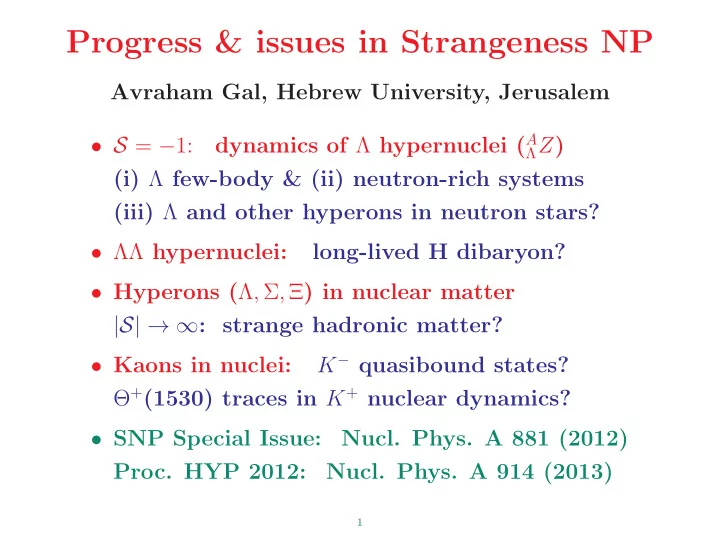
Progress & issues in Strangeness NP Avraham Gal, Hebrew University, Jerusalem dynamics of hypernuclei ( A S = 1: Z ) (i) few-body & (ii) neutron-rich systems (iii) and other hyperons in neutron stars?


slide-1
SLIDE 1

Progress & issues in Strangeness NP

Avraham Gal, Hebrew University, Jerusalem

  • S = −1:

dynamics of Λ hypernuclei (A

ΛZ)

(i) Λ few-body & (ii) neutron-rich systems (iii) Λ and other hyperons in neutron stars?

  • ΛΛ hypernuclei:

long-lived H dibaryon?

  • Hyperons (Λ, Σ, Ξ) in nuclear matter

|S| → ∞: strange hadronic matter?

  • Kaons in nuclei:

K− quasibound states? Θ+(1530) traces in K+ nuclear dynamics?

  • SNP Special Issue:
  • Nucl. Phys. A 881 (2012)
  • Proc. HYP 2012:
  • Nucl. Phys. A 914 (2013)

1

slide-2
SLIDE 2

Λ hypernuclear dynamics

2

slide-3
SLIDE 3

Studies of Λ hypernuclei

  • (K−, π−) – emulsions, CERN, BNL, KEK, LNF, J-PARC
  • (π+, K+) – BNL, KEK, J-PARC
  • (π+, K+ γ) – KEK & (K−, π− γ) – BNL, J-PARC with Hyperball-J
  • (e, e′ K+) – JLab, Hall A and Hall C; now also at MAMI
  • DCX: (π−, K+) – KEK, J-PARC & (K−

stop, π+ prod π− decay) – LNF

Scheduled experiments at J-PARC using meson beams:

  • E13: γ-ray spectroscopy of Λ hypernuclei
  • E10: DCX studies of neutron-rich A

ΛZ (6Li, 9Be & 10B targets)

  • E18: 12

Λ C weak decays

  • E22: weak interactions in 4

ΛH − 4 ΛHe

Studies of exotica & light hypernuclei lifetimes by heavy ions:

  • In GSI, the HypHI Experiment, 6Li on C at 2 A GeV
  • In LHC, the ALICE Collaboration, Pb-Pb at √sNN=2.76 TeV

3

slide-4
SLIDE 4

Observation of Λ single-particle states

20 40 60 80 100 120 140 160 180

  • 10
  • 5

5 10 15 20 25 30

Excitation Energy (MeV) C

  • u

n t s / . 2 5 M e V KEK E369 sΛ pΛ dΛ sΛ fΛ

∆E=1.63 MeVFWHM

89Y(π+,K+)

  • H. Hotchi et al., Phys. Rev. C 64 (2001) 044302

BΛ = 23.11 ± 0.10 MeV

  • T. Motoba, D.E. Lanskoy, D.J. Millener, Y. Yamamoto, NPA 804 (2008) 99:

negligible Λ spin-orbit splittings, 0.2 MeV for 1fΛ

4

slide-5
SLIDE 5

Update: Millener, Dover, Gal PRC 38, 2700 (1988) 0.05 0.1 0.15 0.2 0.25

10 20 30 Binding Energy (MeV)

(pi,K) (e,e’K) Emulsion (K,pi)

Λ Single Particle States

A−2/3

sΛ pΛ dΛ fΛ gΛ

208 139 89 51 4032 28 16 131211 10 8 7

Woods-Saxon V = 30.05 MeV, r = 1.165 fm, a = 0.6 fm

Textbook example of shell model at work. SHF studies suggest ΛNN repulsion.

5

slide-6
SLIDE 6

Hyperon puzzle: QMC calculations

B [MeV] A-2/3 exp N N + NN (I) N + NN (II) 0.0 10.0 20.0 30.0 40.0 50.0 60.0 0.0 0.1 0.2 0.3 0.4 0.5

Lonardoni et al, PRC 89 (2014) 014314

ΛNN effect on BΛ(g.s.)

PRL 114 (2015) 092301

ΛNN effect on neutron stars

  • Adding ΛNN (and YY) stiffens EOS of neutron stars.
  • Σ & Ξ hyperons need to be considered too.
  • YY add 0.3M⊙ to Mmax (Rijken-Schulze 2016).

6

slide-7
SLIDE 7

FINUDA: pπ+ vs. pπ− in

6Li(K− stop, π+)6 ΛH, 6 ΛH → 6He + π−

T(π+)+T(π−)=202–204 MeV (l.h.s.) 200–206 MeV (r.h.s.)

Red rectangles: pπ+=250–255, pπ−=130–137 MeV/c. The 3 events in red are stable against T(π+)+T(π−) cuts.

6 ΛH not confirmed in (π−, K+) by J-PARC E10.

7

slide-8
SLIDE 8

FINUDA+Gal (2012) [PRL 108, 042501; NPA 881, 269]

  • Three 6

ΛH candidate events out of 2.7 x 10⁷ K− stop.

  • BΛ(6

ΛH) constrains ΛN↔ΣN effects in neutron-rich A ΛZ.

8

slide-9
SLIDE 9

Room for hypernuclear spectroscopy

20 40 60 80 100 170 175 180 185 190 195 200 205 E140a (arbitrary) E369 MHY - MA (MeV)

(π+,K+)Λ

12C

12C 0.9 g/cm2

c

  • u

n t s / . 2 5 M e V

  • H. Hotchi et al., PRC 64 (2001) 044302

1sΛ − 1pΛ intermediate structure

Excitation Energy (MeV) 10 20

MeV ⋅ GeV

2

sr nb

exc

dE

e

dE

K

Ω d

e

Ω d σ d

2 4

  • M. Iodice et al., PRL 99 (2007) 052501

12 ΛB in (e, e′K+), Jlab Hall A

energy resolution 1.6 MeV → 0.6 MeV [PRC 90 (2014) 034320]

9

slide-10
SLIDE 10

Hypernuclear production in (K−

stop, π−), PLB 698 (2011) 219 & 226

(MeV)

Λ

B Events/0.5 MeV 1000 2000 3000 4000 5000 6000 7000

  • 80
  • 60
  • 40
  • 20

20 40 Data p Σ → Knp π Λ → Kn π Σ → Kp ν µ → K Hypernuclei Fit

Production spectrum on 7Li

FINUDA, DAΦNE, Frascati

(MeV)

Λ

B Events/0.5 MeV 200 400 600 800 1000 1200 1400 1600 1800 2000 2200 2400 10 20 30 40 50

Data p Σ → Knp π Λ → Kn ν µ → K Hypernuclei Fit

Li

7

/NDF: 0.99

2

χ

Three 7

ΛLi levels, δBΛ=0.4 MeV

Formation rate 1 · 10−3/K−

stop

A=7–16 data also indicate DEEP K− nuclear potential.

10

slide-11
SLIDE 11

Λ

7 Li E2

2.186

Li

6

+

1 7/2+ 5/2+

+

3

0.692 2.050

3/2+ 1/2+

M1

2+ 3.040 0+ 5/2+ 3/2+

Λ

9Be

Be

8 3.068

3.563 1/2+ T=1

M1 M1 3.88 E2 E2

1/2+ 2+ 4.439

+

3/2- 1/2-

Λ

13C

C

12 E1 E1

1/2+ 5/2+ 3/2+4.88

x Λp3/2 x Λp1/2 E2 3.025 10.98 10.83 M1

ΛO

16

1-

M1

1- 0- 1/2-

O

15

3/2- 2-

0.026 6.562

0.718 3/2+ 5/2+

Λ

11B

B

10

1/2+

E2 1.483

7/2+

  • 3/2

2-

Λ

10 B

B

9

< 0.1

1- T=1

+

1

+

3 0+ 2.313 3.948 1+ 1/2+ 3/2+

Λ

15 N

N

14

3/2+,1/2+ 1/2+ 0+ 1+

M1 2.268

T=1 T=1

4.229 4.710

0+

p

  • 3/2

2.000 0-

12C

C

  • 1/2

1-

M1 2.832 0.263 M1

2- 1- 2+

p

Λ

6.786 0.161 1.987 M1

Level energies in MeV

11C 6.042

4.804

  • 3/2

1- 2-

6.176

Hypernuclear γ rays 2012

Hypernuclear level schemes from γ-ray measurements (BNL, KEK)

  • H. Tamura et al., Nucl. Phys. A 835 (2010) 3 [HYP09], updated at HYP12

Λ spin-orbit splitting: 150 keV in 13

ΛC & related 43 keV in 9 ΛBe

11

slide-12
SLIDE 12

p-shell Λ hypernuclei

VΛN = V0(r)+Vσ(r) sN ·sΛ +VLS(r) lNΛ·(sΛ+sN)+VALS(r) lNΛ ·(sΛ−sN)+VT(r) S12

For pNsY : VΛN = ¯ V + ∆ sN · sΛ + SΛ lN · sΛ + SN lN · sN + T S12

R.H Dalitz, A. Gal, Ann. Phys. 116 (1978) 167 D.J. Millener, A. Gal, C.B. Dover, R.H. Dalitz, PRC 31 (1985) 499

NΛ-NΛ

¯ V ∆ SΛ SN T from A = 7 − 9 (−1.32) 0.430 −0.015 −0.390 0.030 fit A = 11 − 16 (−1.32) 0.330 −0.015 −0.350 0.024 fit NΛ-NΣ 1.45 3.04 −0.085 −0.085 0.157 input (in MeV) D.J. Millener, Nucl. Phys. A 804 (2008) 84

12

slide-13
SLIDE 13

Doublet spacings in p-shell hypernuclei (in keV)

D.J. Millener, NPA 881 (2012) 298 Jπ

u

l

ΛΣ ∆ SΛ SN T ∆Eth ∆Eexp

7 ΛLi

3/2+ 1/2+ 72 628 −1 −4 −9 693 692

7 ΛLi

7/2+ 5/2+ 74 557 −32 −8 −71 494 471

8 ΛLi

2− 1− 151 396 −14 −16 −24 450 (442)

9 ΛBe

3/2+ 5/2+ −8 −14 37 28 44 43

11 ΛB

7/2+ 5/2+ 56 339 −37 −10 −80 267 264

11 ΛB

3/2+ 1/2+ 61 424 −3 −44 −10 475 505

12 ΛC

2− 1− 61 175 −22 −13 −42 153 161

15 ΛN

3/2+

2

1/2+

2

65 451 −2 −16 −10 507 481

16 ΛO

1− 0− −33 −123 −20 1 188 23 26

16 ΛO

2− 1−

2

92 207 −21 1 −41 248 224

ΛΣ coupling contributions normally are below 100 keV

13

slide-14
SLIDE 14

The lightest, s-shell, Λ hypernuclei

A ΛZ

T Jπ

g.s.

BΛ (MeV) Jπ

exc.

Ex (MeV)

3 ΛH

1/2+ 0.13(5)

4 ΛH–4 ΛHe 1/2

0+ 2.04(4)–2.39(3) 1+ 1.09(2)–1.406(3)

5 ΛHe

1/2+ 3.12(2)

  • No ΛN and no Λnn bound state are expected.
  • ∆BΛ(4

ΛHe–4 ΛH)=0.35(5) MeV: very large CSB.

Recent A = 3, 4 few-body calculations

  • A. Nogga, NPA 914 (2013) 140

Faddeev & Faddeev-Yakubovsky (chiral LO & NLO).

  • E. Hiyama et al., PRC 89 (2014) 061302(R)

Jacobi-coordinates Gaussian basis (Nijmegen soft-core).

  • R. Wirth et al., PRL 113 (2014) 192502.

ab-initio Jacobi-NCSM (chiral LO).

14

slide-15
SLIDE 15

4 ΛH–4 ΛHe levels before and after J-PARC E13 exp.

  • T. O. Yamamoto et al., J-PARC-E13, PRL 115 (2015) 222501

Λ

He 4 1 + M1 + 1/2 + He 3

Λ

H 4 1 + M1 + 1/2 + H 3 BΛ 2.04}0.04 2.39}0.03 1.15}0.04 1.24}0.05 0.96}0.04 1.08}0.02 (MeV)

1/2+ 1+

1.09 0.02

0+ 1/2+

1 406 . 0 002 . 0 002 .

1+ 0+

2.04 0.04 2.39 0.03 4H 3H 3He 4He

4He(

, ) K

  • (

=1.5 GeV/ ) p c

K

B

[MeV]

[present]

0.95 0.04 0.98 0.03 E= E=

3H + 3He +

MAMI’s new value BΛ(4

ΛH)=2.12±0.01±0.09 MeV,

consistent with emulsion value, obtained by measuring decay π− in 4

ΛH→4He+π− [PRL 114 (2015) 232501].

CSB is strongly spin dependent, dominantly in 0+

g.s.

350±60 keV in 4

ΛH-4 ΛHe vs. ≈−70 keV in 3H-3He.

15

slide-16
SLIDE 16

Relating Λ-Σ0 CSB mixing to ΛΣ SI coupling

Λ N Λ N VΛN−ΣN

  • δM

Σ0

Dalitz-von Hippel (1964): “applies to any isovector meson exchange, π, ρ...” & also to χEFT contact interactions. Applied systematically by A. Gal, PLB 744 (2015) 352 (also in p-shell) & D. Gazda, A. Gal, arXiv:1512.01049.

16

slide-17
SLIDE 17

A=4 CSB:

  • D. Gazda, A. Gal, arXiv:1512.01049

BΛ(0+) ≈ cutoff-independent (dispersion ∼100 keV) BΛ(1+) is cutoff-dependent (dispersion ∼0.5 MeV) but ∆BΛ(0+ 1+) cutoff – (in) dependent.

17

slide-18
SLIDE 18
  • D. Gazda, A. Gal, arXiv:1512.01049

EFT LO cutoff momentum (Λ) dependence of Ex(0+→1+) at HO ¯ hω=30,32 MeV. [exp: Ex(4

ΛHe)=1.41±0.02 MeV]

CSB Λ-Σ0 mixing is correlated with SI ΛΣ coupling. Λ=600 MeV: ∆Ex=0.33±0.03 MeV [exp: 0.32±0.02 MeV]

18

slide-19
SLIDE 19

ΛΛ hypernuclei

19

slide-20
SLIDE 20

Ξ- #1 #2 #3 #4 #5 #6 #7 #8 A B C

Nagara event,

6 ΛΛHe, H. Takahashi et al. (KEK-E373) PRL 87 (2001) 212502

BΛΛ(

6 ΛΛ Heg.s.) = 6.91 ± 0.16 MeV, unambiguously determined.

  • A: Ξ− capture Ξ− + 12C →

6 ΛΛHe + t + α

  • B: weak decay

6 ΛΛHe → 5 ΛHe + p + π− (no 6 ΛΛHe → 4He + H)

  • C: nonmesonic weak decay of 5

ΛHe to two Z = 1 recoils & neutron

20

slide-21
SLIDE 21

Binding energy consistency of ΛΛ hypernuclei

event

A ΛΛ Z

Bexp

ΛΛ

BCM

ΛΛ †

BSM

ΛΛ † †

E373-Nagara

6 ΛΛHe

6.91 ± 0.16 6.91 ± 0.16 6.91 ± 0.16 E373-DemYan

10 ΛΛBe

14.94 ± 0.13 ‡ 14.74 ± 0.16 14.97 ± 0.22 E373-Hida

11 ΛΛBe

20.83 ± 1.27 18.23 ± 0.16 18.40 ± 0.28 E373-Hida

12 ΛΛBe

22.48 ± 1.21 – 20.72 ± 0.20 E176

13 ΛΛB

23.4 ± 0.7 ∗ – 23.21 ± 0.21 † E. Hiyama et al., PRL 104 (2010) 212502, & refs. therein †† A. Gal, D.J. Millener, PLB 701 (2011) 342 ‡ Assuming production in

10 ΛΛBe 1st excited state 2+(3.04 MeV) ∗ Assuming 13 ΛΛBg.s. decay to 13 ΛC∗(5/2+, 3/2+; 4.8 MeV) + π−

  • Hida-event [PTPS 185 (2010) 335] offers no clue
  • BSM

ΛΛ ≈ BCM ΛΛ , but SM spans a wider A range

21

slide-22
SLIDE 22

ΛΛ conclusions

  • Relatively weak ΛΛ interaction

< VΛΛ >≈ 0.6 MeV, |aΛΛ| < 1 fm

  • Onset of ΛΛ binding likely with

5 ΛΛH & 5 ΛΛHe

  • Shell model works well beyond

6 ΛΛHe

  • No sound SM or CM interpretation for Hida event
  • Need more data for systematics and for studying

possible continuum effects from H dibaryon

  • J-PARC E07: S = −2 emulsion-counter studies
  • J-PARC E42: search for H dibaryon in (K−, K+)
  • FAIR (PANDA): slowing down Ξ− from ¯

pp → Ξ−¯ Ξ+

22

slide-23
SLIDE 23

Hyperons in nuclear matter and S = −3, −4 systems

23

slide-24
SLIDE 24

1 2 3 4 5 −60 −40 −20 20 1 2 3 4 5 6 k [fm−1] [MeV] kF [fm−1] 1.15 1.07 1.0 0.9 0.85 0.75 k [fm−1] kF [fm−1] 1.45 1.40 1.35 1.30 1.25 1.20

real(k) with fss2

real(k) with χEFT

(a) 1 2 3 4 5 −20 −10 10 1 2 3 4 5 6 k [fm−1] [MeV] kF [fm−1] 1.45 1.40 1.35 1.30 1.25 1.20 kF [fm−1] 1.15 1.07 1.0 0.9 0.85 0.75 k [fm−1]

real(k) with fss2

real(k) with χEFT

(a) 1 2 3 4 5 −20 20 1 2 3 4 5 6 k [fm−1] [MeV] kF [fm−1] 1.45 1.40 1.35 kF [fm−1] 0.9 0.85 0.75 k [fm−1]

real(k) with χEFT

real(k) with fss2

kF [fm−1] 1.15 1.07 1.0 kF [fm−1] 1.30 1.25 1.20 (a) 1 2 3 −40 40 80 120 160 1 2 3 4 k [fm−1]

<k|VΣN|k> [MeV fm

3]

ΣN 1S0 T=3/2

bare fss2 bare fss2 fss2 χEFT

ΣN 3S1 T=3/2

k [fm−1] bare χEFT bare χEFT fss2 χEFT (b)

Kohno, PRC 81 (2010) 014003 Nuclear matter hyperon s.p. potentials QM fss2 Fujiwara et al. (2007) χ EFT (LO) Polinder et al. (2007) χ EFT (NLO) Haidenbauer- Meißner (2015).

24

slide-25
SLIDE 25

S = −2, −3, −4 deuteron-like L = 0 dibaryon candidates

ΣΣ ΛΞ ΣΞ ΣΞ ΞΞ (I = 2, 1S0) (I = 1

2, 1S0)

(I = 3

2, 1S0)

(I = 3

2, 3S1)

(I = 1, 1S0) NSC97 + − + + + EFT (LO) − + + − + EFT (NLO) − − − − −

NSC97: V.G.J. Stoks, T.A. Rijken, Phys. Rev. C 59 (1999) 3009 EFT (LO): J. Haidenbauer, U.-G. Meißner, Phys. Lett. B 684 (2010) 275 EFT (NLO): JH, UGM, S. Petschauer, Eur. Phys. J. A 51 (2015) 17

  • Systematics of EFT (LO): The S = −3, −4 sectors require only the 5 LECs

determined in the Y N sector fit, independently of the 6th LEC required in the S = −2 sector (this LEC is consistent with zero). Hence get PREDICTIONS.

  • 1S0 in SU(3)f 27 (as nn), 3S1 in SU(3)f 10 (as deuteron).
  • Model dependence is assessed by varying a cutoff momentum in the range

550 − 700 MeV/c. SU(3) breaking aborts binding at NLO.

  • HALQCD Collab. predicts NΩ 2+ bound state [NPA 928 (2014) 89].

25

slide-26
SLIDE 26

Kaons in nuclei

26

slide-27
SLIDE 27

K−p scattering amplitude from NLO chiral SU(3) dynamics

  • Y. Ikeda, T. Hyodo, W. Weise (IHW), PLB 706 (2011) 63; NPA 881 (2012) 98

Threshold f(K−p) given by SIDDHARTA K−H experiment

PLB 704 (2011) 113, NPA 881 (2012) 88. Need f(K−n)→ do K−d.

Strong subthreshold K−p attraction; Λ(1405) physics; consequences for kaonic atoms & nuclear clusters; e.g. K−pp

27

slide-28
SLIDE 28

K−pp quasibound state B & Γ (calc.)

(MeV) chiral, energy dep. calculations non-chiral, static calculations

  • var. [1]
  • var. [2]
  • Fad. [3]
  • Fad. [4]
  • var. [5]
  • Fad. [6]
  • Fad. [7]
  • var. [8]

B 16 17–23 9–16 32 48 50–70 60–95 40–80 Γ 41 40–70 34–46 49 61 90–110 45–80 40–85

Robust binding & large widths; weak binding in χEFT models. Recent searches at J-PARC (E15 & E27) are inconclusive.

  • 1. N. Barnea, A. Gal, E.Z. Liverts, PLB 712 (2012) 132
  • 2. A. Dot´

e, T. Hyodo, W. Weise, NPA 804 (2008) 197, PRC 79 (2009)

  • 3. Y. Ikeda, H. Kamano, T. Sato, PTP 124 (2010) 533
  • 4. J Revai, N.V. Shevchenko, PRC 90 (2014) 034004
  • 5. T. Yamazaki, Y. Akaishi, PLB 535 (2002) 70
  • 6. N.V. Shevchenko, A. Gal, J. Mareˇ

s, PRL 98 (2007) 082301

  • 7. Y. Ikeda, T. Sato, PRC 76 (2007) 035203, PRC 79 (2009) 035201
  • 8. S. Wycech, A.M. Green, PRC 79 (2009) 014001 (including p waves)

28

slide-29
SLIDE 29

What do K− atoms tell us?

10 20 30 40 50 60 70 80 90 100 Z 10

−5

10

−4

10

−3

10

−2

10

−1

10 10

1

width (keV)

kaonic atoms F model n=2 3 4 5 6 7 n=8

K−

atom widths in a best-fit deep potential. χ2 = 84 per 65 data points across the periodic table.

  • E. Friedman, A. Gal, Phys. Rep. 452 (2007) 89.

29

slide-30
SLIDE 30

1 2 3 4 5 6 7

r (fm)

−100 −60 −20

Im VK

− (MeV)

−200 −160 −120 −80 −40

Re VK

− (MeV)

K

− Ni potentials

IHW NLO30 IHW NLO30

1 2 3 4 5 6 7

r (fm)

−100 −60 −20

Im VK

− (MeV)

−200 −160 −120 −80 −40

Re VK

− (MeV)

K

− Ni potentials

IHW IHW 1N 1N mN mN

NLO30: A. Cieply, J. Smejkal, NPA 881 (2012) 115 (in-medium). IHW: Y. Ikeda, T. Hyodo, W. Weise, NPA 881 (2012) 98.

Kaonic-atom best-fit VK− for Ni & its breakdown into in-medium 1N and empirical m(any)N contributions. Best-fit χ2/Natom

data =118/65

Friedman-Gal, NPA 899 (2013) 60.

Upper level sensitive to 1N & lower level to mN terms. Measure both selectively [Friedman-Okada, NPA 915 (2013) 170].

30

slide-31
SLIDE 31

Targets for K− atom measurements

X-ray energy Ex (keV) 100 150 200 250 300 350 400 450 Strong-interaction width Γ (eV) 50 100 150 200 250 300

Detector resolutions

: 5->4 transitions for Z=20,22,24 : 6->5 transitions for Z=34,36,38,40 : 7->6 transitions for Z=50,52,58 : 8->7 transitions for Z=70,73,82

For these targets, both upper-level and lower-level can be studied simultaneously owing to a ≈50 eV resolution of new microcalorimeter detectors.

31

slide-32
SLIDE 32

1 2 3 4 5 6 7 8 κ 80 100 120 140 160 180 BK

  • (MeV)

NL-SH NL-TM1 NL-TM2

40Ca + κK- 1 5 10 15 20 κ 100 102 104 106 108 110 112 BK

− (MeV)

0Λ 20Λ 50Λ 70Λ 100Λ

208Pb + ηΛ + κK−

Gazda-Friedman-Gal-Mareˇ s: PRC 77 (2008) 045206, 80 (2009) 035205

Saturation of B ¯

K(κ) in RMF for multi-K− nuclei & hypernuclei.

Vector-meson repulsion among ¯ K mesons. ¯ K mesons do not replace hyperons in self-bound strange matter.

32

slide-33
SLIDE 33

Summary & Outlook

  • ΛN hypernuclear spin dependence deciphered.
  • How small is Λ spin-orbit splitting and why?
  • Role of 3-body ΛNN interactions?
  • Search for n-rich A

ΛZ; 6 ΛH? (E10).

  • Re-measure the 4

ΛH–4 ΛHe complex (E13).

  • Repulsive Σ-nuclear interaction; how repulsive?
  • Onset of ΛΛ binding:

4 ΛΛ H or 5 ΛΛ Z? (E07).

  • Do Ξ hyperons quasi-bind in nuclei (ΞN → ΛΛ)?

No quasibound Ξ established yet (E05).

  • Onset of Ξ stability:

6 ΛΞ He or 7 ΛΛΞHe?

33

slide-34
SLIDE 34
  • Search for K−pp [Λ∗N(I=1

2,Jπ=0−) dibaryon].

  • Is there Σ∗N(I=3

2,Jπ=2+) dibaryon?

  • No ¯

K condensation in self-bound matter. {N, Λ, Ξ} provides Strange-Hadronic-Matter g.s.

  • Do K−d (SIDDHARTA-2) to constrain K−n.
  • Establish experimental program for precise

K− atom selective measurements.

  • Search for Θ+ pentaquark traces in nuclei by

doing (p,K+).

  • Resolve the 3

ΛH lifetime puzzle (see next page).

34

slide-35
SLIDE 35

Recent HIC 3

ΛH lifetime measurements

Hypertriton Lifetime (ps) 100 200 300 400 500

  • R. J. Prem and P. H. Steinberg

PR 136 (1964) B1803

  • R. E. Phillips and J. Schneps

PR 180 (1969) 1307

  • G. Bohm et al.

NPB 16 (1970) 46

  • G. Keyes et al.

PRD 1 (1970) 66

  • G. Keyes et al.

NPB 67(1973)269 STAR Collaboration Science 328 (2010)58 HypHI Collaboration NPA 913(2013)170

ALICE (PDG) Λ Free H World Average

Λ 3

ALICE Collaboration, PLB 754 (2016) 360. τ(3

ΛH) from heavy-ion reactions much shorter than τΛ.

τ(3

ΛH) ≈ τΛ in microscopic calculations (Kamada et al. 1998).

35

slide-36
SLIDE 36

J-PARC SNP Experiments: Stage-1 Stage-2 Day-1

  • E03: X rays from Ξ− atoms
  • E05: 12C(K−, K+)12

Ξ Be

  • E07: S=-2 emulsion-counter studies
  • E10: DCX studies of neutron-rich A

ΛZ

  • E13: γ-ray spectroscopy of Λ hypernuclei
  • E15: search for K−pp in 3He(K−, n)
  • E18: 12

Λ C weak decays

  • E19: search for Θ+ pentaquark in π−p → K−X
  • E22: weak interactions in 4

ΛH − 4 ΛHe

  • E27: search for K−pp in d(π+, K+)
  • E31: study of Λ(1405) by in-flight d(K−, n)
  • E40: measurement of Σp scattering
  • E42: search for H-dibaryon in (K−, K+) nuclear reactions
  • E62: precision spectroscopy of X-rays from kaonic atoms with TES

36