Strangeness in medium C.Blume, VI-SIM workshop (2006) Motivation - - PowerPoint PPT Presentation

strangeness in medium
SMART_READER_LITE
LIVE PREVIEW

Strangeness in medium C.Blume, VI-SIM workshop (2006) Motivation - - PowerPoint PPT Presentation

Strangeness in medium C.Blume, VI-SIM workshop (2006) Motivation kaon effective mass and potential Evidence at SIS18 (anti)kaon yield (anti)kaon flow phase space distributions Review of AGS results flow of strange particles Exotic


slide-1
SLIDE 1

The Physics of High Baryon Density, ECT*, May 06 N.Herrmann, Uni-HD

1/24

Strangeness in medium

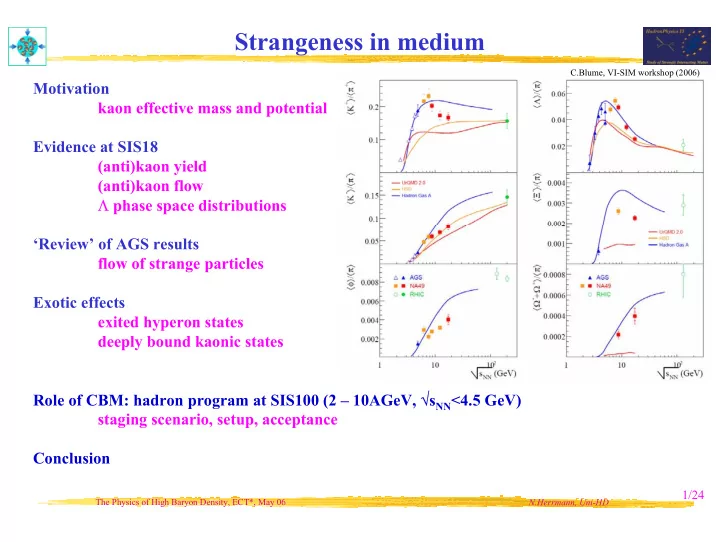
Motivation kaon effective mass and potential Evidence at SIS18 (anti)kaon yield (anti)kaon flow Λ phase space distributions ‘Review’ of AGS results flow of strange particles Exotic effects exited hyperon states deeply bound kaonic states Role of CBM: hadron program at SIS100 (2 – 10AGeV, √sNN<4.5 GeV) staging scenario, setup, acceptance Conclusion

C.Blume, VI-SIM workshop (2006)

slide-2
SLIDE 2

The Physics of High Baryon Density, ECT*, May 06 N.Herrmann, Uni-HD

2/24

0.2ρ0 0.4ρ0 0.8ρ0 1.4ρ0

Kaons in hadronic matter

pK= 0

( )

( )

( )2

1 2 2 2 1 2 *

,

2

p m U p m p

K K

+ + = + =

±

ρ ω effective mass Kaon potential

Production: P ~ exp (-m*/T) → K-yields Propagation: F=-∇U → K-flow

Coupled channel calculation

  • M. Lutz, Phys. Lett. B426 (1998) 12

spectral function of antikaons in dense matter in-medium energy

slide-3
SLIDE 3

The Physics of High Baryon Density, ECT*, May 06 N.Herrmann, Uni-HD

3/24

Kaon & Antikaon Yields

Enhanced Production of K+,K- observed in HI - collisions multistep processes: ∆N →NK+Λ EOS Transport models: no sensitivity of K-/K+ - ratio to in-medium mass of K- ? Role of πΛ↔K-N ?

Production thresholds: NN →NK+Λ Elab= 1.6 AGeV NN →K+K-NN Elab= 2.5 AGeV

P.Senger et al. (KAOS),

  • F. Laue et al. , PRL 82 (1999), updated

A.Förster et al. (KAOS), PRL 91, 152301(2003)

Centrality dependence

IQMD

slide-4
SLIDE 4

The Physics of High Baryon Density, ECT*, May 06 N.Herrmann, Uni-HD

4/24

  • P. Crochet et al. (FOPI), Phys.Lett.B 486,6 (2000)

Kaon sideflow

Ru+Ru @ 1.7 AGeV Differential K+- sideflow ⇒UK(ρ0)=15-20MeV by model comparison!

...) ) 2 cos( v 2 ) cos( v 2 1 ( :

2 1 3

+ ′ + ′ + ∝ ′ Φ − = ′ ϕ ϕ ϕ ϕ ϕ dyd dp p N d

t t R

Azimuthal distributions with respect to reaction plane

slide-5
SLIDE 5

The Physics of High Baryon Density, ECT*, May 06 N.Herrmann, Uni-HD

5/24

Antikaon phase space distributions

K– phase space distribution different from K+ ⇒ UK-(ρ0)= - 70 MeV by model comparison (RBUU)

Note: Integrated K- - yield not directly sensitive to K- - potential due to strangeness exchange reaction K- N ↔ π Λ .

K-/K+ ratio

  • K. Wisniewski et al., (FOPI), Eur.Phys.J.A9,515 (2000)

KaoS: Au+Au 1.5 AGeV

A.Förster et al., (KaoS), PRL 91, 152301 (2003)

slide-6
SLIDE 6

The Physics of High Baryon Density, ECT*, May 06 N.Herrmann, Uni-HD

6/24

  • 0.4
  • 0.2

0.2 0.4

  • 1.5
  • 1
  • 0.5

y(0) V1

95 p 95 K+ 03 p 03 K+ 03 K-

Kaon and Antikaon sideflow

  • A. Mishra et al. PRC 70(2004) 044904

FOPI preliminary σgeo ≤ 560 mb

  • PLab. < 0.5 GeV/c

Pt/m > 0.5

θLab.: 39-130 θLab.: 27-57

K- - sideflow shows unpredicted dependence.

K±, π±, p measurement with large phase space coverage and with sufficient statistics needed

K+ K-

slide-7
SLIDE 7

The Physics of High Baryon Density, ECT*, May 06 N.Herrmann, Uni-HD

7/24

  • 0.2
  • 0.1

0.1 0.2

  • 1.5
  • 1
  • 0.5

y(0) V2

95 K+ 03 K+ KAOS K+ 03 K- KAOS K-

Kaon and antikaon elliptic flow

  • A. Mishra et al. PRC 70(2004) 044904

Kaon and antikaon have different sign. Antikaon elliptic flow strongly in-plane. Available statistics in FOPI (2003): Nev ~ 108, K- ~ 5000, K+ ~ 95000 For relevant statistical errors: N(K-) > 50000 !

KAOS data:

  • F. Uhlig et al.

PRL 95(2005) 012301

FOPI preliminary same condition as V1 analysis

K+ K-

slide-8
SLIDE 8

The Physics of High Baryon Density, ECT*, May 06 N.Herrmann, Uni-HD

8/24

Rapidity distributions @ AGS

Different shapes of the rapidity density distributions for the various species Distributions can be described by longitudinal expansion

(superposition of longitudinally flowing fireballs)

K- show deviations

Au + Au @ 10.7 AGeV

slide-9
SLIDE 9

The Physics of High Baryon Density, ECT*, May 06 N.Herrmann, Uni-HD

9/24

Slopes of Kaon Spectra @ AGS

L.Ahle et al. (E866,E917) PLB 490, 53 (2000)

Au + Au (5% most central ) Antikaon spectra are steeper than Kaon spectra. No clear dependence on incident beam energy.

slide-10
SLIDE 10

The Physics of High Baryon Density, ECT*, May 06 N.Herrmann, Uni-HD

10/24

Kaon sideflow at 6AGeV

Data: P. Chung et al. (E895), PRL85, 940 (2000) Theo: S. Pal et al., Phys.Rev.C62:061903, (2000)

Very strong Kaon antiflow signal, as big as proton flow!

slide-11
SLIDE 11

The Physics of High Baryon Density, ECT*, May 06 N.Herrmann, Uni-HD

11/24

Kaon sideflow @ AGS

  • C. Pinkenburg et al. (E895), nucl-ex0104025

Information on charged kaon flow limited to small acceptance. Magnitude of charged kaon flow is much smaller than K0 flow (strong pt-dependence?).

slide-12
SLIDE 12

The Physics of High Baryon Density, ECT*, May 06 N.Herrmann, Uni-HD

12/24

Kaon sideflow @ AGS

Model comparison to RQMD 2.3

full histogram: mean field dashed histogramm: cascade mode

J.Barrette et al. (E877), NPA 661, 379c (1999) J.Barrette et al. (E877), PR C 63, 014902 (2001)

E877 – Data: Au+Au @ 10.7 AGeV

(K.Filimonov et al.)

K+ show flow, no potential required K- ??

slide-13
SLIDE 13

The Physics of High Baryon Density, ECT*, May 06 N.Herrmann, Uni-HD

13/24

Production of strange baryon resonances

RHIC DATA: S.Salur, nucl-ex/0410039

  • THERM. MOD.: .A. Andronic, private communication

URQMD MOD.: M. Bleicher, NPA 715 (2003) 85

Invariant mass distribution of Λ + π±

Data: Al+Al @ 1.92AGeV Prel.

slide-14
SLIDE 14

The Physics of High Baryon Density, ECT*, May 06 N.Herrmann, Uni-HD

14/24

Strange and anti – baryon production

C.Blume, VI-SIM workshop (2006)

Models predict ratio < 1

Hadron Gas 1: J. Manninen et al. Hadron Gas 2: K. Redlich et al. Hadron Gas 3: J. Rafelski et al.

Multistrange baryon and antibaryon production at threshold unknow or not understood

slide-15
SLIDE 15

The Physics of High Baryon Density, ECT*, May 06 N.Herrmann, Uni-HD

15/24

Evidence for an Excited Hyperon State in pp → pK+Y0*

  • I. Zycchor et al., (ANKE),

PRL 96, 012002 (2006), [nucl-ex/0506014]

pp → pK+π +X − pp → pK+π −X +

mY [MeV/c2]

Y0*: M =1480 MeV/c2 , Γ =60 MeV/c2 Cross section of a few 100 nb for both final states Statistical significance ~ 4.8 σ

pbeam= 3.65 GeV/c Ebeam= 2.83 GeV

mY [MeV/c2]

slide-16
SLIDE 16

The Physics of High Baryon Density, ECT*, May 06 N.Herrmann, Uni-HD

16/24

Motivation of high density kaonic clusters

T.Yamazaki, HFD2006

Prediction of bound states based on deep optical potential:

  • Y. Akaishi, T.Yamazaki,

Phys.Rev.C65, 044005 (2002), Phys.Lett.B535, (2002)

slide-17
SLIDE 17

The Physics of High Baryon Density, ECT*, May 06 N.Herrmann, Uni-HD

17/24

KEK experiment E471/E549

Missing mass spectroscopy

  • M. Iwasaki et al., nucl-ex/0310018 (2003)
  • T. Suzuki et al., Phys. Lett. B 597 (2004) 263

4He(stopped K-,p) pnnK- (T=1)

Mc2 = 3117 MeV, Γ~20 MeV BK =190 MeV S0(3115)

4He(stopped K-,n) ppnK-(T=0,1)

Mc2 = 3140 MeV, Γ ~ 20 MeV BK = 170 MeV S1(3140)

Statistics: 2 ×10⁸ stopped kaons

S0(3115) formation probability: 1% / stopped K- Main decay channel: S0 → ΣNN

ppnnK-

N=(n,p), measured tagging particles (unobserved)

X=(S1,S0)

K-

4He

slide-18
SLIDE 18

The Physics of High Baryon Density, ECT*, May 06 N.Herrmann, Uni-HD

18/24

Alternate view of KEK data

Interpretation by E. Oset and H. Toki, nucl-th/0509048 Absorption of K- on nucleon pair in 4He

K-NN → Λ N , p(proton) = 562 MeV/c → Σ0 N , p(proton) = 488 MeV/c

The two baryons are emitted back to back if there is no initial momentum.

p p Λ (Σ0) p

K- FINUDA from 7Li KEK E471 from 4He Expectation for Λ+p invariant mass: M(Λp) = 2 . mp + mK = 2.37 GeV

slide-19
SLIDE 19

The Physics of High Baryon Density, ECT*, May 06 N.Herrmann, Uni-HD

19/24

Evidence for (ppK-)bound by FINUDA @ DaΦne

  • M. Agnello et al.,

PRL 94, 212303 (2005)

Invariant mass spectroscopy ppK- → Λ + p

AY-theoretical prediction: M(ppK-) = 2.322 GeV Γ = 61 MeV Production probability: P.BR = 0.1% per stopped K- Peak parameter: MeV 67 MeV 115 GeV 009 . 255 . 2

2 14 3 11 3 6 4 5 + + − − + + − −

= Γ = ± = B M

slide-20
SLIDE 20

The Physics of High Baryon Density, ECT*, May 06 N.Herrmann, Uni-HD

20/24

Thermal model predictions

A.Andronic, P.Braun-Munzinger, K.Redlich (2005)

arXiv:nucl-th/0506083

Yield of single strange clusters per Λ peaked at lowest beam energies Abundance larger than Ξ− - baryon below √s<4GeV

SIS, AGS SPS RHIC Density of species i : (in grandcanonical ensemble)

∞ − − −

± =

2 2

1 2 ) , (

3 3

T I S B E i i

i I i S i B i

e dp p g T n

µ µ µ

π µ

Free parameter: chemical potential µB temperature T Fixed by conservation laws: V, µS, µI3

slide-21
SLIDE 21

The Physics of High Baryon Density, ECT*, May 06 N.Herrmann, Uni-HD

21/24

HM3MIN D03MAX PT3MIN PT3MAX Sdxy3max M3LOW 1,7 M3HIGH DML DPHL3MIN 30 YDLMAX 0,65 PTDLMIN PTDLMAX CCNT <10 BM3MIN

F10

Λd – Correlation Signal

Subevents rotated Vertex shifted Lambda Cut “s”

Properties ?

M ≈ M(KEK) = 3.14 GeV Γ >> 20 MeV > Γ(KEK)

Minv (Λ+d) (GeV)

d-Cuts: Data additional cuts: |∆φ|<300 ypair < 0.65 Signal-MC Background-MC Possible decay channel:

d ppnK + Λ →

slide-22
SLIDE 22

The Physics of High Baryon Density, ECT*, May 06 N.Herrmann, Uni-HD

22/24

CBM @ SIS100

Physics questions can be addressed with reduced CBM - setup, Allows for staging of detector implementation Minimal setup: Si-strip stations in Magnet + TOF + intermediate tracker for matching + high speed DAQ D(TOF) = 4 m (use inner part of final TOF wall, 16% of final detector)

slide-23
SLIDE 23

The Physics of High Baryon Density, ECT*, May 06 N.Herrmann, Uni-HD

23/24

Kaon acceptance @ SIS100

URQMD acceptance simulations: 4AGeV 8AGeV Charged Kaon acceptance with 3σ – TOF separation:

55% 64% 77% ε 8 6 4 Elab (AGeV)

Coverage of low – pt range of the spectrum !

slide-24
SLIDE 24

The Physics of High Baryon Density, ECT*, May 06 N.Herrmann, Uni-HD

24/24

Conclusion

Status: Strangeness production at SIS and AGS not fully understood yet. K0 antiflow at 6 AGeV surprisingly large. Collective flow of strange particles from 2 – 10 AGeV largely unknown, differential flow signals essentially not available. To be done: Clarify density dependence of K – interaction in beam energy range from 2 – 8(10) AGeV ! Establish in-medium effects on strangeness as reference for charm production at threshold. Allow for detection of rare decays of exotic strange resonances. Option: Hadron physics program with CBM subsystems at SIS100 ??? What is most important ? Is there support from theory ? Staged implementation of CBM ?