Programs 1 Cooperative Threat Reduction Evolved to combat emerging - - PowerPoint PPT Presentation

programs
SMART_READER_LITE
LIVE PREVIEW

Programs 1 Cooperative Threat Reduction Evolved to combat emerging - - PowerPoint PPT Presentation

CBRN Capacity Building Programs 1 Cooperative Threat Reduction Evolved to combat emerging and global WMD threats Distinct approach to CBRN U.S. Department of State U.S. Department of Energy 2 The Chemical Security Program (CSP)


slide-1
SLIDE 1

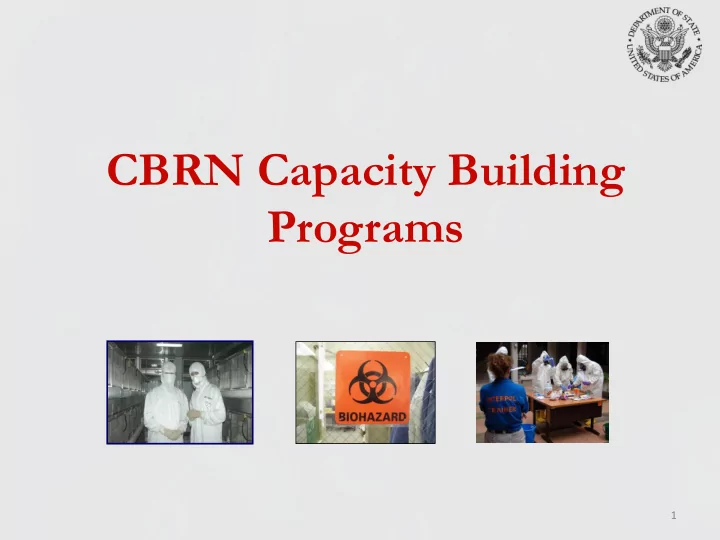
CBRN Capacity Building Programs

1
slide-2
SLIDE 2

Cooperative Threat Reduction

  • Evolved to combat emerging and global

WMD threats

  • Distinct approach to CBRN
  • U.S. Department of State
  • U.S. Department of Energy

2

slide-3
SLIDE 3

CSP promotes chemical security for a safer world.

3

The Chemical Security Program (CSP)

Reduce chemical threats

Secure Chemicals, Infrastructure & Expertise Develop & Strengthen Chemical Security Standards Prevent, Detect, and Disrupt Chemical Attacks

slide-4
SLIDE 4

CSP Activities

4

  • CW Agents
  • Precursors
  • Toxic

Industrial Chemicals

  • Non-state

actors

  • Extremists
  • Criminals
  • Exploiting

expertise

  • Theft &

diversion

  • Illicit trade

Goals Activity Detect, Prevent, & Mitigate Chemical Attacks

  • Chemical Detection and Forensics Training Courses
  • Chemical Vendor - Law Enforcement Workshops
  • Develop U.S. – Host Nation Law Enforcement Partnerships
  • Chemical Risk Management Workshops

Secure Chemicals, Infrastructure, & Expertise

  • Chemical Supply Chain Security Workshop
  • Chemical Security Improvement Grant Competition
  • Develop Chemical Inventory Management Systems
  • Strengthening of Chemical Societies or Associations
  • Personnel Reliability Training Courses

Develop & Strengthen Chemical Security Standards

  • Chemical Policy and Legislation Roundtables
  • Promote Voluntary Security Standards-“Know Your Customer”
  • Promote adoption, implementation of international obligations

(CWC and UNSCR 1540)

slide-5
SLIDE 5

5

BEP Objectives

  • Build capacity of partner states to meet national and international standards including

the World Health Organization International Health Regulation (IHR) standards

  • Partner with biological experts to raise awareness about dual use issues in the life

sciences

  • Enhance networks to improve partner nation capabilities to detect, diagnose, and

report human and animal disease outbreaks

  • Secure pathogens by providing assistance for laboratory biosecurity and biosafety
  • Build safe laboratory capacity to prevent and respond to emerging infectious disease

threats as well as a bioterrorism attack

slide-6
SLIDE 6

BEP Activities

  • Biocontainment labs

– Risk Assessments – Physical Security Upgrades – Inventory Management – SOP Development – Risk Assessment – Technical Consultation:

  • Design
  • Commissioning
  • SOPs
  • Safe and Secure

Operations & Maintenance

  • Sustainability

6

  • Biosafety and biosecurity

best practices

– Awareness Raising – International & In-country Training – Support Biosafety & Biosecurity Associations – Train-the-Trainers Programs – Indigenous BSS Training Capacity Building

slide-7
SLIDE 7

7

PNS Objectives

Insider Threat Mitigation:

  • Develop and sustain trustworthiness programs (i.e. human reliability program,

fitness-for-duty, etc.) to mitigate insider threats at nuclear facilities.

Applied Nuclear Security Culture:

  • Strengthen security practices and procedures at nuclear technical organizations to

prevent diversion of nuclear material.

Nuclear Security Train-the-Trainer Initiatives:

  • Empower partners to institutionalize nuclear security trainings to respond to

emerging threats.

slide-8
SLIDE 8

8

PNS Activities

PNS Does: PNS Does Not:

Focus on the human factor of nuclear security, including human reliability, insider threat, and security culture. Develop physical protection systems or a design basis threat, undertake programs focused on nuclear safety, safeguards or IT infrastructure, emergency response, or general regulatory development. Promote a self-sufficient nuclear security culture, ingrained in partner counties’ nuclear technical organizations. Provide training on nuclear security culture primarily for national or site response forces, border control, or PPS designers and evaluators. Sponsor events which have a majority focus on issues related to nuclear security culture, insider threat, and human reliability. Sponsor events which have a majority focus on issues

  • ther than nuclear security culture, insider threat, and

human reliability. Incorporate nuclear security culture considerations into university curriculum for future technical experts. Develop academic curriculum for guard forces, PPS designers, or topics such as nuclear safety, safeguards, or emergency response. Engage PNS priority countries bilaterally or regionally. Engage non-PNS priority countries bilaterally.

slide-9
SLIDE 9

Export Control and Related Border Security Program

  • EXBS assistance focuses on the broad range of export

controls and border security:

  • Legal and Regulatory
  • Licensing
  • Enforcement
  • Interagency Coordination
  • Government – Industry Outreach
  • EXBS assistance is delivered primarily through training

and detection/interdiction equipment donations.

9

slide-10
SLIDE 10

DOE/NNSA’s Office of Nuclear Smuggling Detection & Deterrence Mission, Goal, & Strategy

  • Mission: To provide equipment, training, and technical support

to international partners to enhance their ability to deter, detect, and investigate the illicit trafficking of special nuclear and other radioactive materials that could be used by terrorists in a nuclear weapon or radiological device

  • NSDD Strategy: incorporates a threat-based, defense-in-depth

approach to target efforts and maximize effectiveness

– Deployment of fixed and mobile systems to close key gaps along high-risk smuggling pathways

  • Over 3100 Radiation Portal Monitors (RPMs) at over 550 sites and
  • ver 90 mobile systems deployed in 56 countries since 1998

– Transition of long-term responsibility to partners within 3

  • Focus on training, workshops, and exercises, as well as support for

maintenance, regulations development, and program management

  • Over 450 sites transitioned to partner country ownership

– Forensics engagements to build awareness, capacity and improve technical expertise

10

slide-11
SLIDE 11

DOE/NNSA’s Office of Nuclear Smuggling Detection & Deterrence Deployments in South East Asia

11

slide-12
SLIDE 12

DOE/NNSA’s Office of Nuclear Smuggling Detection & Deterrence Lessons Learned

  • Threat posed by nuclear and radioactive materials out of

regulatory control persists and is evolving

  • Countries within South East Asia continue to detect and

interdict material out of regulatory control, as well as contaminated cargo, which pose a threat to the security and safety of ASEAN citizens and the global community as a whole

  • Progress in combatting nuclear smuggling will be
  • ptimized only if:

 Detection systems are effectively integrated into national-level

response plans, as well as regional and global strategy for detecting illicit trafficking

 Bilateral and multilateral mechanisms are established to share

data and other information on the detection, seizure, and investigations of material out of regulatory control

 Nations develop regulations governing the operation and

maintenance of their respective nuclear detection architecture

12

slide-13
SLIDE 13

DOE/NNSA’s Office of Nuclear Smuggling Detection & Deterrence Point of Contact

Patricia O’Brien Program Manager for Sustainability +1-202-586-7771 Patricia.O’Brien@nnsa.doe.gov Richard Pappas Deputy Program Manager for Sustainability +1-202-586-2971 Ricard.Pappas@nnsa.doe.gov

13

slide-14
SLIDE 14

Global Initiative to Combat Nuclear Terrorism

  • Voluntary initiative
  • 86 partner nations
  • Capacity building activities
  • Nuclear detection, nuclear forensics,

response and mitigation

14

slide-15
SLIDE 15

Cooperation and Coordination

  • Partner countries
  • International organizations
  • Donor countries
  • Maximize global efforts
  • Avoid duplication and redundancy

15

slide-16
SLIDE 16

16

Questions?