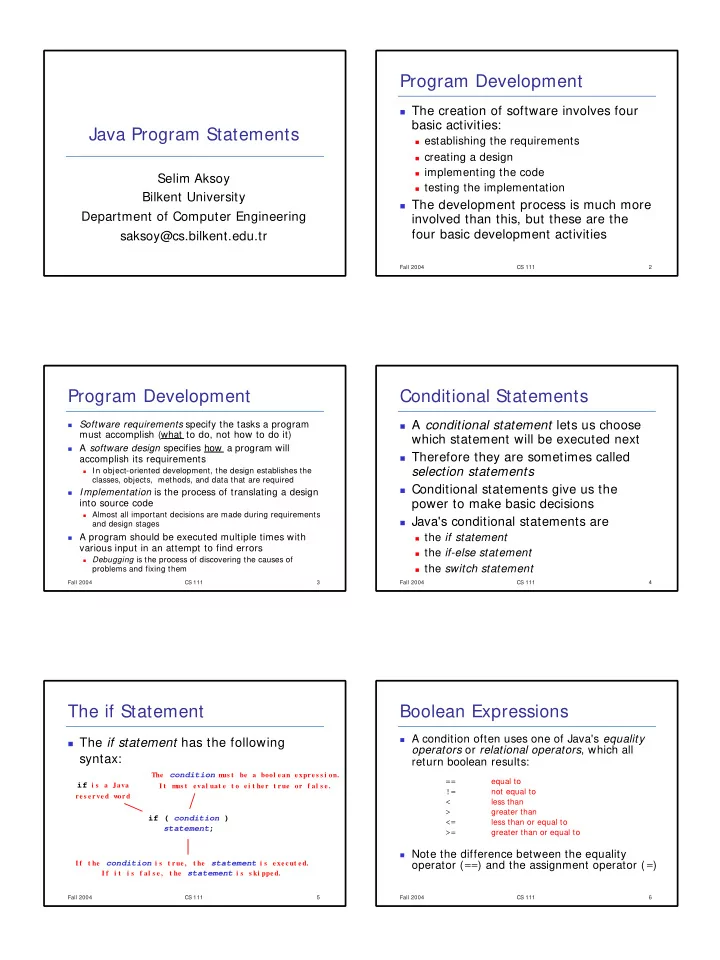

Java Program Statements
Selim Aksoy Bilkent University Department of Computer Engineering saksoy@cs.bilkent.edu.tr
Fall 2004 CS 111 2
Program Development
The creation of software involves four
basic activities:
establishing the requirements creating a design implementing the code testing the implementation
The development process is much more
involved than this, but these are the four basic development activities
Fall 2004 CS 111 3
Program Development
Software requirements specify the tasks a program
must accomplish (what to do, not how to do it)
A software design specifies how a program will
accomplish its requirements
In object-oriented development, the design establishes the
classes, objects, methods, and data that are required
Implementation is the process of translating a design
into source code
Almost all important decisions are made during requirements
and design stages
A program should be executed multiple times with
various input in an attempt to find errors
Debugging is the process of discovering the causes of
problems and fixing them
Fall 2004 CS 111 4
Conditional Statements
A conditional statement lets us choose
which statement will be executed next
Therefore they are sometimes called
selection statements
Conditional statements give us the
power to make basic decisions
Java's conditional statements are
the if statement the if-else statement the switch statement Fall 2004 CS 111 5
The if Statement
The if statement has the following
syntax:
if ( condition ) statement; if i s a Java
r e s e r ve d wor d The condition m us t be a bool e an e xpr e s s i on. I t m us t e val uat e t o e i t he r t r ue or f al s e . I f t he condition i s t r ue , t he statement i s e xe c ut e d. I f i t i s f al s e , t he statement i s s ki ppe d.
Fall 2004 CS 111 6
Boolean Expressions
A condition often uses one of Java's equality
- perators or relational operators, which all
return boolean results:
== equal to != not equal to < less than > greater than <= less than or equal to >= greater than or equal to
Note the difference between the equality
- perator (==) and the assignment operator (=)