Faculty Early Career Development (CAREER) Program Program - - PDF document

faculty early career development career program program
SMART_READER_LITE
LIVE PREVIEW

Faculty Early Career Development (CAREER) Program Program - - PDF document

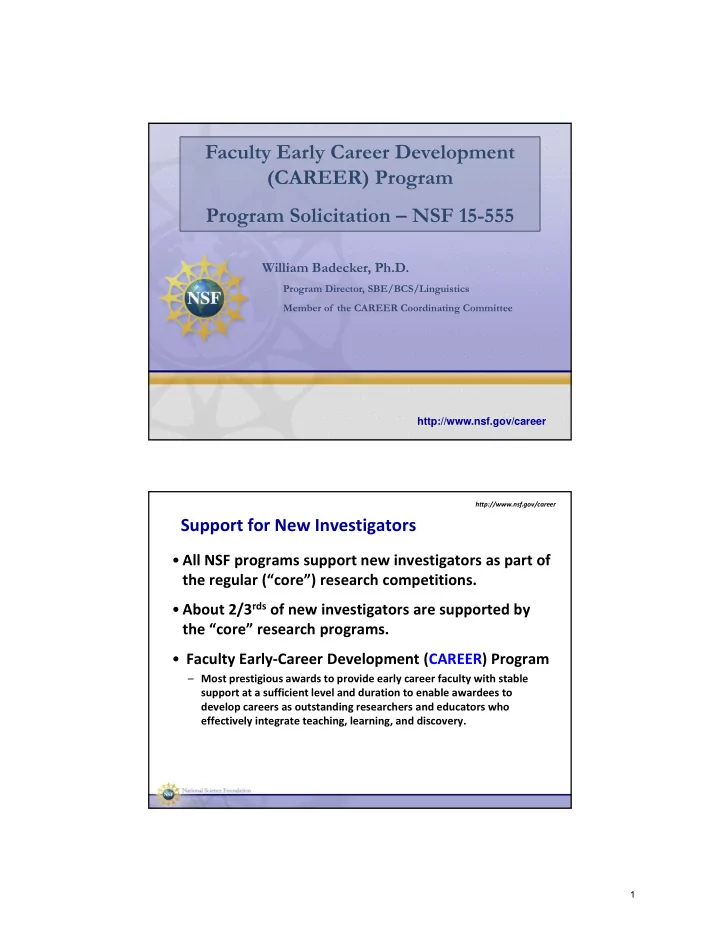
Faculty Early Career Development (CAREER) Program Program Solicitation NSF 15-555 William Badecker, Ph.D. Program Director, SBE/BCS/Linguistics Member of the CAREER Coordinating Committee http://www.nsf.gov/career


slide-1
SLIDE 1

Faculty Early Career Development (CAREER) Program Program Solicitation – NSF 15-555

William Badecker, Ph.D.

Program Director, SBE/BCS/Linguistics Member of the CAREER Coordinating Committee http://www.nsf.gov/career

2

http://www.nsf.gov/career

Support for New Investigators

  • All NSF programs support new investigators as part of

the regular (“core”) research competitions.

  • About 2/3rds of new investigators are supported by

the “core” research programs.

  • Faculty Early‐Career Development (CAREER) Program

– Most prestigious awards to provide early career faculty with stable support at a sufficient level and duration to enable awardees to develop careers as outstanding researchers and educators who effectively integrate teaching, learning, and discovery.

1

slide-2
SLIDE 2

3

http://www.nsf.gov/career

Goals of the CAREER Program

  • Provide stable support for five years ( $400K in most

Directorates – ENG, BIO and GEO/PLR are  $500K) to allow the career development of outstanding new teacher‐ scholars in the context of the mission of their organization.

  • Build a foundation for a lifetime of integrated contributions

to research and education.

  • Provide incentives to Universities to value the integration of

research and education.

  • Increase participation of those traditionally

underrepresented in science and engineering.

4

CAREER is NSF‐wide

  • The program started in 1996
  • All Directorates/Offices participate in the

program

  • Proposals are submitted to program of interest
  • More than 9,000 CAREER awards have been

made over the years

  • NSF Presidential Early‐Career Awards in Science

and Engineering (PECASE) are selected out of the pool of recent CAREER awardees

http://www.nsf.gov/career

2

slide-3
SLIDE 3

5

http://www.nsf.gov/career

Investigator Eligibility Criteria

  • Hold a doctoral degree in a field supported by NSF

by proposal deadline

  • Be untenured up until Oct 1st following proposal

deadline

  • Be employed in a tenure‐track (or equivalent)

position at an eligible institution as an Assistant Professor (until Oct 1st following deadline)

  • Have not previously received a CAREER award
  • Have not had more than two CAREER proposals

reviewed

  • Untenured Associate Professors are NOT eligible

6

http://www.nsf.gov/career

Institutional Eligibility

  • Academic institutions in the U.S., its territories or

possessions, and the Commonwealth of Puerto Rico that award degrees in fields supported by NSF.

  • Non‐profit, non‐degree‐granting organizations such

as museums, observatories or research labs may also be eligible to submit proposals, if the eligibility requirements of the PI's position are satisfied.

  • NSF encourages proposals from different

institutional types, including Minority Serving and Undergraduate Institutions.

3

slide-4
SLIDE 4

7

CAREER Varies Across NSF

http://www.nsf.gov/career

  • Number of submitted CAREER proposals vary widely

across NSF

  • Review and funding methods vary according to

Directorate and Division practices

  • Many CAREER proposals compete with other research

proposals in the most appropriate research program

  • CAREER Coordinating Committee is made up of

members from the different Directorates/Offices – We are the liaison between the programs and the senior management at NSF

8

http://www.nsf.gov/career

200 400 600 800 1000 1200 BIO CISE ENG GEO MPS SBE EHR

Proposals Submitted

2004 2005 2006 2007 2008 2009 2010 2011 2012 2013 2014

4

slide-5
SLIDE 5

9

Merit Review of CAREERs

  • Ad hoc + Panel (with other proposals in the Program –

most of GEO (AGS uses ad hoc only), BIO, and SBE

  • Mostly dedicated CAREER Panels – ENG, CISE, EHR,

MPS varies by Division: – AST – Panel only – CHE, DMR – Mix of ad hoc and panels (check your program) – DMS – mostly panels (2 programs use ad hoc only)

http://www.nsf.gov/career

10

http://www.nsf.gov/career

Success Rates and Expectations

  • CAREER proposals are submitted to a disciplinary unit or

program

  • They are reviewed according to the relevant Program

guidelines ‐ Talk to Program Officer or Division Contact for more information (http://www.nsf.gov/crssprgm/career/contacts.jsp)

  • Make sure to check on typical award sizes in your program
  • Ask about expectations for scope of research and education

plans

  • Assessment of Departmental Letter (2 pages) is part of the

review criteria for CAREER

  • Funding rates follows trend for regular proposals in the

program of interest

5

slide-6
SLIDE 6

11

http://www.nsf.gov/career

20 40 60 80 100 120 140 160 180 200 BIO CISE ENG GEO MPS SBE EHR

Proposals Awarded

2004 2005 2006 2007 2008 2009 2010 2011 2012 2013 2014

ARRA

12

http://www.nsf.gov/career

0% 5% 10% 15% 20% 25% 30% 35% 40% BIO CISE ENG GEO MPS SBE EHR

Success Rate

2004 2005 2006 2007 2008 2009 2010 2011 2012 2013 2014

ARRA

6

slide-7
SLIDE 7

13

http://www.nsf.gov/career

Is CAREER the right program for you?

  • Can you think of a proposal that is appropriate for

NSF with research and education activities that are innovative and ambitious?

  • Is your Department/Organization supportive?
  • Are you seriously committed to the goals of CAREER?
  • Are you at the right stage in your career?
  • Would you like to be considered for the Presidential

Early Career Awards for Scientists and Engineers (PECASE), if eligible?

  • Have you discussed your ideas with mentors,

fellows, Program Officers?

14

http://www.nsf.gov/career

What should be in a CAREER proposal?

  • A compelling research plan
  • Innovative but doable education plan
  • A plan for the effective integration of both sets of

activities (evaluation plan is a big plus) Education activities – curriculum, pedagogy,

  • utreach, mentoring at any level, majors and

non‐majors, teacher preparation or enhancement, K‐12 students, and/or the general public.

7

slide-8
SLIDE 8

15

http://www.nsf.gov/career

CAREER Education Plan

  • Activities should go beyond what is expected from

any Assistant Professor in your field

  • Workload should not be unreasonable
  • Should be informed by what has been successful

in the past ‐ intellectual merit of the education component

  • Should have a plan for assessing the success of the

education program

  • Check with your Program Officer or search the

abstracts on the web

16

http://www.nsf.gov/career

Integration of Research and Education

How will your research impact your education goals and how will your education activities feed back into your research?

  • Involving others (graduate, undergraduates, K‐12, high school

teachers, public) in your research using new tools, laboratory methods, field components, web outreach, cyber networks, etc...

  • Partnering with those in other communities, especially those

traditionally underrepresented in Sciences and Engineering

  • Bringing the excitement of your research topics to help in the

education of others

  • Searching for new methods to deliver your research results to a

broader audience than those in the immediate research community

  • Using the broader community to gather data for your scientific

pursuits (“citizen science”)

8

slide-9
SLIDE 9

17

http://www.nsf.gov/career

CAREER Personnel and Budgets

  • No Co‐Principal Investigators or other senior personnel

are allowed

  • Consultants, sub‐awards are allowed (but no senior

personnel costs in sub‐awards)

  • Some programs will support buy out of academic year

time for teaching intensive institutions (check with your Program Officer)

  • International activities are encouraged and may be

supported by the Office of International Science and Engineering (OISE)

  • Some Directorates prefer making more awards but

closer to the $400K minimum (or $500K in BIO and OPP).

18

http://www.nsf.gov/career

Departmental Letter (2 pages)

  • Support for the PI’s proposed CAREER research and

education activities

  • Description of how the PI’s career goals and

responsibilities mesh with that of the organization and department

  • Commitment to the professional development of the PI

with mentoring and whatever is needed to forward the PI’s efforts to integrate research and education

  • Statement that indicates the PI is eligible for the

CAREER program

  • Should not serve as a letter of recommendation or

endorsement of the PI or the research project

9

slide-10
SLIDE 10

19

http://www.nsf.gov/career

Traits of Successful CAREER Proposals

  • CAREER proposals should match the expectations in the

disciplinary programs in terms of research and education ‐ This is a highly competitive program!

  • Written with peer reviewers (Ad Hoc and/or Panel) in

mind ‐ Ask your Program Officer who will be assessing your proposal

  • Appropriate scope of education and research activities.

It is a 5‐year plan, not your whole life

  • Goes outside the ‘education box’ of regular research

proposals in your field

  • Strikes a balance between doable research activities and

more risky pursuits

20

CAREER Urban Myths

  • “You cannot apply because you have another award

from NSF”

  • “It is an entry program, so apply to CAREER first”
  • “I need to see a successful proposal to write a

successful proposal”

  • “I read on the web that to succeed, I have to....”
  • “CAREER proposals are more portable”
  • “The education component does not matter”
  • “You have no chance, if you are not from a research‐

intensive institution”

http://www.nsf.gov/career

10

slide-11
SLIDE 11

21

http://www.nsf.gov/career

PECASE: Presidential Early‐Career Awards for Science and Engineers

  • PECASE Eligibility ‐ Be a US Citizen or US Permanent

Resident by the time of nomination to the White House’s Office of Science and Technology Policy

  • 20 Nominees for NSF PECASE every year from the

pool of recent CAREER awardees

  • Number of nominees from each Directorate is a

function of the number of proposals submitted to the programs in the Directorate

22

International Research Opportunities for CAREER PIs

  • NSF/ERC: Dear Colleague Letter: Research

Opportunities in Europe for NSF CAREER Awardees (nsf15036)

  • NSF/DFG: Dear Colleague Letter: Research

Opportunities in Germany for NSF CAREER Awardees (nsf15059)

http://www.nsf.gov/career

11

slide-12
SLIDE 12

23

The CAREER website – www.nsf.gov/career

  • Latest Program Solicitation ‐ NSF 14‐532
  • Frequently Asked Questions ‐ NSF 11‐038
  • CAREER Directorate/Division Contacts
  • Link to recent awards
  • Link to PECASE awards
  • Deadlines for the current solicitation

– July 21, 2015 ‐ BIO, CISE, EHR, OCI – July 22, 2015 ‐ ENG – July 23, 2015 ‐ GEO, MPS, SBE, OPP

24

http://www.nsf.gov/career

PECASE: Presidential Early‐Career Awards for Science and Engineers (April 2014)

12