Career Development Benefits of starting early Preparing young - - PowerPoint PPT Presentation

career development
SMART_READER_LITE
LIVE PREVIEW

Career Development Benefits of starting early Preparing young - - PowerPoint PPT Presentation

Career Development Benefits of starting early Preparing young people for a successful future beyond school Andrew Smith Regional Career Development Officer (RCDO) DEECD South-Western Victoria What is a career? A career is all of the paid


slide-1
SLIDE 1

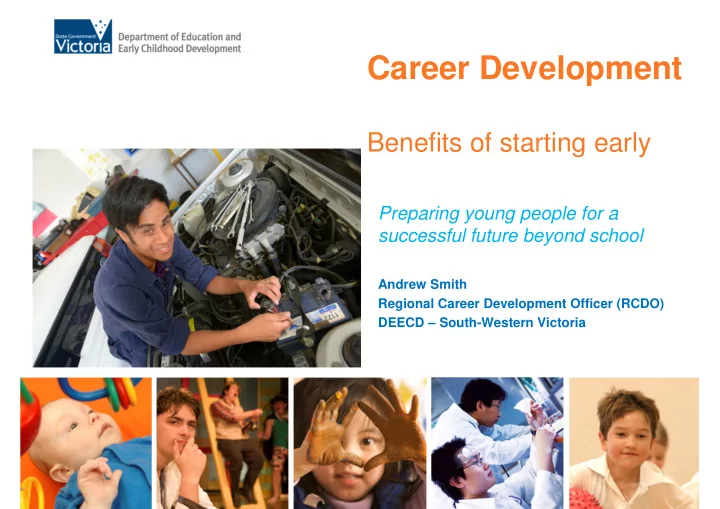
Career Development

Benefits of starting early

Preparing young people for a successful future beyond school

Andrew Smith Regional Career Development Officer (RCDO) DEECD – South-Western Victoria
slide-2
SLIDE 2

What is a career?

A career is all of the paid and unpaid work, learning and life roles you do throughout your life

5

slide-3
SLIDE 3

What is Career Development?

  • Career Development is the complex process of managing

life, learning and work

  • Career Education is the development of skills, knowledge

and attitudes through planned program of learning experiences in education, training and work settings

  • Career Development Programs and Services should

foster the growth of career self-management skills that underpin the person’s ability to successfully navigate their lifelong career journey

slide-4
SLIDE 4

Good-Practice Career Development

What defines good practice in career development services?

starts early and engages parents quality career education culturally sensitive services quality experiential learning supported by leadership Integrated team based strategic approach qualified and experienced careers staff delivery by a combination

  • f providers
slide-5
SLIDE 5

The department has worked closely with Victorian special schools and secondary colleges, and undertaken a review of local, national and international research to identify the features of successful career planning for young people with disabilities. The review identified that good practice in career planning for young people with disabilities is:

– Proactive and starts early – Focused on the individual – Driven by young people and parents – Based on an objective student assessment – Related to life skills development – Inclusive of families and carers – Actively involving businesses, communities and government agencies

Successful career planning

slide-6
SLIDE 6

Careers Curriculum Framework

Career Exploration Young people locate, investigate and consider opportunities in learning and future work options. Career Management Young people make and adjust Career Action Plans and manage their life choices, changes and transitions.

www.education.vic.gov.au/school/teachers/teachingresources/careers

Self Development Young people understand themselves and the influences on them, build their experiences and achievements and develop their capabilities.

slide-7
SLIDE 7

Starting early - Draft CCF – Years 3 - 4

AUSVELS YEAR LEVEL SELF DEVELOPMENT CAREER BUILDING CAREER MANAGEMENT LEVEL 3 3 I WONDER

  • 1. Discover change and growth are part
  • f life.
  • 4. Describe the patterns of changes that individuals

have experienced at school and might experience in the future.

  • 7. Recognise and respect diverse groups in

the school and community.

  • 2. Identify personal attributes that are

personal strengths and relate to work/activities in school and home.

  • 5. Describe the positive contributions work makes to

the family, school and the wider community.

  • 8. Identify possible steps in making career

and other decisions.

  • 3. Describe home and school

work/activity that best suit your personal skills and abilities.

  • 6. Describe a range of work roles, the occupational

fields and the personal attributes required in each.

  • 9. Identify and apply the steps to setting

short-term, long–term, personal and educational goals. LEVEL 4 4 I LEARN

  • 1. Recognise abilities for building

positive relationships in life.

  • 4. Understand types of career information available..
  • 7. Identify the components of a career

portfolio.

  • 2. Explain how personal attributes affect

personal performance in work tasks/activities at home and school.

  • 5. Describe the ways in which work within the family,

school and wider community can be organised and shared.

  • 8. Identify resources (information and

people) that can assist individuals in making decisions in work/other situations at school.

  • 3. Identify the interpersonal and social

skills needed to develop and engage effectively in cooperative work tasks and

  • ther activities.
  • 6. Explain how skills and understandings developed

and used in one area of learning are transferable to

  • thers.
  • 9. Collect information regarding training

and education for a variety of careers.

slide-8
SLIDE 8

Draft CCF – Years 5 - 6

AUSVELS YEAR LEVEL SELF DEVELOPMENT CAREER BUILDING CAREER MANAGEMENT LEVEL 5

5

I CONSIDER

  • 1. Identify personal attributes that are

personal strengths and relate these to work/activities in school and post school environments.

  • 4. Identify males and females in non-traditional work

roles.

  • 7. Build individual work habits and study

skills that apply to a variety of learning situations.

  • 2. Explain how personal attributes affect

self-confidence and performance in a range of work/learning situations.

  • 5. Describe how gender, ethnic and social factors can

influence personal development interests and values.

  • 8. Develop a career action plan for

achieving school related goals and evaluate the consequences of such action.

  • 3. Explain the steps used in a decision

making process focusing on moving into secondary school.

  • 6. Describe self-employment, part-time, full-time,

casual, contract and volunteer work and the contribution each can make to the community.

  • 9. Develop an understanding of

educational tasks and skills necessary to make a smooth transition to the secondary school structure LEVEL 6 6 I PREPARE

  • 1. Identify your own interests and values

in relation to different work tasks/activities and occupations.

  • 4. Use current interests, strengths and limitations to

guide individual career exploration.

  • 7. Identify and describe career pathways

within a range of occupations.

  • 2. Describe how feedback from others

can influence personal performance and self-concept.

  • 5. Describe the rights and responsibilities of workers
  • f workers and employers in a range of occupational

areas.

  • 8. Identify the information and skills

necessary to transition to secondary school

  • 3. Describe school, work and other
  • ptions in the rationale for making

personal choices.

  • 6. Explain how stereotyping can limit the life/work
  • pportunities of people.
  • 9. Identify aspects of initial career

interests and ideas and use these for action plan development.

slide-9
SLIDE 9

Draft Year 3 Career Action Plan

slide-10
SLIDE 10

Draft Year 3 Career Action Plan

Who are you? I like to work with

  • people
  • words
  • plants
  • paints/pencils
  • numbers
  • machines
  • animals
  • computers

I can:

  • speak to other people
  • listen to others
  • work by myself
  • work with other people
  • follow instructions
  • be on time
  • be neat and tidy
  • help others
  • make decisions
  • respect others

And ______________________ ___________________ My future I would like to complete Year 12 YES NO I would like to go on to further training and education YES NO I would like my first job to be _______________________________ I need to know ___________________________________________ I could get information from ________________________________ I could get help from_______________________________________ To achieve my goal I will need to At school ______________________________________________ At home_______________________________________________

slide-11
SLIDE 11

Strengthened Pathways Planning

Strengthened Pathways Planning is a single ‘one-stop shop’ webpage with a printable guidelines booklet.

http://www.education.vic.gov.au/school/teachers/teachingresources/careers/Pages/disabilitypathways.aspx

slide-12
SLIDE 12

Strengthened Pathways Planning

Strengthened Pathways Planning offers an enhanced and integrated approach to career planning for young people with disabilities, which includes four customised components that build upon universal career development resources in schools:

  • 1. Engaging Parents in Career Conversations Framework
  • 2. Career Action Plans
  • 3. R U Ready Student Profile
  • 4. Workplace learning resources
slide-13
SLIDE 13

Strengthened Pathways Planning

The pathways planning is overseen by the young person’s Student Support Group in consultation with the school’s career practitioner, and the agreed activities are incorporated within the young person’s Individual Learning Plan. The Individual Learning Plan binds the components of Strengthened Pathways Planning into a unified approach.

Career Action Plan R U Ready Student Profile Workplace Learning Opportunities Engaging Parents in Career Conversations Individual Learning Plan

slide-14
SLIDE 14

Strengthened Pathways Planning

The R U Ready Student Profile provides a snapshot of a young person’s work-related skills and employability at a point in time. This helps young people, their parents and teachers engage in career conversations about what the young person can do, their strengths, and readiness for work.

R U Ready Student Profile

slide-15
SLIDE 15

Strengthened Pathways Planning

R U Ready Student Profile

slide-16
SLIDE 16

Strengthened Pathways Planning

The Career Action Plan is a student-owned career planning document designed to translate a young person’s dreams and aspirations into specific learning goals and identify relevant work experience opportunities.

Career Action Plan

slide-17
SLIDE 17

Strengthened Pathways Planning

Career Action Plan

slide-18
SLIDE 18

Strengthened Pathways Planning

The Engaging Parents in Career Conversations (EPiCC) Framework provides resources to help schools work together with parents to ensure that young people are empowered with positive career messages both at school and at home.

www.education.vic.gov.au/school/teachers/teachingresources/careers/parentsframe www.education.vic.gov.au/school/parents/beyond/Pages/conversation.aspx

slide-19
SLIDE 19

Strengthened Pathways Planning

Workplace Learning Opportunities enable young people to trial post- school options and gain direct ‘hands on’ experience in a workplace. There are resources available to help school staff to prepare young people with a disability for work experience and structured workplace learning. – a Job Well Done – Work Experience Toolkit – New Ministerial Orders – New Manuals – Workplace Learning Coordinators

Workplace Learning Opportunities

slide-20
SLIDE 20

Strengthened Pathways Planning

Early planning and preparation is essential for successful transition. The following diagram provides a suggested timeline for schools implementing the components of Strengthened Pathways Planning throughout the secondary school years.

slide-21
SLIDE 21

Developing a Whole School Approach

  • Professional learning for all school staff on what is

career development

  • Development of a professional learning team focussing
  • n careers and transitions
  • Engagement of parents through an EPiCC program
  • Engagement of community partners through identifying

key stakeholders

  • Completing the Career Development Quality

Benchmarks for good practice process with all key stakeholders

slide-22
SLIDE 22

Career Development Quality Benchmarks for good practice

  • Practical tool for self assessing career development programs and services and for

developing plans for improvement

  • The tool can be used by schools, TAFE and Learn Local providers
  • Round table discussion of where the school is currently at involving the:
  • Principal or Assistant Principal

Teaching and Learning / Curriculum Coordinator Coordinator(s) of relevant learning area(s) Relevant Level Coordinator(s) Student Wellbeing Coordinator Transition / Careers Practitioner(s) Any other relevant staff

  • Quality career development programs and services are delivered effectively when

all seven key categories are addressed

slide-23
SLIDE 23

Quality Benchmarking

slide-24
SLIDE 24

Quality Benchmarking

slide-25
SLIDE 25

School Action Plan

Possible focus area could include:

  • Develop a vision statement / guiding principles for the school’s career

development / transition program linked directly to the school strategic implementation plan

  • Develop an action plan for developing the career development / transition

program over the next three years

  • Investigate new opportunities to make careers / transition outcomes more

explicit in the curriculum – map individual learning plans (ILPs) to the appropriate outcomes for each student in the Victorian Careers Curriculum Framework

  • Introduce Career Action Plans (CAPs) linked to ILPs for all students in the

middle and later years programs – create opportunities for regular review of plans as part of Student Support Group meetings (SSG) - use the R U Ready profile tool included in the Strengthened Pathways Planning package to inform the ILP

slide-26
SLIDE 26

School Action Plan

  • Facilitate an EPiCC program to equip parents with an

understanding of the current definition of a “Career” and the skills and understanding to support their child’s career development and transition

  • Review teacher role statements to clearly define each teachers

role in the school’s career development / transition program

  • Continue to develop formal links with employers, community and

educational institutions

  • Investigate new work experience opportunities for students
  • Develop new opportunities for all staff to learn about their role in

supporting the career development of their students – possible whole staff professional learning program

slide-27
SLIDE 27

Questions???

Contact details:

Andrew Smith - Regional Career Development Officer DEECD, South Western Victoria Region T: 03 8397 0224 M: 0417 030 690 E: smith.andrew.saj@edumail.vic.gov.au Alan Davies - Regional Career Development Officer DEECD, North Western Victoria Region M: 0459 801 524 davies.alan.AT@edumail.vic.gov.au