Prof. Dr. Celal F Gkay TREATMENT & RECYCLING OF DOMESTIC - - PDF document

prof dr celal f g k ay
SMART_READER_LITE
LIVE PREVIEW

Prof. Dr. Celal F Gkay TREATMENT & RECYCLING OF DOMESTIC - - PDF document

ENVIRONMENTAL PROBLEMS FACING US: AN OVERALL ASSESSMENT FROM TURKEY MAIN THEME TO BE DISCUSSED HERE: Prof. Dr. Celal F Gkay TREATMENT & RECYCLING OF DOMESTIC WASTEWATERS FOR REUSE AND METU Environmental Engineering SUSTAINABILITY.


slide-1
SLIDE 1

1

INNOVA-MED CF Gokcay 1

  • Prof. Dr. Celal F

Gökçay

METU Environmental Engineering Dept., cfgokcay@metu.edu.tr

INNOVA-MED CF Gokcay 2

ENVIRONMENTAL PROBLEMS FACING US: AN OVERALL ASSESSMENT FROM TURKEY

MAIN THEME TO BE DISCUSSED HERE: TREATMENT & RECYCLING OF DOMESTIC WASTEWATERS FOR REUSE AND SUSTAINABILITY. The OUTCOMES OF MEDAWARE PROJECT

INNOVA-MED CF Gokcay 3

MEDAWARE Project

‘Development of Tools and Guidelines for

the Promotion of the Sustainable Urban Wastewater Treatment and Reuse in the Agricultural Production in the Mediterranean Countries’

INNOVA-MED CF Gokcay 4

MEDAWARE Participating Countries

  • 1. Cyprus

Nicosia Agriculture Research Institute

  • 2. Jordan

Irbid Jordan University of Sciences and Technology

  • 3. Lebanon

Beirut American University of Beirut

  • 4. Marocco

El Jadida Chouaib Doukkali University,

  • 5. Palestinian

Authority Gaza Ministry of Environmental Affairs

  • 6. Türkiye

Ankara ODTÜ

  • 7. Türkiye

Istanbul İTÜ

  • 8. Greece

Athens National Tech. Univ. of Athens

  • 9. Greece

Chania- Grete Prospect Systems

  • Env. Protection Tech, & Systems
  • 10. Spain

Boecillo Cartif, Centro de Automatimazion, Robotica y Technologias

INNOVA-MED CF Gokcay 5

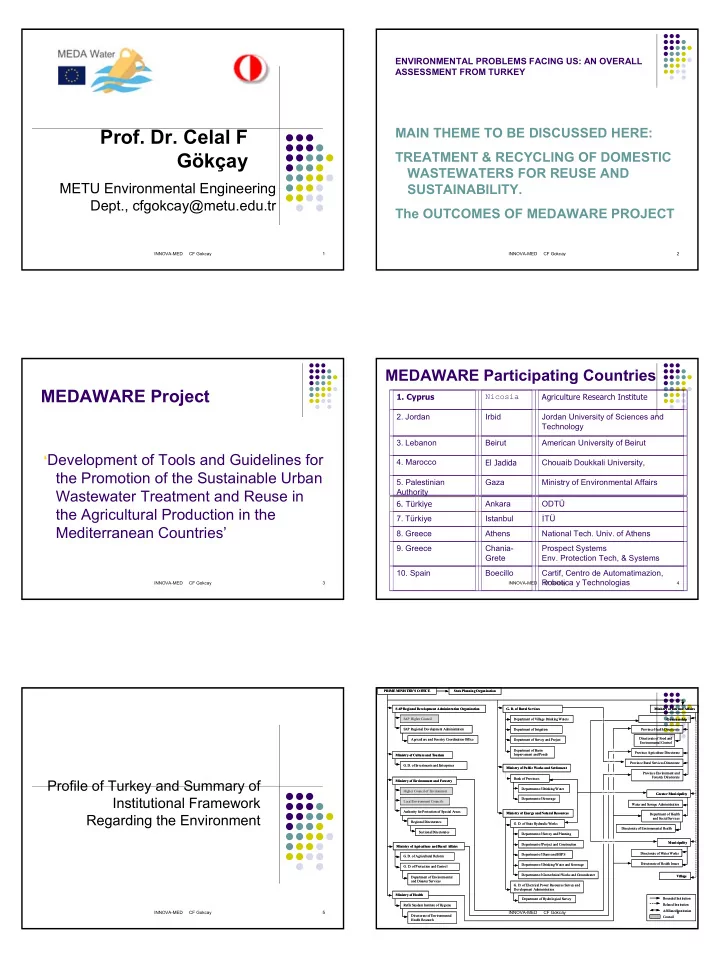
Profile of Turkey and Summary of Institutional Framework Regarding the Environment

INNOVA-MED CF Gokcay 6

Ministry of Health Refik Saydam Institute of Hygiene Directorate of Environmental Health Research Ministry of Public Works and Settlement Bank of Provinces Department of Drinking Water Department of Sewerage

  • G. D. of Rural Services
  • G. D. of State Hydraulic Works

Ministry of Energy and Natural Resources

  • G. D. of Electrical Power Resources Survey and

Development Administration Department of Hydrological Survey Department of Survey and Planning Department of Project and Construction Department of Dams andHEPS Department of Drinking Water and Sewerage Department of Geotechnical Works and Groundwater Ministry of Agriculture and Rural Affairs

  • G. D. of Agricultural Reform
  • G. D. of Protection and Control

Department of Environmental and Disaster Services Ministry of Environment and Forestry Higher Council of Environment Local Environment Councils Authority for Protection of Special Areas Regional Directorates Sectional Directorates Ministry of Culture and Tourism

  • G. D. of Investments and Enterprises

SAP Regional Development Administration Organization SAP Higher Council SAP Regional Development Administration Agriculture and Forestry Coordination Office Municipality Directorate of Water Works Directorate of Health Issues Greater Municipality Water and Sewage Administration Department of Health and Social Services Directorate of Environmental Health Governorship Province Agriculture Directorate Province Rural Services Directorate Province Environment and Forestry Directorate Province Health Directorate Directorate of Food and Environmental Control Village Ministry of Internal Affairs Department of Village Drinking Waters Department of Irrigation Department of Survey and Project Department of Basin Improvement and Ponds PRIME MINISTER’S OFFICE State Planning Organization Bounded Institution Related Institution AffiliatedInstitution Council Ministry of Health Refik Saydam Institute of Hygiene Directorate of Environmental Health Research Ministry of Public Works and Settlement Bank of Provinces Department of Drinking Water Department of Sewerage

  • G. D. of Rural Services
  • G. D. of State Hydraulic Works

Ministry of Energy and Natural Resources

  • G. D. of Electrical Power Resources Survey and

Development Administration Department of Hydrological Survey Department of Survey and Planning Department of Project and Construction Department of Dams andHEPS Department of Drinking Water and Sewerage Department of Geotechnical Works and Groundwater Ministry of Agriculture and Rural Affairs

  • G. D. of Agricultural Reform
  • G. D. of Protection and Control

Department of Environmental and Disaster Services Ministry of Environment and Forestry Higher Council of Environment Local Environment Councils Authority for Protection of Special Areas Regional Directorates Sectional Directorates Ministry of Culture and Tourism

  • G. D. of Investments and Enterprises

SAP Regional Development Administration Organization SAP Higher Council SAP Regional Development Administration Agriculture and Forestry Coordination Office Municipality Directorate of Water Works Directorate of Health Issues Greater Municipality Water and Sewage Administration Department of Health and Social Services Directorate of Environmental Health Governorship Province Agriculture Directorate Province Rural Services Directorate Province Environment and Forestry Directorate Province Health Directorate Directorate of Food and Environmental Control Village Ministry of Internal Affairs Department of Village Drinking Waters Department of Irrigation Department of Survey and Project Department of Basin Improvement and Ponds PRIME MINISTER’S OFFICE State Planning Organization Bounded Institution Related Institution AffiliatedInstitution Council

slide-2
SLIDE 2

2

INNOVA-MED CF Gokcay 7

Laws and Regulations Pertaining to Wastewater Treatment, Disposal and Reuse

Environmental Impact Assessment Regulation MoEF 2002 Environmental Inspection Regulation MoEF 2001 Aquatic Products Regulation MoARA 1995 WPCR Technical Aspects Bulletin MoEF 1991 WPCR Toxic and Hazardous Substances in Water Bulletin MoEF 1989 WPCR Administration Aspects Bulletin MoEF 1989 Water Pollution Control Regulation (WPCR) MoEF 1988 Environment Law MoEF 1983 Law/Regulation/Bulletin Establishment Year

MoEF: Min. Of Environment and Forestry, MoARA: Ministry of Agriculture and Rural Affairs

INNOVA-MED CF Gokcay 8

List of Actors Involved in Wastewater Treatment and Reuse- 1

G.D. of State Hydraulic Works Ministry of Energy and Natural Resources Ward Administration Municipalities Governorships Ministry of Internal Affairs G.D. of Agricultural Reform Ministry of Agriculture and Rural Affairs Ministry of Health Authority for Protection of Special Areas Ministry of Environment and Forestry I S W I S W I S W I S W MONITOR FINAN CE SERVI CE PLAN NING Actor

INNOVA-MED CF Gokcay 9

Ministry of Culture and Tourism Bank of Provinces Ministry of Public Works and Settlement SAP Reg. Development Administration

  • G. D. of Rural Services

State Planning Organization Prime Minister’s Office

  • G. D. of Electrical Power Resources

Survey and Development Administration I S W I S W I S W I S W MONITOR FINANCE SERVICE PLANNIN G Actor

List of Actors Involved in Wastewater Treatment and Reuse - 2 W: Water, S: Sewage (Wastewater), I: Irrigation

INNOVA-MED CF Gokcay 10

Water Potential

Total annual water potential in the country is around

187 Billion m3

30-35 Billion m3 used directly in irrigation Around 5-6 billion m3 is being used for domestic

purposes

Although ample water potential exist, availibility is

not homegenously distributed in time and in space. Local water shortages at times of crisis should be

  • vercome by reusing treated wastewaters.

INNOVA-MED CF Gokcay 11

0.12 0.96 Other 1.57 0.37 Pond 24.1 67.4 Groundwater 39.6 4.90 Dam 2.21 1.54 River 10.3 0.53 Lake 22.1 24.3 Spring water Urban Withdrawal distribution (%) (Total water amount: 6202 x 106 m3) Rural Withdrawal distribution (%) (Total water amount: 164 x 106 m3) Water Withdrawal in Turkey (DSI-2001)

INNOVA-MED CF Gokcay 12

The results of Water Table Observation Studies (DSI 2002)

53 68 The ratio of observed area to total irrigtonal area (%) 100 1009191 100 1258777 Total 1 5214 6109 10000< 1 5992 1 10166 7500-10000 2 20551 2 23322 5000-7500 11 114399 7 91411 2500-5000 86 863035 90 1127769 0-2500 Rate (%) Area (ha) Rate (%) Area (ha) Salinity Levels 2002 2001 Years

slide-3
SLIDE 3

3

INNOVA-MED CF Gokcay 13

Agricultural Land 28 million ha Forest,Meadow s Bushes 23

  • mi. ha

Pasture and Grassland 22 million ha Others 4 million ha Water Surface Area 1 mi. ha Agricultural Land 28 million ha Area that can be irrigated 26 million ha (economically 8.5 million ha) Dry Agriculture 22.5 million ha Wet agriculture 4.5 million ha Special Plants 1 million ha Fallow 16 million ha No Fallow 6 million ha Area that can not be irrigated 2 million ha Area of Turkey 78 million ha Land (Slope 12%): 9 million ha Land (Slope 6%): 17 million ha

INNOVA-MED CF Gokcay 14

14 179 138 tons Fruit 22 357 612 tons Vegetable 32097114 tons Cereals 63 433 032 tons Field crops Production Crops

Vegetable and Fruit production, 2000 (IES)

INNOVA-MED CF Gokcay 15

Indicators of need for reuse:

The year 2007 Has particularly been a dry year where

both agricultural and domestic water resources were adversely affected. Water rationing is being considered by the metropolitan municipalities.

Some of the precious agricultural land, such as Konya

Plain, is suffering from groundwater depletion due to

  • ver abstraction of water through unregulated wells.

Wheat poduction went well below the average annual

figure and the country is to import her wheat for the first tme.

Sugar beeet and seed oil production has gone down. At times like this use of treated waste waters in irrigation

may be a solution.

INNOVA-MED CF Gokcay 16

Based on 2001 General Agricultural Questionnaire (GTS)

Of the 37472 farming units questioned

  • nly 13.24 % responded having

adequate water supplies for irrigation

Although ample water potential exist, availibility is

not homegenously distributed. Local and seasonal water shortages and times of draught should be

  • vercome by reusing treated wastewaters.

INNOVA-MED CF Gokcay 17

Present situation: Inventory of the Current WWTPs, technology, reuse options, EU compatibility

INNOVA-MED CF Gokcay 18

Physical treatment (46 WWTP) Biological Treatment (74 WWTP) Advanced treatment (9 WWTP)

Biologic al 79 % Advance 10 % Physical 11 %

Treatment Technologies

slide-4
SLIDE 4

4

INNOVA-MED CF Gokcay 19

5 10 15 20 25 30 35 40 > 50 20--50 10--20 5--10 1--5 < 1 Capacity, Mm3/year WWTPs Fiziksel Biyolojik İleri

Capacity Capacity Distribution Distribution of

  • f WWTPs

WWTPs

INNOVA-MED CF Gokcay 20

EAS 41.4 % CAS 21.2 % TF 10.9 % SBR 1.1 % Pond 24.2% CAS+NR 5.5 % EAS+NR 3.3 % BF+NR 1.1 % CAS: Conventional Act. Sludge; EAS: Extended Aeration Act. Slu; TF: Trickling Filter.; BF: Biyological filters.; NR: Nutrient treatment.; SBR:Sequencing Batch reactor

Disitribution Disitribution of

  • f Biological

Biological Technologies in Technologies in Numbers Numbers

INNOVA-MED CF Gokcay 21

CAS+NR 23 % BF+NR 2 % EAS 25 % EAS+NR 3 % CAS 47 %

Disitribution Disitribution of

  • f Biological

Biological Technologies Technologies

  • n the
  • n the bases

bases of

  • f Flow

Flow of

  • f Wastewater

Wastewater Treated Treated

INNOVA-MED CF Gokcay 22

6,0 6 15 40 8.030.000 TR-07-11 7,4 13,5 11 52 2.112.620 TR-07-07 7,8 11 8 35 3.721.180 TR-07-06 7,4 11 7 32 4.162.460 TR-07-04 7,6 10 4 25 3.468.960 TR-07-03 6,5 8 10 25 16.425.000 TR-07-02 7,8 10 9 26 16.425.000 TR-07-01 7,8 8 9 49 6.307.200 TR-06-02 NA 15 9 44 192.695.550 TR-06-01 7,9 47 127 188 25.550.000 TR-01-01 pH SS mg/l BOİD5 mg/l COD mg/l Effluent quality Discharge flow (m3/ year) WWTP Code

Example of the WWTP Inventory Displayed in the 1 st Report. Every entry includes the process train, influent and quality values, as well as the below information.

INNOVA-MED CF Gokcay 23

None Kutahya Kutahya 56 Kocaeli – 42 Evler Kocaeli 60 – 75 Tuzla Istanbul None Isparta Isparta 15 – 20 Nizip Gaziantep 5 Gaziantep Gaziantep 4.4 Eskisehir Eskisehir 10 Elazig Elazig None Burhaniye Balikesir 10 Nazilli Aydin 10 Ankara Ankara Industrial input (%) Municipality Province

Entries Entries also also include include per per cent cent industrial industrial input input to to individual individual domestic domestic discharges discharges; as ; as shown shown in in below below example example

INNOVA-MED CF Gokcay 24

Sea 55.2 % Lake/Dam 3.3 % Land 6.3 % River 35.2 %

Percentage of Treated Waters being Discharged to Different Receiving Environs

slide-5
SLIDE 5

5

INNOVA-MED CF Gokcay 25

Nehir 52.5 % Göl 1.1 % Deniz 17.2 % Arazi 7.2 % Baraj 5.2% Diğer 10.3 %

Percentage of Untreated Waters being Discharged to Different Receiving Environs

INNOVA-MED CF Gokcay 26

Distribution of the Wastewater Treatment Plants in Turkey

INNOVA-MED CF Gokcay 27

Already polluted ? IV ? Ankara creek Yes 192x106 ASKİ Ankara AAT Very high IV II 5.3x10⁶ Karasu ? 9x10⁶ Aksaray

  • Bel. AAT

None II II 6.2x10⁶ Seyhan ? ? Doğu Adana AAT Effect Class (downstr eam) Class* (upstream ΣQ of A m3/yıl

A-Rec.

Envir Compl iance ΣQ m3/yıl Name of WWTP

Effect Effect of

  • f WTTPs

WTTPs on the

  • n the Receiving

Receiving Environment Environment-

  • 1

1

Compliance: Compliance to the current Turkish discharge standards

INNOVA-MED CF Gokcay 28

Few IV IV 123x106 Karasu Yes 33x106 Kayseri AAT Few II II 2.8x10⁹ Berdan Yes 12x106 Tarsus Belediyesi AAT ?? III ? ? Saur creek Yes 73x106 GASKİ AAT Few III III 286x106 Porsuk Yes 24.8x10⁶ ESKİ AAT

Effect Class (downstr eam) Class* (upstream ΣQ of A m3/yıl

A-Rec.

Envir Compl iance ΣQ m3/yıl Name of WWTP

Effect Effect of

  • f WTTPs

WTTPs on the

  • n the Receiving

Receiving Environment Environment-

  • 2

2

INNOVA-MED CF Gokcay 29

Wrap-up: Turkish Wastewater Statistics -1

Source: SIS & the MEDAWARE Project total of 3215 Municipalities 1327 municipalities own sewer systems 60 % of the total population is served by sewerage systems 35 % of population is connected to a treatment plant total of 1.6 billion m3 wastewater is treated to some degree

annually

total of 129 (174 According to the Ministry of Environment-2007)

treatment plants, with capacities 3000 PE or higher, exist in the country

78 of the plants provide secondary (biological) treatment Around 1 billion m3 wastewater is being secondary (biologically)

treated

INNOVA-MED CF Gokcay 30

Wrap-up: Turkish Wastewater Statistics -2

Source: SIS & the MEDAWARE Project

9 advanced-nutrient treating (BNR) plants in operation the BNR plants produce effluents compliant with the 91-EU

Directive

a total of 0.208 billion m3 wastewater is advanced treated per

year

14 Plants are extended aeration plants; the likelyhood of bacteria

removals should be high in these

A total of 0.103 billion m3 watewater is being treated in extended

aeration plants per year

3 Plants are trickling filters; treating 0.089 billion m3 / year.

Presumably these plants also provide higher bacteria removals

Remaining 52 plants are mostly conventional activated sludge

plants and few are aerated lagoons.

slide-6
SLIDE 6

6

INNOVA-MED CF Gokcay 31 DIRECT/Gediz Plane Izmir Bay 182 500 000 IZSU Municipality WWTP Merkez İzmir # INDIRECT * Damsa Creek Urgüp Municipality WWTP Urgup Nevsehir INDIRECT * Bulasan River 2 838 240 Ilgın Municipality WWTP Ilgin Konya INDIRECT * Ayas Creek 48 000 Yumurtalık Municipality WWTP Yumurtalık Adana INDIRECT * Kozan Creek 2 780 000 Kozan Municipality WWTP Kozan Adana INDIRECT * Karasu River 32 850 000 Kayseri Municipality WWTP

  • Kayseri

# DIRECT Aras River 551 880 Igdır Municipality WWTP Merkez Igdır (aer. Stabilization)) DIRECT

  • S. Creek

73 000 000 GASKI , Municipality WWTP

  • Gaziantep ** #

INDIRECT * Porsuk River 24 820 000 ESKI, Municipality WWTP

  • Eskisehir ** #

INDIRECT * Ankara Creek 192 695 545 ASKI, Ankara Municipal. WWTP

  • Ankara

INDIRECT * Karasu Stream 9 125 000 Aksaray Municipality WWTP Merkez Aksaray (Primary t.)

Irrigation status Receiving environ. m3/a

Name of plant Place Province

Reuse of Treated Wastewaters in Central, Eastern, SouthEastern, Western Blacksea and Mediterranean Regions in Turkey

WWTP: Wastewater Tr. Plant.; * INDIRECT: Treated wwtrs are given to a river, from where they are drawn for use in irrigation; ** GASKI WWTP serves to irrigate 80 000 ha and ESKI wwtrs for 50 000 ha of land. # Irrigation projects are underway by SHW. Smaller plants, Konya- Kadınhani and Nigde-Bor, wwtrs are directly being used for irrigation (total of 5000 ha)

INNOVA-MED CF Gokcay 32

Occurance Occurance of Water

  • f Water-
  • borne Diseases in Turkey

borne Diseases in Turkey

INNOVA-MED CF Gokcay 33

Turkish Turkish Water Water Reuse Reuse Standards Standards in in Crop Crop Irrigation Irrigation ( (Water Water Polution Polution Control Control Regulation Regulation, , Technical Technical Aspects Aspects Bulletin Bulletin 1991) 1991) -

  • 1

1

INNOVA-MED CF Gokcay 34

>2100 1400-2100 525–1400 175–525 0–175 Total Salts, mg/l >20 >960 12–20 575–960 7–12 336–575 4–7 192–336 0–4 0–192 SO4

  • 2, meq/l

mg/l >20 >710 12–20 426–710 7–12 249–426 4–7 142–249 0–4 0–142 Cl-, meq/l mg/l >133 66–133 <66 Ditto mg/l >2.5 1.25–2.5 >1.25 Sodium Carbonate Residue (RSC), meq/l >26 18–26 10–18 <10 Sodium Adsorption Ratio (SAR) >80 60–80 40–60 20–40 <20 Variable Sodium Percentage, % Na >3000 2000-3000 750–2000 250–750 0–250 EC25 *106 Class V (detrimenta

  • l. unusable)

Class IV (usable with caution) Class III (usable) Class II (good) Class I (very good) Irrigation Water Class Quality Criteria

Turkish Turkish Water Water Reuse Reuse Standards Standards in in Crop Crop Irrigation Irrigation ( (Water Water Polution Polution Control Control Regulation Regulation, , Technical Technical Aspects Aspects Bulletin Bulletin 1991) 1991) -

  • 2

2

INNOVA-MED CF Gokcay 35

>40 40 35 30 30 Temperature <6 or >9 6.5–9 6.5–8.5 6.5–8.5 6.6–8.5 pH >100 60 45 30 20 Suspended Solids, mg/l >200 100–200 50–100 25–50 0–25 BOD5, mg/l >1000 100–1000 20–100 2–20 0–2 Fecal Coliforms, /100ml >50 30–50 10–30 5–10 0–5 NO3

  • or NH4

+, mg/l

C1S4.C2S4. C3S4.C4S4. C4S3.C4S2. C4S1 C1S3.C2S3. C3S3.C3S2. C3S1

  • C1S2. C2S2.

C2S1 C1S1 Irrigation Water Class >2 1.12–2 0.5–1.12 0–0.5 Boron, mg/l Class V

detrimental

unusable) Class IV (usable with caution) Class III (usable) Class II (good) Class I (very good) Irrigation Water Class Quality Criteria

Turkish Turkish Water Water Reuse Reuse Standards Standards in in Crop Crop Irrigation Irrigation ( (Water Water Polution Polution Control Control Regulation Regulation, , Technical Technical Aspects Aspects Bulletin Bulletin 1991) 1991) -

  • 3

3

INNOVA-MED CF Gokcay 36

Municipal Watewater Treatment Costs

slide-7
SLIDE 7

7

INNOVA-MED CF Gokcay 37

0.0450 176,400 96,913 28.18 1.55 Titreyengöl

  • 83.47

1.92 Avsallar * 0.0747 270,000 – 450,000 23.85 1.67 Belek 2 * 0.0752 270,000 – 450,000 23.85 1.67 Belek 1 * 0.0528 212,100 161,100 12.72 1.4 Kumkoy * 0.1534 590,000 80.00 2.92 Kemer *

  • 49.85

15.6 Tarsus

  • Ürgüp

0.032 245,000 445.000 43.78 6.83 İzmit 0.126 215,000 83.700 29 1.16 Akçakoca Unit rn. cost (€/m3) Running cost ( €/year) electricity (kwh/month) Investment (€/p.e) Investment (million €) Municipality

Extended Aeration Plants:

N- Removing plants

INNOVA-MED CF Gokcay 38

Unit running. cost (€/m3) Running cost ( €/year) electricity (kwh/month) Investme nt (€/p.e) Investment (million €) Municipality

275,000 Van 183,600 Nigde 0.0468 769,230 195,150 Marmaris 280,000 22.00 5.00 Kutahya 194,400 2.83 Karabuk 0.0394 2,500,000 1,000,000 Tuzla 0.0903 329,670 120,000 13.76 1.26 Nizip 46.67 46.67 Gaziantep Conventional Activated Sludge Plants - 1

INNOVA-MED CF Gokcay 39

0.0146 363,474 387,116 24.10 7.23 Eskisehir 0.0190 277,777 224,000 Elazig 226,000 Corum 189,000 Burhaniye 0.0753 494,508 120,000 33.41 3.62 Nazilli 0.0176 3,391,923 2,394,634 36.58 142.66 Ankara * 32,400 Kozan

Unit running. cost (€/m3) Running cost ( €/year) electricity (kwh/month) Investmen t (€/p.e) Investment (million €) Municipality

Conventional Activated Sludge Plants - 2

* Generating own electricity

INNOVA-MED CF Gokcay 40

0.0553 488,606 277,421 266.2 8.12 Fethiye 0.0473 1,553,049 1,050,000 59.3 47.4 Kayseri 0.0488 535,000 370,195 32.3 14.15 Iskenderun

Unit running. cost (€/m3) Running cost ( €/year) electricity (kwh/month) Investment (€/p.e) Investment (million €) Municipality

Nutrient Removing BNR Plants

INNOVA-MED CF Gokcay 41

Comparison of Treatment Costs

0.0528 – 0.1534 12.72 – 83.47 Denitrifying oxidation ditch 0.13 € electricity 0.45 € elctrcity + membrane cost 250 - 330 Vacuum membrane reactor MBR * 0.0320 – 0.1260 29.00 – 49.85 Extended Aeration act. sludge 0.0473 – 0.0553 32.30 – 266.2 Denitrifying activated sludge 0.0146 – 0.0903 13.76 – 46.67 Conventional activated sludge Unit Operational Cost (€/m3) Initial Cost (€/capita) Treatment Technology

* Based on Observations on 1500 p.e METU VRM plant

INNOVA-MED CF Gokcay 42

Irrigation costs and Evaluation

slide-8
SLIDE 8

8

INNOVA-MED CF Gokcay 43

Assumptions

Single crop of corn requires 500 mm

water

2.0 tons of corn may be produced per

hectare

Selling price of one ton corn is around

267 US$

534 $ / 5 000 m3 = 0.107 $ revenue/m3 = 10.7 cent/m3

Fundamental Calculations

INNOVA-MED CF Gokcay 44

Costing

Extra cost of caogulation/ flocculation/ filtration

  • ver secondary treated w.water is around 5 US

cents /m3 (Israeli data) to produce 0 coliform/100 (according to the current Turkish and US etc. Standards) water.

This is around 15 cents/m3 with Membrane filtration

(Israil )

In VRM MBRs this is 13 cents/m3 energy cost; 40-45

cents /m3 total treatment cost, inclusive of membrane cost (METU VRM)

INNOVA-MED CF Gokcay 45

Costing - Conclusion

Currently, according to legislations secondary treatment is paid by

the community & tertiary treatment by the farmer.

Considering the cost of fertilizers, diesel fuel, land, labor etc. 5

cents/m3 is not acceptable by the farmers.

Lagooning and trickling filters may paroduce effluents virtually at

no cost.

Lagoons produce near zero coliforms but extremely turbid

  • effluents. This is still not acceptable.

Unless treated waters are crystal clear, they can not be disinfected

by UV.

UV Disinfection costs have become comparable to chlorination

  • costs. Latter produces cancerous products.

INNOVA-MED CF Gokcay 46

Reuse Standards and their Implications

INNOVA-MED CF Gokcay 47

Microbiological Irrigation Water Qulity Guidelines for Treated Wastewaters - 1

Title 22: US Technology based standard. The

  • strictest. Zero F. coli/L

WHO Guideline: Pragmatic approach. The

FC<1000 /100 mL and < 2 NTU is based on bathing water quality criteria

INNOVA-MED CF Gokcay 48

Microbiological Irrigation Water Qulity Guidelines for Treated Wastewaters - 2

Blumenthal et. al. 2000. Guideline developed

for the Mediterranean states considering risk assessment for the region and modelling studies.

Supposed to be optimum for the

Mediterranean states considering their cultural, economic and social characteristics.

slide-9
SLIDE 9

9

INNOVA-MED CF Gokcay 49

Guidelines Guidelines Developed Developed for for the the Mediterranean Mediterranean States States for for Wastewater Wastewater Reuse Reuse in in Irrigation Irrigation Blumenthal et. al. (2000) - 1

INNOVA-MED CF Gokcay 50

Source: Blumenthal, U. J., Mara, D. D., Peasey, A., Ruiz-Palacios, G. and Scott, R.,

  • 2000. Guidelines for the microbiological quality of treated wastewater used in

agriculture: recommendations for revising WHO guidelines. Bulletin of the WHO Vol.78 ( Guidelines Guidelines Developed Developed for for the the Mediterranean Mediterranean States States for for Wastewater Wastewater Reuse Reuse in in Irrigation Irrigation Blumenthal et. al. (2000) - 2

INNOVA-MED CF Gokcay 51

Israeli Israeli Irrigation Irrigation Water Water Quality Quality Standards Standards for for Wastewater Wastewater Reuse Reuse

INNOVA-MED CF Gokcay 52

Conformity of Selected Treatment Plant Effluents to Current Reuse Guidelines in the Central, Eastern, Southeastern, Western Black Sea and Mediterranean Regions in Turkey

No bacteriological or parasitological data available on any of

these plants, therefore classification is only provisional and based on the available data

None of the plants process filtration and disinfection processes

following secondary treatment

On the following conformity table parameters in parenthesis

indicate non-compliant single parameters

Following abbreviations are used in the following table to indicate

process trains:

1= coarse screen 2=fine screen 3=shredder 4=grid trap 5=primary sedim. 6=trickling filter 7=aeration tank 8=secondary clarifier 9=aerated lagoon 10=oxidation ditch 11=disinfection 12=other** (anaerobic + anoxic tanks for nutrient removal)

INNOVA-MED CF Gokcay 53

I-III (BOD5) A 2 15 2+4+7+8 Erzincan Municipality WWTP I- II(BOD5) A, B 2 16 1+2+4+5+7+8+ 12 Elazig Municipality WWTP I-II(N) A, B 1 10 1+2+4+7+8+9+ 11+12** Antalya Hurma WWTP I A, B 1 8 1+2+4+7+8+11+1 2** Alanya Central WWTP I-III(N) A, B 2 15 1+2+4+5+7+8 ASKI, Ankara Central WWTP Turkish Std**** Israeli Std. Mediterranen guideline Classification SS Class SS mg/L Proces * WWTP NameS

Conformity of the selected plants to Turkish and Israeli standar Conformity of the selected plants to Turkish and Israeli standards ds and to and to the the Mediterranean Guideline Mediterranean Guideline -

  • 1

1

INNOVA-MED CF Gokcay 54

Turkish Std**** Classification SS Class SS mg/L Proces * WWTP NameS Israeli Std. Mediterranen guideline

I-III (SS) A, B none 39,5 1+10 Bor WWTP I A, B 2 20 1+2+4+5+7+8+12 Sarıköprü WWTP I-III (EC) A, B 1 3 1+2+4+7+8 Tarsus Municipality WWTP I-III (SS) A none 48 5+12 Kadınhanı Municipality WWTP I-III (EC) A, B 1 10 1+2+4+5+7+8+12* * Kayseri WWTP I A, B 3 25 1+2+4+5+7+8 Isparta Municipality WWTP I A, B 2 15 1+2+4+5+7+8+12* * Iskenderun Municipality WWTP IV-V NONE none 174 1+2+4+5+7+8 Nizip Municipality WWTP *** I A, B 2 15 1+2+4+5+7+8 GASKİ WWTP I-III (N) A, B 2 12 1+2+4+5+7+8 ESKI WWTP

Conformity of the selected plants to Turkish and Israeli standar Conformity of the selected plants to Turkish and Israeli standards and to ds and to Mediterranean Guideline Mediterranean Guideline -

  • 2

2

slide-10
SLIDE 10

10

INNOVA-MED CF Gokcay 55

CONCLUSIONS - 1

A large fraction of the population is connected to treatment plants

(30 %) in Turkey. However this mainly corresponds to the population in cities.

In the case of rural settlements very few are connected to

treatment plants; indicating the need for decentralized, small- scale treatment plants with reuse facilities, Rural areas are mainly indulged in agriculture

The microbiological standards stipulated by the ‘Technical

Aspects Bulletin’ for wastewater reuse in Turkey, and those in US-Title 22, are unrealistically stringent for Turkey, and ought to be updated in the light of the current scientific evidence. Or else municipalities will tend to overlook these standards and unregulated application will become widespread, as in GASKI case.

Reuse standards should be technologically attainable for a

particular country.

INNOVA-MED CF Gokcay 56

Conclusions - 2

The cost of extra treatment exceeds, or approaches to, the selling price of crops.

For example Blumenthal et al. (2000) proposes a

trade off between cost of treatment and level of treatment and the health impact. Accordingly, secondary treated effluents may safely be used in restricted irrigation following a mild and low- cost treatment, such as lagooning, disinfection or both.

INNOVA-MED CF Gokcay 57

CONCLUSIONS-3

In case of reuse for domestic purposes,

adoption of Title 22 or equivalent are inevitable.

This can be financed by appropriate water

tariffs.

INNOVA-MED CF Gokcay 58

CONCLUSIONS - 4

For proper reuse of treated wastewaters in Turkey it

is essential that treatment efficiencies of WWTPs should be under constant surveillance.

Critical microbiological and parasitological

parameters should be included in the standard and be regularly monitored in the effluents

Additional technology standards should be adopted

for added filtration and disinfection of secondary treated wastewaters

INNOVA-MED CF Gokcay 59

CONCLUSIONS - 5

A paradigm change for sustainiblity is essential if reuse of

treated wastewates in agriculture is to be applicable.

According to current concept citizens have to pay the cost of

treatment upto the secondary level. Further treatment for reuse should be borne by the farmers. This is hardly applicable since the selling price of crops is close to the tertiary treatment costs.

Therefore where water reuse has to be practiced and the loop to

be closed, it should be the moral obligation of the citizens to return waters drawn from nature at the pristine state that they received them.

Regional regulations need to be made to this effect. Where this is not affordable then low-cost, less affective but

quality wise still acceptable technologies may be used.

INNOVA-MED CF Gokcay 60

Research being carried out towords the goals of MEDAWARE Project in METU

slide-11
SLIDE 11

11

INNOVA-MED CF Gokcay 61

METU-VRM Project

INNOVA-MED CF Gokcay 62

Aeration with Membrane Bio-Reactor

Fine screen

Conventional Treatment and Re-use

aeration final clarification sand filter UV treatment primary clarification

MBR Technology

INNOVA-MED CF Gokcay 63

Vacuum Vacuum MBR MBR -

  • VRM

VRM

INNOVA-MED CF Gokcay 64

VRM and Membrane Plates

INNOVA-MED CF Gokcay 65

METU VRM Plant

INNOVA-MED CF Gokcay 66

METU VRM Plant

slide-12
SLIDE 12

12

INNOVA-MED CF Gokcay 67

50 100 150 200 250 300 350 400 450 500 550 600 650 10 20 30 40 50 60 70 80 90 100 110 120 130 140 150 160

Time (day) COD (mg/l)

Influent COD conc. Effluent COD conc.

COD Removals in VRM-2006

INNOVA-MED CF Gokcay 68

FECAL COLİFORM Date Effluent F.C.( CF/100ml) Effluent T.C.(CFU/100ml) 4/5/2005 3 212 4/14/2005 220 4/15/2005 4 21 28.04.2005* 162 5/6/2005 1 159 5/17/2005 1 218 5/27/2005 3 210 30.05.05* 142 6/14/2005 2 242 25.06.2005** 142 6/6/2005 4 330 6/22/2005 2 218 17.07.2005** 350 25.07.2005** 210 >1000 27.07.2005** 18 28.07.2005** 13 02.08.2005** 2

Coliform Removals in VRM-2006

INNOVA-MED CF Gokcay 69 Biology 1 2 3 4 5 6 7 20 40 60 Time (day) V S S (g /l) MLVSS(g/l)

VRM

2 4 6 8 10 12 14 10 20 30 40 50 60 Time (day) V S S (g /l)

Dry Solids Content in Chambers

INNOVA-MED CF Gokcay 70

REMOVAL of ALGAE Using TRICKLING FILTERS for Lagoon Up- grade

INNOVA-MED CF Gokcay 71

Represantation of Step Feed Dual Treatment (SFDT)

Step Feed Dual Treatment (SFDT)

INNOVA-MED CF Gokcay 72

slide-13
SLIDE 13

13

INNOVA-MED CF Gokcay 73

Top sight of the filter column

INNOVA-MED CF Gokcay 74

150 550

Q1 Q2 Q1 Q2

10 20 30 40 50 60 70 80 90 100

COD removal Efficiency (%) Influent COD (mg/L)

COD Removal Efficieny

Q1: 0.5 m3/m2-day Q2: 2 m3/m2-day

INNOVA-MED CF Gokcay 75

150 550

Q

1

Q

2

Q

1

Q

2 10 20 30 40 50 60 70 80 90 100

Chl-a Removal Efficiency (%) Influent COD (mg/L)

Chl-a Removal Efficieny

Q1: 0.5 m3/m2-day Q2: 2 m3/m2-day

INNOVA-MED CF Gokcay 76

150 550

Q

1

Q

2

Q

1

Q

2 10 20 30 40 50 60 70 80 90 100

NTU removal Efficiency (%) Influent COD (mg/L)

Q1: 0.5 m3/m2-day Q2: 2 m3/m2-day

NTU Removal Efficieny

INNOVA-MED CF Gokcay 77

Oxidation Pond Outlet Trickling Filter Outlet

INNOVA-MED CF Gokcay 78

SFDT process consistently produced clear effluents

with < 2 NTU up to 2 HLR (m3/m2.day) , thereby meeting the WHO guidelines for unrestricted irrigation.

Effluents were clear enough for subsequent UV

treatment.

Cost of treatment is near Zero if no pumping is

necessary

Around ¼ wastewater will be channeled to the

Trickling filter and rest to the lagoon(s)

slide-14
SLIDE 14

14

INNOVA-MED CF Gokcay 79

THANK YOU FOR YOUR INTEREST

cfgokcay@metu.edu.tr