
SLIDE 1
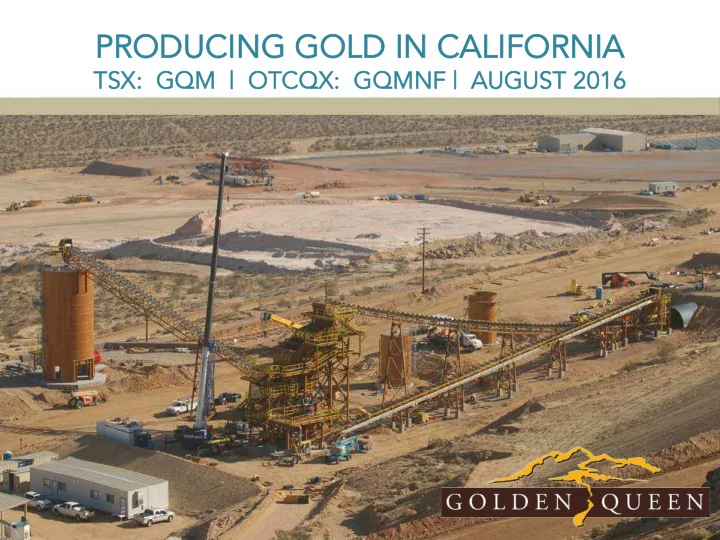
PRODUCING GOLD IN CALIFORNIA PRODUCING GOLD IN CALIFORNIA TSX: GQM - - PowerPoint PPT Presentation
PRODUCING GOLD IN CALIFORNIA PRODUCING GOLD IN CALIFORNIA TSX: GQM | OTCQX: GQMNF | AUGUST 2016 TSX: GQM | OTCQX: GQMNF | AUGUST 2016 Cautionary Statements Cautionary Statements The information in this presentation includes certain
The information in this presentation includes certain “forward-looking information” and “forward-looking statements” within the meaning
States Private Securities Litigation Reform Act of 1995 and applicable Canadian securities legislation . All statements, other than statements of historical fact, included herein including, without limitation, plans for and intentions with respect to our properties, statements regarding intentions with respect to the Soledad Mountain project’s (the “Project”) current and future operating or financial performance including production, rates of return, recoveries, and operating costs are forward-looking statements. Statements concerning Mineral Reserve Estimates and Mineral Resource Estimates are also forward-looking statements in that they reflect an assessment, based on certain assumptions, of the mineralization that would be encountered and mining results if the Project was mined in the manner described. Forward-looking statements involve various risks and uncertainties. There can be no assurance that such statements will prove to be accurate, and actual results and future events could differ materially from those anticipated in such
intentions include, without limitation, risks and uncertainties regarding: the operation of the Project, including additional capital requirements for the Project or future acquisitions; unexpected liabilities of changes in the cost of operations, including costs of extracting gold and silver; refining costs; operating hazards and risks inherent in mining operations; changes to the political environment, laws or regulation, or more stringent enforcement of current laws or regulations in the United States or California; the ability of Golden Queen Mining Company, LCC to obtain and maintain licenses, access rights or permits, required for current and future planned
non-compliance with environmental and permit requirements. Other risks and uncertainties include risks related to volatility in global equities, commodities, foreign exchange, market price of gold and silver and a lack of market liquidity; changes in planned work resulting from logistical, technical or other factors; that results of operations on the Project will not meet projected expectations due to any combination of technical, operational or market factors; uncertainties involved in the interpretation of technical data and the estimation
Forward looking statements are based on numerous assumptions and are subject to all of the risks and uncertainties inherent in our business, including risks inherent in mining. Investors are cautioned that forward-looking statements are not guarantees of future performance and, accordingly, should not to put undue reliance on forward-looking statements. Any forward-looking statement made by us in this presentation is based only on information currently available. Technical information in this presentation was reviewed and approved Sean Ennis, P . Eng., P .E., an independent consultant of the Company and a Qualified Person as defined by National Instrument 43-101.
2
Capital Structure – August 9, 2016
Shares Issued & Outstanding 111,048,683 Options 1,070,000 Warrants (non-listed) 10,757,700 Warrants (GQM.WT) 5,560.000 Fully Diluted Shares 128,536,383 Market Cap (Basic) US$113.3 MM | C$146.6 MM Cash * US$23.3 MM Debt ** US$48.7 MM Enterprise Value US$138.8 MM Insiders Ownership ~30.0% Institutional Ownership ~16.0% Public Float ~54.0%
symbol GQM and in the United States on the OTCQX International under the symbol GQMNF
Soledad Mountain property in Kern County, California
with budget (~$100mm)
$1,250/oz and silver price of US$17/oz
~781k oz Ag (Yr2 - Yr11)
(1) Figures shown on 100% basis. ¡ * Cash (August 9, 2016) comprised of US $16.3 mm 100% attributable to Golden Queen
Mining Ltd. and 50% of Golden Queen Mining LLC’s cash balance of US$13.9 mm. ** Debt (August 9, 2016) comprised of US$40.6 mm loan and 50% of Komatsu loan (~US $16.2 mm).
3
4
4
Mining Mining North-W North-West Pit est Pit Heap Leach Pad & Heap Leach Pad & Merrill-Cr Merrill-Crowe Plant
Crushing-Scr Crushing-Screening Plant & eening Plant & Assay Laboratory Assay Laboratory
6
Primary Section Primary Section Jaw Crusher Jaw Crusher Secondary Section Secondary Section Cone Crusher Cone Crusher Assay Assay Laboratory Laboratory Primary Section Primary Section Coarse Or Coarse Ore Stockpile e Stockpile
7
Secondary Section Secondary Section Cone Crusher Cone Crusher Tertiary Section ertiary Section High Pr High Pressur essure Grinding Roll e Grinding Roll (HPGR) (HPGR) Fine Or Fine Ore Bin e Bin Agglomeration Drum Agglomeration Drum Conveyor to Heap Conveyor to Heap Leach Pad Leach Pad
8
ThyssenKrupp/Polysius
The HPGR in industry The HPGR in industry
projects world-wide
“floating” roll. The “floating” roll is mounted on and can move freely
Benefits of using the HPGR will include: Benefits of using the HPGR will include:
cracks in ore particles
the heap
uses cone crushers and screens to size ore for leaching in a heap leach operation
screening plant
conventional crushing-screening plant
Tertiary Section ertiary Section High Pr High Pressur essure Grinding Roll (HPGR) e Grinding Roll (HPGR)
9
Stage 1 Phase 1 Heap Stage 1 Phase 1 Heap Leach Pad Leach Pad Merrill-Cr Merrill-Crowe Plant &
Overflow Pond Overflow Pond Grass Hoppers Grass Hoppers Conveyor fr Conveyor from
Crushing-Scr Crushing-Screening Plant eening Plant Agglomerated Or Agglomerated Ore on e on the Pad the Pad
10
(California is the 3rd largest oil producing state in the U.S., behind Texas and North Dakota)
projects in the world
northeast of the Los Angeles International Airport
existing paved County road, Silver Queen Road
mile of the Project
Mojave
Union Pacific railroad lines
services
Excellent infrastructure nearby: paved road, power, water, railroad
California
Town of Mojave &
Highway Highway Lar Large wind far ge wind farm m
Soledad Mountain Pr Soledad Mountain Project
Solar panels Solar panels Pr Production
water well water well Power line to site Power line to site
11
In September 2014, Golden Queen Mining Co. Ltd. entered into a joint venture with Gauss LLC, a joint venture owned 70.51% by Gauss Holdings LLC, an entity controlled by Leucadia National Corporation (NYSE:LUK), and 29.49% by Auvergne LLC, an entity controlled by certain members of the Clay family, whereby Gauss LLC invested US$110 million in cash in exchange for a 50% joint venture interest in the Soledad Mountain Project.
Leucadia Leucadia N National C
diversified holding company engaged in a variety of businesses, including investment banking and capital markets, beef processing, asset management, commercial mortgage banking and servicing, manufacturing, auto dealerships, telecommunications, oil & gas, energy projects and real estate. The company has a history of successful investments in the mining sector. Auver Auvergne gne LLC LLC is a wholly-owned entity of the Clay family, who have been long-term, supportive shareholders of Golden Queen. Since the late 1980’s, the Clay family and associated entities have provided significant equity and debt capital to Golden Queen to help fund the exploration and development of the Soledad Mountain Project. Thomas Clay, Manager of Auvergne, has served on the Golden Queen board since 2009 and was appointed Chairman in 2013. ¡ Gauss ¡LLC ¡ JOINT VENTURE Golden Queen Mining Company, LLC ¡ Golden ¡Queen ¡Mining ¡ Holdings ¡Inc. ¡ Golden ¡Queen ¡ ¡ Mining ¡Co. ¡Ltd. ¡
100% ¡Interest ¡ 50% ¡Interest ¡
Auvergne ¡LLC ¡ Leucadia ¡Na$onal ¡Corp. ¡ ¡ (Gauss ¡Holdings ¡LLC) ¡
50% ¡Interest ¡ 70.5% ¡Interest ¡ 29.5% ¡Interest ¡
Soledad ¡ Mountain ¡ Project ¡
¡100% ¡Interest ¡
¡ ¡ Auvergne LLC 12
Thomas M. Clay Thomas M. Clay
Chair Chairman, CEO & Dir man, CEO & Director ector
Robert C. Robert C. Walish alish, Jr , Jr. .
COO COO Pr President & CEO, Golden esident & CEO, Golden Queen Mining LLC Queen Mining LLC
Manager of Chile’s SCM Franke Operation of KGHM International
Carolina, Montana & Nevada and received his Bachelor of Arts degree from the University of Colorado and his Master of Science degree from the University of Wisconsin
Bryan A. Coates Bryan A. Coates
Dir Director ector
Chief Financial Officer of Osisko Mining Corp. with over 30 years of experience in the international and Canadian mining industry
Corporation and the Quebec Mining Association
Guy Le Guy Le Bel Bel
Dir Director ector
Capital with more than 30 years of international mining experience in strategic and financial planning
Ber Bernar nard d Guar Guarnera nera
Dir Director ector
Metallurgical Society of America, Current director, Colorado Mining Association and Broadlands Mineral Advisory Services Ltd. with 40+ years of experience in the global mining industry
Andr Andrée St-Ger ée St-Germain main
Vice Pr ice President Finance & esident Finance & CFO CFO
companies on a variety of financings and M&A advisory assignments
13
14
MDA modeled a total of 1.9 million tons as high-grade vein ore mined by earlier underground
These volumes are therefore not included in the reported resources. Total historical production at Soledad Mountain has been estimated at 1.3 million tons, although detailed production records are not available. This difference is significant as it is possible that the model underestimates the amount
Channel samples included in the Project database consist entirely of cross-cut samples; none of the samples taken along the strike of the mineralized structures were transcribed from original Gold Fields maps into the Project database. The inclusion of the drift-sample data would increase the accuracy of the modeling of the high-grade portions of the mineralized structures, which could further enhance the grade of the resources.
15
in full production, based on the location of the Project in Southern California (proximity to major highways and railway lines).
The waste rock can be classified into a range of products such as riprap, crushed stone and sand with little further processing.
mine rock is underway.
aggregates markets annually.
term contracts for the sale of products have been secured.
16
flows
with existing infrastructure
economics
17
Gold mining on Soledad Mountain dates back to the late 19th century. The largest producer in the area was Gold Fields American Development Co., a subsidiary of Consolidated Gold Fields of South Africa. This syndicate operated an underground mine and mill on the property from 1935 to 1942, when the mine was forced to close by War Production Board Order L-208. Production after the war was minimal, as costs had increased while the price of gold remained fixed at $35 per ounce until 1973. The Soledad Mountain deposit is a large, epithermal, multi-episodic, fault/fissure vein system. Gold and silver mineralization occurs in low sulfidation, quartz adularia veins and stockworks that strike northwest. At least 14 separate veins and related vein splits have been identified. Core veins range from less than 1 metre to 6 metres wide with gold grades typically greater than 3.5 grams per ton, surrounded by lower grade mineralization with widths ranging from 1 metre to greater than 50 metres. The level of oxidation extends to depth and the deposit is well-suited for heap leaching.
Karma Headframe and Mill (Circa 1912) 19
Soledad Mountain is located within the Mojave structural block, a triangular-shaped area bounded to the south by the northwest-trending San Andreas Fault and to the north by the northeast-trending, Garlock Fault. The Mojave block is broken into an orthogonal pattern of N50E to N60E and N40W to N50W fracture systems. These fracture zones likely developed as the result of Late Cretaceous compressional stresses that were present prior to formation of the Garlock and San Andreas Faults. Gold and silver mineralization at Soledad Mountain is hosted by northwest-trending, en-echelon faults and fracture systems. Cretaceous quartz monzonite forms the basement of stratigraphic sequences in the Mojave block. The quartz monzonite is
Springs and Middle Buttes. These volcanic centers consist generally of initial, widespread sheet flows and pyroclastics of quartz latite, followed by restricted centers of rhyolitic flows and rhyolite porphyry intrusives. Rhyolitic flows and intrusives are elongated somewhat along northwest-trending vents and feeder zones. Gold deposits in the Mojave block include Soledad Mountain, Standard Hill, Cactus and Tropico. At Soledad Mountain gold mineralization occurs in low-sulfidation style, quartz-adularia veins and stockworks that strike northwest. Gold mineralization at Standard Hill, located 1 mile northeast of Soledad, consists of north to northwest-striking quartz veins in Cretaceous quartz monzonite and Tertiary, quartz latite volcanic rocks. At the Cactus Gold Mine, 5 miles west of Soledad, gold occurs in northwest and northeast-striking quartz veins, breccias and irregular zones of silicification in quartz latite, rhyolitic flows and rhyolitic intrusive breccias. At least 14 separate veins and related vein splits occur at Soledad Mountain. Veins generally strike N40W and dip at high angles either to the northeast or to the southwest. Mineralization consists of fine-grained pyrite, covellite, chalcocite, tetrahedrite, acanthite, native silver, pyrargyrite, polybasite, native gold and electrum within discrete quartz veins, veinlets, stockworks and irregular zones of silicification. Electrum is about 25% silver. 20
Gold Silver Classification Tonnes Ton g/t
g/t
Measured 4,298,243 4,738,000 0.960 0.028 13.37 0.39 130,000 1,865,000 Indicated 79,237,167 87,344,000 0.549 0.016 9.26 0.27 1,415,000 23,733,000 Measured & Indicated 83,535,409 92,082,000 0.575 0.017 9.53 0.28 1,545,000 25,598,000 Inferred 21,392,329 23,581,000 0.343 0.010 7.20 0.21 245,000 4,965,000 Gold Silver In-Situ Grade Contained Metal Gold Silver Classification Tonnes Ton g/t
g/t
Proven 3,357,000 3,701,000 0.948 0.028 14.056 0.410 102,300 1,517,100 Probable 42,957,000 47,352,000 0.638 0.019 10.860 0.317 881,300 14,999,100 Total & Average 46,314,000 51,053,000 0.661 0.019 11.092 0.324 983,600 16,516,200 In-Situ Grade Contained Metal Gold Silver
Cautionary Cautionary note note to to U.S. U.S. investors investors concer concerning ning measur measured, ed, indicated indicated or
inferred ed resour esources: ces: We advise U.S. investors that while the terms “measured resources”, “indicated resources” and “inferred resources” are recognized and required by Canadian regulations, the U.S. Securities and Exchange Commission does not recognize these terms and these terms do not comply with SEC Guide 7 requirements. Investors are cautioned not to assume that any part or all of the material in these categories will be converted into reserves. It should not be assumed that any part of an inferred mineral resource will ever be upgraded to a higher category. Cautionary Cautionary note note to to U.S. U.S. investors investors concer concerning ning pr proven
probable
mineral reserve eserve estimates: estimates: This slide uses the terms “proven reserves” and “probable reserves” in accordance with NI 43-101. We advise U.S. investors that the requirements of NI 43-101 for identification of “reserves” are not the same as those of the SEC, and reserves reported by the Company in compliance with NI 43-101 may not qualify as “reserves” under SEC Guide 7 standards. Accordingly, information concerning mineral deposits set forth herein may not be comparable with information presented by companies using only U.S. standards in their public disclosure.
.Eng., APEGBC Registered Member who is employed by Norwest Corporation.
grade was varied to reflect differences in estimated metal recoveries for the different rock types mined.
a Au:Ag recovery ratio of 1.6.
.G. employed as Senior Geologist by Mine Development Associates, Inc.,
a Au:Ag recovery ratio of 1.6.
(100% Basis)
Key Parameters Key Parameters 2015 2015 Feasibility Feasibility Study Study
Estimated Mine Life (Years) 11.3 Average Throughput (k short tons per year) 4,594 Stripping Ratio (waste tons:ore tons) 3.41:1 Au Recovery (%) 82.1% Ag Recovery (%) 50.0% Total Au Production (k oz) 807.4 Total Ag Production (mm oz) 8.3 Average Annual Au Production (k oz) (Year 2 – Year 11) 74 Average Annual Ag Production (k oz) (Year 2 – Year 11) 781
revised reserves.
completed on a quarterly basis for the life of the mine.
been included in the mine plan. Successful infill drilling and expanding the Approved Project Boundary may allow us to significantly increase the mine life.
22
Base Case Economics Base Case Economics
(1) (1)
2015 Feasibility Study 2015 Feasibility Study Pre-Tax NPV 5% $289.5 mm Pre-Tax IRR 32.7% After-Tax NPV 5% $213.9 mm After-Tax IRR 28.3% Operating Costs Operating Costs 2015 Feasibility 2015 Feasibility Study Study Mining Costs per Tonne Mined $1.17/t Mining Costs per Tonne of Ore Processed $5.18/t Processing Costs per Tonne of Ore Processed $4.10/t Site G&A per Tonne of Ore Processed $0.72/t Operating Costs per T Operating Costs per Tonne of Or
e Processed
$9.99/t $9.99/t Total Cash Costs, Net of Silver By-Product (1) (2) $518/ $518/oz
Total Cash Costs, Net of Silver By-Product + Susex (1) (2) (3) $558/ $558/oz
(1) Base case done with a gold price of $1,250/oz and a silver price of $17/oz. $25.4mm spent prior to December 31, 2014 has been excluded from economics. (2) Includes royalties, property taxes, California fees, off-site refining charges, reclamation financial assurance. (3) Sustaining capex includes additional mobile mining equipment acquired between Year 2 and Year 10.
items: cyanide, cement, power, labour, fuel) have been brought current
cash cost
Life of Mine Life of Mine Capital Costs Capital Costs 2015 Feasibility 2015 Feasibility Study (US$) Study (US$) Pre-production Capital Costs $99.3 mm Contingency $15.0 mm Working Capital $10.0 mm Financial Assurance Estimate $0.5 mm Mobile Mining Equipment $19.2 mm Total Pr
e-Production
$144.0 mm $144.0 mm Sustaining Capital Costs $25.5 mm Additional Mobile Mining Equipment (Years 2-10) $10.9 mm Total Life of Mine Capital Costs
$180.5 mm $180.5 mm
capital costs update provided in March 2014.
$12.5mm to the joint venture in June 2015 to maintain its 50% interest in the Project.
project as on budget. ¡
24
$127.2 $170.8 $213.9 $256.5 $298.2 Au ¡$1,050 ¡/ ¡Ag ¡$15 Au ¡$1,150 ¡/ ¡Ag ¡$16 Au ¡$1,250 ¡/ ¡Ag ¡$17 Au ¡$1,350 ¡/ ¡Ag ¡$18 Au ¡$1,450 ¡/ ¡Ag ¡$19
Feasibility Study Feasibility Study Base Case Base Case
After-tax IRR(1) After-tax NPV (5%)(1)
US$ MM 19.7% 24.2% 28.3% 32.3% 36.0% Au ¡$1,050 ¡/ ¡Ag ¡$15 Au ¡$1,150 ¡/ ¡Ag ¡$16 Au ¡$1,250 ¡/ ¡Ag ¡$17 Au ¡$1,350 ¡/ ¡Ag ¡$18 Au ¡$1,450 ¡/ ¡Ag ¡$19
Figures shown on a 100% basis
(1) ¡$25.4mm ¡in ¡capital ¡expenditures ¡spent ¡prior ¡to ¡December ¡31, ¡2014 ¡has ¡been ¡excluded ¡from ¡economics. ¡ ¡
25
A detailed review of approvals and permits required for the Project is provided in the Company’s latest Form 10-K filing with the U.S. Securities and Exchange Commission, dated March 16, 2015. The following is therefore only a brief summary. Conditional Use Per Conditional Use Permits mits
filed against the Commission’s decision have been withdrawn and the decision made by the Planning Commission is now final. The Planning Commission approved minor wording changes to the Conditions of Approval on October 28, 2010
The Company recently addressed the conditions precedent to the start of construction as required by the Conditional Use Permits Waste Dischar aste Discharge Requir ge Requirements ements
and Reporting Program for the Project at a public hearing held in South Lake Tahoe on July 14, 2010
Authority to Construct and Per Authority to Construct and Permit to Operate mit to Operate
Department and the Eastern Kern Air Pollution Control District (“EKAPCD”) on July 21, 2009. This study was approved by Kern County Planning Commission on April 8, 2010, as part of the certification of the Supplemental Environmental Impact Report
permits were issued by EKAPCD on February 8, 2012.
to inspection by EKAPCD
26