Mush of Rocks Gary Oberts, Oct.26, 2018 Part 1 Klauea current - - PowerPoint PPT Presentation

mush of rocks
SMART_READER_LITE
LIVE PREVIEW

Mush of Rocks Gary Oberts, Oct.26, 2018 Part 1 Klauea current - - PowerPoint PPT Presentation

DVD #10 Magma: The Building Mush of Rocks Gary Oberts, Oct.26, 2018 Part 1 Klauea current summary and preview of DVD #12 next spring Part 2 DVD terms review 1. Pele is very much in control. Hawaii Co.


slide-1
SLIDE 1

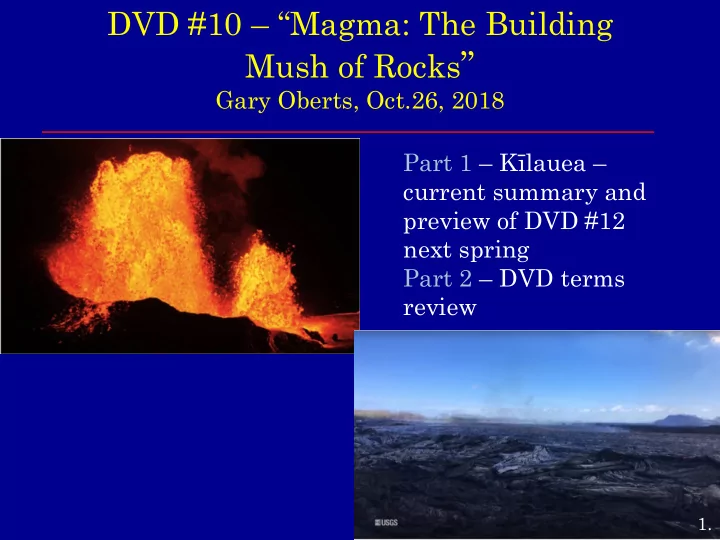
DVD #10 – “Magma: The Building Mush of Rocks”

Gary Oberts, Oct.26, 2018 Part 1 – Kīlauea – current summary and preview of DVD #12 next spring Part 2 – DVD terms review

1.
slide-2
SLIDE 2

“Pele is very much in control.” Hawaii Co. Division of Boating and Ocean Recreation Manager

2.

slide-3
SLIDE 3

3.

slide-4
SLIDE 4

Pu’u ‘Ō’ō Area of new 2018 flows 4.

slide-5
SLIDE 5

5.

slide-6
SLIDE 6

1) Kiluaea summit system with Halema'uma’u and Pu‘u ‘Ō‘ō craters

6.

slide-7
SLIDE 7

7.

slide-8
SLIDE 8

8.

slide-9
SLIDE 9

9.

Halema'uma’u Crater explosion, June 6, 2018

slide-10
SLIDE 10

10.

Halema'uma’u Crater post-explosion

slide-11
SLIDE 11

11.

slide-12
SLIDE 12

2) Lower East Rift Zone (LERZ)

LERZ 12.

slide-13
SLIDE 13

Fissure #8

13.

slide-14
SLIDE 14

14.

slide-15
SLIDE 15

15.

slide-16
SLIDE 16

16.

slide-17
SLIDE 17

17.

slide-18
SLIDE 18

18.

slide-19
SLIDE 19

19.

slide-20
SLIDE 20

20.

slide-21
SLIDE 21

21.

slide-22
SLIDE 22

Credit: USGS

Before and after satellite images of the Fissure 8 area in Leilani Estates

Early Sept. 2018 2014 22.

slide-23
SLIDE 23

High viscosity Low viscosity 23.

slide-24
SLIDE 24

24.

Basaltic, ʻAʻā lava

slide-25
SLIDE 25

25.

slide-26
SLIDE 26

7.5 times/day

(Every 3.18 hours)

At 100 m3/sec

(With flow velocities of 3- 23 ft/sec)

26.

slide-27
SLIDE 27

3) Ocean Inflow

27.

slide-28
SLIDE 28

28.

slide-29
SLIDE 29

29.

slide-30
SLIDE 30

30.

Kapoho Bay – before and after

slide-31
SLIDE 31

31.

slide-32
SLIDE 32

32.

slide-33
SLIDE 33

Videos

https://www.youtube.com/watch?v=cIq43-NkLlo

Source: US Defense News

33.

slide-34
SLIDE 34

http://www.bigislandvideonews.com/2018/06/13/video- drone-captures-dramatic-drop-at-kilauea-summit/

Source: USGS – Hawaii Volcano Observatory

34.

slide-35
SLIDE 35

http://www.bigislandvideonews.com/2018/07/26/video-eruption- update-collapse-event-occurs-during-conference-call/

Source: USGS – Hawaii Volcano Observatory

35.

slide-36
SLIDE 36

Q&A

36.

Resource Links:

  • https://volcanoes.usgs.gov

US Geological Survey (USGS)

  • https://volcanoes.usgs.gov/observatories/hvo/

USGS Hawaii Volcano Observatory (HVO)

  • http://www.bigislandvideonews.com

Big Island Video News (**daily updates and videos since late April)

slide-37
SLIDE 37

NOTE: Use #15 and 16 for flow, etc. **15) http://www.bigislandvideonews.com/20 18/06/16/video-8-am-eruption-update- vog-spreads-disaster-recovery-center-

  • pen/
  • good 2 min. of flow and some into
  • cean (no Fiss 8)

**16) http://www.bigislandvideonews.com/20 18/06/16/video-8-am-eruption-update- vog-spreads-disaster-recovery-center-

  • pen/
  • good 2:11 including Fiss. 8, ocean and

channel Good videos but not used **Below link to NPS 5 Min. video > “2018 Kil. Eruption Update” covering pre-May event through June14 https://www.nps.gov/havo/pla nyourvisit/lava2.htm

slide-38
SLIDE 38

“Geotherm” – a line or surface of actual temperature in the Earth as a function of depth and pressure

  • Ex. 1500°C at

350 km and 13,000 *Mpa (~1.9M psi) 2. *Mpa = megapascal

slide-39
SLIDE 39

3.

“solid” – The temperature is not high enough to allow any melt. “solidus” – The temperature at which rock will begin to melt at a particular depth. “liquidus” – The temperature at which all

  • f the rock will melt.

Note: in one mass of earthen material (like magma), all forms could be present.

slide-40
SLIDE 40

Factors determining magma character:

1) Composition – geochemical make-up i. Basalt dominant, lower Si, (Hawaii, ocean ridges) ii. Rhyolite/andesite, higher Si (Cascades, subduction zones) 2) Viscosity – thickness or stickiness of flow i. High = thicker, explosive (Yellowstone, Cascades)

  • ii. Low = more fluid-like, flows easily (Hawaii)

3) SiO4 (tetrahedron) content i. High = locked tightly, builds pressure ii. Low = flows easier, less constrained 4) Temperature i. High = atoms oscillate, weaker bonds, less pressure ii. Low = pressure builds to explosive 5) Water content i. High = flows easier, lower pressure, separates Si tetrahedron, BUT also can cool magma to increase pressure ii. Low = viscosity increase, higher pressure

4.

slide-41
SLIDE 41
slide-42
SLIDE 42
slide-43
SLIDE 43
slide-44
SLIDE 44

Interesting features: Pele’s Hair

slide-45
SLIDE 45

Blue flames from trapped methane

slide-46
SLIDE 46

Lavanado – heat driven vortex flow

slide-47
SLIDE 47
slide-48
SLIDE 48

First stage: May 3 – May 28, 2018

slide-49
SLIDE 49

Second stage: May 29 - June 15, 2018

slide-50
SLIDE 50

Final stage: June 16 – Aug. 14, 2018

slide-51
SLIDE 51

Note - last one of these on this website – keep checking but this could be max. extent of lava flow

slide-52
SLIDE 52
slide-53
SLIDE 53

Last thermal map with a gray (warm) flow-line being noted – likely just sub-surface flow

slide-54
SLIDE 54
slide-55
SLIDE 55
slide-56
SLIDE 56
slide-57
SLIDE 57

25.