Processes and Exceptions int main( void ) { doing nothing on a busy - - PowerPoint PPT Presentation

processes and exceptions
SMART_READER_LITE
LIVE PREVIEW

Processes and Exceptions int main( void ) { doing nothing on a busy - - PowerPoint PPT Presentation

Processes and Exceptions int main( void ) { doing nothing on a busy system 3 } output_timings(times); 1 end = get_time(); /* do nothing */ start = get_time(); long start, end; for ( int i = 0; i < N; ++i) { } long times[NUM_TIMINGS]; /*


slide-1
SLIDE 1

Processes and Exceptions

1

an infjnite loop

int main(void) { while (1) { /* waste CPU time */ } }

If I run this on a lab machine, can you still use it? …even if the machine only has one core?

2

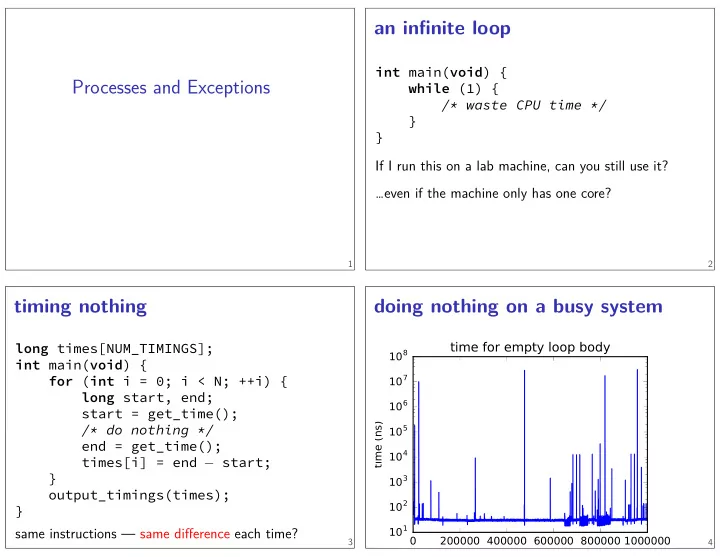
timing nothing

long times[NUM_TIMINGS]; int main(void) { for (int i = 0; i < N; ++i) { long start, end; start = get_time(); /* do nothing */ end = get_time(); times[i] = end − start; }

  • utput_timings(times);

}

same instructions — same difgerence each time?

3

doing nothing on a busy system

200000 400000 600000 800000 1000000 sample # 101 102 103 104 105 106 107 108 time (ns)

time for empty loop body

4

slide-2
SLIDE 2

doing nothing on a busy system

200000 400000 600000 800000 1000000 sample # 101 102 103 104 105 106 107 108 time (ns)

time for empty loop body

5

time multiplexing

loop.exe ssh.exe firefox.exe loop.exe ssh.exe

CPU: time

... call get_time // whatever get_time does movq %rax, %rbp

million cycle delay

call get_time // whatever get_time does subq %rbp, %rax ...

6

time multiplexing

loop.exe ssh.exe firefox.exe loop.exe ssh.exe

CPU: time

... call get_time // whatever get_time does movq %rax, %rbp

million cycle delay

call get_time // whatever get_time does subq %rbp, %rax ...

6

time multiplexing

loop.exe ssh.exe firefox.exe loop.exe ssh.exe

CPU: time

... call get_time // whatever get_time does movq %rax, %rbp

million cycle delay

call get_time // whatever get_time does subq %rbp, %rax ...

6

slide-3
SLIDE 3

illusion: dedicated processor

time multiplexing: illusion of dedicated processor including dedicated registers sometimes called a thread illusion is perfect — except for performance

7

time multiplexing really

loop.exe ssh.exe firefox.exe loop.exe ssh.exe

= operating system exception happens return from exception

8

time multiplexing really

loop.exe ssh.exe firefox.exe loop.exe ssh.exe

= operating system exception happens return from exception

8

OS and time multiplexing

starts running instead of normal program

mechanism for this: exceptions (later)

saves old program counter, registers somewhere sets new registers, jumps to new program counter called context switch

saved information called context

9

slide-4
SLIDE 4

context

all registers values

%rax %rbx, …, %rsp, …

condition codes program counter i.e. all visible state in your CPU except memory address space: map from program to real addresses

10

context switch pseudocode

context_switch(last, next): copy_preexception_pc last−>pc mov rax,last−>rax mov rcx, last−>rcx mov rdx, last−>rdx ... mov next−>rdx, rdx mov next−>rcx, rcx mov next−>rax, rax jmp next−>pc

11

contexts (A running)

%rax %rbx %rcx %rsp … SF ZF PC

in CPU Process A memory: code, stack, etc. Process B memory: code, stack, etc. OS memory:

%raxSF %rbxZF %rcxPC … …

in Memory

12

contexts (B running)

%rax %rbx %rcx %rsp … SF ZF PC

in CPU Process A memory: code, stack, etc. Process B memory: code, stack, etc. OS memory:

%raxSF %rbxZF %rcxPC … …

in Memory

13

slide-5
SLIDE 5

memory protection

reading from another program’s memory?

Program A Program B

0x10000: .word 42 // ... // do work // ... movq 0x10000, %rax // while A is working: movq $99, %rax movq %rax, 0x10000 ...

result: %rax is 42 (always) result: might crash

14

memory protection

reading from another program’s memory?

Program A Program B

0x10000: .word 42 // ... // do work // ... movq 0x10000, %rax // while A is working: movq $99, %rax movq %rax, 0x10000 ...

result: %rax is 42 (always) result: might crash

14

Recall: program memory

0xFFFF FFFF FFFF FFFF 0xFFFF 8000 0000 0000 0x7F… 0x0000 0000 0040 0000 Used by OS Stack Heap / other dynamic Writable data Code + Constants

15

program memory (two programs)

Used by OS Program A Stack Heap / other dynamic Writable data Code + Constants Used by OS Program B Stack Heap / other dynamic Writable data Code + Constants

16

slide-6
SLIDE 6

address space

programs have illusion of own memory called a program’s address space

Program A addresses Program B addresses mapping (set by OS) mapping (set by OS) Program A code Program B code Program A data Program B data OS data … real memory trigger error = kernel-mode only

17

program memory (two programs)

Used by OS Program A Stack Heap / other dynamic Writable data Code + Constants Used by OS Program B Stack Heap / other dynamic Writable data Code + Constants

18

address space

programs have illusion of own memory called a program’s address space

Program A addresses Program B addresses mapping (set by OS) mapping (set by OS) Program A code Program B code Program A data Program B data OS data … real memory trigger error = kernel-mode only

19

address space mechanisms

next week’s topic called virtual memory mapping called page tables mapping part of what is changed in context switch

20

slide-7
SLIDE 7

context

all registers values

%rax %rbx, …, %rsp, …

condition codes program counter i.e. all visible state in your CPU except memory address space: map from program to real addresses

21

The Process

process = thread(s) + address space illusion of dedicated machine:

thread = illusion of own CPU address space = illusion of own memory

22

time multiplexing really

loop.exe ssh.exe firefox.exe loop.exe ssh.exe

= operating system exception happens return from exception

23

exceptions

special control transfer

similar efgect to function call but often not requested by the program

usually from user programs to the OS example: from timer expiring

keeps our infjnite loop from running forever

24

slide-8
SLIDE 8

types of exceptions

interrupts — externally-triggered

timer — keep program from hogging CPU I/O devices — key presses, hard drives, networks, …

faults — errors/events in programs

memory not in address space (“Segmentation fault”) divide by zero invalid instruction

traps — intentionally triggered exceptions

system calls — ask OS to do something

aborts

25

timer interrupt

(conceptually) external timer device OS confjgures before starting program sends signal to CPU after a fjxed interval

26

types of exceptions

interrupts — externally-triggered

timer — keep program from hogging CPU I/O devices — key presses, hard drives, networks, …

faults — errors/events in programs

memory not in address space (“Segmentation fault”) divide by zero invalid instruction

traps — intentionally triggered exceptions

system calls — ask OS to do something

aborts

27

protection fault

when program tries to access memory it doesn’t own e.g. trying to write to bad address OS gets control — can crash the program

  • r more interesting things

28

slide-9
SLIDE 9

synchronous versus asynchronous

synchronous — triggered by a particular instruction

particular mov instruction

asynchronous — comes from outside the program

timer event keypress, other input event

29

exception implementation

detect condition (program error or external event) save current value of PC somewhere jump to exception handler (part of OS)

jump done without program instruction to do so

30

exception implementation: notes

I/textbook describe a simplifjed version real x86/x86-64 is a bit more complicated

(mostly for historical reasons)

31

locating exception handlers

address pointer base + 0x00 base + 0x08 base + 0x10 base + 0x18 … … base + 0x40 … … exception table (in memory) exception table base register

handle_divide_by_zero: movq %rax, save_rax movq %rbx, save_rbx ... handle_timer_interrupt: movq %rax, save_rax movq %rbx, save_rbx ...

… … …

32

slide-10
SLIDE 10

running the exception handler

hardware saves the old program counter identifjes location of exception handler via table then jumps to that location OS code can save registers, etc., etc.

33

exception handler structure

  • 1. save process’s state somewhere
  • 2. do work to handle exception
  • 3. restore a process’s state (maybe a difgerent one)
  • 4. jump back to program

handle_timer_interrupt: mov_from_saved_pc save_pc_loc movq %rax, save_rax_loc ... // choose new process to run here movq new_rax_loc, %rax mov_to_saved_pc new_pc return_from_exception

34

added to CPU for exceptions

new instruction: set exception table base new logic: jump based on exception table new logic: save the old PC

to special register or to memory

new instruction: return from exception

i.e. jump to saved PC

35

added to CPU for exceptions

new instruction: set exception table base new logic: jump based on exception table new logic: save the old PC

to special register or to memory

new instruction: return from exception

i.e. jump to saved PC

35

slide-11
SLIDE 11

added to CPU for exceptions

new instruction: set exception table base new logic: jump based on exception table new logic: save the old PC

to special register or to memory

new instruction: return from exception

i.e. jump to saved PC

35

why return from exception?

not just ret — can’t modify process’s stack

would break the illusion of dedicated CPU

reasons related to address spaces, protection (later)

36

exceptions and time slicing

loop.exe ssh.exe firefox.exe loop.exe ssh.exe

exception table lookup timer interrupt

handle_timer_interrupt: ... ... set_address_space ssh_address_space mov_to_saved_pc saved_ssh_pc return_from_exception

37

defeating time slices?

my_exception_table: ... my_handle_timer_interrupt: // HA! Keep running me! return_from_exception main: set_exception_table_base my_exception_table loop: jmp loop

38

slide-12
SLIDE 12

defeating time slices?

wrote a program that tries to set the exception table:

my_exception_table: ... main: // "Load Interrupt // Descriptor Table" // x86 instruction to set exception table lidt my_exception_table ret

result: Segmentation fault (exception!)

39

privileged instructions

can’t let any program run some instructions allows machines to be shared between users (e.g. lab servers) examples:

set exception table set address space talk to I/O device (hard drive, keyboard, display, …) …

processor has two modes:

kernel mode — privileged instructions work user mode — privileged instructions cause exception instead

40

kernel mode

extra one-bit register: “are we in kernel mode” exceptions enter kernel mode return from exception instruction leaves kernel mode

41

program memory (two programs)

Used by OS Program A Stack Heap / other dynamic Writable data Code + Constants Used by OS Program B Stack Heap / other dynamic Writable data Code + Constants

42

slide-13
SLIDE 13

address space

programs have illusion of own memory called a program’s address space

Program A addresses Program B addresses mapping (set by OS) mapping (set by OS) Program A code Program B code Program A data Program B data OS data … real memory trigger error = kernel-mode only

43

kernel services

allocating memory? (change address space) reading/writing to fjle? (communicate with hard drive) read input? (communicate with keyborad) all need privileged instructions! need to run code in kernel mode

44

types of exceptions

interrupts — externally-triggered

timer — keep program from hogging CPU I/O devices — key presses, hard drives, networks, …

faults — errors/events in programs

memory not in address space (“Segmentation fault”) divide by zero invalid instruction

traps — intentionally triggered exceptions

system calls — ask OS to do something

aborts

45

Linux x86-64 system calls

special instruction: syscall triggers trap (deliberate exception)

46

slide-14
SLIDE 14

Linux syscall calling convention

before syscall: %rax — system call number %rdi, %rsi, %rdx, %r10, %r8, %r9 — args after syscall: %rax — return value

  • n error: %rax contains -1 times “error number”

almost the same as normal function calls

47

Linux x86-64 hello world

.globl _start .data hello_str: .asciz "Hello, ␣ World!\n" .text _start: movq $1, %rax # 1 = "write" movq $1, %rdi # file descriptor 1 = stdout movq $hello_str, %rsi movq $15, %rdx # 15 = strlen("Hello, World!\n") syscall movq $60, %rax # 60 = exit movq $0, %rdi syscall

48

  • approx. system call handler

sys_call_table: .quad handle_read_syscall .quad handle_write_syscall // ... handle_syscall: ... // save old PC, etc. pushq %rcx // save registers pushq %rdi ... call *sys_call_table(,%rax,8) ... popq %rdi popq %rcx return_from_exception

49

Linux system call examples

mmap, brk — allocate memory fork — create new process execve — run a program in the current process _exit — terminate a process

  • pen, read, write — access fjles

terminals, etc. count as fjles, too

50

slide-15
SLIDE 15

system calls and protection

exceptions are only way to access kernel mode

  • perating system controls what proceses can do

… by writing exception handlers very carefully

51

careful exception handlers

movq $important_os_address, %rsp can’t trust user’s stack pointer! need to have own stack in kernel-mode-only memory need to check all inputs really carefully

52

reading keyboard input

int main(void) { char buf[1024]; /* read a line from stdin − − − waits for keyboard input */ if (fgets(buf, sizeof buf, stdin) != NULL) { printf("You ␣ typed ␣ [%s]\n", buf); } }

fgets uses read system call

53

keyboard input timeline

read_input.exe read_input.exe

trap — read system call interrupt — from keyboard = operating system

54

slide-16
SLIDE 16

system call wrappers

library functions to not write assembly:

  • pen:

movq $2, %rax // 2 = sys_open // 2 arguments happen to use same registers syscall // return value in %eax cmp $0, %rax jl has_error ret has_error: neg %rax movq %rax, errno movq $−1, %rax ret

55

system call wrappers

library functions to not write assembly:

  • pen:

movq $2, %rax // 2 = sys_open // 2 arguments happen to use same registers syscall // return value in %eax cmp $0, %rax jl has_error ret has_error: neg %rax movq %rax, errno movq $−1, %rax ret

55

system call wrapper: usage

/* unistd.h contains definitions of: O_RDONLY (integer constant), open() */ #include <unistd.h> int main(void) { int file_descriptor; file_descriptor = open("input.txt", O_RDONLY); if (file_descriptor < 0) { printf("error: ␣ %s\n", strerror(errno)); exit(1); } ... result = read(file_descriptor, ...); ... }

56

system call wrapper: usage

/* unistd.h contains definitions of: O_RDONLY (integer constant), open() */ #include <unistd.h> int main(void) { int file_descriptor; file_descriptor = open("input.txt", O_RDONLY); if (file_descriptor < 0) { printf("error: ␣ %s\n", strerror(errno)); exit(1); } ... result = read(file_descriptor, ...); ... }

56

slide-17
SLIDE 17

types of exceptions

interrupts — externally-triggered

timer — keep program from hogging CPU I/O devices — key presses, hard drives, networks, …

faults — errors/events in programs

memory not in address space (“Segmentation fault”) divide by zero invalid instruction

traps — intentionally triggered exceptions

system calls — ask OS to do something

aborts

57

a note on terminology

the real world does not use consistent terms for exceptions we will follow textbook’s terms in this course the real world won’t you might see:

‘interrupt’ meaning what we call ‘exception’ (x86) ‘exception’ meaning what we call ‘fault’ ‘fault‘ meaning what we call ‘fault’ or ‘abort’ (ARM) … and more

58

signals

Unix-like operating system feature like interrupts for processes: can be triggered by external process (instead of device)

kill command/system call

can be triggered by special events

pressing control-C

can invoke signal handler

59

signal API

sigaction — register handler for signal kill — send signal to process pause — put process to sleep until signal received sigprocmask — block some signals from being received until ready … and much more

60

slide-18
SLIDE 18

example signal program

#include <signal.h> #include <unistd.h> void handle_sigint(int signum) { write(1, "Got ␣ signal!\n", sizeof("Got ␣ signal!\n")); _exit(0); } int main(void) { struct sigaction act; act.sa_handler = &handle_sigint; sigemptyset(&act.sa_mask); sigaction(&act); char buf[1024]; while (fgets(buf, sizeof buf, stdin)) { printf("read ␣ %s", buf); } }

61

signal delivery (1)

signal happens while foo() is running OS writes stack from to user stack OS modifjes registers to call signal handler

address of __restore_rt saved registers PC when signal happened local variables for foo … the stack stack pointer before signal delivered stack pointer when signal handler started

62

signal delivery (2)

handle_sigint: ... ret ... __restore_rt: // 15 = "sigreturn" system call movq $15, %rax syscall

__restore_rt is return address for signal handler system call restores pre-signal state, then returns

63

signal handler unsafety (1)

void *malloc(size_t size) { ... to_return = next_to_return; /* SIGNAL HAPPENS HERE */ next_to_return += size; return to_return; } void foo() { /* This malloc() call interrupted */ char *p = malloc(1024); p[0] = 'x'; } void handle_sigint() { // printf might use malloc() printf("You ␣ pressed ␣ control C.\n"); }

64

slide-19
SLIDE 19

setjmp/longjmp

C fmow control

jmp_buf env; main() { if (setjmp(env) == 0) { // like try { ... read_file() ... } else { // like catch printf("some ␣ error ␣ happened\n"); } } read_file() { ... if (open failed) { longjmp(env, 1) // like throw } ... }

65

implementing setjmp/lonjmp

setjmp:

copy all registers to jmp_buf … including stack pointer

longjmp

copy registers from jmp_buf … but change %rax (return value)

66

setjmp weirdness — local variables

Undefjned behavior:

int x = 0; if (setjmp(env) == 0) { ... x += 1; longjmp(env, 1); } else { printf("%d\n", x); }

67

setjmp weirdness — fjx

Defjned behavior:

volatile int x = 0; if (setjmp(env) == 0) { ... x += 1; longjmp(env, 1); } else { printf("%d\n", x); }

68

slide-20
SLIDE 20
  • n implementing try/catch

could do something like setjmp()/longjmp() but want try to be really fast! instead: tables of information indexed by program counters:

where register values are stored on stack/in other registers where old program counters are stored on stack where catch blocks are located

69