Practice Translate the C code into assembly: label and $t0, $t0, - - PowerPoint PPT Presentation

practice
SMART_READER_LITE
LIVE PREVIEW

Practice Translate the C code into assembly: label and $t0, $t0, - - PowerPoint PPT Presentation

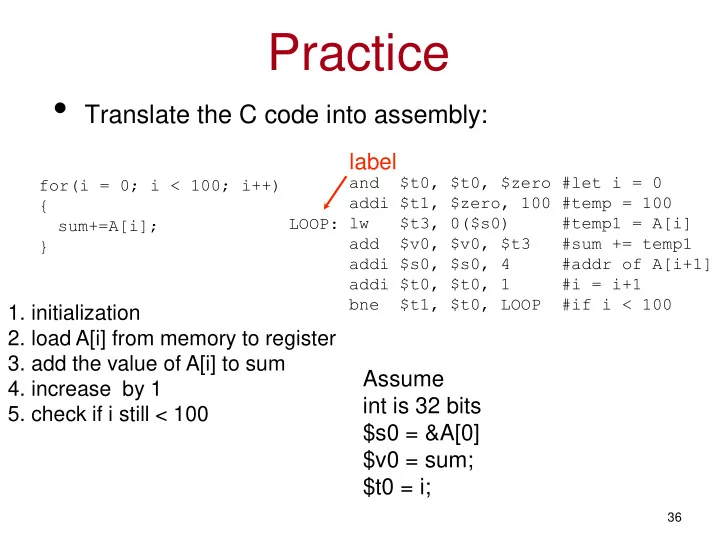
Practice Translate the C code into assembly: label and $t0, $t0, $zero #let i = 0 for(i = 0; i < 100; i++) addi $t1, $zero, 100 #temp = 100 { lw $t3, 0($s0) #temp1 = A[i] LOOP: sum+=A[i]; add $v0, $v0, $t3 #sum += temp1 }


slide-1
SLIDE 1

Practice

  • Translate the C code into assembly:

for(i = 0; i < 100; i++) { sum+=A[i]; }

Assume int is 32 bits $s0 = &A[0] $v0 = sum; $t0 = i;

and $t0, $t0, $zero #let i = 0 addi $t1, $zero, 100 #temp = 100 lw $t3, 0($s0) #temp1 = A[i] add $v0, $v0, $t3 #sum += temp1 addi $s0, $s0, 4 #addr of A[i+1] addi $t0, $t0, 1 #i = i+1 bne $t1, $t0, LOOP #if i < 100 LOOP:

36

label

  • 1. initialization
  • 2. load A[i] from memory to register
  • 3. add the value of A[i] to sum
  • 4. increase by 1
  • 5. check if i still < 100
slide-2
SLIDE 2

To implement the following C code, what are the instructions that we should put in the box?

A:

lw $t0, 0($s2) addi $s2, $s2, 4

C:

sw $t0, 0($s2) addi $s2, $s2, 4

B:

sw $t1, 0($s2) addi $s2, $s2, 4

D:

sw $t1, 0($s2) addi $s2, $s2, 1 add $t0, $zero, $zero addi $t1, $zero, 100 LOOP: addi $t0, $t0, 1 beq $t0, $t1, LOOP for(i = 0; i < 100; i++) A[i] = i;

37

slide-3
SLIDE 3

38

MIPS Mystery 1: Delayed Loads

  • The value retrieved

by a load is not available to the next instruction. Example

  • ri $t0, $zero, 4

sw $t0, 0($sp) lw $t1, 0($sp)

  • r $t2, $t1, $zero
  • r $t3, $t1, $zero

$t2 == 0 $t3 == 4

file: delayed_load.s

Why? We’ll talk about it in a few weeks.

slide-4
SLIDE 4

39

MIPS Mystery 2: Delayed Branches

  • The instruction

after the branch executes even if the branch is taken.

  • All jumps and

branches are delayed -- the next instruction always executes Example

  • ri $t0, $zero, 4

beq $t0, $t0, foo

  • ri $t0, $zero, 5

foo: $t0 == 5

file: delayed_branch.s

Why? We’ll talk about it in a few weeks.

slide-5
SLIDE 5

53

Pseudo Instructions

  • Assembly language programming is repetitive
  • Some code is not very readable
  • The assembler provides some simple

shorthand for common operations

  • Register $at is reserved for implementing them.

Assembly Shorthand Description

  • r $s1, $zero, $s2

mov $s1, $s2 move beq $zero, $zero, <label> b <label> unconditional branch Homework? li $s2, <value> load 32 bit constant Homework? nop do nothing Homework? div d, s1, s2 dst = src1/src2 Homework? mulou d, s1, s2 dst = low32bits(src1*src2)

slide-6
SLIDE 6

Which translation of pseudo instruction into real instructions in correct?

54

Pseudo Inst Meaning Translation A li $s2, <value> Load 32-bit <value> into $s2

  • ri $at, $zero,

<high 16 bits of value> srl $at, $at, 16

  • ri $s2, $at,

<low 16 bites of value> B nop Do nothing add $a1,$a1,$a1 C b <target> Unconditional Branch li $at, <target> jr $at D nop Do Nothing bne $zero, $zero, next next: E C and D

slide-7
SLIDE 7

57

From C to MIPS

slide-8
SLIDE 8

58

Compiling: C to bits

Architecture- independent Architecture- dependent

slide-9
SLIDE 9

59

C Code

Count the number of 1’s in the binary representation of i

slide-10
SLIDE 10

60

In the Compiler

Abstract Syntax Tree

C-Code

slide-11
SLIDE 11

61

In the Compiler

Abstract Syntax Tree Control Flow Graph

slide-12
SLIDE 12

62

In the Compiler

Control flow graph

Assembly

slide-13
SLIDE 13

63

In the Compiler

C-Code

Assembly

slide-14
SLIDE 14

64

In the Assembler

Assembly Executable Binary