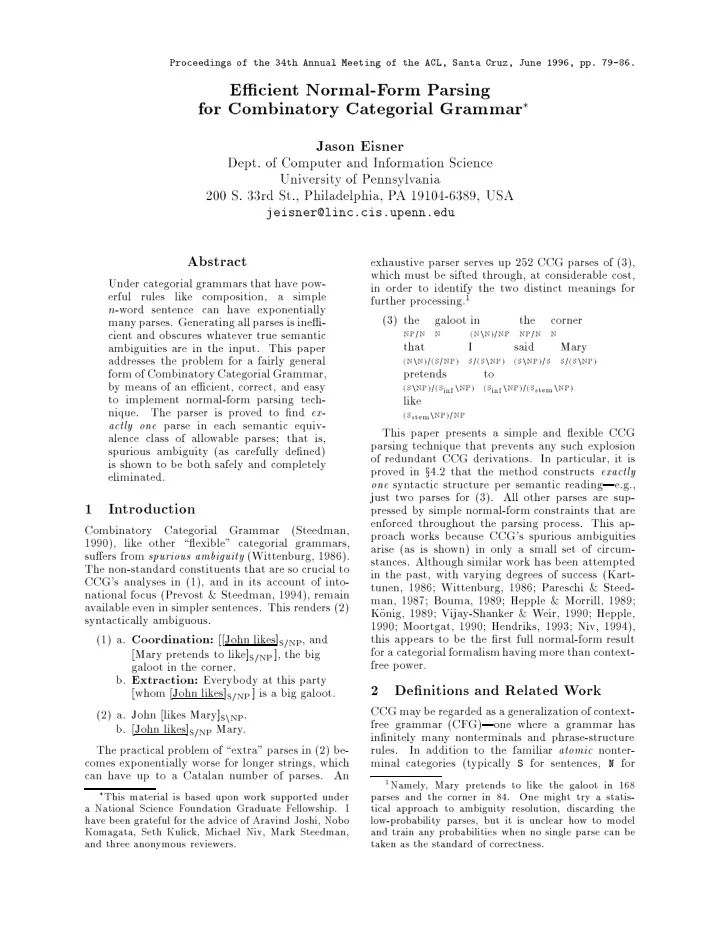
Proceedings of the 34th Annual Meeting of the ACL, Santa - - PDF document

proceedings of the 34th annual meeting of the acl santa
SMART_READER_LITE
LIVE PREVIEW

Proceedings of the 34th Annual Meeting of the ACL, Santa - - PDF document

Proceedings of the 34th Annual Meeting of the ACL, Santa Cruz, June 1996, pp. 79-86. Ecien t Normal-F orm P arsing for Com binatory Categorial Gramm ar Jason Eisner Dept. of Computer and Information Science


slide-1
SLIDE 1 Proceedings
  • f
the 34th Annual Meeting
  • f
the ACL, Santa Cruz, June 1996, pp. 79-86. Ecien t Normal-F
  • rm
P arsing for Com binatory Categorial Gramm ar
  • Jason
Eisner Dept.
  • f
Computer and Information Science Univ ersit y
  • f
P ennsylv ania 200 S. 33rd St., Philadelphia, P A 19104-6389, USA jeisner@l inc .ci s.u pe nn. edu Abstract Under categorial gramma rs that ha v e p
  • w-
erful rules lik e comp
  • sition,
a simple n-w
  • rd
sen tence can ha v e exp
  • nen
tially man y parses. Generating all parses is ine- cien t and
  • bscures
whatev er true seman tic am biguities are in the input. This pap er addresses the problem for a fairly general form
  • f
Com binatory Categorial Grammar, b y means
  • f
an ecien t, correct, and easy to implem en t normal-form parsing tec h- nique. The parser is pro v ed to nd ex- actly
  • ne
parse in eac h seman tic equiv- alence class
  • f
allo w able parses; that is, spurious am biguit y (as carefully dened) is sho wn to b e b
  • th
safely and completely eliminated. 1 In tro duction Com binatory Categorial Grammar (Steedman, 1990), lik e
  • ther
\exible" categorial gramma rs, suers from spurious ambiguity (Witten burg, 1986). The non-standard constituen ts that are so crucial to CCG's analyses in (1), and in its accoun t
  • f
in to- national fo cus (Prev
  • st
& Steedman, 1994), remain a v ailable ev en in simpler sen tences. This renders (2) syn tactically am biguous. (1) a. Co
  • rdination:
[[John lik es ] S/NP , and [Mary pretends to lik e] S/NP ], the big galo
  • t
in the corner. b. Extraction: Ev eryb
  • dy
at this part y [whom [John lik es] S/NP ] is a big galo
  • t.
(2) a. John [lik es Mary] SnNP . b. [John lik es ] S/NP Mary . The practical problem
  • f
\extra" parses in (2) b e- comes exp
  • nen
tially w
  • rse
for longer strings, whic h can ha v e up to a Catalan n um b er
  • f
parses. An
  • This
material is based up
  • n
w
  • rk
supp
  • rted
under a National Science F
  • undation
Graduate F ello wship. I ha v e b een grateful for the advice
  • f
Ara vind Joshi, Nob
  • Komagata,
Seth Kulic k, Mic hael Niv, Mark Steedman, and three anon ymous review ers. exhaustiv e parser serv es up 252 CCG parses
  • f
(3), whic h m ust b e sifted through, at considerable cost, in
  • rder
to iden tify the t w
  • distinct
meanings for further pro cessing. 1 (3) the NP/N galo
  • t
N in (NnN)/NP the NP/N corner N that (NnN)/(S/NP) I S/(SnNP) said (SnNP)/S Mary S/(Sn NP) pretends (Sn NP)/(S inf nNP) to (S inf nNP)/(S stem nNP) lik e (S stem nNP)/NP This pap er presen ts a simple and exible CCG parsing tec hnique that prev en ts an y suc h explosion
  • f
redundan t CCG deriv ations. In particular, it is pro v ed in x4.2 that the metho d constructs exactly
  • ne
syn tactic structure p er seman tic reading|e.g., just t w
  • parses
for (3). All
  • ther
parses are sup- pressed b y simple normal-form constrain ts that are enforced throughout the parsing pro cess. This ap- proac h w
  • rks
b ecause CCG's spurious am biguities arise (as is sho wn) in
  • nly
a small set
  • f
circum- stances. Although similar w
  • rk
has b een attempted in the past, with v arying degrees
  • f
success (Kart- tunen, 1986; Witten burg, 1986; P aresc hi & Steed- man, 1987; Bouma, 1989; Hepple & Morrill, 1989; K
  • nig,
1989; Vija y-Shank er & W eir, 1990; Hepple, 1990; Mo
  • rtgat,
1990; Hendriks, 1993; Niv, 1994), this app ears to b e the rst full normal-form result for a categorial formalism ha ving more than con text- free p
  • w
er. 2 Denitions and Related W
  • rk
CCG ma y b e regarded as a generalization
  • f
con text- free grammar (CF G)|one where a grammar has innitely man y non terminals and phrase-structure rules. In addition to the familia r atomic non ter- minal categories (t ypically S for sen tences, N for 1 Namely , Mary pretends to lik e the galo
  • t
in 168 parses and the corner in 84. One migh t try a statis- tical approac h to am biguit y resolution, discarding the lo w-probabilit y parses, but it is unclear ho w to mo del and train an y probabili tie s when no single parse can b e tak en as the standard
  • f
correctness.
slide-2
SLIDE 2 nouns, NP for noun phrases, etc.), CCG allo ws in- nitely man y slashe d categories. If x and y are categories, then x=y (resp ectiv ely xn y ) is the cat- egory
  • f
an incomplete x that is missing a y at its righ t (resp ectiv ely left). Th us v erb phrases are an- alyzed as sub jectless sen tences Sn NP, while \John lik es" is an
  • b
jectless sen tence
  • r
S/NP. A complex category lik e ((Sn NP)n (SnNP))/N ma y b e written as SnNPn (Sn NP)/N, under a con v en tion that slashes are left-asso ciativ e. The results herein apply to the T A G-equiv alen t CCG formalization giv en in (Joshi et al., 1991). 2 In this v ariet y
  • f
CCG, ev ery (non-lexical) phrase- structure rule is an instance
  • f
  • ne
  • f
the follo wing binary-rule templates (where n
  • 0):
(4) F
  • rw
ard generalized comp
  • sition
>Bn: x=y y j n z n
  • j
2 z 2 j 1 z 1 ! x j n z n
  • j
2 z 2 j 1 z 1 Bac kw ard generalized comp
  • sition
<Bn: y j n z n
  • j
2 z 2 j 1 z 1 xn y ! x j n z n
  • j
2 z 2 j 1 z 1 Instances with n = are called applic ation rules, and instances with n
  • 1
are called c
  • mp
  • sition
rules. In a giv en rule, x; y ; z 1 : : : z n w
  • uld
b e instan tiated as categories lik e NP, S/NP,
  • r
Sn NPn(Sn NP)/N. Eac h
  • f
j 1 through j n w
  • uld
b e instan tiated as either /
  • r
n. A xed CCG gramma r need not include ev ery phrase-structure rule matc hing these templates. In- deed, (Joshi et al., 1991) place certain restrictions
  • n
the rule set
  • f
a CCG grammar, including a re- quiremen t that the rule degree n is b
  • unded
  • v
er the set. The results
  • f
the presen t pap er apply to suc h restricted gramma rs and also more generally , to an y CCG-st yle grammar with a de cidable rule set. Ev en as restricted b y (Joshi et al., 1991), CCGs ha v e the \mildly con text-sensitiv e" expressiv e p
  • w
er
  • f
T ree Adjoining Gramm ars (T A Gs). Most w
  • rk
  • n
spurious am biguit y has fo cused
  • n
categorial for- malism s with substan tially less p
  • w
er. (Hepple, 1990) and (Hendriks, 1993), the most rigorous pieces
  • f
w
  • rk,
eac h establish a normal form for the syn- tactic calculus
  • f
(Lam b ek, 1958), whic h is w eakly con text-free. (K
  • nig,
1989; Mo
  • rtgat,
1990) ha v e also studied the Lam b ek calculus case. (Hepple & Morrill, 1989), who in tro duced the idea
  • f
normal- form parsing, consider
  • nly
a small CCG frag- men t that lac ks bac kw ard
  • r
  • rder-c
hanging com- p
  • sition;
(Niv, 1994) extends this result but do es not sho w completeness. (Witten burg, 1987) assumes a CCG fragmen t lac king
  • rder-c
hanging
  • r
higher-
  • rder
comp
  • sition;
furthermore, his revision
  • f
the com binators creates new, conjoinable constituen ts that con v en tional CCG rejects. (Bouma, 1989) pro- p
  • ses
to replace comp
  • sition
with a new com bina- tor, but the resulting pro duct-grammar sc heme as- 2 This formalization sw eeps an y t yp e-raising in to the lexicon, as has b een prop
  • sed
  • n
linguistic grounds (Do wt y , 1988; Steedman, 1991, and
  • thers).
It also treats conjunction lexically , b y giving \and" the gener- alized category xnx=x and barring it from comp
  • sition.
signs dieren t t yp es to \John lik es" and \Mary pre- tends to lik e," th us losing the abilit y to conjoin suc h constituen ts
  • r
sub categorize for them as a class. (P aresc hi & Steedman, 1987) do tac kle the CCG case, but (Hepple, 1987) sho ws their algorithm to b e incomplete. 3 Ov erview
  • f
the P arsing Strategy As is w ell kno wn, general CF G parsing metho ds can b e applied directly to CCG. An y sort
  • f
c hart parser
  • r
non-deterministic shift-reduce parser will do. Suc h a parser rep eatedly decides whether t w
  • adjacen
t constituen ts, suc h as S/NP and NP/N, should b e com bined in to a larger constituen t suc h as S/N. The role
  • f
the gramm ar is to state whic h com bi- nations are allo w ed. The k ey to eciency , w e will see, is for the parser to b e less p ermissiv e than the gramm ar|fo r it to sa y \no, redundan t" in some cases where the grammar sa ys \y es, grammati cal." (5) sho ws the constituen ts that un trammeled CCG will nd in the course
  • f
parsing \John lik es Mary ." The spurious am biguit y problem is not that the gramma r allo ws (5c), but that the grammar al- lo ws b
  • th
(5f) and (5g)|distinct parses
  • f
the same string, with the same meaning. (5) a. [John] S/(Sn NP) b. [lik es] (Sn NP)/NP c. [John lik es] S/NP d. [Mary] NP e. [lik es Mary] Sn NP f. [[John lik es] Mary] S
  • to
b e disal lowe d g. [John [lik es Mary]] S The prop
  • sal
is to construct all constituen ts sho wn in (5) except for (5f). If w e sligh tly con- strain the use
  • f
the gramma r rules, the parser will still pro duce (5c) and (5d)|constituen ts that are indisp ensable in con texts lik e (1)|while refusing to c
  • mbine
those constituen ts in to (5f). The relev an t rule S/NP NP ! S will actually b e blo c k ed when it attempts to construct (5f). Although rule-blo c king ma y eliminate an analysis
  • f
the sen tence, as it do es here, a seman tically equiv alen t analysis suc h as (5g) will alw a ys b e deriv able along some
  • ther
route. In general,
  • ur
goal is to disco v er exactly
  • ne
anal- ysis for eac h <substring, meaning> pair. By prac- ticing \birth con trol" for eac h b
  • ttom-up
generation
  • f
constituen ts in this w a y , w e a v
  • id
a p
  • pulation
explosion
  • f
parsing
  • ptions.
\John lik es Mary" has
  • nly
  • ne
reading seman tically , so just
  • ne
  • f
its anal- yses (5f){(5g) is disco v ered while parsing (6). Only that analysis, and not the
  • ther,
is allo w ed to con- tin ue
  • n
and b e built in to the nal parse
  • f
(6). (6) that galo
  • t
in the corner that thinks [John lik es Mary] S F
  • r
a c hart parser, where eac h c hart cell stores the analyses
  • f
some substring, this strategy sa ys that
slide-3
SLIDE 3 all analyses in a cell are to b e seman tically distinct. (Karttunen, 1986) suggests enforcing that prop ert y directly|b y comparing eac h new analysis seman ti- cally with existing analyses in the cell, and refus- ing to add it if redundan t|but (Hepple & Morrill, 1989)
  • bserv
e briey that this is inecien t for large c harts. 3 The follo wing sections sho w ho w to
  • btain
eectiv ely the same result without doing an y seman- tic in terpretation
  • r
comparison at all. 4 A Normal F
  • rm
for \Pure" CCG It is con v enien t to b egin with a sp ecial case. Sup- p
  • se
the CCG grammar includes not some but al l instances
  • f
the binary rule templates in (4). (As alw a ys, a separate lexicon sp ecies the p
  • ssible
cat- egories
  • f
eac h w
  • rd.)
If w e group a sen tence's parses in to seman tic equiv alence classes, it alw a ys turns
  • ut
that exactly
  • ne
parse in eac h class satises the fol- lo wing simple declarativ e constrain ts: (7) a. No constituen t pro duced b y >Bn, an y n
  • 1,
ev er serv es as the primary (left) argumen t to >Bn , an y n
  • 0.
b. No constituen t pro duced b y <Bn, an y n
  • 1,
ev er serv es as the primary (righ t) argumen t to <Bn , an y n
  • 0.
The notation here is from (4). More collo quially , (7) sa ys that the
  • utput
  • f
righ t w ard (left w ard) com- p
  • sition
ma y not comp
  • se
  • r
apply
  • v
er an ything to its righ t (left). A parse tree
  • r
subtree that satises (7) is said to b e in normal form (NF). As an example, consider the eect
  • f
these restric- tions
  • n
the simple sen tence \John lik es Mary ." Ig- noring the tags {ot, {f c, and {bc for the mom en t, (8a) is a normal-form parse. Its comp etitor (8b) is not, nor is an y larger tree con taining (8b). But non- 3 Ho w inecien t? (i) has exp
  • nen
tially man y seman- tically distinct parses: n = 10 yields 82,756,612 parses in
  • 20
10
  • =
48,620 equiv alence classes. Karttunen's metho d m ust therefore add 48,620 represen tativ e parses to the appropriate c hart cell, rst comparing eac h
  • ne
against all the previously added parses|of whic h there are 48,620/2
  • n
a v erage|to ensure it is not seman tically redundan t. (Additional comparisons are needed to reject parses
  • ther
than the luc ky 48,620.) Adding a parse can therefore tak e exp
  • nen
tial time. (i) n z }| { : : : S=S S=S S=S S n z }| { SnS SnS SnS : : : Structure sharing do es not app ear to help: parses that are group ed in a parse forest ha v e
  • nly
their syn tactic category in common, not their meaning. Karttunen's ap- proac h m ust tease suc h parses apart and compare their v arious meanings individua ll y against eac h new candi- date. By con trast, the metho d prop
  • sed
b elo w is purely syn tactic|just lik e an y \ordinary" parser|so it nev er needs to unpac k a subforest, and can run in p
  • lynomial
time. standard constituen ts are allo w ed when necessary: (8c) is in normal form (cf. (1)). (8) a. S{ot S/(Sn NP){ot John SnNP{ot (Sn NP)/NP{ot lik es NP{ot Mary b. forwar d applic ation blo cke d by (7a) (e quivalentl y, not p ermitte d by (10a)) S/NP{f c S/(Sn NP){ot John (Sn NP)/NP{ot lik es NP{ot Mary c. NnN{ot (Nn N)/(S/NP){ot whom S/NP{f c S/(Sn NP){ot John (Sn NP)/NP{ot lik es It is not hard to see that (7a) eliminates all but righ t-branc hing parses
  • f
\forw ard c hains" lik e A/B B/C C
  • r
A/B/C C/D D/E/F/G G/H, and that (7b) eliminates all but left-branc hing parses
  • f
\bac kw ard c hains." (Th us ev ery functor will get its argumen ts, if p
  • ssible,
b efore it b ecomes an argumen t itself.) But it is hardly
  • b
vious that (7) eliminates al l
  • f
CCG's spurious am biguit y . One migh t w
  • rry
ab
  • ut
unexp ected in teractions in v
  • lving
crossing comp
  • sition
rules lik e A/B Bn C ! AnC . Signican tly , it turns
  • ut
that (7) really do es suce; the pro
  • f
is in x4.2. It is trivial to mo dify an y sort
  • f
CCG parser to nd
  • nly
the normal-form parses. No seman- tics is necessary; simply blo c k an y rule use that w
  • uld
violate (7). In general, detecting violations will not h urt p erformance b y more than a constan t factor. Indeed,
  • ne
migh t implemen t (7) b y mo di- fying CCG's phrase-structure grammar. Eac h
  • rdi-
nary CCG category is split in to three categories that b ear the resp ectiv e tags from (9). The 24 templates sc hematized in (10) replace the t w
  • templates
  • f
(4). An y CF G-st yle metho d can still parse the resulting spuriosit y-free grammar, with tagged parses as in (8). In particular, the p
  • lynomial-tim
e, p
  • lynomial
  • space
CCG c hart parser
  • f
(Vija y-Shank er & W eir, 1993) can b e trivially adapted to resp ect the con- strain ts b y tagging c hart en tries.
slide-4
SLIDE 4 (9) {f c
  • utput
  • f
>Bn, some n
  • 1
(a forw ard comp
  • sition
rule) {bc
  • utput
  • f
<Bn, some n
  • 1
(a bac kw ard comp
  • sition
rule) {ot
  • utput
  • f
>B0
  • r
<B0 (an application rule),
  • r
lexical item (10) a. F
  • rw
ard application >B0:
  • x=y
{bc x=y {ot
  • (
y {f c y {bc y {ot ) ! x{ot b. Bac kw ard application <B0: ( y {f c y {bc y {ot )
  • xny
{f c xny {ot
  • !
x{ot c. Fwd. comp
  • sition
>Bn (n
  • 1):
  • x=y
{bc x=y {ot
  • (
y j n z n
  • j
2 z 2 j 1 z 1 {f c y j n z n
  • j
2 z 2 j 1 z 1 {bc y j n z n
  • j
2 z 2 j 1 z 1 {ot ) ! x j n z n
  • j
2 z 2 j 1 z 1 {f c d. Bwd. comp
  • sition
<Bn (n
  • 1):
( y j n z n
  • j
2 z 2 j 1 z 1 {f c y j n z n
  • j
2 z 2 j 1 z 1 {bc y j n z n
  • j
2 z 2 j 1 z 1 {ot )
  • xny
{f c xny {ot
  • !
x j n z n
  • j
2 z 2 j 1 z 1 {bc (11) a. Syn/sem for >Bn (n
  • 0):
x=y m f y j n z n
  • j
2 z 2 j 1 z 1 m g ! x j n z n
  • j
2 z 2 j 1 z 1 m c 1 c 2 : : : c n :f (g (c 1 )(c 2 )
  • (c
n )) b. Syn/sem for <Bn (n
  • 0):
y j n z n
  • j
2 z 2 j 1 z 1 m g xny m f ! x j n z n
  • j
2 z 2 j 1 z 1 m c 1 c 2 : : : c n :f (g (c 1 )(c 2 )
  • (c
n )) (12) a. A/C/F A/C/D A/B B/C/D D/F D/E E/F b. A/C/F A/C/E A/C/D A/B B/C/D D/E E/F c. xy :f (g (h(k (x)))(y )) A=C=F A=B B=C=D D=E E=F f g h k It is in teresting to note a rough resem blance b e- t w een the tagged v ersion
  • f
CCG in (10) and the tagged Lam b ek calculus L*, whic h (Hendriks, 1993) dev elop ed to eliminate spurious am biguit y from the Lam b ek calculus L. Although dierences b et w een CCG and L mean that the details are quite dieren t, eac h system w
  • rks
b y marking the
  • utput
  • f
certain rules, to prev en t suc h
  • utput
from serving as input to certain
  • ther
rules. 4.1 Seman tic equiv alence W e wish to establish that eac h seman tic equiv alence class con tains exactly
  • ne
NF parse. But what do es \seman tically equiv alen t" mean? Let us adopt a standard mo del-theoretic view. F
  • r
eac h leaf (i.e., lexeme)
  • f
a giv en syn tax tree, the lexicon sp ecies a lexic al interpr etation from the mo del. CCG then pro vides a derive d interpr etation in the mo del for the complete tree. The standard CCG theory builds the seman tics comp
  • sitionally
, guided b y the syn tax, according to (11). W e ma y therefore regard a syn tax tree as a static \recip e" for com bining w
  • rd
meanings in to a phrase meaning. One migh t c ho
  • se
to sa y that t w
  • parses
are se- man tically equiv alen t i they deriv e the same phrase meaning. Ho w ev er, suc h a denition w
  • uld
mak e spurious am biguit y sensitiv e to the ne-grained se- man tics
  • f
the lexicon. Are the t w
  • analyses
  • f
VP/VP VP VPnVP seman tically equiv alen t? If the lexemes in v
  • lv
ed are \softly kno c k t wice," then y es, as softly(t wice(kno c k)) and t wice(softly(kno c k)) ar- guably denote a common function in the seman tic mo del. Y et for \in ten tionally kno c k t wice" this is not the case: these adv erbs do not comm ute, and the seman tics are distinct. It w
  • uld
b e dicult to mak e suc h subtle distinc- tions rapidly . Let us instead use a narro w er, \in ten- sional" denition
  • f
spurious am biguit y . The trees in (12a{b) will b e considered equiv alen t b ecause they sp ecify the same \recip e," sho wn in (12c). No mat- ter what lexical in terpretations f ; g ; h; k are fed in to the lea v es A/B, B/C/D, D/E, E/F, b
  • th
the trees end up with the same deriv ed in terpretation, namely a mo del elemen t that can b e determined from f ; g ; h; k b y calculating xy :f (g (h(k (x)))(y )). By con trast, the t w
  • readings
  • f
\softly kno c k
slide-5
SLIDE 5 t wice" are considered to b e distinct, since the parses sp ecify dieren t recip es. That is, giv en a suitably free c hoice
  • f
meanings for the w
  • rds,
the t w
  • parses
can b e made to pic k
  • ut
t w
  • dieren
t VP-t yp e func- tions in the mo del. The parser is therefore conser- v ativ e and k eeps b
  • th
parses. 4 4.2 Normal-form parsing is safe & complete The motiv atio n for pro ducing
  • nly
NF parses (as dened b y (7)) lies in the follo wing existence and uniqueness theorems for CCG. Theorem 1 Assuming \pur e CCG," wher e al l p
  • s-
sible rules ar e in the gr ammar, any p arse tr e e
  • is
se- mantic al ly e quivalent to some NF p arse tr e e NF (). (This sa ys the NF parser is safe for pure CCG: w e will not lose an y readings b y generating just normal forms.) Theorem 2 Given distinct NF tr e es
  • 6=
  • (on
the same se quenc e
  • f
le aves). Then
  • and
  • ar
e not semantic al ly e quivalent. (This sa ys that the NF parser is c
  • mplete:
generat- ing
  • nly
normal forms eliminates al l spurious am bi- guit y .) Detailed pro
  • fs
  • f
these theorems are a v ailable
  • n
the cmp-lg arc hiv e, but can
  • nly
b e sk etc hed here. Theorem 1 is pro v ed b y a constructiv e induction
  • n
the
  • rder
  • f
, giv en b elo w and illustrated in (13):
  • F
  • r
  • a
leaf, put NF () = .
  • (<R;
  • ;
  • >
denotes the parse tree formed b y com- bining subtrees
  • ;
  • via
rule R.) If
  • =
<R;
  • ;
  • >
, then tak e NF () = <R; NF ( ); NF ( )> , whic h exists b y inductiv e h yp
  • thesis,
unless this is not an NF tree. In the latter case, WLOG, R is a forw ard rule and NF ( ) = <Q;
  • 1
;
  • 2
> for some forw ard com- p
  • sition
rule Q. Pure CCG turns
  • ut
to pro- vide forw ard rules S and T suc h that
  • =
<S;
  • 1
; NF (< T ;
  • 2
;
  • >
)> is a constituen t and is seman tically equiv alen t to . Moreo v er, since
  • 1
serv es as the primary subtree
  • f
the NF tree NF ( ),
  • 1
cannot b e the
  • utput
  • f
forw ard com- p
  • sition,
and is NF b esides. Therefore
  • is
NF: tak e NF () =
  • .
(13) If NF ( ) not
  • utput
  • f
fwd. comp
  • sition,
  • =
R !
  • =
) R ! NF ( ) NF ( ) def = NF () else
  • =
R !
  • =
) R ! NF ( )
  • 4
(Hepple & Morrill, 1989; Hepple, 1990; Hendriks, 1993) app ear to share this view
  • f
seman tic equiv alence. Unlik e (Karttunen, 1986), they try to eliminate
  • nly
parses whose denotations (or at least
  • terms)
are sys- tematically equiv alen t, not parses that happ en to ha v e the same denotation through an acciden t
  • f
the lexicon. = R ! Q !
  • 1
  • 2
  • =
) S !
  • 1
NF T !
  • 2
  • !
def = NF() This construction resem bles a w ell-kno wn normal- form reduction pro cedure that (Hepple & Morrill, 1989) prop
  • se
(without pro ving completeness) for a small fragmen t
  • f
CCG. The pro
  • f
  • f
theorem 2 (completeness) is longer and more subtle. First it sho ws, b y a simple induc- tion, that since
  • and
  • disagree
they m ust disagree in at least
  • ne
  • f
these w a ys: (a) There are trees
  • ;
  • and
rules R 6= R suc h that <R;
  • ;
  • >
is a subtree
  • f
  • and
<R ;
  • ;
  • >
is a subtree
  • f
  • .
(F
  • r
example, S/S SnS ma y form a constituen t b y either <B1x
  • r
>B1x.) (b) There is a tree
  • that
app ears as a subtree
  • f
b
  • th
  • and
  • ,
but com bines to the left in
  • ne
case and to the righ t in the
  • ther.
Either condition, the pro
  • f
sho ws, leads to dieren t \imm ediate scop e" relations in the full trees
  • and
  • (in
the sense in whic h f tak es imm ediate scop e
  • v
er g in f (g (x)) but not in f (h(g (x)))
  • r
g (f (x))). Con- dition (a) is straigh tforw ard. Condition (b) splits in to a case where
  • serv
es as a secondary argumen t inside b
  • th
  • and
  • ,
and a case where it is a primary argumen t in
  • r
  • .
The latter case requires consid- eration
  • f
  • 's
ancestors; the NF prop erties crucially rule
  • ut
coun terexamples here. The notion
  • f
scop e is relev an t b ecause seman tic in terpretations for CCG constituen ts can b e written as restricted lam b da terms, in suc h a w a y that con- stituen ts ha ving distinct terms m ust ha v e dieren t in terpretations in the mo del (for suitable in terpreta- tions
  • f
the w
  • rds,
as in x4.1). Theorem 2 is pro v ed b y sho wing that the terms for
  • and
  • dier
some- where, so corresp
  • nd
to dieren t seman tic recip es. Similar theorems for the Lam b ek calculus w ere previously sho wn b y (Hepple, 1990; Hendriks, 1993). The presen t pro
  • fs
for CCG establish a result that has long b een susp ected: the spurious am biguit y problem is not actually v ery widespread in CCG. Theorem 2 sa ys al l cases
  • f
spurious am biguit y can b e eliminated through the construction giv en in theorem 1. But that construction merely en- sures a righ t-branc hing structure for \forw ard con- stituen t c hains" (suc h as A/B B/C C
  • r
A/B/C C/D D/E/F/G G/H), and a left-branc hing structure for bac kw ard constituen t c hains. So these familiar c hains are the
  • nly
source
  • f
spurious am biguit y in CCG. 5 Extending the Approac h to \Restricted" CCG The \pure" CCG
  • f
x 4 is a ction. Real CCG gram- mars can and do c ho
  • se
a subset
  • f
the p
  • ssible
rules.
slide-6
SLIDE 6 F
  • r
instance, to rule
  • ut
(14), the (crossing) bac k- w ard rule N/N Nn N ! N/N m ust b e
  • mitted
from English grammar. (14) [the NP/N [[big N/N [that lik es John] Nn N ] N/N galo
  • t
N ] N ] NP If some rules are remo v ed from a \pure" CCG grammar, some parses will b ecome una v ailable. Theorem 2 remains true ( 1 NF p er reading). Whether theorem 1 ( 1 NF p er reading) remains true dep ends
  • n
what set
  • f
rules is remo v ed. F
  • r
most linguistically reasonable c hoices, the pro
  • f
  • f
theorem 1 wil l go through, 5 so that the normal-form parser
  • f
x4 remains safe. But imagine remo ving
  • nly
the rule B/C C ! B: this lea v es the string A/B B/C C with a left-branc hing parse that has no (legal) NF equiv alen t. In the sort
  • f
restricted grammar where theorem 1 do es not
  • btain,
can w e still nd
  • ne
(p
  • ssibly
non- NF) parse p er equiv alence class? Y es: a dieren t kind
  • f
ecien t parser can b e built for this case. Since the new parser m ust b e able to generate a non-NF parse when no equiv alen t NF parse is a v ail- able, its metho d
  • f
con trolling spurious am biguit y cannot b e to enforce the constrain ts (7). The
  • ld
parser refused to build non-NF constituen ts; the new parser will refuse to build constituen ts that are se- man tically equiv alen t to already-built constituen ts. This idea
  • riginates
with (Karttunen, 1986). Ho w ev er, w e can tak e adv an tage
  • f
the core result
  • f
this pap er, theorems 1 and 2, to do Karttunen's redundancy c hec k in O (1) time|no w
  • rse
than the normal-form parser's c hec k for {f c and {bc tags. (Karttunen's v ersion tak es w
  • rst-case
exp
  • nen
tial time for eac h redundancy c hec k: see fo
  • tnote
x 3.) The insigh t is that theorems 1 and 2 estab- lish a
  • ne-to-one
map b et w een seman tic equiv alence classes and normal forms
  • f
the pure (unrestricted) CCG: (15) Tw
  • parses
;
  • f
the pure CCG are seman tically equiv alen t i they ha v e the same normal form: NF () = NF ( ). The NF function is dened recursiv ely b y x 4.2's pro
  • f
  • f
theorem 1; seman tic equiv alence is also dened indep enden tly
  • f
the grammar. So (15) is meaningful and true ev en if ;
  • are
pro duced b y a restricted CCG. The tree NF () ma y not b e a legal p arse under the restricted gramma r. Ho w- ev er, it is still a p erfectly go
  • d
data structure that can b e main tained
  • utside
the parse c hart, to serv e 5 F
  • r
the pro
  • f
to w
  • rk,
the rules S and T m ust b e a v ailable in the restricted grammar, giv en that R and Q are. This is usually true: since (7) fa v
  • rs
standard con- stituen ts and prefers application to comp
  • sition,
most grammars will not blo c k the NF deriv ation while allo w- ing a non-NF
  • ne.
(On the
  • ther
hand, the NF parse
  • f
A/B B/C C/D/E uses >B2 t wice, while the non-NF parse gets b y with >B2 and >B1.) as a magnet for 's seman tic class. The pro
  • f
  • f
theorem 1 (see (13)) actually sho ws ho w to con- struct NF () in O (1) time from the v alues
  • f
NF
  • n
smaller constituen ts. Hence, an appropriate parser can compute and cac he the NF
  • f
eac h parse in O (1) time as it is added to the c hart. It can detect redun- dan t parses b y noting (via an O (1) arra y lo
  • kup)
that their NFs ha v e b een previously computed. Figure (1) giv es an ecien t CKY-st yle algorithm based
  • n
this insigh t. (P arsing strategies b esides CKY w
  • uld
also w
  • rk,
in particular (Vija y-Shank er & W eir, 1993).) The managemen t
  • f
cac hed NFs in steps 9, 12, and esp ecially 16 ensures that duplicate NFs nev er en ter the
  • ldNFs
arra y: th us an y alter- nativ e cop y
  • f
.nf has the same arra y co
  • rdinates
used for .nf itself, b ecause it w as built from iden ti- cal subtrees. The function PreferableTo( ,
  • )
(step 15) pro- vides exibilit y ab
  • ut
which parse represen ts its class. PreferableTo ma y b e dened at whim to c ho
  • se
the parse disco v ered rst, the more left- branc hing parse,
  • r
the parse with few er non- standard constituen ts. Alternativ ely , PreferableTo ma y call an in tonation
  • r
discourse mo dule to pic k the parse that b etter reects the topic-fo cus divi- sion
  • f
the sen tence. (A v arian t algorithm ignores PreferableTo and constructs
  • ne
parse forest p er reading. Eac h forest can later b e unpac k ed in to in- dividual equiv alen t parse trees, if desired.) (Vija y-Shank er & W eir, 1990) also giv e a metho d for remo ving \one w ell-kno wn source"
  • f
spurious am biguit y from restricted CCGs; x 4.2 ab
  • v
e sho ws that this is in fact the
  • nly
source. Ho w ev er, their metho d relies
  • n
the grammati calit y
  • f
certain in ter- mediate forms, and so can fail if the CCG rules can b e arbitr arily restricted. In addition, their metho d is less ecien t than the presen t
  • ne:
it considers parses in pairs, not singly , and do es not remo v e an y parse un til the en tire parse forest has b een built. 6 Extensions to the CCG F
  • rmalism
In addition to the Bn (\generalized comp
  • sition")
rules giv en in x 2, whic h giv e CCG p
  • w
er equiv alen t to T A G, rules based
  • n
the S (\substitution") and T (\t yp e-raising") com binators can b e linguistically useful. S pro vides another rule template, used in the analysis
  • f
parasitic gaps (Steedman, 1987; Sz- ab
  • lcsi,
1989): (16) a. >S: x=y j 1 z m f y j 1 z m g ! x j 1 z m z :f (z )(g (z )) b. <S: y j 1 z xn y j 1 z ! x j 1 z Although S in teracts with Bn to pro duce another source
  • f
spurious am biguit y , illustrated in (17), the additional am biguit y is not hard to remo v e. It can b e sho wn that when the restriction (18) is used to- gether with (7), the system again nds exactly
  • ne
slide-7
SLIDE 7 1. for i := 1 to n 2. C [i
  • 1;
i] := LexCats (word[i]) (* w
  • rd
i stretc hes from p
  • in
t i
  • 1
to p
  • in
t i *) 3. for w idth := 2 to n 4. for star t := to n
  • w
idth 5. end := star t + w idth 6. for mid := star t + 1 to end
  • 1
7. for eac h parse tree
  • =
< R;
  • ;
  • >
that could b e formed b y com bining some
  • 2
C [star t; mid] with some
  • 2
C [mid; end] b y a rule R
  • f
the (restricted) grammar 8. :nf := NF () (* can b e computed in constan t time using the :nf elds
  • f
  • ,
  • ,
and
  • ther
constituen ts already in C . Subtrees are also NF trees. *) 9. existingNF :=
  • ldNFs
[:nf :rule ; :nf :leftchild :se qno ; :nf :rightchild :se qno ] 10. if undened(existi ngNF) (* the rst parse with this NF *) 11. .nf.se qno := (c
  • unter
:= c
  • unter
+ 1) (* n um b er the new NF & add it to
  • ldNFs
*) 12.
  • ldNFs
[:nf :r ul e; :nf :leftchild :se qno ; :nf :rightchild :se qno ] := .nf 13. add
  • to
C [star t; end] 14. .nf.currp arse :=
  • 15.
elsif PreferableTo (; existingNF :cur r par se) (* replace reigning parse? *) 16. .nf := existingNF (* use cac hed cop y
  • f
NF, not new
  • ne
*) 17. remo v e .nf.currp arse from C [star t; end] 18. add
  • to
C [star t; end] 19. .nf.currp arse :=
  • 20.
return(all parses from C [0; n] ha ving ro
  • t
category S) Figure 1: Canonicalizing CCG parser that handles arbitrary restrictions
  • n
the rule set. (In practice, a simpler normal-form parser will suce for most grammars.) parse from ev ery equiv alence class. (17) a. VP /NP (<Bx) VP 1 /NP (<Sx) VP 2 /NP led VP 1 n VP 2 /NP [without-reading] VP nVP 1 y esterda y b. VP /NP (<Sx) VP 2 /NP VP nVP 2 /NP (<B2) VP 1 nVP 2 /NP VP nVP 1 (18) a. No constituen t pro duced b y >Bn, an y n
  • 2,
ev er serv es as the primary (left) argumen t to >S. b. No constituen t pro duced b y <Bn, an y n
  • 2,
ev er serv es as the primary (righ t) argumen t to <S. T yp e-raising presen ts a greater problem. V ari-
  • us
new spurious am biguiti es arise if it is p ermit- ted freely in the grammar. In principle
  • ne
could pro ceed without grammatical t yp e-raising: (Do wt y , 1988; Steedman, 1991) ha v e argued
  • n
linguistic grounds that t yp e-raising should b e treated as a mere lexical redundancy prop ert y . That is, when- ev er the lexicon con tains an en try
  • f
a certain cate- gory X, with seman tics x, it also con tains
  • ne
with (sa y) category T/(Tn X) and in terpretation p:p(x). As
  • ne
migh t exp ect, this mo v e
  • nly
sw eeps the problem under the rug. If t yp e-raising is lexical, then the denitions
  • f
this pap er do not recognize (19) as a spurious am biguit y , b ecause the t w
  • parses
are no w, tec hnically sp eaking, analyses
  • f
dieren t sen tences. Nor do they recognize the redundancy in (20), b ecause|just as for the example \softly kno c k t wice" in x 4.1|it is con tingen t
  • n
a kind
  • f
lexical coincidence, namely that a t yp e-raised sub ject com- m utes with a (generically) t yp e-raised
  • b
ject. Suc h am biguiti es are left to future w
  • rk.
(19) [John NP left SnNP ] S vs. [John S/(Sn NP) left Sn NP ] S (20) [S/(SnNP S ) [SnNP S /NP O /NP I Tn(T/NP O )]] S/S I vs. [S/(SnNP S ) Sn NP S /NP O /NP I ] Tn(T/NP O )] S/S I 7 Conclusions The main con tribution
  • f
this w
  • rk
has b een formal: to establish a normal form for parses
  • f
\pure" Com- binatory Categorial Gramm ar. Giv en a sen tence, ev ery reading that is a v ailable to the grammar has exactly
  • ne
normal-form parse, no matter ho w man y parses it has in toto. A result w
  • rth
remem b ering is that, although T A G-equiv alen t CCG allo ws free in teraction among forw ard, bac kw ard, and crossed comp
  • sition
rules
  • f
an y degree, t w
  • simple
constrain ts serv e to eliminate all spurious am biguit y . It turns
  • ut
that all spuri-
  • us
am biguit y arises from asso ciativ e \c hains" suc h as A/B B/C C
  • r
A/B/C C/D D/En F/G G/H. (Wit-
slide-8
SLIDE 8 ten burg, 1987; Hepple & Morrill, 1989) an ticipate this result, at least for some fragmen ts
  • f
CCG, but lea v e the pro
  • f
to future w
  • rk.
These normal-form results for pure CCG lead di- rectly to useful parsers for real, restricted CCG grammars. Tw
  • parsing
algorithms ha v e b een pre- sen ted for practical use. One algorithm nds
  • nly
normal forms; this simply and safely eliminates spu- rious am biguit y under most real CCG gramma rs. The
  • ther,
more complex algorithm solv es the spu- rious am biguit y problem for any CCG gramma r, b y using normal forms as an ecien t to
  • l
for grouping seman tically equiv alen t parses. Both algorithms are safe, complete, and ecien t. In closing, it should b e rep eated that the results pro vided are for the T A G-equiv alen t Bn (general- ized comp
  • sition)
formalism
  • f
(Joshi et al., 1991),
  • ptionally
extended with the S (substitution) rules
  • f
(Szab
  • lcsi,
1989). The tec hnique eliminates all spurious am biguities resulting from the in teraction
  • f
these rules. F uture w
  • rk
should con tin ue b y eliminating the spurious am biguities that arise from grammati cal
  • r
lexical t yp e-raising. References Gosse Bouma. 1989. Ecien t pro cessing
  • f
exible categorial grammar. In Pr
  • c
e e dings
  • f
the F
  • urth
Confer enc e
  • f
the Eur
  • p
e an Chapter
  • f
the Asso ci- ation for Computational Linguistics, 19{26, Uni- v ersit y
  • f
Manc hester, April. Da vid Do wt y . 1988. T yp e raising, functional com- p
  • sition,
and non-constituen t conjunction. In R. Oehrle, E. Bac h and D. Wheeler, editors, Cate go- rial Gr ammars and Natur al L anguage Structur es. Reidel. Mark Hepple. 1987. Metho ds for parsing com bina- tory categorial gramma r and the spurious am bi- guit y problem. Unpublished M.Sc. thesis, Cen tre for Cognitiv e Science, Univ ersit y
  • f
Edin burgh. Mark Hepple. 1990. The Gr ammar and Pr
  • c
ess- ing
  • f
Or der and Dep endency: A Cate gorial Ap- pr
  • ach.
Ph.D. thesis, Univ ersit y
  • f
Edin burgh. Mark Hepple and Glyn Morrill. 1989. P arsing and deriv ational equiv alence. In Pr
  • c
e e dings
  • f
the F
  • urth
Confer enc e
  • f
the Eur
  • p
e an Chapter
  • f
the Asso ciation for Computational Linguistics, 10{18, Univ ersit y
  • f
Manc hester, April. Herman Hendriks. 1993. Studie d Flexibility: Cate- gories and T yp es in Syntax and Semantics. Ph.D. thesis, Institute for Logic, Language, and Compu- tation, Univ ersit y
  • f
Amsterdam. Ara vind Joshi, K. Vija y-Shank er, and Da vid W eir. 1991. The con v ergence
  • f
mildly con text-sensitiv e gramm ar formalism s. In F
  • undational
Issues in Natur al L anguage Pr
  • c
essing, MIT Press. Lauri Karttunen. 1986. Radical lexicalism. Rep
  • rt
No. CSLI-86-68, CSLI, Stanford Univ ersit y . E. K
  • nig.
1989. P arsing as natural deduction. In Pr
  • c
e e dings
  • f
the 27th A nnual Me eting
  • f
the As- so ciation for Computational Linguistics, V ancou- v er. J. Lam b ek. 1958. The mathematics
  • f
sen- tence structure. A meric an Mathematic al Monthly 65:154{169. Mic hael Mo
  • rtgat.
1990. Unam biguous pro
  • f
repre- sen tations for the Lam b ek Calculus. In Pr
  • c
e e d- ings
  • f
the Seventh A mster dam Col lo quium. Mic hael Niv. 1994. A psyc holinguistically motiv ated parser for CCG. In Pr
  • c
e e dings
  • f
the 32nd A n- nual Me eting
  • f
the A CL, Las Cruces, NM, June. cmp-lg/9406031 . Remo P aresc hi and Mark Steedman. 1987. A lazy w a y to c hart parse with com binatory grammars. In Pr
  • c
e e dings
  • f
the 25th A nnual Me eting
  • f
the Asso ciation for Computational Linguistics, Stan- ford Univ ersit y , July . Scott Prev
  • st
and Mark Steedman. 1994. Sp ec- ifying in tonation from con text for sp eec h syn- thesis. Sp e e ch Communic ation, 15:139-153. cmp- lg/9407015. Mark Steedman. 1990. Gapping as constituen t co
  • r-
dination. Linguistics and Philosophy, 13:207{264. Mark Steedman. 1991. Structure and in tonation. L anguage, 67:260{296. Mark Steedman. 1987. Com binatory gramma rs and parasitic gaps. Natur al L anguage and Linguistic The
  • ry,
5:403{439. Anna Szab
  • lcsi.
1989. Bound v ariables in syn tax: Are there an y? In R. Bartsc h, J. v an Ben them, and P . v an Emde Boas (eds.), Semantics and Con- textual Expr ession, 295{318. F
  • ris,
Dordrec h t. K. Vija y-Shank er and Da vid W eir. 1990. P
  • lyno-
mial time parsing
  • f
com binatory categorial gram- mars. In Pr
  • c
e e dings
  • f
the 28th A nnual Me eting
  • f
the Asso ciation for Computational Linguistics. K. Vija y-Shank er and Da vid W eir. 1993. P arsing some constrained gramma r formalism s. Compu- tational Linguistics, 19(4):591{636. K. Vija y-Shank er and Da vid W eir. 1994. The equiv- alence
  • f
four extensions
  • f
con text-free gram- mars. Mathematic al Systems The
  • ry,
27:511{546. Ken t Witten burg. 1986. Natur al L anguage Pars- ing with Combinatory Cate gorial Gr ammar in a Gr aph-Unic ation-Base d F
  • rmalism.
Ph.D. the- sis, Univ ersit y
  • f
T exas. Ken t Witten burg. 1987. Predictiv e com binators: A metho d for ecien t parsing
  • f
Com binatory Cat- egorial Gramma rs. In Pr
  • c
e e dings
  • f
the 25th A n- nual Me eting
  • f
the A CL, Stanford Univ., July .