Probing the Faraday screen in the nuclear region of 3C 84 Minchul - - PowerPoint PPT Presentation

probing the faraday screen in the nuclear region of 3c 84
SMART_READER_LITE
LIVE PREVIEW

Probing the Faraday screen in the nuclear region of 3C 84 Minchul - - PowerPoint PPT Presentation

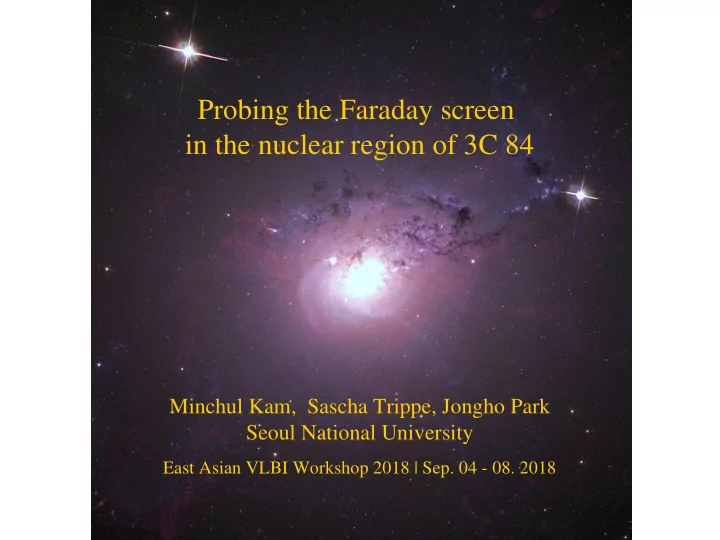
Probing the Faraday screen in the nuclear region of 3C 84 Minchul Kam, Sascha Trippe, Jongho Park Seoul National University East Asian VLBI Workshop 2018 | Sep. 04 - 08. 2018 HST 1.73 view of NGC 1275 VLBA 22GHz z ~ 0.018


slide-1
SLIDE 1

Probing the Faraday screen in the nuclear region of 3C 84

Minchul Kam, Sascha Trippe, Jongho Park Seoul National University

East Asian VLBI Workshop 2018 | Sep. 04 - 08. 2018

slide-2
SLIDE 2

HST 1.73’ view of NGC 1275

z ~ 0.018 d ~ 75 Mpc

VLBA 22GHz

http://pc.astro.brandeis.edu/ images/3c84.html

slide-3
SLIDE 3

VLBA 22 GHz

http://pc.astro.brandeis.edu/ images/3c84.html

VLBA 43 GHz

3 m a s = 1 p a r s e c

  • 3C 84 – central region of NGC 1275

https://www.bu.edu/blazars/VLBA_GLAST/0316.html

slide-4
SLIDE 4
  • 3C 84 is an interesting target !

1) very close (z~0.018, d~75 Mpc) → 1 pc scale structure of the central region is resolved! core : bright, upstream region where the jet begins hotspot : the local-brightest region in the bowshock-like structure 2) very low polarization

  • synchrotron radiation

polarization ! →

1 pc

contours : total intensity colors : polarized intensity

slide-5
SLIDE 5
  • 3C 84 is an interesting target !

1) very close (z~0.018, d~75 Mpc) → 1 pc scale structure of the central region is resolved! core : bright, upstream region where the jet begins hotspot : the local-brightest region in the bowshock-like structure 2) very low polarization

  • synchrotron radiation

polarization ! → What people think for the reason is… → Originally, it is polarized but something depolarizes it. → the prime suspect : Faraday rotation !

1 pc

slide-6
SLIDE 6
  • Polarization angle (EVPA) is rotated by B-field.

B-field polarized emission

φ1=φ0+∆φ1 φ2=φ0+∆φ2

Depolarization !

φ0:thesameintrinsic EVPA

φ 1=φ 0+∆φ 1 φ 2=φ 0+∆φ 2

φ1,φ2:different observed EVPAs

slide-7
SLIDE 7
  • Polarization angle (EVPA) is rotated by B-field.

B-field polarized emission

φ 0:intrinsic EVPA RM ∝∫ n Blos dl ∆φ =λ

2 RM

The effect of Faraday rotation is smaller at higher frequency. → Polarization would be stronger at higher frequency.

λ ↓ (ν ↑ )→∆φ ↓ → m ↑

slide-8
SLIDE 8
  • Polarization angle (EVPA) is rotated by B-field.

B-field polarized emission

φ 1=φ 0+∆φ 1 φ 2=φ 0+∆φ 2

φ 0:intrinsic EVPA RM ∝∫ n Blos dl ∆φ =λ

2 RM

λ ↓ (ν ↑ )→∆φ ↓ → m ↑

φ 1=φ 0+λ 1

2 RM

φ 2=φ 0+λ 2

2 RM

φ 1−φ 2=(λ 1

2−λ 2 2)RM

RM is obtained from multi-frequency polarimetry

  • 1. Does m% increase at higher frequency?
  • 2. How large is the RM?
slide-9
SLIDE 9
  • Data information
  • 1. Very Long Baseline Array (VLBA) – 10 antennas, ~8000 km

Period : Jun. 2014 ~ Sep. 2017 (BU data) Freq : 43.008 / 43.087 / 43.151 / 43.215 GHz

  • 2. Korea VLBI Network (KVN) – 3 antennas, ~480 km

Period : Dec. 2016 ~ (The KVN Large Program - PAGaN) Freq : 22 / 43 / 86 / 129 GHz

slide-10
SLIDE 10

VLBA 43 GHz (Dec. 2016 ~ Sep. 2017)

slide-11
SLIDE 11

The hotspot The hotspot VLBA 43 GHz (Dec. 2016 ~ Sep. 2017)

slide-12
SLIDE 12

The core The core VLBA 43 GHz (Dec. 2016 ~ Sep. 2017)

slide-13
SLIDE 13

KVN 86 GHz (Dec. 2016 ~ Dec. 2017)

slide-14
SLIDE 14

Does m% really increase at higher frequency? (Dec. 2016 ~ Apr. 2017) VLBA 43 GHz KVN 86 GHz

slide-15
SLIDE 15
  • Fractional polarization (m%) do increase at higher frequency !

BU 43 GHz KVN 86 GHz 2016 DEC 0.9 % (23) 1.6 % (9) 2017 JAN 0.3 % (14) 2.2 % (16) 2017 FEB 0.4 % (4) 6.1 % (25) 2017 MAR 0.9 % (19) 2.2 % (22) 2017 APR 0.5 % (16) 1.5 % (21) 2017 JUN 0.3 % (8) 1.2 % (1)

  • bservation date

Yes, m% increases at higher frequency !

BU 43 GHz images were convolved with the KVN 86 GHz beamsize.

slide-16
SLIDE 16
  • The hotspot (43.008 / 43.088 / 43.151 / 43.215 GHz, Jan. 2017)
slide-17
SLIDE 17
  • The hotspot (43.008 / 43.088 / 43.151 / 43.215 GHz, Jan. 2017)
slide-18
SLIDE 18
  • The RM at the hotspot - summary

2015

|RM|∼4.4×10

5rad /m 2

slide-19
SLIDE 19
  • The core (43.008 / 43.088 / 43.151 / 43.215 GHz, Jun. 2017)
slide-20
SLIDE 20
  • The core (43.008 / 43.088 / 43.151 / 43.215 GHz, Jun. 2017)
slide-21
SLIDE 21
  • The RM at the core - summary

|RM|∼6.6×10

5rad /m 2

slide-22
SLIDE 22
  • Point I - The core RM is lower than the expectation !

RM core=6.6×10

5rad/m 2

RM hsp=4.4×10⁵rad /m2

RM ∝∫ ne Bφ dl

slide-23
SLIDE 23
  • Point II - Detection of the negative core RM

Only positive core RM at 220 & 340 GHz

Plambeck+ 2014

  • SMA & CARMA cannot resolve the core.
  • Assumption! Most of the emission at

220 & 340 GHz originates from the core region.

slide-24
SLIDE 24
  • Scenario I : Internal Faraday rotation (Emitting region itself)

Burn 1966

Except the case that emitting region is slab with zero random component of B-field, EVPA rotation will be saturated at low frequencies.

u

2∝λ 2

Faraday screen : slab Faraday screen : sphere

, µ : random component of B-field

lower frequency → lower frequency →

slide-25
SLIDE 25
  • Scenario I : Internal Faraday rotation (Emitting region itself)

Burn 1966

Except the case that emitting region is slab with zero random component of B-field, EVPA rotation will be saturated at low frequencies. If 43 GHz, where we obtained the RM, is located in this saturated range, (1) positive & negative core RM, and (2) the low core RM would be explained.

Faraday screen : slab Faraday screen : sphere ← higher frequency ← higher frequency

u

2∝λ 2 , µ : random component of B-field

slide-26
SLIDE 26
  • Scenario I : Internal Faraday rotation (Emitting region itself)

Burn 1966

Except the case that emitting region is slab with zero random component of B-field, EVPA rotation will be saturated at low frequencies. If 43 GHz, where we obtained the RM, is located in this saturated range, (1) positive & negative core RM, and (2) the low core RM would be explained. → RM will increase at higher frequency where the EVPA rotation is less saturated.

Faraday screen : slab Faraday screen : sphere ← higher frequency ← higher frequency

, µ : random component of B-field

u

2∝λ 2

slide-27
SLIDE 27
  • Scenario II : External Faraday rotation (Hot accretion flow)

Li+ 2016

hot accretion flow - geometrically thick & optically thin turbulent

If polarized emission from the core passes through this accretion flow, (1) positive & negative core RM, (2) the low core RM can be explained.

→ RM will not increase at higher frequency.

slide-28
SLIDE 28
  • To probe the Faraday screen..

Case I : internal to the jet – RM will increase at higher frequency.

Case II : external to the jet – RM will not increase at higher frequency. → RM at higher frequency is necessary !

  • KVN observation at frequencies higher than 86 GHz

We proposed multi-frequency KVN observation at 86 - 90 - 94 & 129 - 138 - 142 GHz.

→ The first attempt to obtain the core RM at this high frequency range.

slide-29
SLIDE 29
  • To probe the Faraday screen..

Case I : internal to the jet – RM will increase at higher frequency.

Case II : external to the jet – RM will not increase at higher frequency. → RM at higher frequency is necessary !

  • KVN observation at frequencies higher than 86 GHz

We proposed multi-frequency KVN observation at 86 - 90 - 94 & 129 - 138 - 142 GHz.

→ The first attempt to obtain the core RM at this high frequency range.

approved !