
CS 4100: Artificial Intelligence Bayes’ Nets
Jan-Willem van de Meent, Northeastern University
[These slides were created by Dan Klein and Pieter Abbeel for CS188 Intro to AI at UC Berkeley. All CS188 materials are available at http://ai.berkeley.edu.]
Probabilistic Models
- Models describe how (a portion of) the world works
ks
- Mo
Model els ar are e al alway ays simplifi ficat cations
- May not account for every variable
- May not account for all interactions between variables
- “All models are wrong; but some are useful.”
– George E. P. Box
- Wha
What do do we do do with h pr proba babi bilistic mode dels?
- We (or our agents) need to reason about unknown variables, given evidence
- Ex
Exampl ple: explanation (diagnostic reasoning)
- Ex
Exampl ple: prediction (causal reasoning)
- Ex
Exampl ple: value of information
Independence Independence
- Tw
Two
- variables are in
independent if if:
- This says that their joint distribution factors into a
product two simpler distributions
- Another form:
- We write:
- In
Indep epen enden ence ce is a a simplifying model eling as assumption
- Em
Empi pirical jo join int dis istrib ibutio ions: at best “close” to independent
- What could we assume for {W
{Weather, Traffic, Cavity, Toothache}?
Example: Independence?
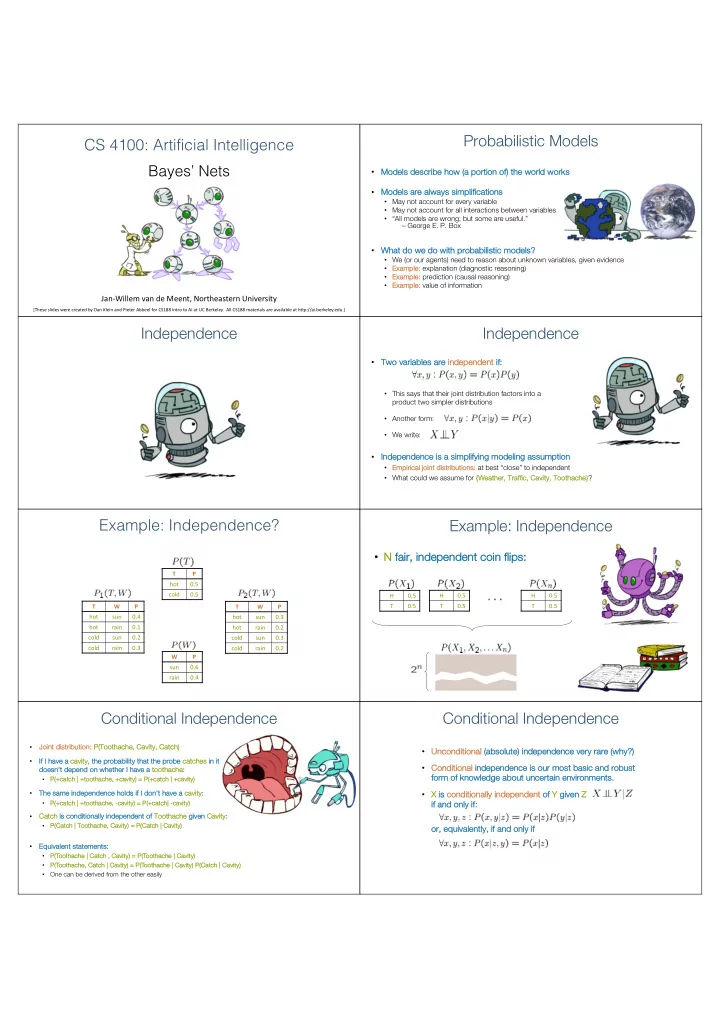
T W P hot sun 0.4 hot rain 0.1 cold sun 0.2 cold rain 0.3 T W P hot sun 0.3 hot rain 0.2 cold sun 0.3 cold rain 0.2 T P hot 0.5 cold 0.5 W P sun 0.6 rain 0.4
Example: Independence
- N fa
fair ir, in independent coin
- in flip
flips:
H 0.5 T 0.5 H 0.5 T 0.5 H 0.5 T 0.5
Conditional Independence
- Jo
Joint distribution: P(T (Toothache, Cavit ity, Catch)
- If
If I h I have a a cavi cavity, t , the p probability t that t the p probe cat catch ches es in in it it do doesn't de depe pend d on whether I have a to tooth thache:
- P(+
P(+cat catch ch | +toothach ache, e, +cavi cavity) y) = P(+ P(+cat catch ch | +cavi cavity)
- The
The sa same ind ndepend ndenc nce hol holds s if I don
- n’t
t have a cavi cavity:
- P(+
P(+cat catch ch | +toothach ache, e, -cavi cavity) ) = P(+ P(+cat catch ch| -cavi cavity)
- Ca
Catch is is condit itio ionally lly in independent of Toot Tootha hache he gi given n Ca Cavit ity:
- P(C
P(Cat atch ch | Toothach ache, e, Cavi avity) y) = P(C P(Cat atch ch | Cavi avity) y)
- Equi
Equivalent nt statement nts:
- P(T
P(Toothach ache e | Cat atch ch , Cavi avity) y) = P(T P(Toothach ache e | Cavi avity) y)
- P(T
P(Toothach ache, e, Cat atch ch | Cavi avity) y) = P(T P(Toothach ache e | Cavi avity) y) P(C P(Cat atch ch | Cavi avity) y)
- One can be derived from the other easily
Conditional Independence
- Un
Uncondit itio ional l (a (abs bsolute) ) inde depe pende dence very rare (wh (why?) ?)
- Co
Condi nditiona nal in independence is is our r most basic ic and ro robust form of kn knowledge about uncertain en environmen ents.
- X
X is is co conditional ally indep epen enden ent of
- f Y gi
given Z if if an and only if:
- r
- r, e
, equivalently, i , if a and o
- nly i