Privacy in Vehicular Ad-hoc Networks Nikolaos Alexiou, LCN, EE KTH - - PowerPoint PPT Presentation

privacy in vehicular ad hoc networks
SMART_READER_LITE
LIVE PREVIEW

Privacy in Vehicular Ad-hoc Networks Nikolaos Alexiou, LCN, EE KTH - - PowerPoint PPT Presentation

Privacy in Vehicular Ad-hoc Networks Nikolaos Alexiou, LCN, EE KTH alexiou@kth.se 2/10/2012 Outline Introduction VANETs: an overview VANET privacy - Anonymity - Location Privacy - VPKI Privacy Attacks Countermeasures


slide-1
SLIDE 1

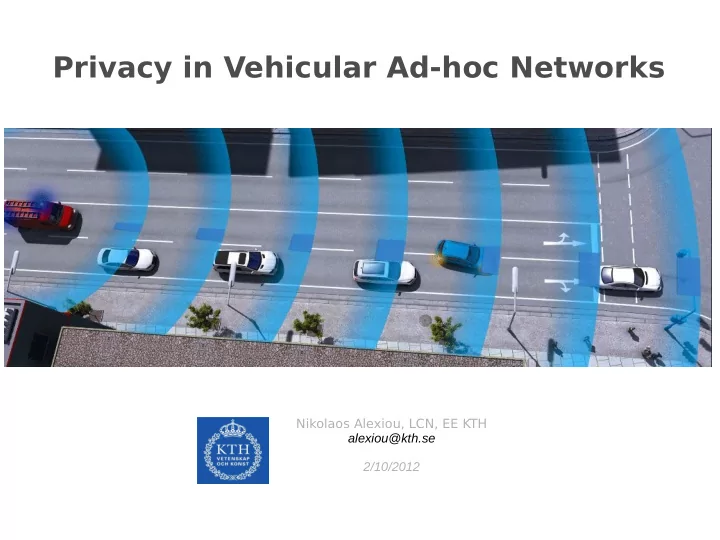
Privacy in Vehicular Ad-hoc Networks

Nikolaos Alexiou, LCN, EE KTH alexiou@kth.se 2/10/2012
slide-2
SLIDE 2

2012-10-04

Outline

  • Introduction
  • VANETs: an overview
  • VANET privacy
  • Anonymity
  • Location Privacy
  • VPKI
  • Privacy Attacks
  • Countermeasures
  • Conclusion

Illustrations from Car2Car Consortium, unless specified otherwise

slide-3
SLIDE 3

2012-10-04

VANETs: An overview

slide-4
SLIDE 4

2012-10-04

VANETs: An overview (cont'd)

  • V2V Communications:
  • Safety applications
  • Location Based Services
  • Proprietary Applications
  • Two types of messages:
  • Cooperative Awareness

Messages (CAM)

  • Decentralized Enviromental

Notification Messages (DENM)

slide-5
SLIDE 5

2012-10-04

VANETs: An overview (cont'd)

  • CAM messages:
  • Beacons, periodically sent
  • Basic status information (speed, location, acceleration, vehicle

identifier)

  • Very important for safety applications
  • A vehicle's neighborhood receives these messages
  • DENM messages:
  • Report information related with events
  • Sent on event detection
  • Contain: event location, timestamp etc
  • Usually distributed to many vehicles over a large area
slide-6
SLIDE 6

2012-10-04

VANETs: An overview (Cont'd)

  • V2I Communications:
  • Vehicle to RSU (Road Side

Units)

  • VANET Services:
  • Location based
  • Safety Applications
  • Proprietary: eg Tolling

Systems

  • Privacy Services
  • 802.11p / LTE
slide-7
SLIDE 7

Privacy & threats?

slide-8
SLIDE 8

2012-10-04

V2V/V2I communications

  • V2V and V2I communications expose sensitive data:
  • To other vehicles
  • Eavesdroppers
  • To infrastructure
  • [1] CAM messages contain information such as:
  • Direction to be taken
  • Vehicle length
  • Vehicle width
  • Occupancy (passengers as percentage)
  • Anonymity: conceal identity
  • Location Privacy: position cannot be systematically recorded

[1]ETSI TS 102 637-2 V1.2.1 (2011-03)

Picture:P. Papadimitratos, L. Buttyan, T. Holczer, E. Schoch, J. Freudiger, M. Raya, Z. Ma, F. Kargl, A. Kung, and J.-P. Hubaux, "Secure Vehicular Communication Systems: Design and Architecture," IEEE Communications Magazine, November 2008.

slide-9
SLIDE 9

2012-10-04

Authentication in VANETs

  • Each vehicle should be identifiable
  • To develop services and applications
  • To issue tickets
  • To resolve accidents
  • Vehicle authentication can be achieved using a PKI → the

Vehicular PKI (VPKI)

  • Each vehicle will store:
  • private keys to sign packets
  • public keys signed by a CA (eg the car manufacturer)
  • Certificates
  • For other vehicles and infrastructure to verify packets
slide-10
SLIDE 10

2012-10-04

VANET Privacy (Cont'd)

image: P. Papadimitratos, L. Buttyan, T. Holczer, E. Schoch, J. Freudiger, M. Raya, Z. Ma, F. Kargl, A. Kung, J.-P. Hubaux, Secure Vehicular Communication Systems: Design and Architecture

slide-11
SLIDE 11

2012-10-04

Generally about privacy: Why?

  • If you have nothing to hide, why do you need privacy?
  • If I have nothing to hide, you have no cause to watch me.
  • Who defines what is wrong behavior or not?

Bruce Schneier on Security, Chapter 4: Privacy and Surveillance

slide-12
SLIDE 12

2012-10-04

So far we know:

  • V2V/V2I communications leak information
  • Privacy threat
  • Anonymity
  • Location Privacy
  • VPKI needed to authenticate vehicles
  • Certificates from a trusted CA
  • The next question is...
slide-13
SLIDE 13

How to protect privacy in VANETs?

slide-14
SLIDE 14

2012-10-04

Pseudonyms: Anonymity

  • Pseudonyms to provide anonymity
  • Where and how to store pseudonyms at the car?
  • Hardware Security Module (HSM)
  • Tamper-Proof crypto device
  • Corner stone of in-vehicle security
  • How to obtain pseudonyms?
  • How to protect location privacy?
  • Why need many pseudonyms?
slide-15
SLIDE 15

2012-10-04

Pseudonyms: Location Privacy

Each pseudonym is valid for a specific period of time

slide-16
SLIDE 16

2012-10-04

The VANET Architecture

  • Vehicular Public Key

Infrastructure

  • pseudonyms signed by CA
  • Pseudonym Certification

Authority (PCA)

  • Why?
  • Trust in signatures
  • PCA per manufacturer?
  • Hierarchical VPKI
  • Cross-certification between

countries

slide-17
SLIDE 17

2012-10-04

How to generate pseudonyms?

  • Each vehicle can generate a set of:
  • Private/Public keys in the HSM
  • A large set of keys (e.g to be enough for a week)
  • Short life-time
  • Each needed for a limited number of beacons
  • Public keys need to be signed by a CA
  • Send over wireless to be signed
  • Private keys stay in the HSM
  • Pseudonymous Certificates: A signature of a CA over each of

the public keys

slide-18
SLIDE 18

A first bad VPKI architecture example

slide-19
SLIDE 19

2012-10-04

Pseudonymous Certificates

EPuKpca{Sigv(Alexiou, KBZ 5567,t),Certv(PuKv)}*

EPuKv{Sigpca(Sheldon1)...Sigpca(Sheldonx)}*

PCA

*This is just an illustration example

slide-20
SLIDE 20

2012-10-04

Pseudonymous Certificates (Cont'd)

Preserves location privacy and anonymity for V2V The PCA knows who (alexiou) and which (pseudonyms) PCA

EPuKpca{Sigv(Alexiou, KBZ 5567,t),Certv(PuKv)}*

EPuKv{Sigpca(Sheldon1)...Sigpca(Sheldonx)}*

slide-21
SLIDE 21

2012-10-04

  • The vehicle should be protected against the infrastructure
  • The PCA must NOT learn the identity of the vehicle or the driver
  • To achieve that, another authority is needed
  • Long Term Certification Authority (LTCA)
  • Holds real information of the vehicle (and possibly the drivers)
  • The new architecture
  • LTCA: knows only real identities
  • PCA: knows only pseudonyms

Pseudonymous Certificates (Cont'd)

slide-22
SLIDE 22

A better VPKI architecture example

slide-23
SLIDE 23

2012-10-04

PCA

SK_pca PuK_pca

LTCA

SK_ltca PuK_ltca

EpuK_ltca(Alexiou,KBZ5567,t) OK (You can grant pseudonyms) EPuKpca{EPuKLTCA(Alexiou, KBZ 5567,t),Certv(PuKv)}* EPuKv{Sigpca(Sheldon1)...Sigpca(Sheldonx)}*

Pseudonymous Certificates (Cont'd)

slide-24
SLIDE 24

2012-10-04

PCA

SK_pca PuK_pca

LTCA

SK_ltca PuK_ltca

EpuK_ltca(Alexiou,KBZ5567,t) OK (You can grant pseudonyms) EPuKpca{EPuKLTCA(Alexiou, KBZ 5567,t),Certv(PuKv)}* EPuKv{Sigpca(Sheldon1)...Sigpca(Sheldonx)}*

Doesn't know who Doesn't know which

Pseudonymous Certificates (Cont'd)

slide-25
SLIDE 25

2012-10-04

Pseudonymous Certificates (Cont'd)

PCA

SK_pca PuK_pca

LTCA

SK_ltca PuK_ltca

EpuK_ltca(Alexiou,KBZ5567,t) OK (You can grant pseudonyms) EPuKpca{EPuKLTCA(Alexiou, KBZ 5567,t),Certv(PuKv)}* EPuKv{Sigpca(Sheldon1)...Sigpca(Sheldonx)}*

Doesn't know who Doesn't know which

A possible threat??

slide-26
SLIDE 26

2012-10-04

PCA

SK_pca PuK_pca

LTCA

SK_ltca PuK_ltca

EpuK_ltca(Alexiou,KBZ5567,t) OK (You can grant pseudonyms) EPuKpca{EPuKLTCA(Alexiou, KBZ 5567,t),Certv(PuKv)}* EPuKv{Sigpca(Sheldon1)...Sigpca(Sheldonx)}*

Doesn't know who Doesn't know which

Pseudonym Resolution

Resolution Authority

Tell me which?

slide-27
SLIDE 27

2012-10-04

PCA

SK_pca PuK_pca

LTCA

SK_ltca PuK_ltca

EpuK_ltca(Alexiou,KBZ5567,t) OK (You can grant pseudonyms) EPuKpca{EPuKLTCA(Alexiou, KBZ 5567,t),Certv(PuKv)}* EPuKv{Sigpca(Sheldon1)...Sigpca(Sheldonx)}*

Doesn't know who Doesn't know which

Pseudonym Resolution

Resolution Authority

Tell me who?

slide-28
SLIDE 28

2012-10-04

Pseudonym Resolution

  • When does the resolution happen?
  • Accidents
  • Misbehavior
  • Alternative resolution methods exist
  • [2]: encrypting vehicle's identity with Res. CA's PuK
  • Others: additional CA's for:
  • Misbehavior, Grant of Access, Legal Aspects

[2] Kargl, F. ; Zhendong Ma ; Weber, M. , V-Tokens for Conditional Pseudonymity in VANETs

slide-29
SLIDE 29

2012-10-04

Pseudonym Revocation

  • Certificates will eventually expire
  • Vehicles may
  • Misbehave
  • Destroyed
  • Retired
  • Revocation of pseudonym certificates to prevent malicious

behavior

slide-30
SLIDE 30

2012-10-04

Other Pseudonymous Schemes

  • Group Signatures
  • Hide the identity within a group of vehicles
  • Each vehicle stores:
  • A group secret key
  • A group public key
  • Tokens for revocation
  • Problems:
  • Efficiency
  • More difficult to handle revocations
  • Difficult to handle dynamic groups
slide-31
SLIDE 31

Attacks against location privacy

slide-32
SLIDE 32

2012-10-04

Tracking attacks: Location Privacy

  • Each beacon contains the

vehicle's location/direction etc

  • Adversaries can collect the

beacons

  • LP is highly dependable on

the anonymity set

  • E.g. how many cars on the

road?

  • Cannot assume that vehicles

can change pseudonyms for each packet transmitted

slide-33
SLIDE 33

2012-10-04

Tracking attacks: Location Privacy

  • Change pseudonyms to avoid

tracking

  • Beacon frequency e.g. 10Hz
  • Given that there are many

cars on the road:

  • It should be very difficult to

track a vehicle

  • Is this the case?
  • Multi-hypothesis testing,

kalman filters

slide-34
SLIDE 34

2012-10-04

Multi-Hypothesis testing: An overview

  • Tracking as data association problem
  • Position & velocity
  • For each measurement a new set of data association

hypothesis

  • Essentially guessing the next state
  • New measurements arrive
  • Probability of association of the guess to the measurement
  • Higher probability is chosen
slide-35
SLIDE 35

2012-10-04

Tracking Results

Images: B. Wiedersheim, F. Kargl, Z. Ma, and P. Papadimitratos, “Privacy in Inter-Vehicular Networks: Why simple pseudonym change is not enough”

slide-36
SLIDE 36

2012-10-04

Reasoning about Location Privacy

  • How to increase:
  • Increasing pseudonym changing frequency
  • Spatial noise
  • Impact on safety?
  • Adversarial models
  • Eavesdropper: needs many devices
  • Internal: is the most dangerous one
  • What else could be done?
  • Mixing zones
slide-37
SLIDE 37

2012-10-04

  • Idea: change pseudonym

where it is harder to link two successory ones

  • Force pseudonym changes

within regions

  • Where can this be done?
  • Road junctions
  • Traffic lights

Mix-Zones

Image: Julien Freudiger, Reza Shokri, and Jean-Pierre Hubaux On the Optimal Placement of Mix Zones

slide-38
SLIDE 38

2012-10-04

  • An RSU at the intersection
  • Distributes a secret key to the

vehicles within the mix-zone

  • They beacon using signing

with the group key

  • The vehicle uses its regular

pseudonym when leaving the mix-zone

Mix-Zones (cont'd)

Image: J. Freudiger, M. Raya, M. Felegyhazi, P. Papadimitratos, and J.-P. Hubaux, "Mix-Zones for Location Privacy in Vehicular Networks”

slide-39
SLIDE 39

2012-10-04

Mix-Zones: Some results

Images: J. Freudiger, M. Raya, M. Felegyhazi, P. Papadimitratos, and J.-P. Hubaux, "Mix-Zones for Location Privacy in Vehicular Networks”

slide-40
SLIDE 40

2012-10-04

Conclusion

  • Anonymity through pseudonymous certificates
  • Location privacy through changing certificates
  • Tracking attacks from:
  • Eavesdroppers
  • Internal adversaries
  • VPKI architecture to minimize the probability of tracking by a

trusted party

  • Mix-zones/pseudonym change frequency to avoid

eavesdroppers

slide-41
SLIDE 41

2012-10-04

References

  • Suggested:
  • P. Papadimitratos, L. Buttyan, T. Holczer, E. Schoch, J. Freudiger, M.Raya, Z. Ma, F. Kargl, A. Kung, and J.-P. Hubaux,

"Secure Vehicular Communication Systems: Design and Architecture," IEEE Communications Magazine, November 2008

  • B. Wiedersheim, F. Kargl, Z. Ma, and P. Papadimitratos, “Privacy in Inter-Vehicular Networks: Why simple pseudonym

change is not enough,” IEEE/IFIP International Conference on Wireless On-demand Network Systems and Services (IEEE/IFIP WONS), Kranjska Gora, Slovenia, February 2010

  • Further Reading:
  • http://preserve-project.eu/
  • M. Raya and J.-P. Hubaux. The Security of Vehicular Ad Hoc Networks. In Proc. of Third ACM Workshop on Security of Ad

Hoc and Sensor Networks (SASN 2005), Alexandria, USA, Nov. 2005.

  • J. Freudiger, M. Raya, M. Felegyhazi, P. Papadimitratos, and J.-P. Hubaux, "Mix-Zones for Location Privacy in Vehicular

Networks," ACM Workshop on Wireless Networking for Intelligent Transportation Systems (ACM WiN-ITS 2007), Vancouver, BC, Canada, August 2007

  • Giorgio Calandriello, Panos Papadimitratos, Jean-Pierre Hubaux, and Antonio Lioy. 2007. Efficient and robust

pseudonymous authentication in VANET. In Proceedings of the fourth ACM international workshop on Vehicular ad hoc networks (VANET '07). ACM, New York, NY, USA, 19-28.

  • F. Schaub, F. Kargl, Z. Ma, and M. Weber, "V-tokens for Conditional Pseudonymity in VANETs", IEEE Wireless

Communications & Networking Conference (IEEE WCNC 2010), Sydney, Australia, IEEE, 04/2010.

slide-42
SLIDE 42

Questions