Primary Chemoradiation for Oropharynx Cancer or how I learned to - - PowerPoint PPT Presentation

primary chemoradiation for oropharynx cancer
SMART_READER_LITE
LIVE PREVIEW

Primary Chemoradiation for Oropharynx Cancer or how I learned to - - PowerPoint PPT Presentation

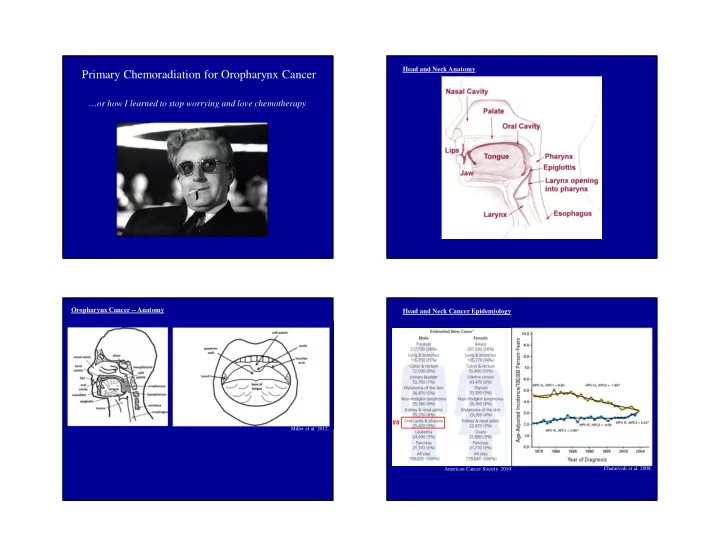
Head and Neck Anatomy Primary Chemoradiation for Oropharynx Cancer or how I learned to stop worrying and love chemotherapy Oropharynx Cancer -- Anatomy Head and Neck Cancer Epidemiology #8 Miller et al. 2012. American Cancer Society. 2010.


slide-1
SLIDE 1

Primary Chemoradiation for Oropharynx Cancer

…or how I learned to stop worrying and love chemotherapy

Head and Neck Anatomy Oropharynx Cancer -- Anatomy

Miller et al. 2012. American Cancer Society. 2010.

Head and Neck Cancer Epidemiology #8

Chaturvedi et al. 2008.

slide-2
SLIDE 2

Oropharynx Cancer: HPV and Prognosis

Chaturvedi et al. 2011.

“Curing” HNSCC’’ Curative modalities: Surgery, radiation Chemotherapy not curative, may potentiate radiation Curable stages: Localized Regionally advanced

  • Resectable
  • Radiation possible (maximum lifetime dose)

Incurable: Recurrent – no further radiation or surgery possible Metastatic Oropharynx SCC Staging

T Size Invasion T1 < 2 cm T2 2-4 cm T3 > 4 cm +Lingual surface +Epiglottis T4a +Larynx +Tongue muscles +Medial pterygoid +Hard palate +Mandible T4b +Lateral pterygoid +Pterygoid plates +Lateral nasopharynx +Skull base +Encases carotid N # Size Side N0 N1 1 < 3 cm Ipsilateral N2a 1 3-6 cm Ipsilateral N2b >1 < 6 cm Ipsilateral N2c < 6 cm Contralateral Bilateral N3 > 6 cm M Distant metastases M0 M1 Present

≥ Stage I ≥ Stage II ≥ Stage III ≥ Stage IVa ≥ Stage IVb Stage IVc Oropharynx Simplified Decision Tree

T Size Invasion T1 < 2 cm T2 2-4 cm T3 > 4 cm +Lingual surface +Epiglottis T4a +Larynx +Tongue muscles +Medial pterygoid +Hard palate +Mandible T4b +Lateral pterygoid +Pterygoid plates +Lateral nasopharynx +Skull base +Encases carotid N # Size Side N0 N1 1 < 3 cm Ipsilateral N2a 1 3-6 cm Ipsilateral N2b >1 < 6 cm Ipsilateral N2c < 6 cm Contralateral Bilateral N3 > 6 cm M Distant metastases M0 M1 Present

Surgery and/or XRT Definitive chemoradiation Chemoradiation Surgery + XRT +/- Chemo Palliative therapy

slide-3
SLIDE 3

Metaanalysis of chemotherapy in head and neck cancer (MACH-NC) 87 trials, 16,665 patients, median 5.5 years f/up

Rationale for concurrent chemoradiation in OPC

Blanchard et al. 2011.

Glottic Larynx Decision Tree Glottic Larynx Decision Tree Rationale for concurrent chemoradiation in oropharyngeal carcinoma Risk of Death @ 5 years

Blanchard et al. 2011.

Absolute risk HR p Sequence Adjuvant +0.4% 1.15 p < 0.0001 Neoadjuvant

  • 1.4%

1.00 Concurrent

  • 8.1%

0.78 Chemo Platinum + 5FU 0.83 p < 0.004 Platinum 0.70 Single agent non-platinum 1.01

Take Home: 1. Concurrent

  • 2. Platinum
slide-4
SLIDE 4

Seiwert TY et al. (2007) Nat Clin Pract Oncol 4: 156–171

Single agent regimens with XRT

Oropharynx/Mixed: RT vs chemoRT

GORTEC1 Intergroup2

Pts 113 109 95 87 89 RT 70 Gy 35 fx 70 Gy 35 fx 70 Gy 35 fx 70 Gy 35 fx 30 Gy, break, surgery vs boost Chemo carbo/5FU cisplatin cisplatin/5FU OS 5 yr 16% 5 yr 22% 3 yr 23% 3 yr 37% 3 yr 27% Toxicity 30% late 56% late

Dry mouth, cervical fibrosis

52% acute 89% acute 77% acute

N, V, mucositis

Combination chemotherapy + XRT

MACH-NC 3 year OS = 41.1% 5 year OS = 32.7%

T3+ and N3 tumors?

  • 1. Calais G, JNCI 91:2081-6, 1999
  • 2. Adelstein, JCO, 21(1):92, 2003

Wait a minute…

Chemo 2. Robert Arneson. 1992.

Does it have to be chemotherapy?

Bonner et al. 2006.

Cetuximab Median LRC 24.4 vs 14.9 months OS 49.0 vs 29.3 months

slide-5
SLIDE 5

XRT +/- Novel EGFR inhibitor (Nimotuzumab)

A few burning questions HPV+

  • 1. Deintensify?
  • 1. Cetuximab = cisplatin?

All OPC

  • 1. Better induction?
  • 2. New therapies
  • a. Targeted
  • b. Immune

E1308: HPV-specific Trial Chemotherapy-Cetuximab to Select HPV+ Oropharynx Patients for Lower Dose Radiation

INDUCTION (3 cycles) Weekly Paclitaxel + Cetuximab ELIGIBILITY Stage III,IVA,B Resectable HPV + Oropharynx CONCURRENT IMRT 69.3Gy/33fxs Cetuximab 250mg/m2 qwk CR <CR CONCURRENT IMRT 54Gy/27 fxs Cetuximab 250mg/m2 qwk

Cetuximab loading dose = 400mg/m2 on Day1 of Cycle1 with Induction

N=83 Trials: HPV+ deintensify radiation

RTOG 1016

cisplatin vs cetuximab head to head

Trials: HPV+ cetuximab vs cisplatin

slide-6
SLIDE 6

TAX 324: Docetaxel/Cisplatin/5-FU vs Cisplatin/5-FU Sequential Therapy in Advanced SCCHN

Chemotherapy- and RT-naïve stage III/IV SCCHN

  • Oral cavity, oropharynx,

hypopharynx, larynx N=501 R A N D O M I Z E Cisplatin (100 mg/m2) 5-FU (1000 mg/m2/day, days 1-5) every 3 weeks, C-I 3 cycles Carboplatin (AUC 1.5 weekly) Daily RT (5 days/week)

ICT CRT

Docetaxel (75 mg/m2) Cisplatin (100 mg/m2) 5-FU (1000 mg/m2/day, 96-hr C-I) every 3 weeks, 3 cycles

Posner, N Engl J Med. 2007;357:1705. Induction therapy: regimen

TAX 324: TPF vs PF Sequential Therapy in Advanced SCCHN

TPF 62% PF 48% TPF 67% PF 54% Log-rank P=0.0058 HR=0.70 TPF 53% PF 42% TPF 49% PF 37% Log-rank P=0.004 HR=0.701

Survival PFS

Months Survival Probability (%)

6 12 18 24 30 36 42 48 54 60 66 72 10 20 30 40 50 60 70 80 90 100 TPF (N=255) PF (N=246)

Months PFS Probability (%)

6 12 18 24 30 36 42 48 54 60 66 72 10 20 30 40 50 60 70 80 90 100 TPF (N=255) PF (N=246)

  • TPF improves survival and PFS compared with PF

Posner, N Engl J Med, 2007;357:1705.

Induction therapy: regimen

DeCIDE and PARADIGM

But the questions still is: do we need induction? Induction+CRT vs CRT Trial Population N Regimen 3y OS Induction CRT PARADIGM1 Stage II-IV 145 Docetaxel + Cisplatin + 5-Fluorouracil Weekly carboplatin or docetaxel 73%* Cisplatin (q3w x2) 78%* DeCIDE2 N2/N3 SCC head and neck 280 Docetaxel + Cisplatin + 5-Fluorouracil Docetaxel + Hydroxyurea + 5-Fluorouracil 75%* Docetaxel + Hydroxyurea + 5-Fluorouracil 73%*

  • 1. Haddad et al., ASCO 2012.
  • 2. Cohen et al. ASCO 2012.

*Not significant

  • May need larger number in subgroups

Induction therapy: additional thoughts
slide-7
SLIDE 7

Clinical judgment / scenario

– Radiation field too big – Patient too sick Weekly carboplatin and paclitaxel Moosmann et al. 2003.

Induction therapy: additional thoughts Conclusions

  • HPV+ oropharyngeal carcinoma
  • HPV+ prognosis better, but treated like HPV- for now
  • Chemoradiation for advanced stage
  • Concurrent, platinum
  • Research may identify relative efficacy of less toxic agents