HPV+ Oropharynx Cancer: Are We Ready to De Intensify Treatment? - - PDF document

hpv oropharynx cancer are we ready to de intensify
SMART_READER_LITE
LIVE PREVIEW

HPV+ Oropharynx Cancer: Are We Ready to De Intensify Treatment? - - PDF document

Winship Cancer Institute of Emory University HPV+ Oropharynx Cancer: Are We Ready to De Intensify Treatment? Jonathan J Beitler, MD, MBA, FACR Depts of Radiation Oncology, Otolaryngology, Hematology & Medical Oncology Winship Cancer Center


slide-1
SLIDE 1

1

Winship Cancer Institute of Emory University

Jonathan J Beitler, MD, MBA, FACR

Depts of Radiation Oncology, Otolaryngology, Hematology & Medical Oncology Winship Cancer Center of Emory University

HPV+ Oropharynx Cancer: Are We Ready to De‐Intensify Treatment?

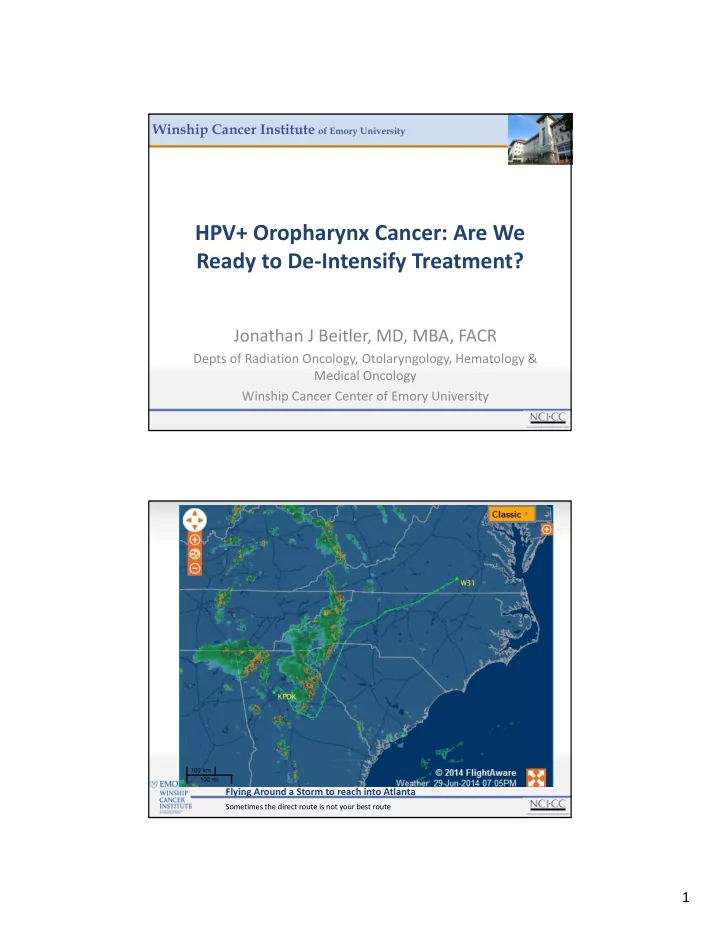
Flying Around a Storm to reach into Atlanta

Sometimes the direct route is not your best route

slide-2
SLIDE 2

2

  • Anatomically distinct from oral cavity cancers
  • Classically treated with radiation‐based approaches
  • Classically associated with smoking/alcohol risk

factors

  • 5‐year survival rates 43‐58%

What is Oropharyngeal cancer

  • Intergroup: 70Gy vs 70Gy+cisplatin vs

splitcourse‐chemoRT

  • RTOG 0129: 70Gy+cisplatin vs

Accel70Gy+cisplatin

  • RTOG 0522: Accel70 Gy+cisplatin vs

Accel70Gy+cisplatin+cetuximab

  • RTOG 1016: Accel70 Gy+cisplatin vs

Accel70Gy+cetuximab – closing 2014

  • NRG HN002: In development, based on

principles of de‐intensification

Paradigm shift: De‐intensification

slide-3
SLIDE 3

3

(Ang, Harris et al. 2010) RTOG 0129, Con Boost

  • Cyclin‐dependent kinase (CDK) inhibitor
  • Inactivates CDKs that phosphorylate retinoblastoma

(Rb)

  • HPV oncoprotein E7 binds and inactivates Rb,

causing upregulation of p16

  • Immunohistochemical stain
  • Cheap and readily optimized for clinical labs
  • Has become the surrogate marker for HPV – and a

selection criterion in RTOG clinical trials

What is P16

slide-4
SLIDE 4

4

Acute Toxicity Burden of current chemoradiation approach

Trotti A et al. Lancet Oncol 2007;

Estimated for Bioradiotherapy Platinum based Chemoradiotherapy RT alone

  • Swallowing dysfunction
  • Pharyngeal strictures
  • Xerostomia and dental effects
  • Chronic pain
  • Osteoradionecrosis/chondroradionecrosis
  • Particularly germane because HPV+ OPC patients are

15 years younger than other HN cancer patients

Long‐term morbidity of full‐dose chemoradiation

slide-5
SLIDE 5

5

What Can We DO?

  • 1) Decrease chemotherapy

a) Less toxic chemotherapy b) Radiation Alone c) Surgery alone and Surgery + prn XRT/chemo

  • 2) Decrease the XRT

– Induction Chemo and Chemo Selection‐E1308

  • 3) New Trials

– TORS – HN01

RTOG 1016

a)Less Toxic Chemotherapy

slide-6
SLIDE 6

6

RTOG 1016

a)Less Toxic Chemotherapy

  • Primary Objective‐5 Year Survival
  • Opened June 2011

– After a hiatus the study was enlarged to 1,000 patients to allow for 834 eligible patients

  • Waiting for 45 events….

– The study is doing well…

b) Radiation Alone

slide-7
SLIDE 7

7

PMH XRT Alone

b) Radiation Alone

Natural History of HPV Disease

+HPV ‐HPV

slide-8
SLIDE 8

8

b) Radiation Alone

  • The Distant Control rates for +HPV low risk

patients (T1‐T3, N0‐N2a, or less than 10 pack year N2b) was… similar between RT and

CRT alone

  • MD Anderson‐Similar
  • Would keep T3 out of LR group

c)Surgery alone

slide-9
SLIDE 9

9

Surgery + prn XRT/Chemo

Arch Otolaryngol Head Neck Surg. 2010;136(11):1079‐1085

38% avoided chemotherapy and 11% avoided XRT

Lots of Enthusiasm(2012)

slide-10
SLIDE 10

10

2013

Data on PFS are premature. A 2 year PFS of 85% or better will be considered worthy of further study

slide-11
SLIDE 11

11

2014

Median Follow up was 23.4 months. This is from time of registration and Includes three 21‐day cycles of induction chemo and 2‐3 weeks for assesstment Of response….Possible lead time bias? 3 Months

At 23 months, ECOG 1308 just MISSED it’s target

A 2 year PFS of 85% or better will be considered worthy of further study

slide-12
SLIDE 12

12

INTERMEDIATE: Clear margins ≤ 1 mm ECS 2–3 metastatic LN PNI LVI HIGH RISK: Positive Margins > 1 mm ECS or ≥ 4 metastatic LN Radiation Therapy IMRT 60 Gy/30 Fx Evaluate for 2-yr PFS Local-Regional Recurrence, Functional Outcomes/QOL Transoral Resection (any approach) with neck dissection Radiation Therapy IMRT 50Gy/25 Fx

ECOG 3311 P16+ Trial – Low Risk OPSCC: Personalized Adjuvant Therapy Based on Pathologic Staging of Surgically Excised HPV+ Oropharynx Cancer

Assess Eligibility: HPV (p16)+ SCC

  • ropharynx

Stage III-IV: cT1-3, N1-2b (no T1N1) Baseline Functional/ QOL Assessment

Observation R A N D O M I Z E Radiation Therapy IMRT 66 Gy/33 Fx + CDDP 40 mg/m2 wkly LOW RISK: T1-T2N0-N1 negative margins

24

slide-13
SLIDE 13

13

NRG HN002: A Randomized Phase II Trial for Patients with P16 Positive, Non‐Smoking Associated, Locoregionally Advanced Oropharyngeal Cancer

  • OP SCCA
  • ≤10 pack‐

year

  • T1‐T2 N1‐

N2b

  • T3 N0‐

N2b 44% of RTOG 1016 population eligible

Eligibility

60 Gy XRT (2Gy/fx) in 6 weeks + cisplatin 40 mg/m2 weekly x 6 cycles 60 Gy XRT (2 Gy/fx) at 6 fractions/week for 5 weeks R E G I S T E R

R A N D O M I Z E

Central review p16+ IHC

S T R A T I F Y

Declare Intent Unilat vs Bilat Neck XRT

Waiting Until Hurricane Arthur Had Passed

Sometimes time clears the air….