Prevention across the lifespan (Prevention for Lifes transitions) - - PDF document

prevention across the lifespan prevention for life s
SMART_READER_LITE
LIVE PREVIEW

Prevention across the lifespan (Prevention for Lifes transitions) - - PDF document

Prevention Across the Lifespan Marcia Baker Ph.D. Candidate LCDC, ACPS, LBSW Five for Fighting "100 Years" - YouTube Prevention across the lifespan (Prevention for Lifes transitions) Thoughts???? 1 Exercise


slide-1
SLIDE 1

1

“ Prevention Across the Lifespan”

Marcia Baker Ph.D. Candidate LCDC, ACPS, LBSW Five for Fighting "100 Years" - YouTube

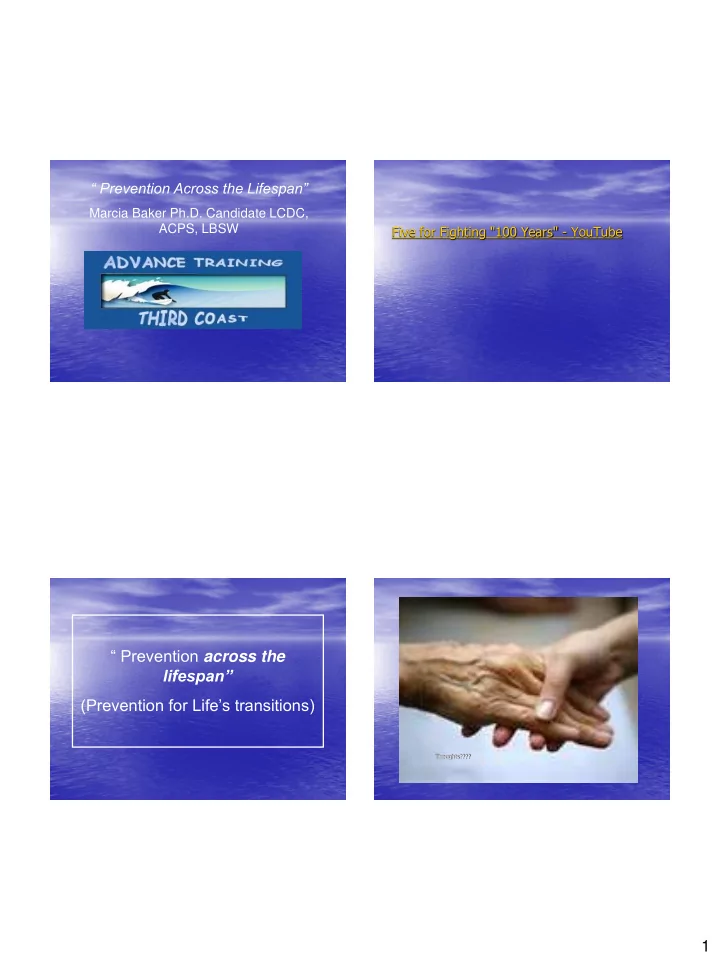
“ Prevention across the lifespan” (Prevention for Life’s transitions)

Thoughts????
slide-2
SLIDE 2

2

Exercise

  • Break up into groups of____
  • Discuss these stages of life and

experiences that go with it:

  • Birth, Toddler, Childhood, Adolescent,

Teenager, Young adult, Adult, Middle-age,

  • lder adult.

Lifespan Definition

  • One way of looking at Lifespan is all the various

ways that our life can change and create experiences for us such as: Disabilities Diseases Parenting Stages of Development (Aging) Employment School

Prevention Across the Lifespan (cycle)

Prenatal Early Childhood/ School age Adolescent Young Adult Adult Elderly

  • Utero

exposure

  • Poor

nutrition

  • Active

use/abuse

  • Social and

family conditions Substances used by parent: Alcohol, heroin, cocaine, meth, prescription drugs, smoking, etc.

  • Risk/Protective
  • Social and family

conditions

  • Parent active

use/abuse

  • Poor nutrition
  • Violence/abuse
  • Environmental

influence

  • Socioeconomics
  • Parent Education

Substances used by parent: Alcohol, cocaine, heroin, meth, etc; smoking, etc.

  • Risk/Protective

Factors

  • Experimentation
  • Peer influence
  • Underage drinking
  • Mental Health

Issues

  • School

Performance

  • Academic Success
  • Income/family

relations

  • Sexuality and

mental health development

  • Self esteem and

social behaviors Substances used by parent: *Marijuana, smoking, meth, inhalants, club drugs, alcohol, etc.

  • Risk/Protective

Factors

  • College transition
  • Workforce/income
  • Social and

environmental pressures

  • Education and social

success

  • Marketing exposure
  • Mental Health Issues
  • Abuse AOD
  • (habit formation of

illicit substance abuse

  • Self medications

Substances: Alcohol, smoking, prescription drugs, cocaine, heroin, etc.

  • Employment

status

  • Income
  • Housing
  • Violent

behavior

  • Use/Abuse
  • Family

relations

  • Treatment

experiences Substances: Alcohol, smoking, prescription drugs, heroin, cocaine, etc.

  • Retirement
  • Depression
  • Self

medication

  • Economics
  • Poor nutrition
  • Family

relations

  • Treatment

experiences Substances: Alcohol, smoking, prescription drugs

Contributed by Tania Garcia, CSAP’s Northeast CAPT

Why Be Concerned About Health Across the Lifespan

  • Need to understand the influence of social and

health determinants as predictors of population and individual health (environment, access)

  • Social determinants of health structure will

determine population health, behavior and services utilization

  • Social determinants of health will influence

health from early life (aging, education, social safety net, lifestyle series, employment, income, wellness and access)

Contributed by Tania Garcia, CSAP’s Northeast CAPT March 06

slide-3
SLIDE 3

3

Traditionally, Substance Abuse Prevention has been without significant collaboration

  • Prevention Programs have been developed

in many fields that do not communicate with one another such as:

  • School settings
  • Criminal Justice settings
  • Mental Health Organizations
  • Substance Abuse treatment organizations

A Public Health Issue: Substance Use and Abuse???

“Prevention” Across the Lifespan has been an integral part of many public health programs:

  • Suicide prevention
  • Disease prevention
  • Obesity/nutrition
  • Diabetes prevention
  • Child abuse prevention
  • Injury prevention
  • Cardiovascular health

Lifespan Prevention –Connecting the Dots

  • A way to define collaboration
  • A way to assist organizations

providing prevention to work together using the newly defined Strategic Prevention Framework from SAMHSA.

slide-4
SLIDE 4

4

Strategic Prevention Framework

Strategic Prevention Framework Steps

  • The SPF requires States and communities to

systematically:

  • Assess their prevention needs based on

epidemiological data,

  • Build their prevention capacity,
  • Develop a strategic plan,
  • Implement effective community prevention

programs, policies and practices, and

  • Evaluate their efforts for outcomes.

Exercise

  • Divide up into groups
  • Discuss how we can assist in connecting

the dots.

  • How can you be a part of the solution?

Public Health Promotion

  • Are we Salespeople for a Healthier Life?
  • What is Sustainability?
  • How do we promote Sustainability?
slide-5
SLIDE 5

5

Prevention Resources

  • Local county health department
  • Arizona County Extension
  • Center for Applied Behavioral Health Policy
  • Arizona Prevention Research Center
  • Arizona Prevention Resource Center
  • NREPP
  • Arizona Dept. of Education
  • Arizona Dept. of Aging and Disability
  • Arizona Office on Aging

How to become a Prevention Specialist

  • IC & RC
  • ABCAC

Questions Resources

  • SAMHSA’s Older American Substance Abuse and Mental

Health Technical Assistance Center www.samhsa.gov/OlderAdultsTAC

  • SAMHSA’s Co-Occurring Center for Excellence

http://coce.samhsa.gov

  • SAMHSA’s FASD Center for Excellence

www.fascenter.samhsa.gov

  • CSAP’s Centers for the Application of Prevention

Technologies (CAPTs) http://captus.samhsa.gov

  • YOUTUBE 100 years