PHYSICAL ACTIVITY AND WALKING PERFORMANCE ACROSS THE LIFESPAN IN - - PDF document

physical activity and walking performance across the
SMART_READER_LITE
LIVE PREVIEW

PHYSICAL ACTIVITY AND WALKING PERFORMANCE ACROSS THE LIFESPAN IN - - PDF document

PHYSICAL ACTIVITY AND WALKING PERFORMANCE ACROSS THE LIFESPAN IN MULTIPLE SCLEROSIS Jessica F. Baird, Katie L. J. Cederberg, E. Morghen Sikes, Stephanie L. Silveira, Brenda Jeng, Jeffer E. Sasaki, Brian M. Sandroff, & Robert W. Motl


slide-1
SLIDE 1

PHYSICAL ACTIVITY AND WALKING PERFORMANCE ACROSS THE LIFESPAN IN MULTIPLE SCLEROSIS

Jessica F. Baird, Katie L. J. Cederberg, E. Morghen Sikes, Stephanie L. Silveira, Brenda Jeng, Jeffer E. Sasaki, Brian M. Sandroff, & Robert W. Motl

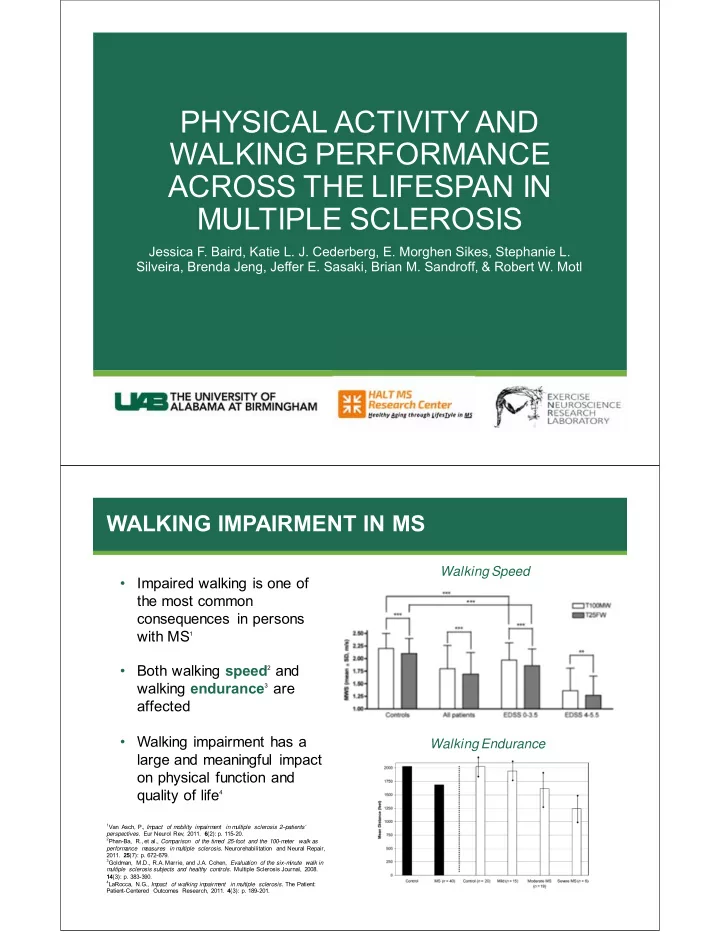
WALKING IMPAIRMENT IN MS

  • Impaired walking is one of

the most common consequences in persons with MS

1

  • Both walking speed

2 and

walking endurance

3 are

affected

  • Walking impairment has a

large and meaningful impact

  • n physical function and

quality of life

4

1Van Asch, P., Im

pact of m

  • bility im

pairm ent in m ultiple sclerosis 2–patients’

  • perspectives. Eur Neurol Rev, 2011. 6(2): p. 115-20.

2Phan-Ba, R., et al., Com

parison of the tim ed 25-foot and the 100-m eter walk as perform ance m easures in m ultiple sclerosis. Neurorehabilitation and Neural Repair,

  • 2011. 25(7): p. 672-679.

3Goldman, M.D., R.A. Marrie, and J.A. Cohen, Evaluation of the six-m

inute walk in m ultiple sclerosis subjects and healthy controls. Multiple Sclerosis Journal, 2008. 14(3): p. 383-390.

4LaRocca, N.G., Im

pact of walking im pairm ent in m ultiple sclerosis. The Patient: Patient-Centered Outcomes Research, 2011. 4(3): p. 189-201.

Walking Endurance Walking Speed

slide-2
SLIDE 2

* *

WALKING PERFORMANCE AND PHYSICAL ACTIVITY

MVPA (min/day) 6MW (feet) VO2peak (ml/kg/min)

0.47 0.62 0.40

43.4 ± 7.7 45.9 ± 9.6 49.5 ± 10.2 49.0 ± 11.6

*

THE PREVALENCE OF OLDER ADULTS WITH MS IS ON THE RISE

Purpose: Examine the relationship between physical activity and walking performance across the lifespan among adults with MS

slide-3
SLIDE 3

METHODS: PARTICIPANTS AND PROCEDURES

  • Participants
  • 20 to 79 years of age
  • Diagnosis of MS
  • Ambulatory with or without

assistance

  • Relapse free for at least 30 days
  • Categorized into one of three

predetermined groups based on age:

  • Young Adults = 20 – 39 years
  • Middle-age Adults = 40 – 59 years
  • Older Adults = 60 – 79 years
  • Walking Performance
  • Walking speed = T25FW
  • Walking endurance = 6MW
  • Physical Activity
  • ActiGraph, model GT3X+
  • 7 days; valid day = minimum 10 hours

wear time

  • Data processed into 60 second epochs
  • Time spend engaged in Light Physical

Activity (LPA) and Moderate-to-Vigorous Physical Activity (MVPA) calculated with MS specific cutpoints5

5Sandroff, B.M., R.W. Motl, and Y. Suh, Accelerom

eter output and its association with energy expenditure in persons with m ultiple sclerosis. Journal of Rehabilitation Research & Development, 2012. 49(3).

HYPOTHESES

  • We expected walking performance and physical activity to decrease

with increasing age

  • Trend analysis
  • We expected there to be a strong association between physical

activity and walking performance, and this relationship would be strongest among older adults with MS

  • Spearman’s rank-order correlations
  • Examined initial group differences as potential confounders
slide-4
SLIDE 4

RESULTS: PARTICIPANTS

Table 1. Demographic and clinical characteristics of participants by age group Age Groups Young (n=39) Middle-aged (n=44) Older (n=41) Total (124) p-value Age; years 33.3 (5.0) 48.5 (5.8) 65.8 (4.5) 49.4 (14.1) 0.001** Sex; % female 79.5 72.7 73.2 75.0 0.74 Race; % Caucasian 43.6 65.9 82.9 64.5 0.01* Type of MS; % RRMS 87.2 88.6 82.9 89.9 0.82 PDDS; Median (IQR) 0.0 (3.0) 1.0 (2.0) 2.0 (3.5) 1.0 (3.0) 0.02* Disease Duration; years 6.7 (5.0) 12.4 (5.8) 19.9 (8.7) 13.1 (8.6). 0.001** Data presented as mean (SD) unless otherwise noted. MS = multiple sclerosis; RRMS = relapsing- remitting MS; PDDS = Patient Determined Disease Steps; * = p<0.05; ** = p<0.01; Young adults = 20-39 years; Middle-aged = 40-59 years; Older adults = 60-79 years

RESULTS: WALKING PERFORMANCE AND PHYSICAL ACTIVITY BY AGE GROUP

Y

  • ung

Middle-aged Older F p LPA; min/day 307.0 (100.2) 309.1 (79.8) 296.1 (97.9) 0.24 0.62 MVPA; min/day 21.7 (14.4) 24.6 (17.4) 12.8 (13.1) 6.05 0.02* T25FW; sec 4.7 (1.7) 5.5 (3.5) 6.0 (3.1) 4.45 0.04* 6MW; ft 1584.8 (359.3) 1551.4 (554.5) 1378.3 (404.9) 4.12 0.04*

250 270 290 310 330 5 10 15 20 25 30 Young Middle-aged Older 3 4 5 6 7 1200 1300 1400 1500 1600 1700 Young Middle-aged Older

LPA (min/day) MVPA (min/day) T25FW (sec) 6MW (ft)

* * *

slide-5
SLIDE 5

RESULTS: THE RELATIONSHIP BETWEEN PHYSICAL ACTIVITY AND WALKING PERFORMANCE

LPA MVPA Young Middle-aged Older Overall Young Middle-aged Older Overall T25FW

  • 0.27

0.08

  • 0.40*
  • 0.17
  • 0.22
  • 0.51**
  • 0.62**
  • 0.54**

6MW 0.21

  • 0.08

0.34* 0.17 0.33 0.43** 0.62** 0.56**

100 200 300 400 500 600 700 2 4 6 8 10 12 14 16 18

LPA (min/day)

20 40 60 80 100 120 140 2 4 6 8 10 12 14 16 18

MVPA (min/day) T25FW (sec)

100 200 300 400 500 600 700 500 1000 1500 2000 2500 3000 20 40 60 80 100 120 140 500 1000 1500 2000 2500 3000

6MW (ft)

RESULTS: CONTROLLING FOR RACE, AMBULATORY DISABILITY, AND DISEASE DURATION

LPA MVPA Young Middle-aged Older Overall Young Middle-aged Older Overall T25FW

  • 0.15

0.15

  • 0.44*
  • 0.10
  • 0.01
  • 0.16
  • 0.63**
  • 0.33**

6MW 0.02

  • 0.13

0.31 0.08 0.10 0.08 0.70** 0.38**

  • 150
  • 50

50 150 250

  • 4
  • 2

2 4 6

  • 20
  • 10

10 20 30

  • 4
  • 2

2 4 6

T25FW (residuals; sec)

  • 150
  • 50

50 150 250

  • 600
  • 100

400 900

  • 20
  • 10

10 20 30

  • 600
  • 100

400 900

6MW (residuals; ft) MVPA (residuals; min) LPA (residuals; min)

slide-6
SLIDE 6

CONCLUSIONS

  • MVPA, walking speed, and walking endurance progressively decreased with

increasing age

  • Older adults with MS have a particular need for rehabilitation approaches aimed

at improving walking performance

  • Aging + MS = ?
  • MVPA strongly correlated with walking performance in Older adults with MS
  • Behavior change interventions that target MVPA may be an approach for

improving walking performance in older adults with MS

  • What about LPA?
  • What about young adults with MS?

ACKNOWLEDGMENTS

  • UAB Center for Exercise Medicine NIH T32 postdoctoral training grant
  • Exercise Neuroscience Research Laboratory
slide-7
SLIDE 7

QUESTIONS?

EMAIL: JFBAIRD@UAB.EDU