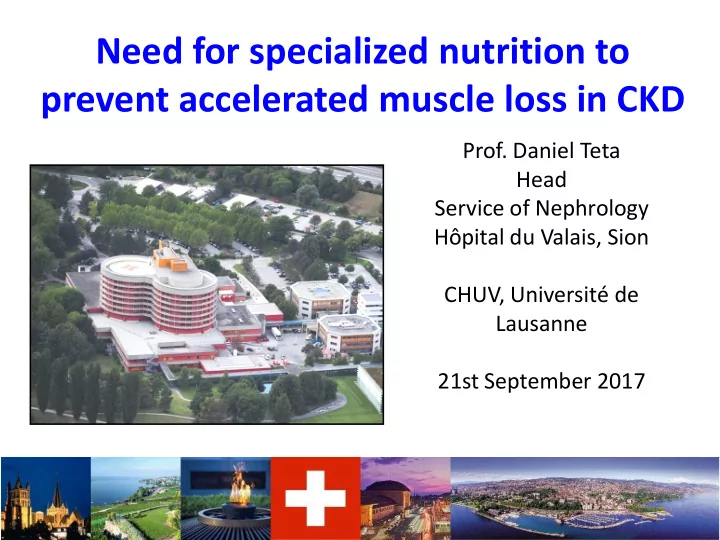
SLIDE 1 Need for specialized nutrition to prevent accelerated muscle loss in CKD
Head Service of Nephrology Hôpital du Valais, Sion CHUV, Université de Lausanne 21st September 2017
SLIDE 2
Speaker fees: Abbott Nutrition, Fresenius Medical Care, B Braun, Roche, Amgen, Shire Research Grants/Research Financial Supports: Baxter/Gambro, B Braun, Fresenius Medical Care, Advisory Committments: Abbott Nutrition, Nestlé, Otsuka
Conflicts of interest, last 5 years
SLIDE 3 CKD Classification - K/DIGO 2012
3
Kidney Int Suppl 2013; 3: 19–62 (red = very poor prognosis)
SLIDE 4
Johansson L. Teta D et al. Nephrol Dial Transplant. 2016;32(7):1127-1136 .
Incident dialysis patients in Europe: it grows old !
SLIDE 5 Protein-energy wasting (PEW) is prevalent in CKD
PEW is a state of depletion of body stores
- loss of body/adipose mass
- Loss of muscle mass
- Decline of nutrition biomarkers (e.g.albumin)
- Low energy/protein intake
Fouque D et al. on behalf of the ISRNM, Kidney Int 2008
SLIDE 6
Johansson L, Teta D et al et al. Nephrol Dial Transplant 2016; 32(7): 1127-1136 Cianciaruso B et al. Nephrol Dial Transplant 1995; 10 (Suppl 6): 65-68 .
Prevalence of malnutrition (PEW) in dialysis patients is very high
SLIDE 7
N = 142 incident ESRD patients (91 males, 52.8 ± 1.0 years, 74.2 ± 1.2 kg body weight) 34 with diabetes mellitus (19 insulin-dependent and 15 non insulin dependent). Pupim LB et al. Kidney Int 2005; 68: 2368-2374
Accelerated loss of lean body mass in incident dialysis patients with diabetes
SLIDE 8
Weight and muscle loss in chronic illness
Evans WJ et al. Clin Nutr 2008
SLIDE 9 CVD Frailty Infection
Co-Morbid Conditions (Diabetes, CVD, Depression)
Dialysis- Associated Catabolism
Metabolic Derangements (Insulin Resistance, Metabolic Acidosis, IGF-1/GH Resistance)
Dietary Nutrient Intake
Loss of Kidney Function Uremic Toxins Protein-Energy Wasting Sarcopenia
Inflammation
Etiology and Consequences of Protein Energy Wasting in CKD
Carrero JJ et al on behalf of ISRNM; J Ren Nutr 2013
SLIDE 10 Macronutrient requirements in dialysis patients
10
ESPEN (1) NKF (2) EBPG (3) ISRNM (4)
Protein g/kg*/day
Prot of HBV 50%
1.2 – 1.4 1.2 > 1.1 > 1.2 Energy kcal/kg*/day 35 < 60 y: 35 > 60 y: 30 30-40 30-35 1 - Cano N et al. Clin Nutr, 2006 and 2009 2 - National Kidney foundation. Am J Kidney Dis, 2000 3 - Fouque D et al. EBPG. Nephrol Dial Transplant 2007 4 - Ikizler TA, Teta D et al. Kidney Int 2013
* Kg per ideal weight
SLIDE 11
Recommendations from the PROT-AGE and ESPEN Expert Groups for the older
Bauer J et al. on the behalf of the PROT-AGE Group. J Am Dir Assoc 2013 Deutz NEP et al. Clin Nutr 2014; 33, 929-936;
SLIDE 12 Protein diets recommendations according to various CKD states
CKD 3-4 LPD 0.6-0.8 30-40 + ++ Transplant* HPD 1.4 30-40 ++ + Dialysis SPD 1.2-1.4 30-40 +++ + * first 3 months Transplant LPD 0.8 30-(40) +/- +++ Diet Prot (g/kg/d) Energy (kcal/kg/d)
SLIDE 13 The older dialysis patient - drop in energy intakes
- 30-50% drops of energy intakes with aging (from 20 to 80 years-old)
- Predilection for energy-diluted foods such as grains, vegetables and fruits,
in place of energy-dense and protein-rich nutrients
- Due to:
- Anorexia
- Lack of taste
- Masticatory disability
- Multiple medications
- Depression
- Loneliness
- Dialysis as a stressor event
- Frequent hospitalizations
SLIDE 14 14
Low physical activity: Steps number measured in 1133 HD patients
<50y 50-65y 65-80y >80y 5000 10000 15000 20000 25000
Steps number / day
Panaye M, Kolko-Labadens A, Lasseur C, Paillasseur JL, Guillodo MP, Levanier M, Teta D, Fouque D. J Ren Nutr 2015 Very low active energy expenditure in the elderly HD
SLIDE 15 Energy expenditure in older dialysis patients
Energy expenditure may decrease in older dialysis patients due to:
- Lower resting energy expenditure (lower muscle mass)
- Lower active energy expenditure (sedentary behavior)
- 20% in elderly dialysis patients vs other patients
! However, older dialysis patients may be subjected to more hospitalizations, inflammation, and thus hypermetabolism, which may counteract in part
this lower energy expenditure
SLIDE 16
Older dialysis patients: Mismatch – actual intakes/ energy requirements
SLIDE 17 Nutritional management of older CKD patients
- No specific studies looking at nutritional interventions in
exclusively in only older CKD patients
- Nutritional interventional studies include many older CKD
(mainly on dialysis) patients
- Prevention strategies > Treatment strategies
- Spontaneously lower intakes of energy, protein, calcium,
phosphorus
- Spontaneously lower intakes of vitamins and micronutrients
- Protein intake recommendations differ according to CKD
status
SLIDE 18 Prevention of PEW in dialysis patients : effect of renal specific oral supplements
Month 1 Month 2 Month 3 Standard Treatment + Renal specific ONS (n= 46, age 71.4) Standard Treatment (n = 40, age: 76) Baseline
- Randomised, controlled trial, n = 86
- 18 centres (16 France, 1 Germany, 1 Switzerland)
- Inclusion: patients at risk of malnutrition: prot intake (nPNA) < 1.0 g/kg/d,
with no PEW Outcomes:
- Nutritional – dietary intake, dry body weight, BMI, SGA,
- Biochemical – Alb, PreAlb, nPCR, Cr, P, Ca
- Clinical – SF-36, phosphate binder use
Fouque D, McKenzie J, de Mutsert R, Azar R, Teta D, Plauth M, Cano N. Nephrol Dial Transplant 2008; 23: 2902-2910
SLIDE 19 Oral supplements enabled HD patients to achieve recommended nutrient intakes
0.4 0.8 1.2
Standard Treatment Renilon
10 20 30 40
Standard Treatment Renilon
p < 0.05 between groups Recommended Intake (KDOQI/EDTA) Baseline Month 3 Month 3 - baseline Total Energy Intake (kcal/kg/d) Total Protein Intake (g/kg/d)
Fouque D, McKenzie J, de Mutsert R, Azar R, Teta D, Plauth M, Cano N. Nephrol Dial Transplant 2008; 23: 2902-2910
SLIDE 20 Indicators of nutritional status
0.8 0.9 1 1.1 1.2 Baseline Month 1 Month 2 Month 3
nPCR (g/kg/d)
34 34.5 35 35.5 36 Baseline Month 1 Month 2 Month 3 280 290 300 310 320 Baseline Month 1 Month 2 Month 3 61 62 63 64 Baseline Month 1 Month 2 Month 3
- Se. Albumin (g/L)
- Se. Pre-albumin (mg/L)
Dry body weight (kg)
Renilon Standard care
† p<0.001 p= 0.06
SLIDE 21 In center provision of intradialytic meals
Rationale
- 1. In dialysis patients, energy, nutritional « gaps » between
requirements and spontaneous intakes
- gap of Energy: 5-10 kcal/kg/day
- gap of Protein: 0.2-0.4 g/kg/day
- 2. Meals during HD may suppress HD-induced catabolic effect
Strategies to close the « nutritional gap »
- In center / intradialytic nutritional intakes
Kalantar Zadeh K, Ikizler TA. J Ren Nutr 2012
SLIDE 22
Protein metabolism during HD: effect of fasting vs fed state
Veeneman Am J Physiol 2003
Effect of feeding
SLIDE 23 Plasma aminoacid concentrations decline during a high flux HD session (4h)
The decline in plasma AA is sensed by the muscle cell. Muscle protein synthesis is blocked by a low extracellular AA concentration N= 10 P Deléaval, D Teta, D Fouque et al, 2007
Tx total d'AA 500 1000 1500 2000 2500 3000 3500 T0 T1 T2 T3 T4 temps (heure) umol/l Tx total d'AA
SLIDE 24
Prevention of PEW: Snacks during HD: «Lausanne recipe»
Kcal Prot (g) Glu (g) Phos (mg) K (mg) Na (mg) 2 tartines 360 8,6 60 110 140 550 Sandwich Ham 380 20 47 215 205 1175 Sandwich Cheese 490 21 47 380 170 830 15 g protein powder + 2 tartines 420 22 60 220 145 550 250 ml (2 x) Renilon 7,5 500 19 50 15 0,8 150 200 ml Resource 2,0 fibre 400 18 44 180 320 120 200 ml Fortimel 200 20 21 400 400 100
SLIDE 25
Pupim L et al. Am J Physiol 2004
Exercise augments the acute anabolic effects of IDPN in HD patients
SLIDE 26
Resistance exercise may be more efficient than aerobic exercise to maintain lean body mass in CKD patients
SLIDE 27 Toigo G et al. Clin Nutr, 2000 Fouque D et al. EBPG. Nephrol Dial Transplant 2007
Recommended intakes in micronutrients in dialysis patients: (addition necessary because of losses through dialysates)
ESPEN 2000 (1) Pyridoxin, mg 10-15 Vitamin C, mg 30-60 Folic Acid, mg 1 Vitamin D, IU
according to [Ca] & [PTH]
Zinc, mg 15 Selenium, µg 50-70 EBPG 2007 (2) Thiamine, Riboflavin, cobalamine, Niacin, Biotine, pentothenic A & tocopherol should be supplemented (expert opinion)
SLIDE 28
If PEW established, use of ONS in HD patients is efficient to treat PEW: summary of RCT
Authors n Days Nutritional significant effects Acchiardo et al. (1982) 15 105 ↑ albumin, transferrin, bone density Allman et al. (1990) 21 180 ↑ BW, lean body mass Tietze et al. (1991) 19 120 ↑ BW, arm muscle circumference Eustace et al. (2000) 47 90 ↑ albumin, grip strength, SF12 mental health Hiroshige et al (2001) 44 180 ↑ DEI, DPI, fat mass, fat free mass, albumin Sharma et al. (2002) 40 30 ↑ albumin Leon et al. (2006) 180 365 ↑ DEI, DPI, albumin Cano et al. (2007) 186 365 ↑ nPNA, BMI, albumin, prealbumin Fouque et al. (2008) 86 90 ↑ DEI, DPI, SGA, QOL Moretti et al. (2009) 49 365 ↑ nPNA, albumin Ikizler TA, Teta D et al. on the behalf of the ISRNM Kidney Int 2013
SLIDE 29
Correction of metabolic acidosis improves protein metabolism and plasma albumin in pre-dialysis patients
De Brito-Ashurst I et al. J Am Soc Nephrol 2009
SLIDE 30
Sarcopenia and specific nutrients: systematic review (PubMed)
Morley JE et al. J Am Dir Assoc 2010; 11: 391-396
SLIDE 31
Clinical effects of vitamin D on muscle, gait and falls in the elderly and in CKD
Halfon M, Phan O, Teta D : BioMed Research Int 2015 Gordon PL et al. J Ren Nutr 2012, 22: 423 – 433 Taskapan H et al. Clin Nephrol 2011, 76: 110–116 Zahed N et al. Saudi Journal of Kid Dis and Transplant 2014: 25: 998–1003
SLIDE 32 Prevention of muscle loss in older CKD patients
- Maintain energy requirements: 26-35 kcal/kg/day according to
physical activity/clinial condition : individualization !
- Dialysis: High protein requirements : 1.2 - 1.5 g/kg/day
- Enriched-protein meals during dialysis
- If PEW established: ONS and/or IDPN are efficient
- Supplementation of micronutrients necessary
- Individualized prescription of electrolytes/calcium
- Correction of metabolic acidosis
- Non dialysis CKD: low protein diets (with enough calories)
- Other interventions (vitamine D – n-3 fatty acids) - low evidence
SLIDE 33
Thank you for your attention